Zarathustra pursued a life as a poet, priest, and spiritual teacher in northeastern Iran about 3,500 years ago, several centuries before the Vedic poets and Homer. He is thus the earliest known writer in any Indo-European language. That his poems can be read in the condition in which they were sung and speak directly to us through the millennia must be considered a veritable miracle.
The Gathas is a hymn in praise of timeless wisdom and with its aphoristic exposition the work resembles a didactic philosophical poem. Zarathustra wants to present a true picture of reality, of the imperishable archetypes of the world of thought as well as of the role of the individual in the material world. More than anything else, he urges us to value our free will, to listen to the voice of our conscience and contribute to the good renewal of the world.
In this translation, the Old Avestan literature is presented for the first time in Swedish in direct translation by Ashk Dahlén, docent of Iranian languages at Uppsala University, who also has provided the book with an introductory preface as well as comments, and a glossary.
Zoroastrianism was the religion of the ancient Persian kings and following the Arab conquest, it remained the religion of a significant portion of the population in Iran and parts of Central Asia. This book investigates the most important polemical treatise in the Zoroastrian tradition, the Škand Gumānīg-Wizār (“The Doubt-Dispelling Disquisition”), which was written by the theologian and philosopher Mardānfarrox son of Ohrmazddād. The text was composed in the ninth or tenth centuries in a language known as Middle Persian.
A sophisticated work of rationalist theology, the Škand Gumānīg-Wizār systematically critiques several rival religions of the late antique and early medieval Middle East, including Islam. The critique of Islam found in chapters 11 and 12 is the only sustained, systematic polemic against Islam in premodern Zoroastrian literature, one that attacks monotheism by focusing on the problem of evil. The text is of fundamental importance for understanding Iran’s transformation from a predominantly Zoroastrian society to a predominantly Muslim one during the Early Middle Ages.
This is the first book devoted to the Islamic sections of the Škand Gumānīg-Wizār. It provides a new translation and commentary of these important sections along with introductory chapters that explore Zoroastrians’ relationship with other religions in Late Antiquity and the early Islamic period; Mardānfarrox’s intellectual milieu (especially the influence of Islamic theology and interreligious debates); and the history of Zoroastrian polemics against Islam.
We often assume that our present world alone has experienced the phenomenon of globalization and that it is necessarily a feature of the modern age. And in this we like to imagine the world of the past as made up of homogeneous monolithic blocks with rigid and well-defined impenetrable boundaries. Nothing could be further from the truth. The ancient world enjoyed an interconnectedness as tight if not tighter than ours is today. Nowhere do we see this connection better than between the Greek and the Persian world. The conflict between the two serves as the starting point of the archetypal conflict between the Orient and the Occident. However, at the same time, Persian culture served as a foundation for Greek moral philosophy and by extension, had a major influence on later Jewish, Christian and Islamic philosophy. The transition from mythological to philosophical knowledge occurs in Greek thought when it encounters these Magi. In this regard, we shall see that Plato had a special relationship with the Magi, and the Magi in turn held Plato in high regard. However, Plato’s example is by no means an isolated case. We have other equally famous examples of Greek philosophers who we are told went to study in Persia before Plato, namely Pythagoras and Democritus.
Prof. Dr. Alberto Cantera (Freie Universität Berlin) will deliver the 9th Ratanbai Katrak Lectures 101 years after the inauguration of the Ratanbai Katrak Lecturership at the University of Oxford.
‘With which Yasna shall I worship you (kana θβąm yasna yazāne)? Zoroastrian Rituals in the Antique and Late Antique Iranian world’
Please use this link to attend the lectures on Zoom.
Lecture 1: Manuscripts and Rituals: The Written Transmission of the Zoroastrian Rituals 11 May 2023, 5:30pm – 7:00pm; Wolfson College, Linton Road, Oxford OX2 6UD
Lecture 2: The Questioned Antiquity of the Zoroastrian Rituals: Their Reception in Western Academia 18 May 2023, 5:30pm – 7:00pm; Wolfson College, Linton Road, Oxford OX2 6UD
Lecture 3: The Ritual System: Modularity and Productivity 25 May 2023, 5:30pm – 7:00pm; Ertegun House, 37A St. Giles’, Oxford OX1 3LD
Like many other religions, Zoroastrianism frequently restructured its priestly organization during its long history, largely because of the environmental changes to which it was exposed. A major shift in status – from being the state religion in the Sasanian Empire to holding only a minor position in the early Islamic period – challenged the Zoroastrian hierarchy of authority. The Abbasid state provided Zoroastrianism with an opportunity to initiate a new office, which was called hu-dēnān pēšōbāy “Leader of the Zoroastrians”. This article is the first to deal with this office in detail and scrutinizes the concept of leadership (pēšōbāyīh) in Sasanian and Abbasid Zoroastrianism. It sheds some light on the priestly structure of Zoroastrianism in this period and investigates the position of the office within the overall religious organization. It re-examines, moreover, evidence for the officiating Zoroastrian theologians in this office at the Abbasid court in Baghdad. Finally, it searches for the parallels between this office and that of the East-Syrian catholicos and the Jewish exilarch.
The Circle for Late Antique and Medieval Studies presents a discussion with Professors Almut Hintze, Martin Schwartz and Peter Jackson Rova on the oral traditions in Zoroastrianism. The panel discussion is online and open to the public. The website is here.
How should we conceive of Prophet Zoroaster? What was the context in which he lived and composed the Gathas of Zoroaster? Do they provide a unique window into oral composition and transmission of tradition(s)? Can the early poetry attributed to Zoroaster teach us something about the cryptic techniques of Indo-European poetry and the beginnings of Greek philosophy? How did orality sustain the Zoroastrian community through millennia?
Panaino, Antonio, Andrea Piras and Paolo Ognibene (eds). 2023. Studi iranici ravennati IV (Indo-iranica et orientalia, Lazur 25). Milan: Mimesis.
This volume collects a number of scientific articles dealing with history, linguistics, philology, archaeology, ethnology and anthropology of the ancient and modern Iranian peoples.
But we would like to take this opportunity to mention ‘Zoroastrianism: History, Religion and Belief‘, which has been designed by Dr Sarah Stewart and Dr Céline Redard and is offered as a free online course (MOOC).
The latest issue of Iran and the Caucasus (26.4) contains several interesting contributions.
Table of contents:
Li Sifei: Tubo-Sogdian Relations along the Silk Road: On an Enigmatic Gold Plaque from Dulan (Qinghai, China)
Sebastian Bitsch: Hell’s Kitchen: The Banquet in the Hereafter and the Reflexion of Zoroastrian Eschatological Motifs in the Qurʾān
Alex MacFarlane: The City of Brass and Alexander’s Narrow Grave: Translation and Commentary of Kafas added to Manuscript M7709 (Part 2)
Richard Foltz: The Survival of Ossetians in Turkey
Marco Fattori: The Elamite Version of A2Ha and the Verb vidiyā- in Old Persian
John D. Bengtson and Corinna Leschber: On Criticism of S. L. Nikolayev/S. A. Starostin, A North Caucasian Etymological Dictionary
Victoria Arakelova: The Talishis on Opposite Banks of the Araxes River: Identity Issues
Arsen K. Shahinyan: The Southern Boundaries of the Southern Caucasus
Adrian C. Pirtea: [Review of] Samuel N. C. Lieu, Glen L. Thompson (eds.), The Church of the East in Central Asia and China (China and the Mediterranean World, 1), Turnhout: “Brepols”, 2020.—xiii + 245 pp.
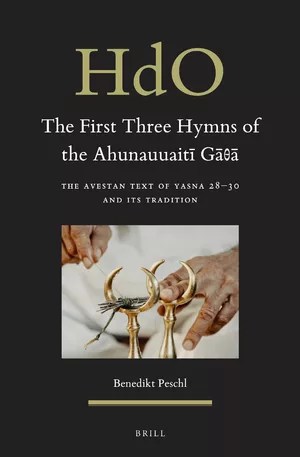
At the center of this book stands a text-critical edition of three chapters of the Gāthās, exemplifying the editorial methodology developed by the “Multimedia Yasna” (MUYA) project and its application to the Old Avestan parts of the Yasna liturgy. Proceeding from this edition, the book explores aspects of the transmission and ritual embedding of the text, and of its late antique exegetical reception in the Middle Persian (Pahlavi) tradition. Drawing also on a contemporary performance of the Yasna that was filmed by MUYA in Mumbai in 2017, the book aims to convey a sense of the Avestan language in its role as a central element of continuity around which the Zoroastrian tradition has evolved from its prehistoric roots up to the modern era.
Table of Contents
Part 1 Editing Old Avestan in the Context of the MUYA Project
Manuscripts Collated
Methodology of the Collation Process (1): Transcription of the Manuscripts
Methodology of the Collation Process (2): Regularisation of Variant Readings
Scope of the Constituted
Editorial Decisions Regarding Non-Trivial Phonetic and Orthographic Alternations
Part 2 Yasna 28–30: Text, Translation, Selected Commentaries and Glossary
Preliminaries to the Edition of the Avestan Text
Yasna 28: Edition of the Avestan Text
Yasna 29: Edition of the Avestan Text
Yasna 30: Edition of the Avestan Text
Yasna 28: Constituted Text and Translation
Yasna 29: Constituted Text and Translation
Yasna 30: Constituted Text and Translation
Notes on the Translation of the Avestan Text
Selected Commentary Essays Proceeding from the Avestan Text
Glossary of the Avestan text of Yasna 28–30
Part 3 Studies on the Ritual Setting of the Ahunauuaitī Gāθā (Yasna 28–34)
Ritual Actions During the Recitation of the Ahunauuaitī Gāθā
Considerations on the Rationale Behind Specific Ritual Actions
Ritual Directions Accompanying Yasna 28–30 in the Manuscript Tradition
Studies on the Exegetical Reception of Yasna 28
Re-approaching the Pahlavi Gāθās
Edition and Translation of Pahlavi Yasna 28
Pahlavi Yasna 28: Commentary
On the Marginal Headings Accompanying the Old Avesta in the Exegetical Manuscripts of the Yasna
Yasna 28.11, Yašt 1.26 and the Warštamānsar Nask: Untangling an Intertextual Network
Appendix to Part 4: Edition and Translation of the Commentary on Yasna 28 in the Dēnkard Epitome of the Warštamānsar Nask (Dk 9.28)
Concluding Thoughts: Advancing a Holistic Approach to the Zoroastrian Textual Tradition
Benedikt Peschl holds a BA in General and Indo-European Linguistics from the University of Munich, an MA in Religions of Asia and Africa from SOAS University of London, and a PhD in Study of Religions from SOAS (2021). He now works as a postdoctoral researcher at the Institute of Iranian Studies of Freie Universität Berlin.