Tag: History of Iran

  • The Medes. 25 Years Afterwards

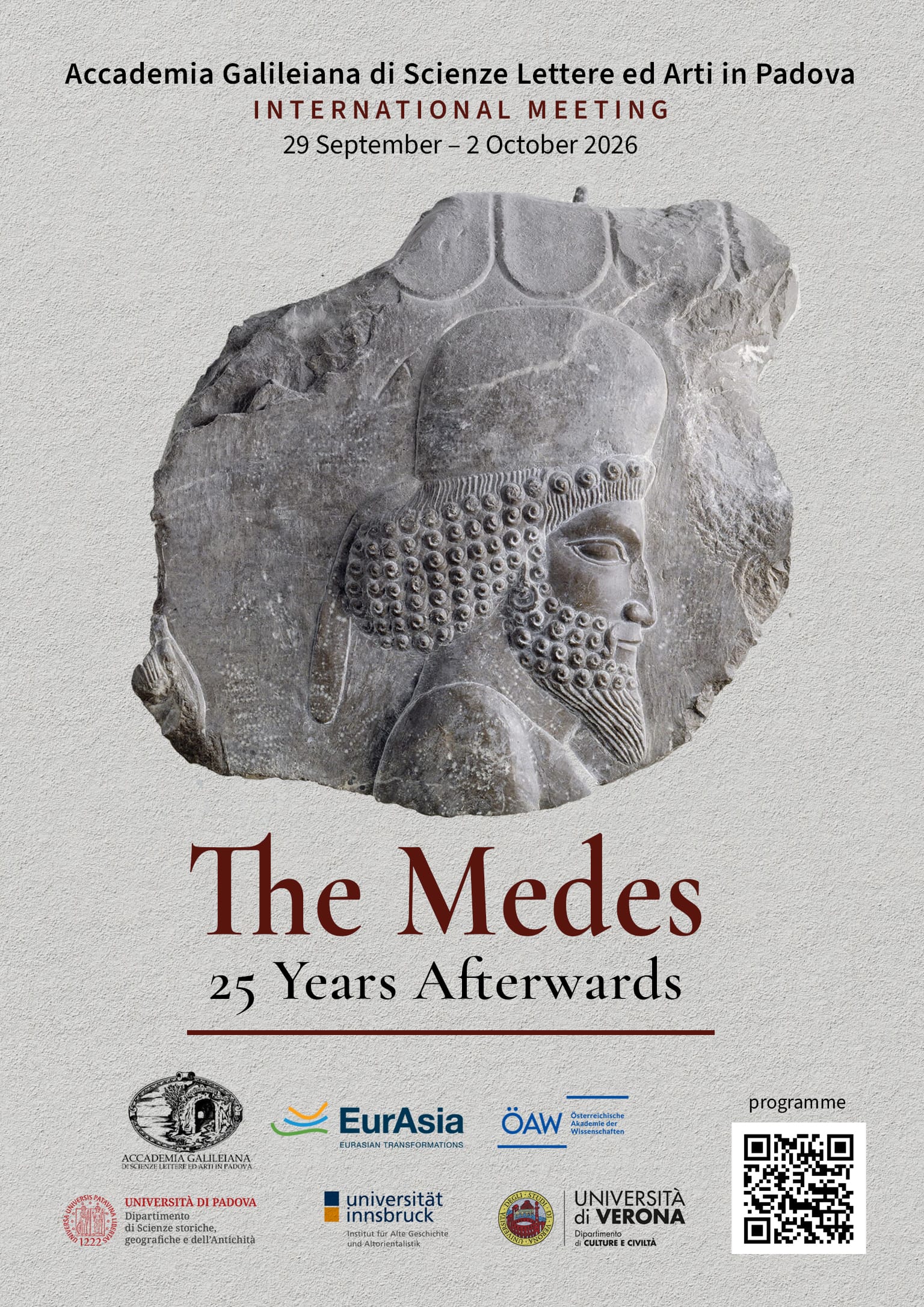
    The Medes. 25 Years Afterwards

    The Medes. 25 Years Afterwards

    International Meeting
    Accademia Galileiana di Scienze Lettere ed Arti, Padova, Italy
    29 September – 2 October 2026

    Twenty-five years after the 2001 meeting dedicated to the Medes and their place in the history of the Ancient Near East, an international group of scholars will gather once again in Padova for “The Medes. 25 Years Afterwards.”

    The meeting will take place in the historic main hall of the Accademia Galileiana di Scienze Lettere ed Arti and will provide a forum for scholarly discussion and exchange among specialists from different disciplines and methodological traditions.

    A central aim of the meeting is to encourage dialogue between different approaches to the Medes and their historical legacy. Particular attention will be devoted to perspectives from archaeology, Ancient Near Eastern history, Greek and Roman historiography, Iranian and Persian heritage, and modern socio-political concepts and developments.

    Programme

    • Tuesday, 29 September 2026, 4:00 PM
      Welcome Address
      Giovanna Zaniolo — Accademia Galileiana di Scienze Lettere ed Arti in Padova
      Robert Rollinger — Österreichische Akademie der Wissenschaften, Wien / Accademia Galileiana di Scienze, Lettere ed Arti in Padova / Leopold-Franzens-Universität Innsbruck
      Giovanni-Battista Lanfranchi — Accademia Galileiana di Scienze Lettere ed Arti in Padova
      Simonetta Ponchia — Università degli studi di Verona
      Salvatore Gaspa — Università degli studi di Padova
      Introduction
      Robert Rollinger — Österreichische Akademie der Wissenschaften
    • Wednesday, 30 September 2026, 9:30 AM
      Chair: Giovanni-Battista Lanfranchi — Accademia Galileiana di Scienze Lettere ed Arti in Padova
      Hagmatāna: An Archaeological Inquiry into the Material Culture of the ‘Median Period’ (Iron Age III)
      Mehrdad Malekzadeh — Iranian Center for Archaeological Research
      Zahra Golmohammadi — University of Münster
      The Archaeology of Mannea
      Kazem Mollazadeh — Bu-Ali Sina University Hamadan
      Coffee Break
      Chair: Salvatore Gaspa — Università degli studi di Padova
      The Historical Geography of Media
      Iraj Rezaei — University of Tehran
      Between Assyria and the Iranian Highlands: the Dinka Settlement Complex and the Problem of the Medes
      Andrea Squitieri — Università degli studi di Padova
      Lunch
    • Wednesday, 30 September 2026, 2:30 PM
      Chair: Jan Tavernier — Katholieke Universiteit Leuven
      Dealing with a Powerful Neighbour: Media and Babylonia at the turn of the 6th century BCE
      Clara Gibert — Université Paris 1 Sorbonne
      The Medes in Aramaic Sources
      Holger Gzella — Ludwig-Maximilians-Universität München
      Coffee Break
      Chair: Irene Salvo — Università degli studi di Verona
      The Medes in Classical sources
      Kai Ruffing — Universität Kassel
      Median Revisited: Linguistic Origins and the Spread of Median Loanwords
      Milad Abedi — Leopold-Franzens-Universität Innsbruck
      Coffee Break
      Chair: Melanie Malzahn — Universität Wien
      Keynote: Iranian, Median, Zagrosian: linguistic variety in Northwest Iran during the first millennium BCE
      Adriano Rossi — Università degli studi di Napoli “L’Orientale”
    • Thursday, 1 October 2026, 9:30 AM
      Chair: Luigi Turri — Università degli studi di Verona
      Arabs of the east: the Medes in a global perspective
      Simonetta Ponchia — Università degli studi di Verona
      New light on Medo-Babylonian campaigning against the Assyrian west
      Alexander J. Edmonds — University of Münster
      Coffee Break
      Chair: Gian Pietro Basello — Università degli studi di Napoli “L’Orientale”
      The collapse of the Assyrian Empire – global considerations and eastern perspectives
      John MacGinnis — British Museum London & University of Cambridge
      Rethinking Cyrus at the Median Court: The Royal Hostage Tradition Revisited
      Yazdan Safaee — Leopold-Franzens-Universität Innsbruck
      Lunch
    • Thursday, 1 October 2026, 2:30 PM
      Chair: Sebastian Fink — Leopold-Franzens-Universität Innsbruck
      Herodotus, Greek Genealogies, and the Succession of Empires
      Julian Degen — Leopold-Franzens-Universität Innsbruck
      Where were the Seven Walls of Ecbatana? The Medes between Myth & Archaeology
      Touraj Daryaee — University of California at Irvine
      Coffee Break
      Chair: Florian Schwarz — Österreichische Akademie der Wissenschaften
      The Image of the Medes in Early Armenian Historiography
      Yervand Grekyan — National Academy of Sciences of Armenia
      Tribes among Ancient and Modern Kurds
      Nicola degli Esposti — Università degli studi di Bologna
      Coffee Break
      Chair: Simonetta Ponchia — Università degli studi di Verona
      Keynote: TBA
      Giovanni-Battista Lanfranchi — Accademia Galileiana di Scienze Lettere e Arti in Padova
    • Friday, 2 October 2026, 9:30 AM
      Chair: Salvatore Gaspa — Università degli studi di Padova
      Looking for the Medes in Urartian History
      Annarita S. Bonfanti — New York University
      The Construct of Median Art and Archaeology: Media in the Antiquities Market, Historiography and Political Narratives of the 20th Century
      Matthew Canepa — University of California at Irvine
      Coffee Break
      Chair: Omar Coloru — Università degli studi di Bari Aldo Moro
      The Dream of Astyages: Echoes of the Medes in the Western Imagination
      Ian Macgregor-Morris — Leopold-Franzens-Universität Innsbruck
      TBA
      Hemati Azandaryani — Bu-Ali Sina University
      Lunch
    • Friday, 2 October 2026, 2:30 PM
      Chair: Sebastian Fink — Leopold-Franzens-Universität Innsbruck
      Kerkeneš Dağ and the Median Western Frontier
      Andrea Bianchini — Università di Verona
      The Medes and Native Iranian Historical Traditions
      Reza Sh. Zarghamee — University of Saint Andrews, Scotland
      Coffee Break
      Chair: Robert Rollinger — Österreichisches Akademie der Wissenschaften
      CONCLUSION AND FINAL DISCUSSION
      Josef Wiesehöfer — Christian-Albrechts-Universität zu Kiel
      M. Rahim Shayegan — University of California in Los Angeles

    The conference will also be streamed live on the Accademia Galileiana YouTube channel. You can access the live stream via the link here.

  • War in the Ancient Iranian Empires

    Hyland, John O. & Khodadad Rezakhani (eds.). 2024. Brill’s companion to war in the ancient Iranian empires (Brill’s Companions to Classical Studies: Warfare in the Ancient Mediterranean World 9). Leiden: Brill.

    Brill’s Companion to War in the Ancient Iranian Empires examines military structures and methods from the Elamite period through the Achaemenid, Seleucid, Arsacid, and Sasanian empires. War played a critical role in Iranian state formation and dynastic transitions, imperial ideologies and administration, and relations with neighbouring states and peoples from Central Asia to the Mediterranean. Twenty chapters by leading experts offer fresh approaches to the study of ancient Iranian armies, strategy, diplomacy, and battlefield methods, and contextualise famous conflicts with Greek and Roman opponents.

    Table of Contents

    (more…)
  • An Armenian Futūh Narrative

    La Porta, Sergio & Alison M. Vacca. 2023. An Armenian Futūh Narrative: Łewond’s Eighth-Century History of the Caliphate (Late Antique and Medieval Islamic near East 4). Chicago: Institute for the Study of Ancient Cultures of the University of Chicago.

    The History of the Armenian priest Łewond is an important source for the history of early Islamic rule and the only contemporary chronicle of second/eighth-century caliphal rule in Armenia. This volume presents a diplomatic edition and new English translation of Łewond’s text, which describes events that took place during the century and a half following the Prophet Muḥammad’s death in AH 11/632 CE. The authors address Łewond’s account as a work of caliphal history, written in Armenian, from within the Caliphate. As such, this book provides a critical reading of the Caliphate from one of its most significant provinces. Reading notes clarify many aspects of the period covered to make the text understandable to students and specialists alike. Extensive commentary elucidates Łewond’s narrative objectives and situates his History in a broader Near Eastern historiographical context by bringing the text into new conversations with a constellation of Arabic, Greek, and Syriac works that cover the same period. The book thus stresses the multiplicity of voices operating in the Caliphate in this pivotal period of Near Eastern history.

  • Medieval Muslim Mirrors for Princes

    Marlow, Louise. 2023. Medieval Muslim mirrors for princes: An anthology of Arabic, Persian and Turkish political advice. Cambridge: Cambridge University Press.

    The ‘mirror for princes’ genre of literature offers advice to a ruler, or ruler-to-be, concerning the exercise of royal power and the wellbeing of the body politic. This anthology presents selections from the ‘mirror literature’ produced in the Islamic Early Middle Period (roughly the tenth to twelfth centuries CE), newly translated from the original Arabic and Persian, as well as a previously translated Turkish example. In these texts, authors advise on a host of political issues which remain compelling to our contemporary world: political legitimacy and the ruler’s responsibilities, the limits of the ruler’s power and the limits of the subjects’ duty of obedience, the maintenance of social stability, causes of unrest, licit and illicit uses of force, the functions of governmental offices and the status and rights of diverse social groups. Medieval Muslim Mirrors for Princes is a unique introduction to this important body of literature, showing how these texts reflect and respond to the circumstances and conditions of their era, and of ours.

  • The End of Empires

    Gehler, Michael, Robert Rollinger & Philipp Strobl (eds.). The End of Empires. Wiesbaden: Springer.

    The articles of this comprehensive edited volume offer a multidisciplinary, global and comparative approach to the history of empires. They analyze their ends over a long spectrum of humankind’s history, ranging from Ancient History through Modern Times. As the main guiding question, every author of this volume scrutinizes the reasons for the decline, the erosion, and the implosion of individual empires.

    All contributions locate and highlight different factors that triggered or at least supported the ending or the implosion of empires. This overall question makes all the contributions to this volume comparable and allows to detect similarities, differences as well as inconsistencies of historical processes.

    Several contributions tackle with the problems of the end of ancient Iranian empires:

  • Culinary and Dining Practices in the Greater Iranian World

    Farridnejad, Shervin, and Touraj Daryaee (eds). 2022. Food for gods, food for mortals. Culinary and dining practices in the greater Iranian world. University of California, Irvine.

    Preparing, serving, and consuming food can be political, as it was arranged in the royal banquet of the great kings. It could also be considered as a ritual, both in the frame of the greater ritual practices in the banquets for the gods, as well as according to a set of family costumes and gestures, which endures from one generation to the next. All these aspects have been one of the major human’s activates during the history of the civilizations and have fascinated the scholars to investigate and decode the culinary customs of the peoples during the history. The contributions of this volume present a small collection of writings, which put focus on various aspects of culinary and dining practices in the Greater Iranian World from the ancient period to the contemporary religious feast of Sufi Orders in the Balkans. They aim to overview the recent developments in the field and discuss selected aspects of the rich variety of culinary practices.

    (more…)
  • The Arsacids

    Payravi Conference on Ancient Iranian History IV: Contextualizing Iranian History: The Arsacids (ca. 250 BC – 224 AD)

    Poster © Kourosh Beigpour

    Payravi Conference on Ancient Iranian History IV: “Contextualizing Iranian History: The Arsacids” organized by Touraj Daryaee, Matthew Canepa, and Robert Rollinger, will take place Feb. 28-March 2, 2022 and focus on the archaeology, history, numismatics, and religions of the Arsacid Empire. The event will be held in-person at the University of California, Irvine’s Jordan Center for Persian Studies with several options to participate remotely, either through the livestream on the UCI Jordan Center for Persian Studies & Culture‘s FB page or through the webinar: https://bit.ly/UCIPayravi2022

    Conference Program

    (more…)
  • Faster than the Arrow of Ārash: the Long Journey of the Narratives in Iran

    Norozi, Nahid (ed.). 2021. Come la freccia di Ārash: il lungo viaggio della narrazione in Iran : forme e motivi dalle origini all’epoca contemporanea (atti del V CoBIran, 22-23 ottobre 2020) (Indo-iranica et orientalia). Milano: Mimesis Edizioni.

    The narrative in the multi-millennial Iranian culture has taken many forms in prose and verse and, just as the famous arrow of the Iranian hero-archer Ārash – which according to the myth covered an unusual space flying from the Alborz mountains south of the Caspian Sea to Marv in Central Asia – comes to us miraculously traveling beyond all boundaries in space and time, because the word is “faster in traveling than the arrow of Ārash”. The present volume contains the articles, presented at the “V Convegno Bolognese diIranistica (V CoBIran)” dedicated to “Forms and motives of narration in Iran, from the origins to the contemporary era”.

    Table of Contents

    1. Aliasghar Mohammadkhani: “Excursus sulla narratologia in Iran”

    2. Antonio Clemente Domenico Panaino: “Ǝrəxša’s Death or Self-sacrifice: The Ancient Iranian Saga of the Archer”

    3. Ezio Albrile: “Guerre tra Angeli e Demoni. Le origini dello gnosticismo tra Babilonia e Iran”

    4. Paolo Ognibene: “L’iscrizione di Dario a Bīsutūn: al di l. dell’interpretazione storico-filologica”

    5. Andrea Piras: “La luna di Mani e la luna di al-Moqannaʿ: miracoli carismatici e loro usi politici”

    6. Gianfilippo Terribili: “Fabbricazione storiografica e definizione identitaria. La genesi della malvagia religione secondo i teologi zoroastriani (DkIII 227, 229, 288)”

    7. Matteo Compareti: “Tipologie eroiche nell’arte narrativa sogdiana e nell’epica persiana: il caso di Rustam e di Isfandyār”

    8. Simone Cristoforetti: “La storia del villaggio distrutto e poi riedificato nello Shāhnāma: un brano di polemistica antimazdakita?”

    9. Francesco Omar Zamboni: ‘”Avicenna e l’allegoria filosofica – “Ḥayy ibn Yaqẓān”’

    10. Nahid Norozi: “Il “Vis e Rāmin” di Gorgāni e il “Bahman-nāme” di Irānshāh: aspetti intertestuali anche in relazione con il “Khosrow e Shirin” di Neẓāmi”

    11. Carlo Saccone: “Forme della narrazione dell’Altro nelle lettere persiane, da Ferdowsi a Sa‘di e Nasimi”

    12. Hasan Zolfagari: “Analisi narratologica del racconto “La Fata Verde e la Fata Gialla”

    13. Fabio Tiddia: “Il motivo “qalandar” nella letteratura mistica persiana”

    14. Maurizio Silvio Pistoso: “Guerre del Golfo in salsa safavide. I poemetti persiani dell’enigmatico “Qadri”

    15. Stefano Pellò: “Atmosfere indo-persiane: cumulonembi, bolle e avatāra monsonici in Mīrzā ‘Abd al-Qādir Bīdil (1644-1720) e nella sua scuola”

    16. Bianca Maria Filippini: “La “spaventosa Tehr.n”: alcune riflessioni sulla rappresentazione della citt. come metafora delle derive della modernit. in Iran”

    17. Adone Brandalise: “Sguardo e narrazione nel cinema iraniano”

    18. Faezeh Mardani: “Recente letteratura persiana sulla “guerra imposta” con particolare riferimento a tre romanzi tradotti in italiano”

    19. Anna Vanzan: “La fortuna di un testo. In margine alle traduzioni de Il Pesciolino Nero di Samad Behrangi”

  • Iran and its Histories

    Daryaee, Touraj & Robert Rollinger (eds.). 2021. Iran and its histories. From the beginnings through the Achaemenid Empire (Classica et Orientalia 29). Wiesbaden: Harrossowitz.

    Dealing with the “history” of Iran is a challenge for many reasons. “Iran” is a term with different meanings through the ages. Today, it refers to the boundaries of modern Iran, but historically and culturally it covers a much larger territory. The western term “Persia” exemplifies these uncertainties for it is used colloquially as a synonym for “Iran,” but can also refer to the Achaemenid, Arsacid or Sasanian Empires and later empires on the Iranian Plateau. Besides these geographical ambiguities there is also the “ethnic” and linguistic dimension of the term “Iran”. Iranian languages are a major branch of the Indo-European language family and people using these languages have played a decisive role in the history of “Iran” since the first millennium BCE. How should we situate the ‘autochthonous՚ civilizations on the plateau, such as those at Konar Sandal (Jiroft), Sialk in Kashan, or for that matter the region of Elam with its longue durée history and influence? So what does it mean when we talk about “Persia” and “Iran” from a historical point of view?

    This volume brings together the contributions of the first and second Payravi conferences on Ancient Iranian History, held at the University of California Irvine in 2018 and 2019. The 16 contributions united in this volume tackle various problems of early Iranian history in many ways. They cover a wide range of time, from the Paleolithic to the end of the Achaemenid empire and Alexander III (“the Great”) and give vibrant insights into the dynamic processes of the history of Iran within the framework of the most recent results of scholarly research.

    (more…)
  • Afterlives of Ancient Rock-Cut Monuments in the Near East

    Ben-Dov, Jonathan & Felipe Rojas (eds.). 2021. Afterlives of ancient rock-cut monuments in the Near East. Brill.

    This book concerns the ancient rock-cut monuments carved throughout the Near East, paying particular attention to the fate of these monuments in the centuries after their initial production. As parts of the landscapes in which they were carved, they acquired new meanings in the cultural memory of the people living around them. The volume joins numerous recent studies on the reception of historical texts and artefacts, exploring the peculiar affordances of these long-lasting and often salient monuments. The volume gathers articles by archeologists, art historians, and philologists, covering the entire Near East, from Iran to Lebanon and from Turkey to Egypt. It also analyzes long-lasting textual traditions that aim to explain the origins and meaning of rock-cut monuments and other related carvings.

    Three chapters of this volume deals specifically Ancient Iranian rock-cut monuments:

    (more…)