Tag: Linguistics

  • Corpus Avesticum III: Phonetics and Phonology in Avestan and Beyond

    A Vidēvdād Sāde, 1704. (©Jamsheed K. Choksy) via EIr.
    A Vidēvdād Sāde, 1704. (©Jamsheed K. Choksy) via EIr.

    Corpus Avesticum III: “Phonetics and Phonology in Avestan and Beyond”

    Paris, 25-26. April. 2016

    The third meeting of the European research network Corpus Avesticum to be held in Paris, 25-26 April. 2016. Researchers from France, Spain, Germany, Italy, Belgium and the UK will meet to discuss various projects in preparation of a new edition of the Avesta and the special topic of this meeting.

    This meeting is dedicated to the research questions mainly regarding to the “Phonetics and Phonology in Avestan and Beyond”.

    See here the detaild Programm and the Abstracts.

    Program:

    25. April 2016

    • Briefing: Current state of Avestological project of the members of the Network
    • Salome Gholami: “Newly found Avestan manuscripts from Yazd”
      Martin Kümmel: “Avestan syllable structure: a look from Middle Iranian”
    • Götz Keydana: “Evidence for foot structure in Early Vedic”
      Paul Widmer: “Phonological domains in Avestan”
    • Chiara Riminucci-Heine: “Av. saoka- und av. hu-xšn aora- : zwei altiranische Wortstudien”
    • Almut Hintze: “Proto-Indo-European *h₁u es- ‘to be good’ and Avestan vahma-“
    • Michiel de Vaan: “On the orthography and phonology of <h>”
    • Alberto Cantera & Jaime Martínez Porro: “On the treatment of n before front vowels”
    • Benedikt Peschl: “The transmission of anaptyxis before the endings -biš and -biio in Avestan”

    26. April 2016

    • Armin Hoenen: “La statistique des déviations du Yasna”
    • Tim Aufderheide: “Zoroastrian phoneticians? Reconstructing the phonetic knowledge underlying the transmission of the Avesta”
    • Shervin Farridnejad: “Scribal Schools and Dialectal Characteristics in the Transmission of the Avesta”
    • Miguel Ángel Andrés Toledo: “Avestan and Pahlavi Paleography
      in the oldest Pahlavi Widewdad Manuscripts”
    • Salome Gholami: “Dialectal phonological variations in the colophons”

    The Project of Corpus Avesticum (CoAv) is a pan-European Co-operation that aims at making the Zoroastrian Texts, called the Avesta accessible in a new Edition. The current one stems from 1896 and is erroneous with regard to many crucial aspects, the most important of which is the amalgamation of the liturgical and exegetical text witnesses.

    See also the previous posts on the First and Second Meeting of Corpus Avesticum.

  • Zoroastrian Dari (Behdini) in Kerman

    Gholami 2016Gholami, Saloumeh & Armita Farahmand. 2016. Zoroastrian Dari (Behdini) in Kerman. (Estudios Iranios Y Turanios. Supplementa Didactica 1). Girona: Sociedad de estudios iranios y turanios (SEIT).

     Dari (also known as Behdīnī, Gavrī, or Gavrūnī), the topic of the present book is a critically endangered Iranian language. The study of Zoroastrian Dari is of particular importance for Iranian dialectology and comparative linguistics. This language is used in a parallel way to the Persian language of the Muslim population, and one can observe strong influence from Persian, especially in the domain of the lexicon. But Dari also differs from Persian, having special characteristics common to the languages of the North-West Iranian group. Sharing of both North-West and South-West features draws our attention to the fact that the immigrants to Yazd and Kerman originally came from different regions of Iran. The primary aim of this book is to teach Kermani Dari as a living language. This book offers basic materials for those who are interested in learning Dari. The focus is not only on grammar but also includes sections on learning vocabulary, listening to original documented materials, and also writing and understanding texts. The book consists of seven chapters.

    See the table of contents here.


    Saloumeh Gholami is a scholar of Iranian linguistics at the Institute of Empirical Linguistics at the Goethe University of Frankfurt, Germany.

    Armita Farahmand is a member of the Zoroastrian community in Kerman and a scholar of Zoroastrianism.

  • A tribute to Éric Pirart

    The second issue of the Estudios Iranios y Turanios, which was launched last year by the Sociedad de Estudios Iranios y Turanios, has been published. This issue of the journal, entitled Homenaje a Éric Pirart en su 65º aniversario, collects a number of philological discussions in honour of Éric Pirart’s 65th birthday.

    The ToC is here.

  • Greek and ancient Iranian plague

    A female Xenopsylla cheopis flea, known as the “oriental rat flea”. Image © Copyright 2015 Walid Shoebat.

    Milizia, Paolo. 2015. Greek λοιμός, Middle Persian rēm, and the Avestan root rai̯-. Indogermanische Forschungen 120(1).

    The Greek name of the plague has not received a satisfactory etymological explanation so far. On the other hand, the largely accepted hypothesis that the Middle Persian noun rēm ‘dirt, impurity’ is derived from a verbal base meaning ‘defecate’ is, in fact, problematic. The present paper aims to show that MPers. rēm and Gk. λοιμός can be viewed as reflexes of a PIE stem *loi̯-mó- indicating a ‘polluted (and polluting) substance’ and that the Avestan root rai̯-, probably connected with MPers. rēm, must have had the generic meaning of ‘to dirt, to pollute’.
  • Research on Yaghnobi

    Benkato, Adam. 2015. Review article: Recent work in Yaghnobi Studies. Iran and the Caucasus 19. 283–294.

    This review article discusses various issues raised by the two reports of the Italian missions to the Yaghnob Valley in Tajikistan. It aims to provide a critical review of the publications,  which present a broad variety of new research on the Yaghnobi people, as well as a more general discussion of the methodology involved in studying this group.

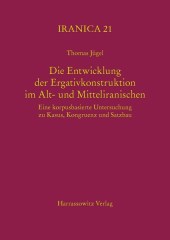
  • Ergativity in Old and Middle Iranian languages

    Ergativity is a grammatical phenomenon that has been discussed controversially in linguistics in general and in the Iranian Studies in particular. The scientific debate is characterized by a lack of consideration of the Old and Middle Iranian data. In many cases, the selected examples, which their position in the respective language system is  still unclear, are associated with theory-driven assumptions about a hypothetical model of development, which is to be plausible, but not verifiable.

    The present study provides a solution through the complete analyzing of the Avestan , Old Persian, Bactrian and Parthian documents as well as an extensive study of Middle Persian evidences (approximately 12,500 Middle Persian cases). In addition to the relevant ergativity aspects such case, congruence, word order,  and reflexivity both the development of syntactic structures (e.g. relative clauses) as well as the verbal and nominal system (e.g. the temporal aspect system or the function of enclitic personal pronouns) are discussed .

    Results are illustrated with relevant evidences  (over 1,400 examples alone in the main part), whose validity is constantly checked and  based critically on detailed philological discussion. The material part also serves as a vademecum, which can be used in parallel with the reading of the main part, as well as a separate reference book that systematically illustrates the history of the object in ergative languages.

    The volume presents the most exhaustive investigation on ergativity in within the Old and Middle Iranian languages.

    The detaild Table of Content of this book and the English Summery are availabe. (more…)

  • Proto-Indo-European Lexicon

    Proto-Indo-European Lexicon

    The generative etymological dictionary of Indo-European languages

    The current version, PIE Lexicon Pilot 1.1, presents digitally generated data of hundred most ancient Indo-European languages with three hundred new etymologies for Old Anatolian languages, Hitttite, Palaic, Cuneiform Luwian and Hieroglyphic Luwian, arranged under two hundred Indo-European roots.

    The correspondences contain data of all fourteen sub-branches of the Indo-European languages, Albanian, Anatolian, Armenian, Baltic, Celtic, Germanic, Greek, Indo-Aryan, Iranian, Italic, Old Balkan (Satem), Old Balkan (Centum), Slavic and Tocharian.


  • A new etymological dictionary of Persian language

    HassandoustHassandust, Mohammad. 2015. The etymological dictionary of Persian. 5 Vols. Tehran: Academy of Persian Language and Literature.

    The Etymological Dictionary of Persian is the most comprehensive and up-to-date work in the field of Classical and Modern New Persian historical lexicology and etymology. Since the publication of P. Horn’s Grundriss der neupersischen Etymologie (1893) and H. Hübschman’s Persische Studien (1895), enormous progress has been made in the field, and many etymologies have been revised or proposed. This new etymological dictionary, with more than 5500 entries, covers the entire principal vocabulary of Persian lexicon of both Iranian and non-Iranian origin, as well as the inherited lexicon of Persian and synthesizes the achievements of Iranian, and Indo-European, comparative linguistics over the last century. It covers also the vocabularies from diffrent sources of the Persian language attested in Classical poetry, historical narratives, mediaeval Farhangs “dictionaries”, as well as the vocabularies from modern urban and daily vernaculars.

    (more…)

  • Dictionary of the Old Persian royal inscriptions

    Schmitt, Rüdiger. 2014. Wörterbuch der Altpersischen Königsinschriften. Wiesbaden: Reichert.

    The present volume is closing a gap of the specialist literature felt for some time, because the glossaries and dictionaries available cover the Old Persian vocabulary only in part and are defective in some respects. For preparing a new Old Persian dictionary the situation is quite favourable at present, since a complete edition of the royal inscriptions has been published in 2009 by the author in his book “Die altpersischen Inschriften der Achaimeniden” (Wiesbaden 2009), where only some texts of minor relevance, the inscriptions on vessels, seals (and sealings) and weights, had been ignored. A dictionary like the present comprehensive work probably never had been tackled before for a corpus language like Old Persian, for in order to cope the divergent needs of all sorts of users it contains six separate lists or indexes: lists of (1) the transliterated and (2) the transcriptional word-forms (this one giving a short grammatical definition and a list of all references), (3) the lexicon proper, arranged by word-stems, roots etc. and giving a translation as well as short information about the (syntactical, phraseological or other) use of the word and its etymology, and finally (4–5) reverse indexes of the first two lists and (6) of the dictionary itself (verbal roots, nominal and pronominal stems and indeclinable words being kept apart).

    For more information see the ToC and read the Preface (in German) to this volume .

    About the Author:

    Rüdiger Schmitt, from 1979 to his retirement in 2004 Professor of Comparative Indo-European Philology and Indo-Iranian Studies at Saarland University in Saarbrücken; born in Würzburg on June 1, 1939; studies from 1958 to 1965 in Würzburg, Erlangen and Saarbrücken, particularly with Manfred Mayrhofer; after publications on Indo-European poetical language, on the Greek and Armenian languages specialized on the ancient Iranian languages, Old Persian epigraphy and, above all, Iranian personal names.

  • The family tree of Iranian

    Dr Agnes Korn (University of Frankfurt) will be addressing the Indo-European Seminar on the subject

    The family tree of Iranian and its problems


    At 4.30 pm on Wed. June 17, Room 1.11, Faculty of Classics, Sidgwick Site Cambridge (CB3 9DA)
    Tea will be served from 4.15