Tag: Avestan

  • Ritual Formulae, Structures, and Activities in Vedic and Avestan Liturgies

    Sadovski, Velizar. 2018. Ritual formulae, structures, and activities in Vedic and Avestan liturgies. Münchener Studien zur Sprachwissenschaft 71/1. 81134.

    Die Arbeit präsentiert Untersuchungen zu einer Reihe von Begriffen aus dem Bereich des indoiranischen Kultus bzw. Rituals einerseits in ihrem Kontext innerhalb der vedischen und avestischen Ritualdichtung und -praxis und andererseits vom Standpunkt ihrer mythologischen Relevanz, insbesondere in Bezug auf ihre Rolle für die „Mythopoia“ in den Sakraltexten von Indern und Iraniern. So werden einerseits Personifikationen bzw. Deifikationen derartiger Kultbegriffe geschildert, andererseits verschiedene Mechanismen ihrer Kombinatorik auf syntagmatischer, intra-textueller Ebene (innerhalb des Kontexts eines liturgischen Hymnus/Vorgangs) bzw. auf inter-textueller Ebene, im Rahmen des Hypertexts der aus zahlreichen einzelnen Litaneien bestehenden Ritualhymnen und in den aus ganzen solchen Einzelliturgien bestehenden Ritualkomplexen dargestellt. – Der vorliegende Aufsatz entwickelt dabei die Idee über die fundamentale Rolle von Katalogen, Listen und Enumerationen als poetische, aber auch als mythologische und kosmologische Form: Basierend auf mehreren früheren Studien des Verfassers, die das Funktionieren solcher intertextuell verbundenen Textcorpora in der indoiranischen Ritualdichtung vor allem textlinguistisch, vom formalen, kompositionellen und kognitiven Standpunkt behandeln, gibt nun das Thema „Ritus im Mythos“ die Gelegenheit, die katalogisch aufgebauten Formen von Litaneien und Liturgien in den vedischen Sakraltexten vom RV an (insbesondere in den RV-Khilas und dem Yajurveda) und in der ‚Langen Liturgie‘ des Avesta sowie ihre Bedeutung sowohl zur rituellen „Wieder-Erschaffung des Universums“ mit jedem Kultakt und -text als auch zur Mythologisierung entsprechender Begriffe mit rituellem Inhalt zu untersuchen.
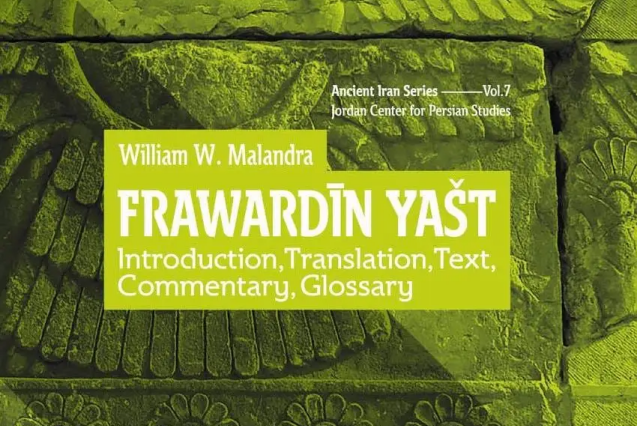
  • The Frawardīn Yašt

    The Frawardīn Yašt

    Malandra, William W. 2018. The Frawardīn Yašt. Introduction, translation, text, commentary and glossary (Ancient Iran Series 7). Irvine: Jordan Center for Persian Studies.

    With the encouragement of Professor Touraj Daryaee, I have undertaken a new edition of my old The Fravaši Yašt: Introduction, Text, Translation and Commentary, diss. University of Pennsylvania, 1971 [University Microfilms, Ann Arbor]. At the time when I wrote the dissertation I was very much under the influence of W. B. Henning’s “The Disintegration of the Avesta Studies” and the then recent book by I. Gershevitch The Avestan Hymn to Mithra. I expressed my misgivings concerning Henning’s stress-accent theory in my Preface, but was not prepared to tackle the issue, and thus treated the text as if it were prose. In the years since it has become abundantly clear that much of the Yašts were originally composed in verse, as best articulated by K. F. Geldner in his Über die Metrik des jüngeren Avesta (1877). Thus, Part II of the present work is devoted to a study of metrics and their importance for understanding the formation of the Yašts and particularly the Frawardīn. In order to make manifest the structure of Avestan poetry I have laid out the translation and text according to my construction of the Avestan.

    From the Preface
  • Farnah: Indo-Iranian and Indo-European Studies in Honor of Sasha Lubotsky

    Beek, Lucien, Alwin Kloekhorst, Guus Kroonen, Michaël Peyrot & Tijmen Pronk (eds.). 2018. Farnah. Indo-Iranian and Indo-European studies in honor of Sasha Lubotsky. Ann Arbor; New York: Beech Stave Press.

    Over thirty specialists in Indo-European linguistics have contributed this elegant volume in honor of Prof. Sasha Lubotsky of Leiden University. Besides giving an excellent snapshot of the research currently being undertaken by his students and colleagues at that institution, Farnah contains contributions from well-known scholars across the world covering topics in Tocharian, Germanic, Slavic, Indo-Iranian, and Anatolian linguistics, to name a few.

    Click here to see a full list of the contributions.

    Table of Contents

      • Peter C. Bisschop: Vedic Elements in the Pāśupatasūtra
      • Václav Blažek: The Case of Tocharian ‘silver’: Inherited or Borrowed?
      • Michiel de Vaan: The Noncanonical Use of Instrumental Plurals in Young Avestan
      • Desmond Durkin-Meisterernst: Sogdian Plurals in the Vessantara Jātaka
      • Jost Gippert: A Middle Iranian Word Denoting an Office-Holder
      • Stephanie W. Jamison: The Vedic Perfect Imperative and the Status of Modal Forms to Tense-Aspect Stems
      • Michael Janda: Vedisch dhénā-: Bedeutung und Etymologie
      • Jay H. Jasanoff: The Phonology of Tocharian B okso ‘ox’
      • Jared Klein: Syncretism in Indo-European: A Natural History
      • Alwin Kloekhorst: The Origin of the Hittite ḫi-Conjugation
      • Werner Knobl: Das Demonstrativpronomen ETÁD im Ṛgveda
      • Petr Kocharov: A Comment on the Vocalization of Word-initial
        and Medial Laryngeals in Armenian
      • Frederik Kortlandt: The Indo-European k-Aorist
      • Guus Kroonen: Lachmann’s Law, Thurneysen’s Law, and a New Explanation of the PIE no-Participles
      • Leonid Kulikov: Vedic āhanás– and Its Relatives/Cognates within and outside Indo-Iranian
      • Martin Joachim Kümmel: The Survival of Laryngeals in Iranian
      • Rosemarie Lühr: Prosody in Indo-European Corpora
      • Hrach Martirosyan: Armenian Andndayin ōj and Vedic Áhi-Budhnyà– ‘Abyssal Serpent’
      • Ranko Matasović: Iranian Loanwords in Proto-Slavic: A Fresh Look
      • H. Craig Melchert: Semantics and Etymology of Hittite takš
      • Benedicte Nielsen Whitehead: PIE *gwh3-éu– ‘cow’
        Alan J. Nussbaum, A Dedicatory Thigh: Greek μηρὀς and μῆρα Once Again
      • Norbert Oettinger: Vedisch Vivásvant– und seine avestische Entsprechung
      • Birgit Anette Olsen: The Development of Interconsonantal Laryngeals in Indo-Iranian and Old Avestan ząθā ptā
      • Michaël Peyrot: Tocharian B etswe ‘mule’ and Eastern East Iranian
      • Georges-Jean Pinault: New Look at Vedic śám
      • Tijmen Pronk: Old Church Slavonic (j)utro, Vedic uṣár– ‘daybreak, morning’
      • Velizar Sadovski: Vedic and Avestan Parallels from Ritual Litanies
        and Liturgical Practices I
      • George Starostin: Typological Expectations and Historic Reality: Once Again on the Issue of Lexical Cognates between Indo-European and Uralic
      • Lucien van Beek: Greek πέδιλον ‘sandal’ and the Origin of the e-Grade in PIE ‘foot’
    • Michael Weiss: Veneti or Venetes? Observations on a Widespread Indo-European Tribal Name
  • Cosmic, cultic and social spaces in Early Zoroastrianism

    Rezania, Kianoosh. 2017. Raumkonzeptionen im früheren Zoroastrismus. Kosmische, kultische und soziale Räume (Iranica, GOF III/NF 14). Wiesbaden: Harrassowitz Verlag.
    Space, like time, is one of the basic categories of our thinking. Their concepts do not remain constant in different cultures or in changing periods, which is why dealing with a historical cultural phenomenon always requires a review of these categories in their specific culture and time. Based on the oldest linguistic and architectural evidence of Iran from the 12th to the 4th century BC, for the first time Kianoosh Rezania offers a comprehensive study of space concepts in Zoroastrianism in ancient Iran.
    Based on current and historical theories of space, the Zoroastrian spaces are divided into cosmic, cultic and social spaces. The depiction of the cosmic spaces describes spatial abstractions in ancient Iranian languages as well as Zoroastrian boundary principles. Rezania examines the coordinate systems that ancient Iranians used for orientation in space and how they transformed their cognitive maps into text. This also includes the portrayal of the Zoroastrian worldview according to their older texts. At the intersection of cosmic and cultural spaces, there are transcendent spaces that contain, on the one hand, utopian spaces for communication with gods, some of which are written by poets. Since the study does not rule out dynamics and change processes in the ritual domain, reconstructions of Zoroastrian ritual surfaces in the Avestan period are presented without the inclusion of recent materials. In addition, the spatially represented social structure of the Avestan society and their spatial symbolic orders are presented.
    For the table of contents of this volume visit here.
  • Reinventing Mosaic Torah in the Light of the Law of Ahura Mazdā and Zarathustra

    Leningrad Codex text sample, portions of Exodus 15:21-16:3

    Kiel, Yishai. 2017. Reinventing Mosaic Torah in Ezra-Nehemiah in the light of the law (dāta) of Ahura Mazda and Zarathustra. Journal of Biblical Literature 136(2). 323–345.

    In this study I examine the linguistic and theological contours of the term (tôrâ) in Ezra-Nehemiah—particularly the identification of with the law () of God promulgated by Ezra (Ezra 7:14)—through the lens of Old Persian and Avestan notions of “the law set down (dāta)” by Ahura Mazda and revealed through Zarathustra. While the basic notion of divine revelation of laws through the mediation of Moses emerges already in preexilic biblical texts, I posit that the innovative link drawn by the authors of Ezra-Nehemiah between the Old Persian and Avestan term dāta (via Aramaic ) and the Hebrew reflects a broader and more comprehensive impact of Avestan traditions, mediated by Achaemenid ideology, on the construction and conceptualization of Mosaic in Ezra-Nehemiah. Weighing in on the ongoing debate over the range of imperial authorization of local legislation and cult in Judea, Egypt, and Asia Minor, I argue that the Achaemenids, who were probably involved in certain aspects of the codification and canonization of textual, legal, and theological manifestations of Zoroastrianism, functioned as agents (whether actively or passively) in facilitating and reinforcing the adaptation by the Babylonian-Judean scribes of Avestan notions of divine revelation of the law and scriptural unity linked to personal authority.
  • The Coherence of Yasna

    Zoroastrian fire ceremony.

    Ahmadi, Amir. 2017. On the coherence of Yasna: A critical assessment of recent arguments. Bulletin of the School of Oriental and African Studies 1-26.
    DOI

    In recent years a number of scholars have proposed more or less detailed schemas of the formation of the Zoroastrian ritual. These schemas offer accounts of the arrangement of the texts in the liturgy, the process of its formation, and even its function from an endogenous perspective. One way or another, they argue that the official Zoroastrian liturgy is an integrated ritual with a coherent text, and that the function of the ritual and the intention behind the arrangement of the texts can be determined by means of philological, literary and comparative analyses. The questions of formation and meaning of the Zoroastrian liturgy these scholars have placed on the agenda are important not only for the study of Zoroastrianism but also for the history of religions and ritual theory. I consider their accounts with respect to the texts they invoke and the methods they use, and show that their arguments suffer from fatal flaws.

  • Avestan Textile Terms

    Andrés-Toledo, Miguel Ángel. 2017. Sasanian exegesis of Avestan textile terms. In Gaspa, Salvatore, Cécile Michel & Marie-Louise Nosch (eds.), Textile terminologies from the Orient to the Mediterranean and Europe, 1000 BC to 1000 AD, 397–403. Lincoln, NE: Zea Books.

    DOI

    (more…)

  • Corpus Avesticum Berolinense

    Today, the Institute of Iranian Studies, Freie Universität Berlin, received the confirmation of funding for Corpus Avesticum Berolinense (CAB), a long-term project funded by the German Research Foundation (DFG) for 12 years . The goal of CAB is to edit all Zoroastrian rituals preserved in the Avestan language. This is excellent news for the institute and the discipline. The BiblioIranica team congratulates Prof. Alberto Cantera for this achievement. It is more than well-deserved.

    See the institute’s announcement for more information.

  • The Sanskrit Yasna

    Goldman, Leon. 2017. The Sanskrit Yasna Manuscript S1. Facsimile Edition (Corpus Avesticum / Handbook of Oriental Studies. Section 2 South Asia, 32/1). Leiden: Brill.
    The manuscript S1 is one of the chief witnesses to the Sanskrit Yasna, containing the Avestan text of the Zoroastrian Yasna liturgy to chapter 46.19, together with a Sanskrit translation and commentary. This book contains the complete, full-colour set of facsimile images of S1.
    An introduction by Leon Goldman provides an overview of the Zoroastrian Sanskrit tradition together with a discussion of the S1 manuscript covering its physical appearance, its age and history, and for the first time, a detailed palaeographic analysis of the Avestan and Sanskrit text.

    (more…)

  • Ancient Iranian Terminologies of Armour and Textile

    Gaspa, Salvatore, Cécile Michel & Marie-Louise Nosch (eds.). 2017. Textile Terminologies from the Orient to the Mediterranean and Europe, 1000 BC to 1000 AD. Lincoln, Nebraska: Zea Books.
    This volume is the fruit of a longstanding collaboration in the field of textile terminologies. Since 2005, Cécile Michel and Marie-Louise Nosch have collaborated on numerous academic activities – joint teaching, lectures at conferences, experimental workshops, co-publishing and co-editing. The second conference on textile terminology was held in June 2014 at the University of Copenhagen. Around 50 experts from the fields of Ancient History, Indo-European Studies, Semitic Philology, Assyriology, Classical Archaeology, and Terminology from twelve different countries came together at the Centre for Textile Research, to discuss textile terminology, semantic fields of clothing and technology, loan words, and developments of textile terms in Antiquity.
    Three contributions in this volume are related to Iranian Studies, all available for free to read, download and share: