Category: Books

  • Elam and Its Neighbors

    Elam and Its Neighbors

    Prechel, Doris & Alexander Pruß (eds.). 2025. Elam und seine Nachbarn. 10. Internationales Colloquium der Deutschen Orient-Gesellschaft, 8.–10. April 2019, Mainz. Wiesbaden: Harrassozitz.

    Die antike Kulturregion Elam im Südwesten des heutigen Iran war über Jahrtausende hinweg eines der bedeutendsten Zentren politischer Macht und kultureller Entwicklung in Vorderasien. Neben dem benachbarten Mesopotamien spielte es im späten 4. Jahrtausend v. Chr. eine bedeutende Rolle bei der Entstehung und Entwicklung urbaner Gesellschaftsformen im Vorderen Orient. Im späten 3. und dem 2. Jahrtausend v. Chr. war der elamische Staat zeitweise so mächtig, dass seine Herrscher mehrfach entscheidend in die Geschichte Babyloniens eingreifen konnten. Auch nach der Zerschlagung des elamischen Reiches im 7. Jahrhundert v. Chr. hat Elam bis in die Zeit des Achämenidenreiches (550–330 v. Chr.) seinen eigenständigen kulturellen Charakter bewahren können. Totz seiner offenkundigen Bedeutung sind Elam und seine Kultur lange Zeit nur von wenigen Spezialisten erforscht worden.

    Mit dieser zentralen Kulturregion des Alten Orients und den Beziehungen zu ihren Nachbarn hat sich das 10. Internationale Colloquium der Deutschen Orient-Gesellschaft befasst, dessen Beiträge in diesem Band versammelt sind. Der zeitliche Rahmen reicht dabei von der Mitte des 3. Jahrtausends v. Chr. bis in die Achämenidenzeit. Die besondere Betonung der Beziehungen Elams zu seinen Nachbarn soll verdeutlichen, dass Elam nicht nur ein östliches „Anhängsel“ Mesopotamiens war, sondern ein wichtiger Knotenpunkt in einem bis nach Zentralasien, das iranische Hochland und die Golfregion reichenden Netzwerk.

    See the table of contents here.

  • The Significance of the Wreath in the Late Antique Orient

    The Significance of the Wreath in the Late Antique Orient

    Corfù, Nicolas Assur. 2025. Die Bedeutung des Kranzes im spätantiken Orient: zu Thronbesteigung, Kranzübergabe und Religionen im Sasanidenreich. Basel: Schwabe Verlag.

    The wreath first appears in funerary culture in the West and in Egypt. Later, it increasingly came to represent victory as well, deriving from the oriental nose-rope with ring, which was adopted and adapted into the West during Greece’s ‘Orientalizing Period’. In Sasanian iconography, the wreath was re-imported from the West: it now symbolizes victory, honor, or a funerary aspect.

    This book examines the wreath in East and West from its first appearance up to Late Antiquity. The author develops a new interpretation of the inscription ANRm-b and offers a novel reading of rock reliefs depicting wreath-giving, using a group-theoretical approach from mathematics: as an act of honoring a deceased predecessor of the commissioning Sasanian ruler.

  • Eating and Drinking in the Ancient Near East

    Eating and Drinking in the Ancient Near East

    Martino, Stefano de, Elena Devecchi and Maurizio Viano (eds.). 2024. Eating and drinking in the ancient Near East: Proceedings of the 67th Rencontre Assyriologique Internationale, Turin, July 12–16, 2021 (dubsar 33). Münster: Zaphon.

    This volume comprises many of the papers presented at the 67th Rencontre Assyriologique Internationale in July 2021 in Turin. Due to pandemic restrictions the participants of the conference could not meet in person. The encompassing topic “Eating and Drinking in the Ancient Near East” is broad and declinable under different perspectives. Key lectures (1) have been delivered by Cécile Michel on “Gender Aspects in Food and Drink Preparation” and by Theo van den Hout on “Hittite Foodways: The King as the Provider of his People”. Subsequent lectures grouped around the following sections: (2) Food Production, (3.) Resource Management, (4.) Rituality, Banquet and Commensality, (5.) Medicine and Literature, (6.) Philological and Archaeological Researches, (7.) Varia. The lections feature both philological as well as archaeological topics, presenting new insights into well-known texts as well as hitherto unpublished material. Among others Paola Paoletti examines “Butter and Cheese Production in the Third Millennium BCE Babylonia”, Juliette Mas “Funerary Drinking Vessels in Early and Middle Bronze Age Upper Mesopotamian Burials”, while Ludovico Portuese pursues “The Assyrian Royal Banquet”, and Jan Tavernier “The Use of Eggs in Mesopotamian Medicine and beyond”, to list just a few of the 35 articles.

    Two contributions investigate topics that are related to ancient Iran:

    • Francesca Giusto: Dairy Production in SW Iran from the Middle Elamite to the Neo-Elamite Period
    • Trudy Kawami: What Fine Ceramics Can Tell Us About Social Drinking in Iron Age Iran
  • Late Achaemenid Texts from Šāṭer

    Late Achaemenid Texts from Šāṭer

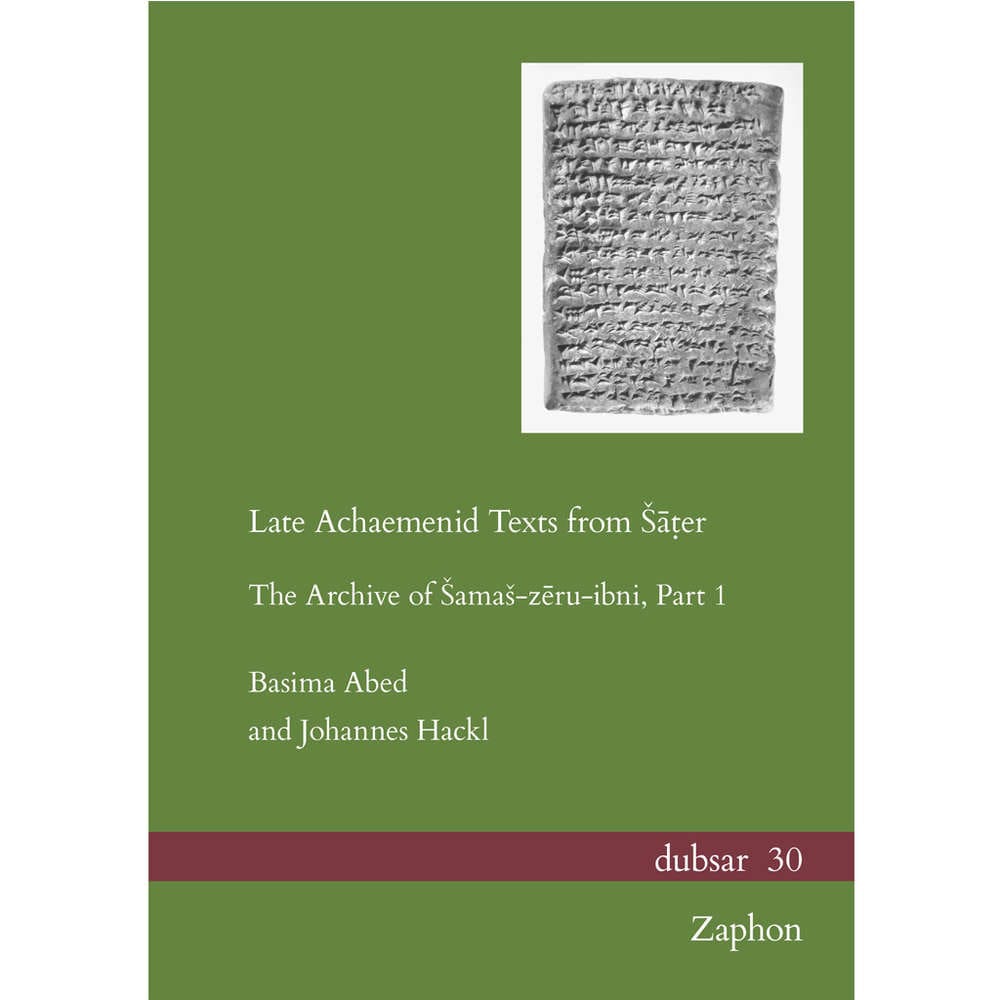
    Abed, Basima & Johannes Hackl. 2024. Late Achaemenid texts from Šāṭer: The archive of Šamaš-zēru-ibni, Part 1 (dubsar 30). Münster: Zaphon.

    The 67 texts presented in this volume are part of a larger group of (Babylonian) Late Achaemenid legal documents from Šāṭer, a city that is believed to be located somewhere in the area northwest of Uruk up to the outskirts of Nippur. Together with a brief introduction and indices, it included transliterations, autographed copies and photographs of a group of texts that were confiscated from illicit excavators by the Iraqi Antiquity Authorities as part of a larger group of texts now housed in the Iraq Museum. The common element that ties these texts together is their identical archival and commercial context; they can be identified as certain components of the archive belonging to Šamaš-zēru-ibni, son of Ayyanaˀad, an agricultural entrepreneur who was active in and around the Southern Babylonian city Šāṭer during the second half of the fifth century BCE.

  • Hybrid Judeo-Persian and Arabic Correspondence

    Hybrid Judeo-Persian and Arabic Correspondence

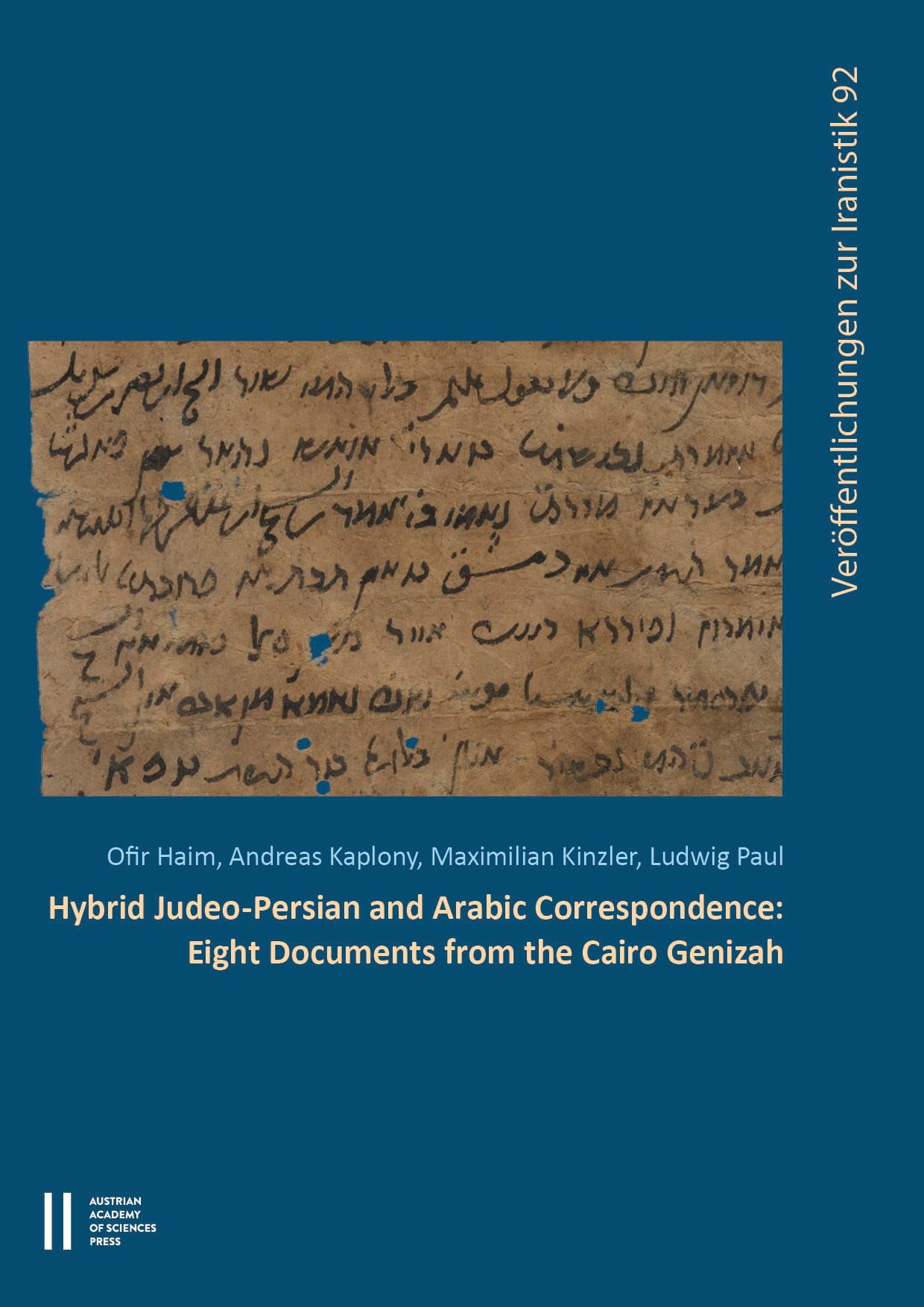
    Haim, Ofir, Andreas Kaplony, Maximilian Kinzler & Ludwig Paul. 2025. Hybrid Judeo-Persian and Arabic correspondence. Eight documents from the Cairo Genizah (Veröffentlichungen zur Iranistik 92). Wien: Österreichische Akademie der Wissenschaften.

    The more than 300,000 documents discovered in a storeroom of the Ben Ezra Synagogue in Old Cairo in the late 19th century, now housed in the collections in St. Petersburg, Cambridge, and Paris, are known as the Cairo Genizah. These documents, which span a wide array of subjects, are invaluable sources for understanding the history of medieval Judaism, as well as for the social and economic landscape of the Mediterranean from the 10th to the 13th centuries. Among them are thousands of private and commercial letters written in Arabic (in both Hebrew and Arabic scripts), alongside some 25 documents in Judeo-Persian—Persian written in Hebrew script. Due to the considerable challenges posed by their interpretation, only a small fraction of these texts has been published thus far.   This volume presents editions of eight previously unpublished documents dated to around the turn of the millennium (991–1002 CE) and mentioning key places such as Baghdad and Basra. Included are two pages from a merchant’s notebook, written in both Jewish-Persian and Arabic, along with several letters. Of particular interest are two letters, one in Judeo-Persian and its near-literal Arabic translation, highlighting the fluidity between these two languages. The blending of Judeo-Persian and Arabic in all eight texts offers a compelling reason to publish them together. This linguistic fusion underscores the fact that the authors of these letters were part of a broad network of Jewish merchants, notably including the Tustarī and Ibn ʿAwkal families.

    Table of Content.

  • The Great King’s Word under AhuraMazdā’s Protection

    The Great King’s Word under AhuraMazdā’s Protection

    Aliyari Babolghani, Salman. 2024. The Great King’s word under AhuraMazdā’s protection: Trilingual Achaemenid royal inscriptions of Susa I (Dariosh Studies III/1) (Ancient Iranian Series 17). Leiden: Brill.
    This volume presents part of the author’s research on the Achaemenid Royal Inscriptions recovered in the ruins of the Achaemenid palaces in Susa, conducted within the framework of the DARIOSH-Louvre Project. It offers a new study of several fragmentary inscriptions in Old Persian, Achaemenid Elamite, and Achaemenid Babylonian, currently designated as DSe, DSt, DSb, DSl, DSa, DSk, DSi, DSp, D²Sb, DSj, A²Se, DSs, ‘Inc. Sb’, and others. The book provides a new edition of each inscription based on both published and unpublished fragments. Additionally, it introduces some new lexicons and cuneiform signs in the Old Persian language and script.

    Table of Contents (PDF)

    Part 1: Some Fragments of a Foundation Stone Table Inscription

    1 AhuraMazdā Protected the Great King’s “Written Word” 

    Fresh Old Persian Lexicon in Newly Discovered Fragments of DSe 

    Part 2: Terracotta Brick Inscriptions

    2 “AhuraMazdā Belongs to Me” 

    Inscriptions DSa, DSb, DSk, DSl, and DSae 

    Part 3: Some Threshold Inscriptions

    3 “I Did All Superior” 

    4 A Marvelous Palace Built by a Righteous King 

    DSj Inscription 

    Appendix 1: Persian Translations of the Inscriptions

    Appendix 2: Revised List of Old Persian Logograms 

  • Contributions on History and Culture of Elam and its Neighbouring Regions

    Contributions on History and Culture of Elam and its Neighbouring Regions

    Mofidi-Nasrabadi, Behzad (ed.). 2024. Contributions on History and Culture of Elam and its Neighbouring Regions (Elamica 14). Hildesheim: Franzbecker.

    The new book in the series Elamica is out and it contains three contributions:

    • T. Brandes & D. Prechel: Keilschrifttexte aus Haft Tappeh (KHT) der Ausgrabungen zwischen 2005 und 2012. Teil 3
    • B. Mofidi-Nasrabadi: Supplementum zu den Tontafeln der rezenten Ausgrabungen in Haft Tappeh
    • B. Rafiei-Alavi & M.-A. Emami: A Diachronic View of Copper-Alloys in the Elamite Metallurgy, A Reassessment of Susa Copper-Based Metal

  • Bridging the Gap: Disciplines, Times, and Spaces in Dialogue

    Bridging the Gap: Disciplines, Times, and Spaces in Dialogue

    Kallas, Nathalie (ed.). 2025. Bridging the gap: Disciplines, times, and spaces in dialogue. Vol. 2. Oxford: Archaeopress.

    This volume gathers the papers presented at sessions 3, 7 and 8 from the conference Broadening Horizons 6, held at the Freie Universität Berlin, 24–28 June 2019, and is available in open access.

    The second volume compiles papers presented in three enlightening sessions: Session 3 – Visual and Textual Forms of Communication; Session 7 – The Future of the Past. Archaeologists and Historians in Cultural Heritage Studies; and Session 8 – Produce, Consume, Repeat. History and Archaeology of Ancient Near Eastern Economies. Within this volume, the 20 papers traverse diverse topics spanning multiple periods, from the 5th millennium BCE to the Roman Empire, and encompass a wide array of geographical regions within the Near East.

    Among other relevant contributions, the following papers deal with aspects of ancient Iranian history and culture:

    • Delphine Poinsot: Sexuation of animals’ bodies in the bullae from Qasr-I Abu Nasr
    • Olivia Ramble: Generations of Writing: The Secondary Inscriptions of Darius’ tacara at Persepolis
    • Takehiro Miki: Deciphering the Skills of the Prehistoric Painting Technique: Case Study of the Painted Pottery of the 5th Millennium BCE from Tall-e Bakun A (Fars province, Iran)
    • Yazdan Safaee: Persian Female Weavers in the Persepolis Economy
  • The ‘Two Eyes’ Rivalry of Byzantium and Sasanian Persia

    The ‘Two Eyes’ Rivalry of Byzantium and Sasanian Persia

    Blachford, Kevin. 2024. World order in Late Antiquity: The ‘two eyes’ rivalry of Byzantium and Sasanian Persia. Oxford: Oxford University Press.

    The East Romans of Byzantium and the Sasanian Persians competed as geopolitical rivals for over four centuries between 224 and 628 ad. Through a series of intractable conflicts, these two great empires would develop a dual hierarchy that sought to divide the known world between them. Despite competing claims to universal rule, mutual spheres of interest arose as both empires sought to create rules, norms, and standard practices of diplomatic behaviour to regulate their inter-imperial rivalry. Defined by contemporaries as the ‘Two Eyes’ of the Earth, this suzerain order aimed to hierarchically organize those considered ‘barbarians’. This period of late antiquity is rarely considered within the discipline of international relations. Through an English School approach, this work examines the diverse suzerain order of late antiquity as ‘barbarous’ nomadic tribes challenged the hierarchical ambitions of two rival empires who both claimed a unique role in the maintenance of world order.

  • Sasanian Coin Legends

    Sasanian Coin Legends

    Matloubkari, Esmaeil. 2024. Sasanian Coin Legends: A Linguistic Approach to Historical Analysis. Tehran: Negah-e Moaser.

    Epigraphic sources and historical texts indicate that the political ideology of the Sasanians underwent significant transformations over time. If we consider Sasanian coins as the most important—and sometimes the only—expressions of Sasanian kingship ideology, then the linguistic study of coin legends becomes a key method for understanding the socio-political significance of these titles.

    The titles inscribed on Sasanian coins during the 3rd and 4th centuries AD appear to have been rooted in native traditions, either imitated and reconstructed by the Sasanians or influenced by external traditions transmitted through the Parthians, Hellenistic states, and Kushans. The formalization of Zoroastrianism as the state religion in the 4th century AD led to Middle Persian becoming the sole official language, resulting in the gradual removal of non-native titles from Sasanian coinage. Nevertheless, such titles continued to exist in a localized form within the political sphere and the propaganda of the Sasanian government.
    Lexical analysis suggests that most of the titles and honorifics found on Sasanian coins originated from religious contexts, often adapted—with modifications—from Old or Middle Iranian texts. From the 5th to the 7th century, these titles increasingly reflected Zoroastrian religious traditions while also showing traces of the ancient Iranian bureaucratic system. The titulature found on Sasanian coins and inscriptions was a crucial instrument for legitimizing Sasanian kingship, and changes in these titles provide valuable insights into the evolution of political thought during the Sasanian era.
    Given the scarcity of contemporary Sasanian texts, coin legends remain among the few available sources that reference the “King of Kings,” the court, and the state. By examining the etymology of these terms in Old and Middle Iranian texts, historians can gain a deeper understanding of their meanings, thereby shedding light on the socio-political structures of the Sasanian period.