Author: Arash Zeini

  • The Frontier Pushes Back

    The Frontier Pushes Back

    Garosi, Eugenio. 2025. The frontier pushes back: From local languages to imperial substrate(s) in scribal practices in 8th-century Central Asia. Iranian Studies FirstView. 1–15.

    This article draws on documentary texts from multilingual archives of early Islamic Central Asia to illustrate connections between the Arabic and Middle Iranian scribal world. Here, I contend that some lesser-known evidence from Sogdia contributes new elements to current debates on the contact between Arabic and Middle Iranian scribal traditions and provides a measure of “intensity” of Arab rule in the region more generally. In particular, ostraca from various Transoxanian administrative centers provide documentary confirmation that a class of biliterate Arabic-Sogdian scribes was active in the local bureaucracy as early as the mid-8th century. When viewed in dialogue with archives from coeval Iran and Iraq, the Transoxanian evidence helps lead to a more nuanced understanding of the so-called “Pahlavi diplomatic substrate” model.

    Abstract
  • New Readings in Seven Middle Persian Documents

    New Readings in Seven Middle Persian Documents

    Asefi, Nima. 2025. New readings in seven Middle Persian documents from the archive of Hastijan with an edition of Berk. 19. Berkeley Working Papers in Middle Iranian Philology 3(5). 1-19.

    This article proposes new readings and interpretations for parts of seven Middle Persian documents first published by Dieter Weber, namely: Berk. 80, Berk. 95, Berk. 43B, Tehran B, LA1, Berk. 149, and Berlin 28. It also provides the editio princeps of Berk. 19.

    Abstract
  • Zoroastrian Conversations S02 E01

    Zoroastrian Conversations S02 E01

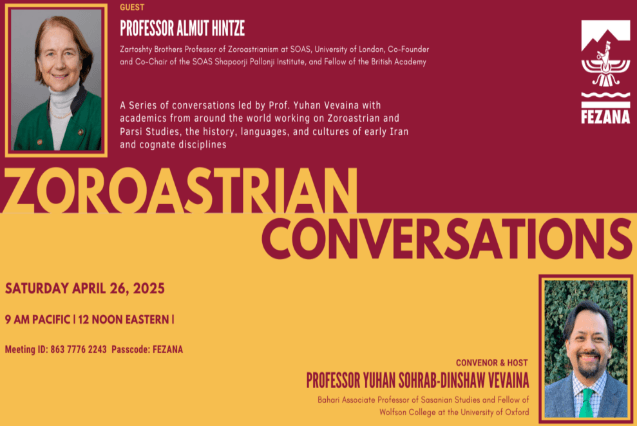
    Prof. Yuhan S.–D. Vevaina will open the first episode of the second season of ‘Zoroastrian Conversations’ with Prof. Almut Hintze, Zartoshty Brothers Professor of Zoroastrianism at SOAS, University of London, Co-Chair of the SOAS Shapoorji Pallonji Institute, and Fellow of the British Academy.

    Date:
    Saturday, 26 April 2025
    Time:
    9 AM Pacific | 12 Noon Eastern | 5 PM London | 9:30 PM Mumbai

    Zoom meeting ID: 863 7776 2243 Passcode: FEZANA.

    Zoom and other information: https://fezana.org/conversations/

  • Between the Tigris and Zagros

    Between the Tigris and Zagros

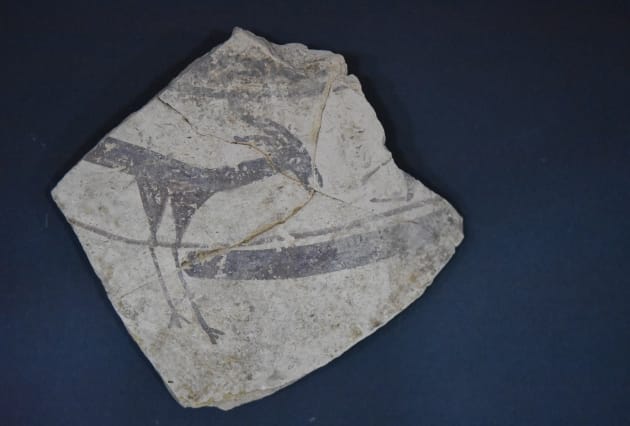
    Peyronel, Luca. 2025. Entre le Tigre et le Zagros. Les recherches archéologiques de la mission italienne de l’Université de Milan dans la plaine d’Erbil (Kurdistan irakien). ArchéOrient – Le Blog.

    About ArchéOrient – Le Blog

    ArchéOrient-Le Blog is run by members of the « Archéorient » research centre of the University of Lyon 2 (CNRS/University Lyon 2), based at the Maison de l’Orient et de la Méditerranée (Lyon, France). The blog aims to promote exchanges and to give greater visibility to new scientific information in the field of archaeology and history of societies and environments during the Holocene in the Mediterranean, the Near and Middle East, the Caucasus and Central Asia, and more recently, the Horn of Africa and West Africa. This Blog is open to all representatives of the international scientific community and welcomes contributions in French and English.

  • Summer School of Oriental Languages

    Summer School of Oriental Languages

    The Summer School in Oriental Languages is a unique opportunity to study languages and scripts that are often described as rare, even though they are spoken or have been spoken by millions of speakers, in the form of major and minor courses. This summer school offers top-level teaching and the most recent research findings in Oriental languages and literature, with ECTS credits awarded upon validation.

    From the website

    The Summer School of Oriental Languages is organised by the University of Lausanne and will be held at the Venice International University (Italy), from 10–19 July 2025.

    For more information about the programme, registration, and ECTS requirements visit the website. The deadline for registration is 30 May 2025.

  • Greek Citizenship under Arsacid Rule

    Greek Citizenship under Arsacid Rule

    Nabel, Jake. 2025. The verb empoliteuō and Greek citizenship under Arsacid rule. Classical Journal 120(3). 249–276.

    The primary translation for the ancient Greek verb ἐμπολιτεύω in several dictionaries is “to be a citizen, have civil rights.” That definition is untenable. The connotations of ἐμπολιτεύω for citizen status are usually indeterminate, but where they are clear, the verb has the opposite meaning and refers to non-citizens rather than citizens. This sense is crucial to the study of Greek citizenship in the Arsacid empire, because ἐμπολιτεύω appears twice in a key passage from Josephus on Greco-Babylonian relations in the poleis of Arsacid Mesopotamia. The verb’s dictionary definition has led some historians to the conclusion that non-Greeks were citizens of these poleis. Along with local evidence in Akkadian, a review of ἐμπολιτεύω‘s appearances in literature and epigraphy suggests the opposite.

    Abstract
  • The Arsacids of Rome

    The Arsacids of Rome

    Nabel, Jake. 2025. The Arsacids of Rome: Misunderstanding in Roman-Parthian relations. California: University of California Press.

    At the beginning of the common era, the two major imperial powers of the ancient Mediterranean and Near East were Rome and Parthia. In this book, Jake Nabel analyzes Roman-Parthian interstate politics by focusing on a group of princes from the Arsacid family—the ruling dynasty of Parthia—who were sent to live at the Roman court. Although Roman authors called these figures “hostages” and scholars have studied them as such, Nabel draws on Iranian and Armenian sources to argue that the Parthians would have seen them as the emperor’s foster children. These divergent perspectives allowed each empire to perceive itself as superior to the other, since the two sides interpreted the exchange of royal children through conflicting cultural frameworks. Moving beyond the paradigm of great powers in conflict, The Arsacids of Rome advances a new vision of interstate relations with misunderstanding at its center.

    A free ebook version of this title is available through Luminos, University of California Press’s Open Access publishing program. Visit www.luminosoa.org to learn more.

  • New Epigraphic Discoveries from Ancient Bactria

    New Epigraphic Discoveries from Ancient Bactria

    Friday 21 March

    5:30pm-7:00pm

    Nicholas Sims-Williams, Ancient India & Iran Trust; SOAS University of London

    New Epigraphic Discoveries from Ancient Bactria

    Further details: https://www.festival.cam.ac.uk/events/new-epigraphic-discoveries-ancient-bactria

    Booking is required for this talk. To book a place, email info@indiran.org

    Bactria is the Greek name for the area around the city of Bactra, modern Balkh in northern Afghanistan. During most of the first millennium CE, the principal language of this region was Bactrian, a language related to modern Persian and Pashto but written in a local adaptation of the Greek alphabet. This language was almost unknown until the discovery over the past 30 years or so of a large body of Bactrian documents written on parchment, together with a few important inscriptions carved on stone. In this talk I will discuss some of the most recent discoveries, concentrating on what they contribute to our understanding of the history of the region. The earliest, an inscription of the Kushan king Vima Taktu discovered in Tajikistan in 2022, dates from the beginning of the 2nd century CE. Although very short, it has made possible the partial decipherment of an accompanying text in a previously undeciphered script and language. The latest, the inscription of Jaghori in southern Afghanistan, is dated in the mid-8th century and records a battle between a local and an Indian prince, possibly a prelude to the replacement of the dynasty of the ‘Turk Shahis’ by that of the ‘Hindu Shahis’. In between these two extremes comes a still unpublished collection of letters written on birchbark, which seems to be the archive of a local ruler who was a vassal of the Sasanian kings of Iran in the late 4th century.

    Nicholas Sims-Williams is Emeritus Professor of Iranian and Central Asian Studies, SOAS University of London, and Chair of the Ancient India & Iran Trust.

  • Norouz 1404

    Norouz 1404

    We wish our followers, colleagues and friends a joyful Norouz 1404! As nature awakens with the arrival of spring, may this renewal bring you health, hope and happiness.

    Thank you for your continued support and engagement—we truly appreciate it. May the spirit of Norouz inspire a bright and fulfilling year ahead!

    نوروز شاد و پیروز!

  • Zoroastrian Hermeneutics in Late Antiquity

    Zoroastrian Hermeneutics in Late Antiquity

    Pourdavoud Lecture Series

    Zoroastrian Hermeneutics in Late Antiquity

    The Sūdgar Nask of Dēnkard Book 9

    Wednesday, April 2, 2025 at 4:00pm Pacific
    Royce Hall 306

    Hybrid Zoom option available
    Registration required

    Speaker: Yuhan Sohrab-Dinshaw Vevaina

    The Sūdgar Nask of Dēnkard Book 9 is a commentary on the ‘Old Avesta’ of the 2nd millennium BCE produced in Pahlavi (Zoroastrian Middle Persian) in the Sasanian (224–651 CE) and early Islamic centuries. This commentary is a value-laden, ideologically motivated discourse that displays a rich panoply of tradition-constituted forms of allegoresis. It mobilizes complex forms of citation, allusion, and intertextuality from the inherited Avestan world of myth and ritual in order to engage with and react to the profound changes occurring in Iranian society. Despite its value and importance for developing our nascent understanding of Zoroastrian hermeneutics and the self-conception of the Zoroastrian priesthood in Late Antiquity, this primary source has attracted scant scholarly attention due to the extreme difficulty of its subject matter and the lack of a reliable translation. This 2-volume work represents the first critical edition, translation, and commentary of this formidable text which will contribute to the philological, theological, and historiographical study of Zoroastrianism in a pivotal moment in its rich and illustrious history. Reading the Sūdgar Nask is a hermeneutic process of traversing texts, genres, and rituals in both the Avestan and Pahlavi corpora, thus activating nodes in a web or network of textual and meta-textual relations that establish new forms of allegoreses or meaning making. It is argued that this entire hermeneutical complex of weaving a ‘new’ text composed of implicit proof text and explicit commentary renews, extends, and, ultimately, makes tradition.