
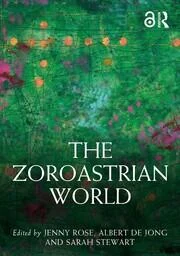
Rose, Jenny, Albert De Jong & Sarah Stewart (eds.). 2026. The Zoroastrian World. New York: Routledge.
Although Zoroastrians in the contemporary world are numerically few – estimated recently at less than 150,000 across the globe – their ancient Iranian ancestors ruled vast areas of the Near East for over a millennium. From the mid‑sixth century BCE to the mid‑seventh century CE, the historical contribution of the ‘Mazda-worshipping’ religion to the intellectual, cultural, and political development of the region was momentous. The migration of some Zoroastrians to north-western India also had a significant social and economic impact on early modern and modern India. From the mid-seventeenth century until the present, Zoroastrianism has also played an important role in European discourse.
Written by a distinguished team of international contributors, including many Zoroastrians, The Zoroastrian World presents a global guide to Zoroastrianism from the earliest period to the modern day, offering original perspectives through substantial thematic contributions on the lived experience of Zoroastrian communities across the world. This volume is organised into five distinct sections:
- Imagining Zoroastrianism
- The Developing Zoroastrian World
- Living Realities: Zoroastrian Narrative and Symbol in the Modern World
- Contemporary Challenges in the Zoroastrian World
- Creative Contributions from the Zoroastrian World
The Zoroastrian World provides an authoritative and accessible source of information on topics relating to the Zoroastrian religion, with a particular focus on interdisciplinary connections. The volume is essential reading for students engaged in studies of Religion, Philosophy and Ethics; Ancient and Modern Iran; the Near and Middle East; Central Asia; South Asian Religions; and Cultural History. The Zoroastrian World is intended for all curious readers, who seek to know more about this ancient, enduring religion.
The editors are excited to showcase the original artwork ‘The Garden of the Universe’ by Hormazd Narielwalla as the cover of this book.
The Open Access version of this book is available at PDF.
Table of Contents
Introduction
Jenny Rose, Albert de Jong, and Sarah Stewart
Part 1. Imagining Zoroastrianism
1. How Zoroastrianism imagined itself
Albert de Jong
2. Recasting Zoroastrian dualism within the Greek philosophical imagination
Maria Cristina Mennuti
3. Imagining Zoroastrianism in the light of the Maga Brahmanas and the Kambojas
Antonio Panaino
4. Zoroastrianism in the Chinese imagination
Jeffrey Kotyk
5. Zoroastrianism/Persian religion in the Hebrew Bible
Jason M. Silverman
6. Zoroastrianism in the Babylonian Talmud
Geoffrey Herman
7. Manichaean, Christian, and Mandaean Views of Zoroastrianism
Jason D. BeDuhn and Paul C. Dilley
8. Zoroastrianism in early Arabic sources
Kayla Dang
9. The European ‘rediscovery’ of the Ancient Persians and their worldview
Olivia Ramble
10. The history of the study of Zoroastrianism
Albert de Jong
11. Zoroastrianism and Freemasonry in colonial-era India and Britain: imagining Zoroastrianism and re-imagining Freemasonry
Simon Deschamps
12. A ‘Persian history’? Achaemenid history and Zoroastrian reception in Gore Vidal’s Creation
Charlotte Howley
13. The fascination of the flame: Zoroastrianism and tourism
Jenny Rose and Sarah Stewart
Part 2. The Developing Zoroastrian World
HISTORY
14. Imagining Ahura Mazda: the earliest form of Zoroastrianism
Almut Hintze
15. Persian religion in the Achaemenid Empire
Amirardalan Emami
16. Zoroastrianism in the religious context of the Arsacid Empire
Lucinda Dirven
17. Zoroastrianism in the Sasanian Empire
Albert de Jong
18. Zoroastrianism in Iran from the Arab conquests to the mid-nineteenth century
Kiyan Foroutan
19. Zoroastrianism in India: from the migrations of the Parsis to the late eighteenth century
Shervin Farridnejad
SOURCES
20. The developing Zoroastrian world and orality
Philip G. Kreyenbroek
21. The oldest sources for Zoroastrianism: Avestan and Old Persian
Amir Ahmadi
22. “A jewel of wisdom literature in the Pahlavi tradition of Zoroastrianism”
Alan Williams
23. The meaning of Persian Zoroastrian literature
Albert de Jong
24. A historical overview of Parsi writing in Gujarati
Meher Mistry
25. Zoroastrian literature in English from the nineteenth to early twentieth centuries
Jenny Rose
MATERIAL EVIDENCE
26. Central Asian expressions of Zoroastrianism
Michael Shenkar
27. Central Asian Zoroastrianism: can a case be made for Sogdiana?
Pavel Lurje and Kersi B. Shroff
28. Zoroastrianism in Anatolia and the Caucasus
Matthew P. Canepa
29. The ‘fire-worshippers’ of Georgia
Sarah Stewart
Part 3. Living Realities: Zoroastrian Narrative and Symbol in the Modern World
30. The role of Parsi Zoroastrians in the evolution of British colonial India
Omar Ralph
31. Zoroastrian politics in the era of the Constitutional Revolution in Iran (1905-1911)
Janet Kestenberg Amighi
19. Reconciling Persianate and Western forms of knowledge: esotericism as Zoroastrian hermeneutics in colonial India
Mariano Errichiello
20. Calling on divine help: Parsi religious expressions in Mumbai, Navsari, and Surat
Khojeste P. Mistree
ZOROASTRIAN COMMUNITIES IN DIASPORA
34. Zoroastrian communities outside India and Iran
Rashna Writer
35. A personal account of migrating to North America
Tanya Hoshi
36. Teach your children well: Zoroastrian religious education
Jenny Rose and Sarah Stewart
DIGITAL APPROACHES TO ZOROASTRIANISM
37. The use of digital resources in studying the Zoroastrian religion
Edward N. Surman
38. Digital projects in Zoroastrianism
Céline Redard
39. The impact of the digital world on internal Zoroastrian discourse
Nazneen Engineer
Part 4. Contemporary Challenges in the Zoroastrian World
INTERNAL CHALLENGES
40. Demographic issues and identity in twenty-first-century India: Jiyo Parsi
Shernaz Cama
41. The reverberations of the dokhmenashini debate in Mumbai and Zoroastrian death rituals practiced in India
Dorothea Lüddeckens and Ramiyar Karanjia
PERSPECTIVES ON THE ZOROASTRIAN PRIESTHOOD
42. Perspectives on the Parsi priesthood in India
Kerman Daruwalla
43. Perspectives on the Zoroastrian priesthood in Iran
Mobed Ramin Shahzadi and Mobedyar Parva Namiranian
44. Perspectives on the Parsi priesthood from the UK: an interview with Ervad Yazad T. Bhadha
Sarah Stewart
45. Perspectives on the Parsi priesthood from the United States: an interview with Zerkxis Bhandara
Sarah Stewart
46. Who speaks for Zoroastrianism today?
Ruzbeh Hodiwala
THE CHANGING ROLES OF MEN AND WOMEN
47. The changing roles of men and women within the Iranian Zoroastrian community
Shahin Bekhradnia
48. The changing roles of Parsi men and women in India
Nazneen Engineer
49. Care for the Zoroastrian elderly in India
Dinshaw K. Tamboly
50. A caring model for the elderly in the UK
Zubin Sethna and Rozy Contractor
EXTERNAL CHALLENGES
51. Zoroastrianism and human rights
Niaz Kasravi
52. Zoroastrianism and the environment: reviving the forests of Doongerwadi in Mumbai, India
Rashneh N. Pardiwala
53. Zoroastrian approaches to business ethics and sustainable development in contemporary times
Edul Daver
Part 5. Creative Contributions from the Zoroastrian World
54. ‘First Darling of the Morning’: an interview with Parsi novelist, Thrity Umrigar
Jenny Rose
55. A larger laughter: the unique legacy of Parsi theatre
Meher Marfatia
56. The house of song
Raiomond Mirza
57. Devotional poetry and songs of the Zoroastrians of Iran
Farzaneh Goshtasb
58. “I yam what I yam”: a conversation with screenwriter, director and photographer, Sooni Taraporevala
Jenny Rose
59. The Garden of the Universe: an interview with artist Hormazd Narielwalla
Sarah Stewart
60. Identity and silk: the emergence and re-emergence of Sino-Parsi trade textiles
Firoza Punthakey Mistree
61. “You have to crack a few eggs to make a Parsi omelette”: an interview with chef and culinary author, Farokh Talati
Jenny Rose
62. Memories of growing up in Iran, Persian food, Zoroastrian festivals, and life as an author and cookery writer: an interview with Shirin Simmons
Sarah Stewart
63. How Parsis helped make India a cricketing nation
Mihir Bose