Category: Books

  • The Book of Zambasta

    Sims-Williams, Nicholas. 2022. The Book of Zambasta. Metre and stress in Old Khotanese (Beiträge Zur Iranistik Band 49). Wiesbaden: Reichert Verlag.

    Khotanese, a language belonging to the Iranian branch of Indo-European, which was spoken in the first millennium CE, has a rich literature including the Book of Zambasta, a poetic exposition of Mahāyāna Buddhism in 24 chapters. This poem makes use of three metres, whose nature has been a matter of controversy for more than a century. While its first editor, Ernst Leumann (1859–1931), regarded Khotanese metre as essentially quantitative (moraic) and derived it from a Proto-Indo-European metrical system supposedly reflected also in the Greek hexameter and the Middle High German Nibelungenlied, other scholars have understood it in very different ways: as a purely stress-based metre related to that of poetry in some other Iranian languages; as an adaptation of Indian metrics; or as representing a transitional stage from a quantitative to a stress-based system. The present work offers a closely-argued new analysis, demonstrating that the metre is indeed based on the quantitative (moraic) principle, but with an obligatory ictus in the cadences which leads to the systematic lightening of certain unstressed syllables. The results shed light on the equally controversial issue of Khotanese accentuation and many other aspects of the language and its history. The book includes the complete text of the poem with interlinear scansion. Additional fully searchable text-files available online make it possible for any reader to check the arguments and results.

    Table of Contents (ToC)

  • The Age of Persia

    Radner, Karen, Nadine Moeller & D. T. Potts (eds.). 2023. The Oxford History of the Ancient Near East Volume V: The Age of Persia. Oxford: Oxford University Press.

    The fifth and final volume of the Oxford History of the Ancient Near East covers the period from the second half of the 7th century BC until the campaigns of Alexander III of Macedon (336-323 BC) brought an end to the Achaemenid Dynasty and the Persian Empire. Tying together areas and political developments covered by previous volumes in the series, this title covers also the Persian Empire’s immediate predecessor states: Saite Egypt, the Neo-Babylonian Empire, and Lydia, among other kingdoms and tribal alliances. The chapters in this volume feature a wide range of archaeological and textual sources, with contributors displaying a masterful treatment of the challenges and advantages of the available materials. Two chapters focus on areas that have not enjoyed prominence in any of the previous volumes of this series: eastern Iran and Central Asia. This volume is the necessary and complementary final component of this comprehensive series.

    (more…)
  • The Sasanians in conflict

    The latest issue of Antiquité Tardive (30/2022) is out, which is a special issue dedicated to Sasanian history: “Les Sassanides en conflit: géopolitique de l’empire perse tardo-antique.”

    TABLE OF CONTENTS

    Les Sassanides en conflit : géopolitique de l’empire perse tardo-antique

    Philip Huyze, Introduction générale : l’empire sassanide dans le monde interconnecté de l’Antiquité tardive/ General introduction: the Sasanian empire in the interconnected world of Late Antiquity

    Samra Azarnouche, Présentation du dossier Les Sassanides en conflit : géopolitique de l’empire perse tardo-antique

    Hervé Inglebert, La place de l’empire sassanide dans les débats sur l’Antiquité tardive/ What place for the Sasanian Empire in the debates about Late Antiquity?

    (more…)
  • Gandhāran Art in its Buddhist Context

    Rienjang, Wannaporn & Peter Stewart (eds.). 2023. Gandhāran art in its Buddhist context. Oxford: Archaeopress Archaeology.

    This book considers Gandhāran art in relation to its religious contexts and meanings within ancient Buddhism. Addressing the responses of patrons and worshippers at the monasteries and shrines of Gandhāra, papers seek to understand more about why Gandhāran art was made and what its iconographical repertoire meant to ancient viewers.

  • The Rediscovery and Reception of Gandhāran Art

    Rienjang, Wannaporn & Peter Stewart (eds.). 2022. The rediscovery and reception of Gandhāran art. Oxford: Archaeopress Archaeology.

    From the archaeologists and smugglers of the Raj to the museums of post-partition Pakistan and India, from coin-forgers and contraband to modern Buddhism and contemporary art, this fourth volume of the Gandhāra Connections project presents the most recent research on the factors that mediate our encounter with Gandhāran art.

  • Concepts of Resilience for the Study of Early Iranian Societies

    Bernbeck, Reinhard, Gisela Eberhardt & Susan Pollock (eds.). 2023. Coming to terms with the future: Concepts of resilience for the study of early Iranian societies. Leiden: Sidestone Press.

    The collection of essays in this book focuses on the highlands of Iran in pre-modern times, reaching from the Paleolithic to the medieval period. What holds the diverse contributions together is an issue that is closely related to debates in our own times: crises and how societies in the past dealt with them. We start from the premise that general circumstances in the fractured topographic structure of the Iranian highlands led to unique relations between ecological, social, economic and political conditions.

    In three sections entitled “Climate and palaeoenvironment”, “Settlement, subsistence and mobility” und “Political and economic institutions”, the authors ask what sorts of crises afflicted past societies in the Iranian highlands, to what extent they proved resilient, and especially what strategies they developed for enhancing the resilience of their ways of life. Looking for answers in paleoenvironmental proxy data, archaeological findings and written sources, the authors examine subsistence economies, political institutions, religious beliefs, everyday routines and economic specialization in different temporal, spatial and organizational scales.

    This book is the first volume of a series published by the German-Iranian research cooperation “The Iranian Highlands: Resiliences and Integration in Premodern Societies”. The goal of the research project is to shine a new light on communities and societies that populated the Iranian highlands and their more or less successful strategies to cope with the many vagaries, the constant changes and risks of their natural and humanly shaped environments.

  • Achaemenid Residences from Persepolis to Susa

    Yaghmaee, Esmail & Samira Imeni. 2022. Achaemenid Residences from Persepolis to Susa [Manzelgāh-hāye Haḵāmanešī az Taḵt-I Ğamšīd tā Šūš]. Tehran: Karnamak (in Persian).

    This book results from a series of archaeological surveys in south Iran, notably Fars province, which led to the recognition of structures remaining of palaces or pavilions. The authors discuss that these structures were residences of the king and members of the royal house who resided in these houses, which were surrounded by agricultural lands and plantations for royal hunts. Besides the hills and other archaeological finds, the column bases are considered an indicator of such residences. The residence in Dašt-i Gohar near Persepolis and the column base now kept in Rām Hormoz are considered, respectively, the first and last of these residences.

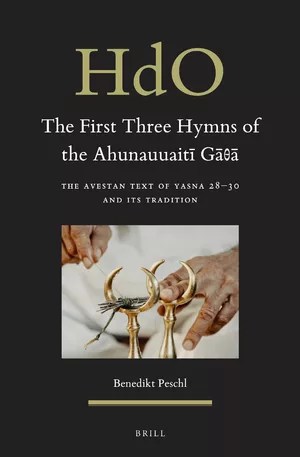
  • The First Three Hymns of the Ahunauuaitī Gāθā

    Peschl, Benedikt. 2022. The First Three Hymns of the Ahunauuaitī Gāθā. The Avestan Text of Yasna 28–30 and Its Tradition (Corpus Avesticum 4). Leiden: Brill.

    At the center of this book stands a text-critical edition of three chapters of the Gāthās, exemplifying the editorial methodology developed by the “Multimedia Yasna” (MUYA) project and its application to the Old Avestan parts of the Yasna liturgy.
    Proceeding from this edition, the book explores aspects of the transmission and ritual embedding of the text, and of its late antique exegetical reception in the Middle Persian (Pahlavi) tradition. Drawing also on a contemporary performance of the Yasna that was filmed by MUYA in Mumbai in 2017, the book aims to convey a sense of the Avestan language in its role as a central element of continuity around which the Zoroastrian tradition has evolved from its prehistoric roots up to the modern era.

    Table of Contents

    Part 1 Editing Old Avestan in the Context of the MUYA Project

    • Manuscripts Collated
    • Methodology of the Collation Process (1): Transcription of the Manuscripts
    • Methodology of the Collation Process (2): Regularisation of Variant Readings
    • Scope of the Constituted
    • Editorial Decisions Regarding Non-Trivial Phonetic and Orthographic Alternations

    Part 2 Yasna 28–30: Text, Translation, Selected Commentaries and Glossary

    • Preliminaries to the Edition of the Avestan Text
    • Yasna 28: Edition of the Avestan Text
    • Yasna 29: Edition of the Avestan Text
    • Yasna 30: Edition of the Avestan Text
    • Yasna 28: Constituted Text and Translation
    • Yasna 29: Constituted Text and Translation
    • Yasna 30: Constituted Text and Translation
    • Notes on the Translation of the Avestan Text
    • Selected Commentary Essays Proceeding from the Avestan Text
    • Glossary of the Avestan text of Yasna 28–30

    Part 3 Studies on the Ritual Setting of the Ahunauuaitī Gāθā (Yasna 28–34)

    • Ritual Actions During the Recitation of the Ahunauuaitī Gāθā
    • Considerations on the Rationale Behind Specific Ritual Actions
    • Ritual Directions Accompanying Yasna 28–30 in the Manuscript Tradition
    • Studies on the Exegetical Reception of Yasna 28
    • Re-approaching the Pahlavi Gāθās
    • Edition and Translation of Pahlavi Yasna 28
    • Pahlavi Yasna 28: Commentary
    • On the Marginal Headings Accompanying the Old Avesta in the Exegetical Manuscripts of the Yasna
    • Yasna 28.11, Yašt 1.26 and the Warštamānsar Nask: Untangling an Intertextual Network
    • Appendix to Part 4: Edition and Translation of the Commentary on Yasna 28 in the Dēnkard Epitome of the Warštamānsar Nask (Dk 9.28)
    • Concluding Thoughts: Advancing a Holistic Approach to the Zoroastrian Textual Tradition

    Benedikt Peschl holds a BA in General and Indo-European Linguistics from the University of Munich, an MA in Religions of Asia and Africa from SOAS University of London, and a PhD in Study of Religions from SOAS (2021). He now works as a postdoctoral researcher at the Institute of Iranian Studies of Freie Universität Berlin.

  • The Horse, the Ass, and the Mule

    Poinsot, Delphine Margaux Spruyt (eds). 2022. Equidés, le cheval, l’âne et la mule dans les empire de l’Orient ancien. Paris: Routes de l’Orient Actes.

    This is an open-access book. To download an original file (170 Mb), click here and for a compressed version here.

    Several of the contributions interest scholars and students of Iranian studies:

    • Delphine Poinsot: Le cheval de la victoire: Postures équestres et royauté dans les reliefs de Šāpūr Ier
    • Hervé Monchot & Julio Bendezu-Sarmiento: Des ânes, du cuivre et des moines Une étude préliminairesur l’importance des équidés dans l’économie d’un complexeminier aux époques kouchanosassanide (Mes Aynak, Afghanistan)
    • Jérémy Clément: L’élevage des chevaux de guerre dans le royaume séleucide Héritages achéménides et innovations hellénistiques.
    • Thomas Salmon: Combattre à cheval pendant les guerres byzantino-perses Les évolutions des cavaleries byzantine et sassanide pendant les guerres des VIe et VIIe siècles
    • Marina Viallon: Un rare mors de cheval sassanide et son caveçon conservés au Metropolitan museum of Art, New York
    • Samra Azarnouche: Miracles, oracles et augures Essai sur la symbolique du cheval dans l’Iran ancien et médiéval
  • Iranian Studies from Ravenna, vol. 4

    Ognibene, Paolo, Antonio Panaino & Andrea Piras. 2023. Studi Iranici Ravennati IV. Milano; Udine: Mimesis.

    The forth volume of the Studi Iranici Ravennati, a collection of research papers on Iranian studies edited by the scholars of Iranian Studies at the University of Bologna in Ravenna.

    (more…)