Brill’s Companion to War in the Ancient Iranian Empires examines military structures and methods from the Elamite period through the Achaemenid, Seleucid, Arsacid, and Sasanian empires. War played a critical role in Iranian state formation and dynastic transitions, imperial ideologies and administration, and relations with neighbouring states and peoples from Central Asia to the Mediterranean. Twenty chapters by leading experts offer fresh approaches to the study of ancient Iranian armies, strategy, diplomacy, and battlefield methods, and contextualise famous conflicts with Greek and Roman opponents.
Die ersten Zivilisationen der Weltgeschichte, Ägypten und Mesopotamien, werden oft getrennt untersucht. Diese Studie verfolgt einen anderen Ansatz und konzentriert sich auf die Beziehungen zwischen diesen beiden Flusskulturen. Sie befasst sich mit der afrikanisch-babylonischen Interaktion im Zeitraum 626–331 v. Chr., als Babylonien (der heutige Südirak) zunächst das Zentrum eines Staates war, der den alten Nahen Osten dominierte, und dann eine wichtige Provinz im achämenidischen Reich. Während dieser 300 Jahre führten Auseinandersetzungen zwischen dem saitischen Ägypten (664–525) und dem chaldäischen Babylonien (626–539) sowie die persische Eroberung Ägyptens zu einem Macht- und Bevölkerungstransfer „von Memphis nach Babylon“. Das übergeordnete Ziel dieser Arbeit ist die Erörterung der Beziehungen zwischen Afrika und Mesopotamien. Die genaueren Ziele dieser Studie bestehen darin, Afrikaner (Ägypter, Kuschiten, Libyer) in babylonischen Texten aus der chaldäischen (626–539) und achämenidischen (539–331) Zeit zu identifizieren und die Anwesenheit von Afrikanern im chaldäischen und achämenidischen Babylonien zu erörtern unter dem Gesichtspunkt individuell-biografischer und kollektiv-demografischer Ebenen und Perspektiven. Die folgenden Forschungsfragen werden gestellt: Wer waren diese Afrikaner (in Bezug auf ethnische Zugehörigkeit, Geschlecht/Gender, Alter und Klasse)? Was haben diese Leute (beruflich) gemacht? Wann lebten sie (im Hinblick auf die Regierungszeit oder den Zeitraum)? Wo lebten sie (in Bezug auf Dorf, Stadt und Region)? Wie wurden sie in das babylonische Reich eingegliedert (zwangsweise/freiwillig, erste/zweite Generation usw.)? – Die Anwesenheit der afrikanischen Beamten im Dienste des chaldäischen und achämenidischen Babyloniens weist auf einen komplexen Prozess hin, in dem sowohl Anpassung als auch Kooptation eine Rolle spielten. Der Wunsch oder das Bedürfnis des Einzelnen, sich anzupassen, um zu überleben, co-existierte zusammen mit einem externen Druck von staatlicher Seite, der darauf abzielte, die afrikanischen Deportierten zu loyalen und profitablen Untertanen zu machen. Der Transfer von Memphis nach Babylon musste eine kontinuierliche Neubewertung dessen mit sich gebracht haben, was es bedeutete, ein Teil der ägyptischen Zivilisation an den Flüssen Babylons zu sein.
In this collection, Fatemeh Keshavarz and Ahmet T. Karamustafa bring together leading researchers from comparative literature, history, literary criticism and religious studies to explore the major authors and genres of medieval Persian mystical literature. Breaking out of the all-inclusive literary history framework, the contributors write on topics that have energised their scholarship over time and address areas where the literary and the mystical have mingled and led to paradigmatic creations. How can you interpret the climactic conclusion to the framing narrative of The Speech of the Birds of ‘Attar of Nishapur? How did ‘Aziz Nasafi understand the concept of religion? What do Rumi’s conversations with the Divine tell us about his teachings and his poetry? How do medieval Persian Sufi commentators add to our understanding the Qur’an? How can we utilise Sufi manuals, life stories and utterances? All of these explorations and more bring the depth and eloquence of Persian mystical literature to life in this volume.
Editor note: This books falls outside our known comfort zone, but not by such a wide margin that we can ignore it. ~AZ
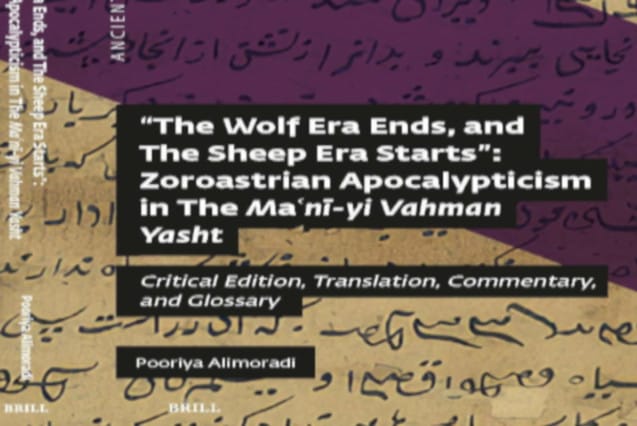
This book studies, for the first time, the Maʿnī-yi Vahman Yasht , the New Persian version of the Zand ī Wahman Yašt , the most important Zoroastrian text in apocalyptic genre. Through offering a critical edition, translation, and commentary, Alimoradi argues that the MVY is not a translation of the extant Pahlavi ZWY and is derived from another recension of apocalyptic materials in Pahlavi. He also offers suggestions in identifying several unspecified characters and events referred to in the text whose identities have been debated for decades. The book is relevant to those interested in Zoroastrianism, Iranian apocalyptic traditions, and anyone studying the Arab conquests in Western and Central Asia in 6ᵗʰ to 9ᵗʰ c. CE.
The present volume addresses dynamic and collective authorship by examining how authors and scribes in the Persianate parts of the Islamic world produced, copied, and interpreted texts during the manuscript age within specific cultural contexts, out of political necessity and as a result of professional choices. The processes of scribal adaptation faced by scholars studying the Islamic world in the pre-modern period took many different forms, most of which are still unexplored. The changes applied consist of minor corrections and amendments, as well as full-fledged reworkings of a text and modifications to its core ideological components. Under the label “ideological variations”, this volume intends to discuss any deliberate changes in content, rather than form, made by authors, copyists, and readers intervening at various stages in the process of textual production and transmission.
What type of exchanges occurred between West and East Asia in the first millennium CE? What sort of connections existed between Persia and China? What did the Chinese know of early Islam? This study offers an overview of the cultural, diplomatic, commercial, and religious relationships that flourished between Iran and China, building on the pioneering work of Berthold Laufer’s Sino-Iranica (1919) while utilizing a diverse array of Classical Chinese sources to tell the story of Sino-Iran in a fresh light to highlight the significance of transcultural networks across Asia in late antiquity.
This unique book is the first publication on the art of teaching Persian literature in English, consisting of 18 chapters by prominent early-career, mid-career and established scholars, who generously share their experiences and methodologies in teaching both classical and modern Persian literature across various academic traditions in the world. The volume is divided into three parts: the background to teaching Persian literature: pedagogy, translation and canon, and thematic and topical approaches to the Persian literature class. It includes such topics as the history of teaching Persian literature, the traditional teaching of Persian literature, the political and ideological intentions revealed in the formation of the Persian literature curriculum, the necessity to include marginalized modern Persian literature, such as women’s or diaspora literature, and more applied approaches to curriculum development and teaching.
How do we reconstruct ancient societies’ cultural and visual identities? Prudence Oliver Harper has dedicated her scholarly and curatorial career to piecing together the material culture of communities across ancient Western Asia, Iran, and Central Asia. A number of her colleagues – art historians, archaeologists, philologists, and conservators – have contributed essays to this volume to reflect Harper’s range of contributions throughout her six-decade career. Many of the essays focus on ancient metalwork, Harper’s major expertise, while others on glyptics, ivory, or glass, three of her other interests. The essays aim to make sense of this region’s diverse cultural identities, many of which are the results of cross-cultural exchange. Some authors have employed iconographical or socio-historical approaches; others have complementarily opened new facets of cultural identities through technical and scientific analyses, collection history, and provenance research.
Morano, Enrico & Samuel N. C. Lieu (eds.). 2024. Varia Manichaica (Corpus Fontium Manichaeorum. Analecta Manichaica 3). Turnhout: Brepols.
This volume brings together the works of some of the best known and most established scholars in Gnostic and Manichaean studies, Iranologists and art historians. It contains two important and indispensable catalogues of Turfan texts and also studies covering topics such as cosmogony, hymnology and manuscript illumination. A number of Turfan texts in Sogdian and Uygur are published here for the first time.
Table of Contents
Sergio Basso: “Manichaean fragments related to the ‘Barlaam and Ioasaph saga’”
Adam Benkato: A Fragment of an Iranian Manichaean ‘Oral Tradition’
Fernando Bermejo-Rubio: Mani as a paradigm of the Manichaean Church in the Cologne Mani Codex
Şehnaz Biçer and Betül Özbay: The Lotus illustration in a Manichaean manuscript
Iris Colditz: Strategies for success. Manichaeism under the early Sasanians
Desmond Durkin-Meisterernst: An update of Boyce’s Catalogue of Manichaean Middle Persian and Parthian
Eduard Iricinschi: How Do Wisdom, Law, and Revelation a Religion Make? Appropriation and Displacement in the ‘Chapters of the Wisdom of My Lord Mani’
Samuel N.C. Lieu: A catalogue of the Uygur Manichaean texts
Enrico Morano: Uygur in the Manichaean Sogdian texts in Manichaean script from the Berlin Turfan Collection
Nicholas Sims-Williams: The “seven adversities” in a Manichaean Sogdian hymn
Michel Tardieu: La métaphore de l’auberge
Peter Zieme: “Worte für die Seele”. Altuigurische manichäische Fragmente with an appendix by Yutaka Yoshida