Author: Shervin Farridnejad

  • Hybrid Judeo-Persian and Arabic Correspondence

    Hybrid Judeo-Persian and Arabic Correspondence

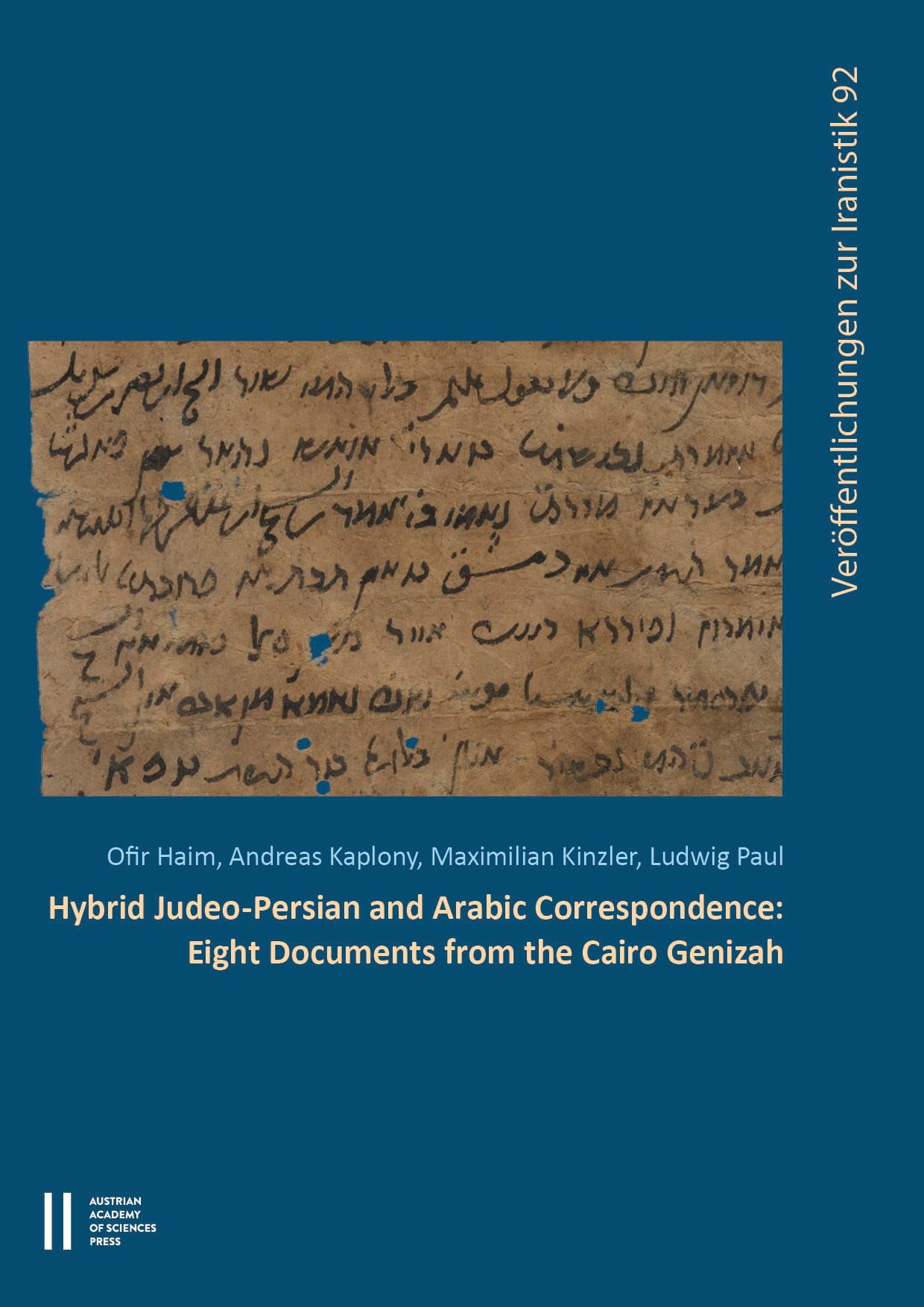
    Haim, Ofir, Andreas Kaplony, Maximilian Kinzler & Ludwig Paul. 2025. Hybrid Judeo-Persian and Arabic correspondence. Eight documents from the Cairo Genizah (Veröffentlichungen zur Iranistik 92). Wien: Österreichische Akademie der Wissenschaften.

    The more than 300,000 documents discovered in a storeroom of the Ben Ezra Synagogue in Old Cairo in the late 19th century, now housed in the collections in St. Petersburg, Cambridge, and Paris, are known as the Cairo Genizah. These documents, which span a wide array of subjects, are invaluable sources for understanding the history of medieval Judaism, as well as for the social and economic landscape of the Mediterranean from the 10th to the 13th centuries. Among them are thousands of private and commercial letters written in Arabic (in both Hebrew and Arabic scripts), alongside some 25 documents in Judeo-Persian—Persian written in Hebrew script. Due to the considerable challenges posed by their interpretation, only a small fraction of these texts has been published thus far.   This volume presents editions of eight previously unpublished documents dated to around the turn of the millennium (991–1002 CE) and mentioning key places such as Baghdad and Basra. Included are two pages from a merchant’s notebook, written in both Jewish-Persian and Arabic, along with several letters. Of particular interest are two letters, one in Judeo-Persian and its near-literal Arabic translation, highlighting the fluidity between these two languages. The blending of Judeo-Persian and Arabic in all eight texts offers a compelling reason to publish them together. This linguistic fusion underscores the fact that the authors of these letters were part of a broad network of Jewish merchants, notably including the Tustarī and Ibn ʿAwkal families.

    Table of Content.

  • The Great King’s Word under AhuraMazdā’s Protection

    The Great King’s Word under AhuraMazdā’s Protection

    Aliyari Babolghani, Salman. 2024. The Great King’s word under AhuraMazdā’s protection: Trilingual Achaemenid royal inscriptions of Susa I (Dariosh Studies III/1) (Ancient Iranian Series 17). Leiden: Brill.
    This volume presents part of the author’s research on the Achaemenid Royal Inscriptions recovered in the ruins of the Achaemenid palaces in Susa, conducted within the framework of the DARIOSH-Louvre Project. It offers a new study of several fragmentary inscriptions in Old Persian, Achaemenid Elamite, and Achaemenid Babylonian, currently designated as DSe, DSt, DSb, DSl, DSa, DSk, DSi, DSp, D²Sb, DSj, A²Se, DSs, ‘Inc. Sb’, and others. The book provides a new edition of each inscription based on both published and unpublished fragments. Additionally, it introduces some new lexicons and cuneiform signs in the Old Persian language and script.

    Table of Contents (PDF)

    Part 1: Some Fragments of a Foundation Stone Table Inscription

    1 AhuraMazdā Protected the Great King’s “Written Word” 

    Fresh Old Persian Lexicon in Newly Discovered Fragments of DSe 

    Part 2: Terracotta Brick Inscriptions

    2 “AhuraMazdā Belongs to Me” 

    Inscriptions DSa, DSb, DSk, DSl, and DSae 

    Part 3: Some Threshold Inscriptions

    3 “I Did All Superior” 

    4 A Marvelous Palace Built by a Righteous King 

    DSj Inscription 

    Appendix 1: Persian Translations of the Inscriptions

    Appendix 2: Revised List of Old Persian Logograms 

  • Zarathustra in Pahlavi Literature

    Vassalli, Massimiliano. 2024. Zarathustra nella letteratura pahlavi: Il libro VII del Denkard (Testi del Vicino Oriente antico/Letteratura iranica, 3.1). Torino: Paideia.

    In this work, readers are introduced to the first Italian translation of the main Pahlavi source of the legend of Zarathustra, Chapter VII of the Dēnkard. This fundamental text of Zoroastrian literature, dating back to the early Islamic period (7th–10th century CE), narrates the biography of the Iranian “prophet” within the framework of the universal history of creation. The guiding thread of this account is the miracles performed by the divine word throughout the centuries, up until the end of time. The work, edited by Massimiliano Vassalli, contextualizes the Iranian text and its protagonist within the historical and cultural background of the period in which it was written and provides an Italian version accompanied by philological, historical, and literary explanatory notes.

  • Narseh, King of Kings

    Weber, Ursula. 2024. Narseh, König der Könige des Sāsānidenreiches (293-302 n. Chr.): eine prosopographisch-historische Studie (Acta Iranica 63). Leuven: Peeters.

    The present study on the Iranian Sasanian ruler Narseh (293–302) addresses a research gap. Its aim is to present the biography of the king, his concept of rulership, and his political legacy against the backdrop of Persian-Roman relations in the 3rd century AD. While the Roman Empire in the West recovered from a phase of internal instability through profound political transformation, a new political power emerged beyond the Euphrates following the fall of the Parthian Empire—the Sasanian Empire under Ardashir I (224–651), the grandfather of King Narseh. The study of King Narseh’s era is based on a diverse range of literary, epigraphic, numismatic, and archaeological sources of varying origins and reliability. Of particular significance is Narseh’s extensive Middle Persian-Parthian bilingual inscription from the tower of Paikuli. This subjective account of the circumstances of his accession to the throne served both as a report of justification and a legitimizing inscription against suspicions of usurpation.

  • Representations of Kingship in Pre-Islamic Central Asia

    Representations of Kingship in Pre-Islamic Central Asia

    Shenkar, Michael. 2025. Kings of cities and rulers of the steppes: Representations of kingship in pre-Islamic Central Asia (Schriften zur vorderasiatischen Archäologie 22). Wiesbaden: Harrassowitz Verlag.

    Kings of Cities and Rulers of the Steppes examines the iconography of Central Asian rulers from the Bronze Age to the Early Islamic period, focusing on the cultural, religious, and ideological messages conveyed through royal imagery. With over 650 illustrations (including 300 original drawings), Michael Shenkar traces the evolution of kingship and its iconography over time, highlighting Central Asia’s role as a meeting point for Iranian, Greek, Chinese, Indian, and Turkic cultures. Often referred to as a “crossroads of civilizations,” Central Asia provides a rich context in which these cultures interacted and influenced one another. By examining royal imagery as a historical and cultural source, this book uncovers the cultural complexities behind the kings who ruled the region’s rich cities and vast steppes. It uses these visual representations as a lens to explore the cultural, political, and religious dynamics that defined Central Asia’s heritage.
    A major theme of the book is the unparalleled diversity of ancient Central Asian royal imagery, which reflects both the political fragmentation of the region and the interactions between nomadic and sedentary populations. Shenkar also highlights the distinct feature of collective sovereignty found in many Central Asian and Iranian states. Post-nomadic royal clans such of the Scythians, Yuezhi, Huns, and Turks often utilized an ‘appanage system’, allowing rulers to express their identities by combining traditional symbols of power with unique elements that differentiated them from others. This book provides an ambitious, multi-century exploration of Central Asian kingship, offering new insights into the political and cultural significance of the region’s royal imagery

  • Dabir (vol. 11)

    Dabir (vol. 11)

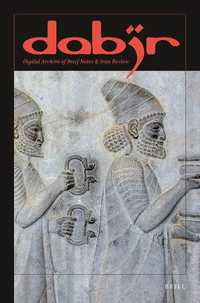
    Volume 11 of Dabir (2024) is now available both online and in print, featuring two issues:

    Table of Contents:

    • David Gilinsky: A Newly Discovered Jewish Persian Poet
    • Mateusz M.P. Kłagisz: A Supplementary Contribution to Research on Turkish Köse, Iranian Kuse and Their Slavic Zoomorphic Counterparts
    • Esmaeil Matloubkari: wkl or hwkd: Reading the Legitimizing Title on the Sasanian King Walāsh Coin
    • Yusef Saadat: nihang and āhang: Two Administrative Terms in Middle Persian and Bactrian
    • Hossein Sheikh: One Hundred Thousand Greetings! The Opening Section of Early Judeo-Persian Letters
  • Recent Studies on Persian-Greek Relations

    Recent Studies on Persian-Greek Relations

    Kühne, Sebastian. 2024. Kommunikation, Konsens und Konflikt: neuere Untersuchungen zu den persisch-griechischen Beziehungen (Oriens et occidens 43). Stuttgart: Franz Steiner Verlag.

    Sebastian Kühne addresses selected aspects of the political interactions between the Greek city-states of the 5th and 4th centuries BCE and the Achaemenid Empire. He examines the relationships that developed between these two powers from a consistently Persian perspective. The study focuses on the mechanisms of diplomatic exchange between the Greek poleis and the Persian Great Kings and, building on this, the outcomes of these political interactions, which have gone down in history as the “King’s Peace” and the “Peace of Pelopidas.” Finally, the analysis highlights the tools available to the Achaemenid rulers to assert their interests vis-à-vis the Greek city-states. Through his analysis, the author revises older scholarly views that have dominated previous studies on Greek-Persian agreements and military conflicts, bringing to light new aspects regarding the diplomatic exchanges between Greece and the Achaemenid Empire.

    For the table of contents see here.

  • Mani’s Living Gospel and the Ewangelyōnīg Hymns

    Shokri-Foumeshi, Mohammad (ed.). 2025. Mani’s Living Gospel and the Ewangelyōnīg hymns. Edition, reconstruction and commentary with a codicological and textual approach based on Manichaean Turfan fragments in the Berlin Collection (Corpus Fontium Manichaeorum. Series Iranica 3). Turnhout: Brepols.

    This work deals with the manuscript fragments of Maniʼs Living Gospel and the Ewangeliōnīg Hymns of his followers in the eastern Manichaean churches. The author identifies new fragments and improves the previous reconstructions. In this context, he analyzes all the Manichaean and non-Manichaean documents. This book is designed to enlarge our understanding of the Turfan texts by presenting new texts and interpretations.

    Summary

    TABLE OF CONTENTS

    Acknowledgements
     
    CHAPTER ONE INTRODUCTION
    1.1 Aim, Plan, and Strategy
    1.2 Material and Content of the Living Gospel and Ewangelyōnīg Hymns
    1.3 Outline of This Study
    1.4 History of Prior Research

    (more…)
  • The Bundahišn

    The Bundahišn

    Malandra, William W. 2024. The Bundahišn. Translated with Commentary (Monograph Series 68). Leesburg VA: The Journal of Indo-European Studies.

    The Bundahišn was a sort of final clearinghouse for Iranian religion and cosmogony, completed shortly before the Arabian conquest of Iran and the extinguishing of most forms of Indo-Iranian religion from the world. It has been mined extensively by scholars – especially Georges Dumézil – for the many traces of the Indo-European past it contains. With his encyclopedic knowledge of IE linguistics and Sanskrit and classical literature, Professor Malandra has accompanied his translation with notes which not only illuminate the more confusing elements of the text, but also ground it in the world of Indo-European and Indo-Aryan literature. Readers will surely appreciate the author’s clear and engaging writing as he guides them through this intriguing text.

    Table of Contents

    • Preface
    • List of Abbreviations
    • Introduction
    • Translation of The Bundahišn, chapters I-XXXVI with extensive notes
    • Appendix A – Translation of the Wizīdagīhā ī Zādspram text with notes;
    • Appendix B – Calendar & Reckoning;
    • Appendix C – Planets & Stars;
    • References;
    • Extensive Index.
  • Persian Metalwork along the Silk Road

    Entangled Objects of Eurasia: Persian Metalwork along the Silk Road

    Wednesday 16 October 2024

    • Matthew Canepa | University of California, Irvine

    Scriptive Things and Commensal Warfare: Luxury Vessels across post-Achaemenid Asia

    • Yukio Lippit | Harvard University

    Echoes of Persian Silverware in the Shosoin Treasury

    • Yuka Kadoi  | University of Vienna          

    Silver in the Mongol Empire: Alternative Nomadic Aesthetics

    • Johannes Preiser-Kapeller | ÖAW – IMAFO

    Chair and moderator

    Zoom registration required (anton.matejicka@univie.ac.at)

    (more…)