Author: Shervin Farridnejad

  • Narrative Illustration on Qajar Tilework in Shiraz

    Seyed Mousavi, Atefeh. 2018. Narrative Illustration on Qajar Tilework in Shiraz (Beiträge zur Kulturgeschichte des Islamischen Orients). 2 vols. Dortmund: Verlag für Orientkunde.

    Tilework illustration of the Qajar period has received comparatively little scholarly consideration. This applies specifically to Shiraz, where the art was abundantly practiced. My book, the first of its kind, presents a detailed analytical study of Qajar tile painting in Shiraz. The material has been collected during two extensive fieldwork trips. Having collected more than 5,000 photos, I have chosen 42 historical buildings in Shiraz with tile work decoration for a detailed analysis, supplying minute descriptions for each and every image together with a solid documentation of the tiles’ respective location in the buildings. My study identifies, classifies and analyzes the depicted themes and the craftsmanship behind it. Particular attention has been devoted to a detailed discussion of the prominent themes, their argument and motivation, as well as to popular artists of the period. In addition to the study, my work contains ample visual documentation.

    Vol. 1, 335 pages (Texts); Vol. 2, 268 pages (Coloured Images)

  • A Thousand Judgements: Festschrift for Maria Macuch

    Hintze, Almut, Desmond Durkin-Meisterernst & Claudius Naumann (eds.). 2019. A thousand judgements: Festschrift for Maria Macuch. Wiesbaden: Harrassowitz Verlag.

    This volume in honour of Maria Macuch brings together twenty-six articles by friends and colleagues to celebrate the academic work of the foremost living expert of Sasanian law. The subjects covered here include Iranian linguistics and philology, Judeo-Persian, Zoroastrian law and religion, Manichaeism, and the Babylonian Talmud. They reflect the breadth of the work of Maria Macuch. The volume includes studies of important Iranian legal, grammatical and religious terms and titles, of the intercultural engagement between Zoroastrians, Manichaeans and Jews, and editions and studies of texts and text fragments in Pahlavi, Sogdian, Khotanese and Judeo-Persian languages. The book will be of special interest to legal, cultural and religious historians as well as to philologists and linguists.

    Table of Contents (PDF)

    • Miguel Ángel Andrés-Toledo: “Ritual Competence and Liability of Minors in Ancient Zoroastrianism. On Avestan dahmō.kərəta– and š́iiaoϑnāuuarəz-“
    • Samra Azarnouche: “Les fonctions religieuses et la loi zoroastrienne: le cas du hērbed
    • David Buyaner: “Zur Haar- und Nagelpflege im Zoroastrismus. Beiträge zur Erklärung mittelpersischer Rechts- und Religionsterminologie. III.”
    • Alberto Cantera: “About the Epithet pauruuaniia- of the Zoroastrian Sacred Girdle (Y 9.26)”
    • Iris Colditz: “Eine vergessene zoroastrische Märtyrerin?”
    • Desmond Durkin-Meisterernst: “Manichaean Book Quires”
    • Yaakov Elman †: “The Torah of Temporary Marriage. A Study in Cultural History”
    • Ela Filippone: “On Old Persian tačara- and its Elusive Meaning”
    • Philippe Gignoux: “Les ‹ Mémoires › dans l’archive pehlevie de Berkeley/Berlin”
    • Jost Gippert: “Onomastica Irano-Iberica. II. The Name of a Zoroastrian “Bishop””
    • Rika Gyselen: “Les données de géographie administrative sassanide
    • dans le Šahrestānīhā-ī Ērānšahr : une réévaluation”
    • Almut Hintze: “Maria Macuch and Iranian Studies”
    • Tal Ilan and Reuven Kiperwasser: “Virginity and Water: Between the Babylonian Talmud and Iranian Myth”
    • Éva M. Jeremiás: “The Technical Term tarkīb “Compound” in the Indigenous Persian “Scientific” Literature”
    • Judith Josephson: “Aristotle’s Theory of the Elements and Zoroastrian Dualism”
    • Yishai Kiel and Prods Oktor Skjærvø: “Normative and Theological Dissent in Early Zoroastrian Law: Pahlavi Nīrangestān 23″
    • Götz König: “Die Pahlavi-Literatur des 9./10. Jahrhunderts und ihre frühe Kodex Überlieferung (I)”
    • Manfred Lorenz † : “Ignatius Pietraszewski – ein polnischer Iranist in Berlin”
    • Mauro Maggi: “Annotations on the Book of Zambasta, V: Indian Parallels to 2.139 and the Musk of Khotan”
    • Enrico Morano und Christiane Reck: “Vom ersten bis zum 30. Tag: Ein Blatt mit soghdischen prognostischen und medizinischen Kalendertexten”
    • Antonio Panaino: “Thе Liturgical Daēnā. Speculative Aspects of the Next-of-Kin Unions”
    • Adriano V. Rossi: “Iranian Words in čam°*”
    • Martin Schwartz and Alexis Manaster Ramer: “Some Interlinguistic Iranian Conundrums”
    • Nicholas Sims-Williams: “The Wisdom of Aḥiqar and the Wisdom of Ādurbād: A Manichaean Parallel”
    • Dieter Weber: “The Story of Windād-Burzmihr. A Zoroastrian Entrepreneur in Early Islamic Times”
    • Yutaka Yoshida: “Some New Interpretations of the Two Judeo-Persian Letters from Khotan”

  • Becoming Zarathustra

    Kellens, Jean. 2018. Becoming Zarathustra. In Hugh B. Urban & Greg Johnson (eds.), Irreverence and the sacred: Critical studies in the history of religions, 185–193. New York: Oxford University Press.

    This chapter examines the role of ritual and sacrifice in the most sacred Zoroastrian literature, the Gâthâs in order to explore the complex relationship between the figure of Zarathustra and the human ritual officiant. The chapter presents a very Lincoln-ian sort of history of the field of Zoroastrian studies itself, interrogating the contexts and biases of particular scholars in their various readings and misreadings of the tradition. At the same time, it offers a new way of thinking about the figure of Zarathustra himself, who is best understood not as the semi-historical “founder” of Zoroastrianism but rather as the mythical personality into which the human officiant is himself transfigured through the ritual operations.

  • Indo-Iranian lexicon and phraseology in the ritual poetry of the Avesta, Veda and Beyond

    Sadovski, Velizar. 2017. The columns of R̥ta: Indo-Iranian lexicon and phraseology in the ritual poetry of the Avesta, Veda and Beyond. In Ivo Hajnal, Daniel Kölligan & Katharina Zipser (eds.), Miscellanea Indogermanica: Festschrift für José Luis García Ramón zum 65. Geburtstag (Innsbrucker Beiträge zur Sprachwissenschaft 154), 715–743. Innsbruck: Institut für Sprachen und Literaturen der Universität Innsbruck.

    The focus of the present article […] is laid on the phraseological and poetical combinatorics of the word for ‘pillar, column’, Ved. sthū́ṇā-, YAv. stū̆nā-, OPers. stūnā-, fem. […], which as a common appellative designates a constructive element of the Vedic and Avestan house (incl. the ‘mobile house’, the [migration] wagon) and functions, as well, as a key metaphor in hymns of house, e.g. in the ceremony of ‘ascending the pillar’ (by the beams) in the ritual of building a new home […]. Both in its everyday usage and in its metaphoric applications in texts of ritual character, the word seems to belong to a common lexical stratum of Indic and Iranian.

  • Religious change among the Safavids

    Stickel, Farida. 2019. Zwischen Chiliasmus und Staatsraeson: Religiöser Wandel unter den Safaviden (Religionsgeschichtliche Versuche und Vorarbeiten 70). Boston, MA: De Gruyter.

    Die Arbeit geht dem religiösen Wandel in Iran unter den Safaviden nach. Dabei wird nicht die Verkündung der Schia als offizieller Religion 1501 in den Mittelpunkt gestellt. Vielmehr werden die Safaviden kontextualisiert, der religiöse Wandel selbst anhand beteiligter Akteure, Auswirkungen auf religiöse Institutionen und Legitimation von Herrschaft sowie der Übersetzung in Architektur und Performanz von Ritualen nachgezeichnet.

  • A Sogdian Fragment from Niya

    Sims-Williams, Nicholas & Bi Bo. 2018. A Sogdian fragment from Niya. In Huaiyu Chen & Xinjiang Rong (eds.), Great journeys across the Pamir mountains (Brill’s Inner Asian Library 37), 83–104. Leiden: Brill.

    In 1994, the Sino-Japanese Niya Expedition Team excavated an artifact (93A27F1:3) at Niya. It is a small brown package or pouch made from a piece of paper (originally mistaken for parchment) fastened by a woolen string. Traces of writing were visible, so the artifact was provisionally referred to as “A Kharoṣṭhī text written on parchment” in the preliminary report of its discovery. In 2007, when the Xinjiang Institute of Archaeology’s research group on Niya was editing the third volume of the Report on the Sino-Japanese Joint Expedition in Niya, they carefully examined this “parchment text.” After the string was untied, it was found that the paper had been used to wrap up a powder of vegetable origin, perhaps spices or medicine. When the powder was removed, a text written in black ink in a clear script was visible. Noting that the writing appeared to be the same as that of the Sogdian “Ancient Letters” found near Dunhuang, which were written in the early fourth century, and other Sogdian fragments of similar date found at Loulan, the local archaeologists were able to determine that this new fragment was also written in early Sogdian script.

  • Ritual Formulae, Structures, and Activities in Vedic and Avestan Liturgies

    Sadovski, Velizar. 2018. Ritual formulae, structures, and activities in Vedic and Avestan liturgies. Münchener Studien zur Sprachwissenschaft 71/1. 81134.

    Die Arbeit präsentiert Untersuchungen zu einer Reihe von Begriffen aus dem Bereich des indoiranischen Kultus bzw. Rituals einerseits in ihrem Kontext innerhalb der vedischen und avestischen Ritualdichtung und -praxis und andererseits vom Standpunkt ihrer mythologischen Relevanz, insbesondere in Bezug auf ihre Rolle für die „Mythopoia“ in den Sakraltexten von Indern und Iraniern. So werden einerseits Personifikationen bzw. Deifikationen derartiger Kultbegriffe geschildert, andererseits verschiedene Mechanismen ihrer Kombinatorik auf syntagmatischer, intra-textueller Ebene (innerhalb des Kontexts eines liturgischen Hymnus/Vorgangs) bzw. auf inter-textueller Ebene, im Rahmen des Hypertexts der aus zahlreichen einzelnen Litaneien bestehenden Ritualhymnen und in den aus ganzen solchen Einzelliturgien bestehenden Ritualkomplexen dargestellt. – Der vorliegende Aufsatz entwickelt dabei die Idee über die fundamentale Rolle von Katalogen, Listen und Enumerationen als poetische, aber auch als mythologische und kosmologische Form: Basierend auf mehreren früheren Studien des Verfassers, die das Funktionieren solcher intertextuell verbundenen Textcorpora in der indoiranischen Ritualdichtung vor allem textlinguistisch, vom formalen, kompositionellen und kognitiven Standpunkt behandeln, gibt nun das Thema „Ritus im Mythos“ die Gelegenheit, die katalogisch aufgebauten Formen von Litaneien und Liturgien in den vedischen Sakraltexten vom RV an (insbesondere in den RV-Khilas und dem Yajurveda) und in der ‚Langen Liturgie‘ des Avesta sowie ihre Bedeutung sowohl zur rituellen „Wieder-Erschaffung des Universums“ mit jedem Kultakt und -text als auch zur Mythologisierung entsprechender Begriffe mit rituellem Inhalt zu untersuchen.

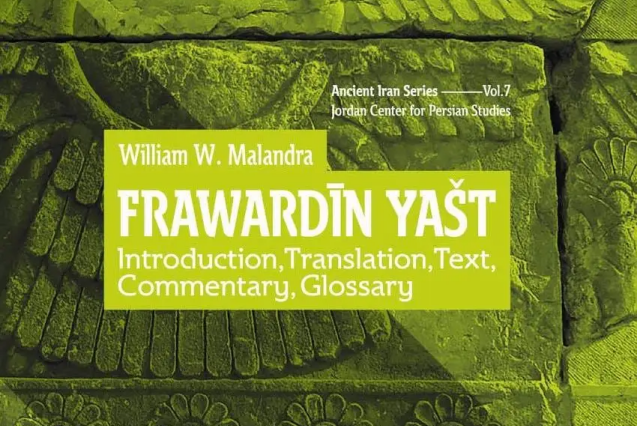
  • The Frawardīn Yašt

    The Frawardīn Yašt

    Malandra, William W. 2018. The Frawardīn Yašt. Introduction, translation, text, commentary and glossary (Ancient Iran Series 7). Irvine: Jordan Center for Persian Studies.

    With the encouragement of Professor Touraj Daryaee, I have undertaken a new edition of my old The Fravaši Yašt: Introduction, Text, Translation and Commentary, diss. University of Pennsylvania, 1971 [University Microfilms, Ann Arbor]. At the time when I wrote the dissertation I was very much under the influence of W. B. Henning’s “The Disintegration of the Avesta Studies” and the then recent book by I. Gershevitch The Avestan Hymn to Mithra. I expressed my misgivings concerning Henning’s stress-accent theory in my Preface, but was not prepared to tackle the issue, and thus treated the text as if it were prose. In the years since it has become abundantly clear that much of the Yašts were originally composed in verse, as best articulated by K. F. Geldner in his Über die Metrik des jüngeren Avesta (1877). Thus, Part II of the present work is devoted to a study of metrics and their importance for understanding the formation of the Yašts and particularly the Frawardīn. In order to make manifest the structure of Avestan poetry I have laid out the translation and text according to my construction of the Avestan.

    From the Preface
  • The Shahnameh: the Persian epic in world literature

    Dabashi, Hamid. 2019. The Shahnameh: the Persian epic in world literature. New York: Columbia University Press.

    The Shahnameh, an epic poem recounting the foundation of Iran across mythical, heroic, and historical ages, is the beating heart of Persian literature and culture. Composed by Abu al-Qasem Ferdowsi over a thirty-year period and completed in the year 1010, the epic has entertained generations of readers and profoundly shaped Persian culture, society, and politics. For a millennium, Iranian and Persian-speaking people around the globe have read, memorized, discussed, performed, adapted, and loved the poem.

    In this book, Hamid Dabashi brings the Shahnameh to renewed global attention, encapsulating a lifetime of learning and teaching the Persian epic for a new generation of readers. Dabashi insightfully traces the epic’s history, authorship, poetic significance, complicated legacy of political uses and abuses, and enduring significance in colonial and postcolonial contexts. In addition to explaining and celebrating what makes the Shahnameh such a distinctive literary work, he also considers the poem in the context of other epics, such as the Aeneid and the Odyssey, and critical debates about the concept of world literature. Arguing that Ferdowsi’s epic and its reception broached this idea long before nineteenth-century Western literary criticism, Dabashi makes a powerful case that we need to rethink the very notion of “world literature” in light of his reading of the Persian epic.

    About the Author

    Hamid Dabashi is Hagop Kevorkian Professor of Iranian Studies and Comparative Literature at Columbia University. He is a founding member of the Institute for Comparative Literature and Society at Columbia University. Among his most recent books are The World of Persian Literary Humanism (2015) and Persophilia: Persian Culture on the Global Scene (2016).

  • Persian Literature from Outside Iran

    Perry, John (ed.). 2018. Persian Literature from Outside Iran: The Indian Subcontinent, Anatolia, Central Asia, and in Judeo-Persian (History of Persian Literature IX). London: I.B. Tauris.

    After the fall of the Sassanian Empire and with it the gradual decline of Middle Persian as a literary language, New Persian literature emerged in Transoxiana, beyond the frontiers of present-day Iran, and was written and read in India even before it became firmly established in cities such as Isfahan on the Iranian plateau. Over the course of a millennium (ca. 900-1900 CE), Persian established itself as a contact vernacular and an international literary language from Sarajevo to Madras, with Persian poetry serving as a universal cultural cachet for literati both Muslim and non-Muslim. The role of Persian, beyond its early habitat of Iran and other Islamic lands, has long been recognized: European scholars first came to Persian via Turkey and British orientalists via India. Yet the universal popularity of poets such as Sa’di and Hafez of Shiraz and the ultimate rise of Iran to claim the centre of Persian writing and scholarship led to a relative neglect of the Persianate periphery until recently. This volume contributes to the scholarship of the Persianate fringe with the aid of the abundant material (notably in Tajik, Uzbek and Russian) long neglected by Western scholars and the perspectives of a new generation on this complex and important aspect of Persian literature.

    Table of contents

    Introduction: Persian Language and Literature Beyond Iran and Islam (J. R. Perry)

    PART 1: PERSIAN LITERATURE IN THE INDIAN SUB-CONTINENT

    • Chapter 1: Establishment of Centers of Indo-Persian Court Poetry (Alyssa Gabbay)
    • Chapter 2: Teaching Of Persian In South Asia (T. Rahman)
    • Chapter 3: The Persian Language Sciences in India (J. R. Perry)
    • Chapter 4: Persian Historiography in India (B. Auer)
    • Chapter 5: Persian Literature of the Parsis in India (J. K. Choksy)
    • Chapter 6: Ismaili Literature in Persian in Central and South Asia (F. Daftary)
    • Chapter 7: Persian Medical Literature in South Asia (F. Speziale)
    • Chapter 8: Inscriptions and Art-Historical Writing (Y. Porter)

    PART 2: PERSIAN LITERATURE IN ANATOLIA AND THE OTTOMAN REALMS, POST-TIMURID CENTRAL ASIA, TAJIKISTAN, MODERN AFGHANISTAN; JUDEO-PERSIAN LITERATURE

    • Chapter 9: Persian Literature in Anatolia and the Ottoman Realms (S. Kim)
    • Chapter 10: Persian Literature in Central Asia under Uzbek Rule (Ertugrul Ökten)
    • Chapter 11: Tajik Literature (K. Hitchins)
    • Chapter 12: Persian Literature in Modern Afghanistan (R. Farhadi And J. R. Perry)
    • Chapter 13: Judeo-Persian Literature (Vera Basch Moreen)