
Russell, James R. 2020. Poets, Heroes, and their Dragons: Armenian And Iranian Studies (Ancient Iran Series 13, 1-2). 2 vols. Irvine, CA: Jordan Center for Persian Studies, University of California, Irvine.
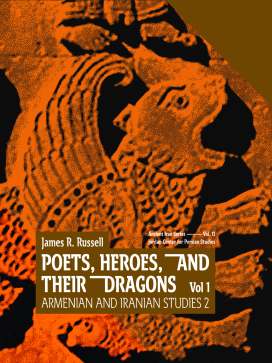
The present volume is a collection of articles published by Professor James R. Russell of Harvard University, in various journals over the past decades. James Russell has been one of the pioneers in the field of Armenian and Iranian Studies, where he has demonstrated the importance of Iranian civilization for pre-Christian Armenia.
Table of Contents
VOL. 1
- “Two Roads Diverged: Ancient Cappadocia and Ancient Armenia,” in R.G. Hovannisian, ed., Armenian Kesaria/Kayseri and Cappadocia, UCLA Armenian History and Culture Series, Historic Armenian Cities and Provinces 12, Costa Mesa, CA: Mazda, 2013, pp. 33-42.
- “A Note on Armenian hrmštk-el,” in Uwe Bläsing, Victoria Arakelova, and Matthias Weinreich, eds., Studies on Iran and the Caucasus in Honour of Garnik Asatrian, Leiden: Brill, 2015, pp. 365-371.
- “An Armenian Spirit of Time and Place: The Švot,” Revue des Etudes Arméniennes 1936 (2014-2015), pp. 13-59.
- “The Epic of Sasun: Armenian Apocalypse,” in Sergio La Porta, ed., The Armenian Apocalyptic Tradition, Leiden: Brill, 2014, pp. 41-77.
- “Language of Demons, Language of Men,” in publication, Festschrift Michael Stone, ed. Theo Van Lint, forthcoming
- “The Cross and the Lotus: The Armenian Miscellany Patmut‘iwn płnje k‘ałak‘i (‘History of the City of Brass’),” in Vesta Curtis and Sarah Stewart, eds., The Rise of Islam (The Idea of Iran, Vol. 4), London: I.B. Tauris, 2009, pp. 71-81.
- “On an Armenian Word List from the Cairo Geniza,” Iran and the Caucasus 17 (2013), pp. 189-214.
- “The Vision of the Painting: Alexander Kondratiev’s Novella Dreams,” Alexander A. Sinitsyn and Maxim M. Kholod, eds., Koinon Dōron: Studies and Essays in Honour of Valery P. Nikonorov on the Occasion of His Sixtieth Birthday presented by His Friends and Colleagues, St. Petersburg: St. Petersburg State University Faculty of Philology, 2013, pp. 323-354.
- “Heaven Is Here and the Emperor Is Near: A Traveler’s Guide to Heaven,” Academic Forum Collected Papers: The unity of Humanity and Heaven and Civilizational Diversity, Beijing, China: Institute for Advanced Humanistic Studies, PKU, 2014, pp. 191-222.
- “The Interrupted Feast,” in Bernard Outtier, Cornelia B. Horn, Basil Lourié, and Alexey Ostrovsky, eds., Armenia between Byzantium and the Orient: Celebrating the Memory of Karen Yuzbashian (1927-2009), Leiden: Brill, 2019, pp. 468-529.
- “Hārūt and Mārūt: The Armenian Zoroastrian Demonic Twins in the Qur’ān Who Invented Fiction,” in S. Tokhtasev and P. Luria, eds., Commentationes Iranicae: Sbornik statei k 90-letiyu V.A. Livshitsa, St. Petersburg: Institute of Oriental Manuscripts of the Russian Academy of Sciences and Nestor-Historia, 2013, pp. 469-480.
- “The Curving Shore of Time and Space: Notes on the Prologue to Pushkin’s Ruslan and Ludmila,” in Steven Fine and Shai Secunda, eds., Shoshannat Yaakov: Jewish and Iranian Studies in Honor of Yaakov Elman, Leiden: Brill, 2012, pp. 318-365.
- “Early Armenian Civilization,” in Edmund Herzig and Marina Kurkchiyan eds., The Armenians: Past and present in the making of national identity, London and New York: Routledge Curzon, 2005, pp. 23-40.
- “Magic Mountains, Milky Seas, Dragon Slayers, and Other Zoroastrian Archetypes,” Bulletin of the Asia Institute 22, Ann Arbor, MI, 2008 [2012], pp. 57-80).
- “Armenian Secret and Invented Languages and Argots,” Acta Linguistica Petropolitana, Transactions of the Institute for Linguistic Studies, Russian Academy of Sciences, St. Petersburg, Vol. VIII, part 3, St. Petersburg: Nauka, 2012, pp. 602-684.
- “The Demon Weed,” Bulletin of the Asia Institute 19, 2009, pp. 131-134. 445
- “The Shrine Beneath the Waves,” RES 51, Cambridge, MA, Spring 2007, pp. 136-156.
- “The Memory Palace of St. Grigor Narekac‘i,” Hask hayagitakan taregirk‘ New Series, Year X, 2002-2006, Antelias, Lebanon, 2006, pp. 59-81.
- “The Science of Parting: Eliade, Iranian Shamanism, and the View from Tomis,” Studia Asiatica XI, Bucharest, 2010.1-2, pp. 89-97.
- “The Bells: From Poe to Sardarapat,” Journal of the Society for Armenian Studies 21 (2012), pp. 127-168.
- “Misak‘ Medzarents‘: The Calm Before the Storm,” lecture at Boston University, 13 Oct. 2010.
- “The Book of the Way (Girk‘ Chanaparhi) of Yeghishe Charents: An Illuminated Apocalyptic Gospel for Soviet Armenia,” Armenian Studies Program Occasional Paper Series, University of California, Berkeley, Stephan Astourian, ed., Spring 2012.
- “Frik: The Bridge of Poetry,” Anathemata Heortika: Studies in Honor of Thomas F. Mathews, ed. Joseph D. Alchermes, Mainz: Philipp Von Zabern, 2009, pp. 256-264.
- “Sasanian Yarns: The Problem of the Centaurs Reconsidered,” La Persia e Bisanzio, Roma: Accademia Nazionale dei Lincei, 2004, pp. 411-438.
- “Solov’i, Solov’i,” St. Nersess Theological Review 10 (2005), pp. 77-139. 679
VOL. 2
- “An Armenological Note on Kartīr’s Vision,”Dasturji Dr. Hormazdyar Dastur Kayoji Mirza Birth Centenary Memorial Volume, Udvada (Gujarat, India): Dastur Kayoji Mirza Institute, 2010, pp. 253-258.
- “The Rime of the Book of the Dove (Stikh o Golubinoi knige): From Zoroastrian cosmology and Armenian heresiography to the Russian novel,” in Christine Allison, Anke Joisten-Pruschke, and Antje Wendtland, eds., From Daena to Din: Religion, Kultur und Sprache in der iranischen Welt, Wiesbaden: Harrassowitz,
2009, pp. 141-208 (Festschrift Prof. Dr. Philip Kreyenbroek). - “On an Armenian Magical Manuscript ( Jewish Theological Seminary, New York, MS 10558),” Proceedings of the Israel Academy of Sciences and Humanities(2002-2014), Jerusalem 2015, pp. 105-192.
- “The Script of the Dove: An Armenian Hetaerogram,” Journal of Armenian Studies, Belmont, MA, Vol. IX, Nos. 1-2, 2010, pp. 61-108.
- “An Armenian magico-medical manuscript (Bzhshkaran) in the NAASR Collection,” Journal of the Society for Armenian Studies 20, 2011, pp. 111-130.
- “The Seh-lerai Language,” Journal of Armenian Studies 10.1-2 (2012-2013), pp. 1-85.
- “Iranians, Armenians, Prince Igor, and the Lightness of Pushkin,” Iran and the Caucasus 18 (2014), pp. 345-381.
- “On the image of Zarathustra,” in Alan Williams, Sarah Stewart, and Almut Hintze, eds., The Zoroastrian Flame: Exploring Religion, History, and Tradition, London: I.B. Tauris, 2016, pp. 147-178.
- “The Elephant in the Room: Dawt‘ak the Rhetor’s Gift List,” forthcoming in Revue des Études Arméniennes 38, 2017.
- “Heresies: On an Armenian prayer to the sun,” Journal of the Society for Armenian Studies 26, 2017, pp. 3-16.
- “Odysseus and a Phoenician Tale,” ВестникСПбГУ. Философия и
конфликтология, 2018. Т. 34, вып. 2, стр. 233-250. - “The Lyre of King David and the Greeks,” Judaica Petropolitana8, 2017, pp. 12-33.
- “The Bible and revolution: some observations on Exodus, Psalm 37, Esther, and Philo,” Judaica Petropolitana 7, 2017, pp. 109-134.
- “From Mashtots‘ to Nga‘ara: The Art of Writing and Cultural Survival in Armenia and Rapa Nui,” in Hebrew University Armenian Studies 15, Armenian, Hittite, and Indo-European Studies: A Commemoration Volume for Jos J.S. Weitenberg, ed. Uwe Bläsing, Jasmine Dum-Tragut, and Theo Maarten van Lint, Leuven: Peeters, 2019, pp. 271-318.
- “Iranian in the Hekhalot,” in Matteo Compareti, ed., Fabulous Creatures and
Spirits in Ancient Iranian Culture, Bologna: Casa Editrice Persiani, 2018, pp. 93-110. - “From Parthia to Robin Hood: The Armenian Version of the Epic of the Blind Man’s Son (Köroghlu),” The Embroidered Bible: Studies in Biblical Apocrypha and Pseudepigrapha in Honour of Michael E. Stone, eds. Lorenzo DiTommaso, Matthias Henze, and William Adler, Studia in Veteris Testamenti Pseudepigrapha, Leiden: E.J. Brill, 2017, pp. 877-898.
- “The Armenian Magical Scroll and Outsider Art,” Iran and the Caucasus Vol. 15.1-2, Leiden and Erevan, 2011, pp. 5-47.
- “Argawan: The Indo-European Memory of the Caucasus,” Journal of Armenian
Studies VIII.2, Fall 2006 [2007], pp. 110-147. - “The Memory Palace of St. Gregory of Narek,” Hask hayagitakan taregirk’ (Hask
Armenological Yearbook), New Series, Year X, 2002-2006, Antelias, Lebanon,
2006, pp. 59-81. - עלעצנירפש ראפ ןושל א (A loshn far Shprintzele), forthcoming in Jewish Languages
(St. Petersburg), 2020. - “The Black Dervish of Armenian Futurism,” in Garnik Asatrian, ed., Caucaso- Caspica IV, Short Monograph Series, Erevan: Russian-Armenian University, 2019, pp. 245-319.


