Author: Arash Zeini

  • Jerusalem in the Achaemenid Period

    Kim, Jieun. 2016. Jerusalem in the Achaemenid period. Peter Lang AG, Internationaler Verlag der Wissenschaften.

    This is the first book to explore the importance of agriculture in relation to the restoration of the Jerusalem temple in the Book of Haggai during the Achaemenid period. Scholars discussing the rebuilding of the temple have mainly focused on the political and social context. Additionally,the missions of Ezra and Nehemiah have been used as a basis for analysing the economy of postexilic Judah. This has, however, understated the wider socio-economic significance of the temple by disregarding the agricultural capacity of Judah.
    The Book of Haggai is primarily concerned with agriculture and the temple. This analysis of Haggai includes an examination of the temple’s reconstruction from a historical and economic point of view, with agriculture playing a central role. Archaeological records are examined and show that prized commodities such as olives and grapes were produced in and around Jerusalem in large quantities and exported all over theancient Near East.
    This book is intended to shed new light on the value of agriculture for the people of Judah and the whole imperial economy. It also presents a new interpretation of the Book of Haggai and a new perspective on the temple economy in Jerusalem.
    Jieun Kim finished her second PhD at the School of Divinity,  University of Edinburgh in November 2013. After receiving her first  PhD from Yonsei University, she taught for several years in Seoul as a lecturer and an assistant professor. She is currently an independent scholar and her next research project will focus on land ownership in the Books of Ezra and Nehemiah.
  • Central Asia and Iran: Greeks, Parthians, Kushans and Sasanians

    Dabrowa, Edward (ed.). 2016. Central Asia and Iran: Greeks, Parthians, Kushans and Sasanians (Electrum 22). Krakow: Jagiellonian University Press.

    This volume contains 12 studies on political, social, economic, and religious aspects of the history of Central Asia and Iran in the period from the fourth century B.C.E. to the fifth century C.E. by leading specialists in the field. They interpret and reconstructing the region’s past based on various kinds of evidence, including literary, archaeological, linguistic, and numismatic. Some papers present the findings of recent archaeological excavations in Old Nisa and Uzbekistan for the first time.

    Table of Contents

  • On the Explanation of Chess and Backgammon

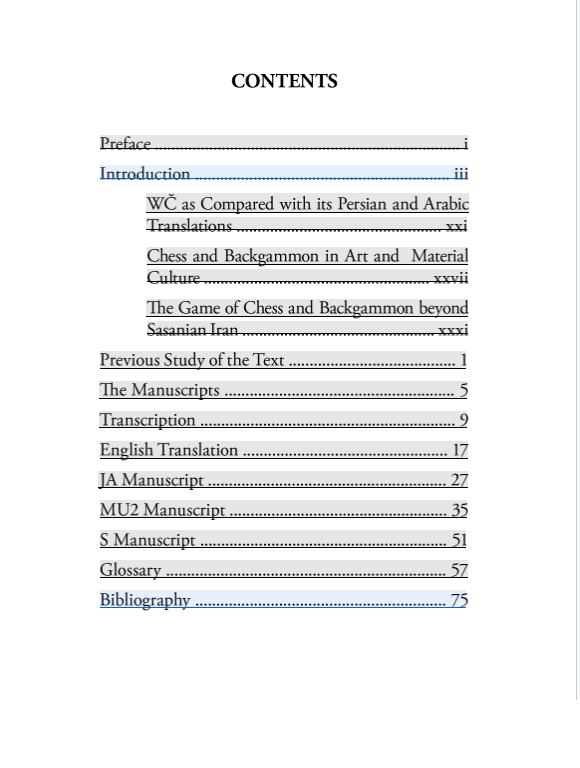
    Touraj, Daryaee. 2016. On the explanation of chess and backgammon: A Middle Persian text (Ancient Iran Series 2).  UCI Jordan Center for Persian Studies. H&S Media.

    The book is an edition of the earliest text in Middle Persian on the rules and views of the games of chess and backgammon, reported to be from the time of Khusro Anushirvan in the 6th CE.

    Table of Contents

  • The New Chronology of the Bronze Age Settlement of Tepe Hissar, Iran

    Gursan-Salzmann, Ayş. 2016.  The New Chronology of the Bronze Age Settlement of Tepe Hissar, Iran. Philadelphia. University of Pennsylvania Museum of Archaeology and Anthropology .

    Tepe Hissar is a large Bronze Age site in northeastern Iran notable for its uninterrupted occupational history from the fifth to the second millennium B.C.E. The quantity and elaborateness of its excavated artifacts and funerary customs position the site prominently as a cultural bridge between Mesopotamia and Central Asia. To address questions of synchronic and diachronic nature relating to the changing levels of socioeconomic complexity in the region and across the greater Near East, chronological clarity is required. While Erich Schmidt’s 1931-32 excavations for the Penn Museum established the historical framework at Tepe Hissar, it was Robert H. Dyson, Jr., and his team’s follow-up work in 1976 that presented a stratigraphically clearer sequence for the site with associated radiocarbon dates. Until now, however, a full study of the site’s ceramic assemblages has not been published.

    This monograph brings to final publication a stratigraphically based chronology for the Early Bronze Age settlement at Tepe Hissar. Based on a full study of the ceramic assemblages excavated from radiocarbon-dated occupational phases in 1976 by Dyson and his team, and linked to Schmidt’s earlier ceramic sequence that was derived from a large corpus of grave contents, a new chronological framework for Tepe Hissar and its region is established. This clarified sequence provides ample evidence for the nature of the evolution and the abandonment of the site, and its chronological correlations on the northern Iranian plateau, situating it in time and space between Turkmenistan and Bactria on the one hand and Mesopotamia on the other.

    Ayşe Gürsan-Salzmann, a graduate of Robert College (Istanbul) and Ball State University, earned her M.A. and Ph.D. degrees in anthropology from the University of Pennsylvania. She is Senior Consulting Scholar in the Mediterranean Section of the Penn Museum and the Deputy Director of the Gordion Archaeological Project.

    Table of Contents

  • The Nisibis War

    Harrel, John. 2016.  The Nisibis War: The Defence of the Roman East AD 337–363. Pen & Sword Military.

    The war of 337-363 (which the author dubs the ‘Nisibis War’), was an exception to the traditional Roman reliance on a strategic offensive to bring about a decisive battle. Instead, the Emperor Constantius II adopted a defensive strategy and conducted a mobile defence based upon small frontier (limitanei) forces defending fortified cities, supported by limited counteroffensives by the Field Army of the East. These methods successfully checked Persian assaults for 24 years. However, when Julian became emperor his access to greater resources tempted him to abandon mobile defence in favour of a major invasion aimed at regime change in Persia. Although he reached the Persian capital, Ctesiphon, he failed to take it, was decisively defeated in battle and killed. The Romans subsequently resumed and refined the mobile defence, allowing the Eastern provinces to survive the fall of the Western Empire.
    John Harrel applies his personal experience of military command to a strategic, operational, tactical and logistical analysis of these campaigns and battles, highlighting their long-term significance.
  • Zoroastrianism in the Levant

    Abouzayd, Shafiq (ed.). 2014. Zoroastrianism in the Levant: Proceedings of conferences held in 2010 & 2012. ARAM 26(1).

    Table of contents:

    Patricia Crone: “Pre-existence in Iran: “Zoroastrians, ex-Christians Mu‘tazilites, and Jews on the human acquisition of bodies”

    Oktor Skjærvø & Yaakov Elman: “Concepts of pollution in late Sasanian Iran. Does pollution need stairs, and dose it fill space?”

    Maria Macuch: “The case against Mār Abā, the Catholicos, in the light of Sasanian law”

    Sara Kuehn: “The dragon fighter: The influence of Zoroastrian ideas on Judaeo-Christian and Islamic iconography”

    Geoffrey Herman: “Like a slave before his master: A Persian gesture of deference in Sasanian, Jewish, and Christian sources”

    Michał Gawlikowski: “Zoroastrian echoes in the Mithraeum at Hawarte, Syria”

    Vicente Dobroruka: “Zoroastrian apocalyptic and Hellenistic political propaganda”

    Dan D.Y. Shapira: “Pahlavi Fire, Bundahishn 18”

    Matteo Compareti: “The representation of Zoroastrian divinities in late Sasanian art and their description according to Avestan literature”

    Bahman Moradian: “The day of Mihr, the month of Mihr and the ceremony of Mihrized in Yazd”

    Ezio Albrile: “Hypnotica Iranica: Zoroastrian ecstasy in the West”

    Andrew D. Magnusson: “On the origins of the prophet Muhammad’s charter to the family of Salman Al-Farisi”

    Predrag Bukovec: “The soul’s judgement in Mandaeism: Iranian influences on Mandaean afterlife”

    Daphna Arbel: “On human’s elevation, hubris, and fall from glory. Traditions of Yima/Jamshid and Enochmetatron – an indirect cultural dialogue?”

    Vicente Dobroruka: “The order of metals in Daniel 2 and in Persian apocalyptic”

    Myriam Wissa: “Pre-Islamic topos in Dhu’l-Nūn Al-Misrī’s teaching: A re-assessment of the Egyptian roots of the knowledge of the name of god and their interaction with Zoroastrianism in the Achaemenid period ”

    David H. Sick: “The choice of Xerxes: A Zoroastrian interpretation of Herodotus 7.12-18”

  • Bar Hebraeus The Ecclesiastical Chronicle

    Wilmshurst, David. 2016. Bar Hebraeus The Ecclesiastical Chronicle (Gorgias Eastern Christian Studies 40). New Jersey. Gorgias Press.

    The Ecclesiastical Chronicle of the Syriac Orthodox polymath Bar Hebraeus (†1286), an important Syriac text written in the last quarter of the 13th century, has long been recognised as a key source for the history of the Syriac Orthodox Church and the Church of the East. Bar Hebraeus describes the eventful history of the “Jacobite” and “Nestorian” Churches, as they were then called, from their earliest beginnings down to his own time, against the background of christological controversies, Roman?Persian wars, the Arab Conquest, the Crusades and the 13th-century Mongol invasions. Two continuators bring the story down to the end of the 15th century, shedding valuable light on a relatively obscure period in the history of both Churches. The Ecclesiastical Chronicle was translated into Latin between 1872 and 1877, but has never before been fully translated into English. Gorgias Press is proud to publish the first complete English translation of this influential text, by respected Syriac scholar David Wilmshurst.

    This elegant translation of the Ecclesiastical Chronicle captures the flavour of Bar Hebraeus’s style, and is complemented by a facing Syriac text. Wilmshurst also provides a detailed introduction, setting the chronicle in its historical and literary context. His translation is accompanied by five maps, showing the dioceses of the two Churches and the towns, villages and monasteries of Tur ‘Abdin and the Mosul Plain. A helpful bibliography and index are also provided.

    David Wilmshurst was educated at Worcester College, Oxford, where he took a first-class BA degree in Classics (1979) and a D Phil degree in Oriental Studies (1998). He has spent much of his life in Hong Kong, and is one of the few modern scholars of the Church of the East who can read Syriac, Arabic and Chinese. He is the author of The Ecclesiastical Organisation of the Church of the East, 1318–1913 (Louvain, 2000), a study of the Christian topography of Iraq and Iran, and The Martyred Church (London, 2011), a general history of the Church of the East. Both books have been warmly praised by leading scholars.


    Table of Contents

    • Table of Contents (page 5)
    • Introduction (page 7)
      • Preliminary Remarks (page 7)
      • The Career of Bar Hebraeus (page 9)
      • The Literary Achievement of Bar Hebraeus (page 12)
      • The Chronicle of Bar Hebraeus (page 16)
      • The Ecclesiastical Chronicle as Literature (page 19)
      • The Ecclesiastical Chronicle as History (page 27)
    • Text and Translation (page 41)
      • Section One (page 42)
      • Section Two (page 350)
    • Appendix One: The Patriarchs and Maphrians of the Jacobite Church (page 547)
    • Appendix Two: The Patriarchs of the Church of the East (page 551)
    • Select Bibliography (page 555)
    • Index (page 559)
    • Maps (page 589)
  • Seleukid Royal Women

    Seleukid Royal Women is introduced by our guest contributor Khodadad Rezakhani, a Humboldt Fellow at the Institute of Iranian Studies, Free University of Berlin.

    Coskun, Altay & Alex McAuley (eds.). 2016. Seleukid royal women: Creation, representation and distortion of Hellenistic queenship in the Seleukid Empire (Historia, Einzelschriften 240). Stuttgart: Franz Steiner Verlag.

    Khodadad writes:

    ‘The study of any period of ancient history of Iran away from political history is a welcomed change in scholarship. The arrival of this volume, edited by two of the most prominent scholars of the Hellenistic period and in a framing that embraces the multi-cultural nature of the Seleukid kingship is a most exciting development that needs to be celebrated. It should also be considered as a blue-print for future studies of similar calibre and scope in other periods of the history of the region. Hopefully, the proliferation of such studies would bring the history of “in-between” (to quote the prologue) more to the attention of the general audiences, as well as the scholars, of the ancient world. Perhaps the volume could have benefited from more in-depth studies of the majority of the (non-Greek speaking) areas of the Seleukid domains, a lacuna which is perhaps more a fault of the experts of these non-Greek speaking in-betweens than the erudite editors of the volume’.

    (more…)

  • Ancient tales of giants

    Goff, Matthew, Loren Stuckenbruck & Enrico Morano (eds.). 2016. Ancient tales of giants from Qumran and Turfan: Contexts, traditions, and influences (Wissenschaftliche Untersuchungen zum Neuen Testament 360). Mohr Siebeck.

    While there has been much scholarly attention devoted to the Enochic Book of the Watchers , much less has been paid to the Book of Giants from Qumran. This volume is the proceedings of a conference that convened in Munich, Germany, in June 2014, which was devoted to the giants of Enochic tradition and in particular the Qumran Book of Giants . It engages the topic of the giants in relation to various ancient contexts, including the Hebrew Bible, the Dead Sea Scrolls, and ancient Mesopotamia. The authors of this volume give particular attention to Manichaeism, especially the Manichaean Book of Giants , fragments of which were found in Turfan (western China). They contribute to our understanding of the range of stories Jews told in antiquity about the sons of the watchers who descended to earth and their vibrant Nachleben in Manichaeism.

    (more…)

  • Emergence of Iranian nationalism

    Zia-Ebrahimi, Reza. 2016. The emergence of Iranian nationalism: Race and the politics of dislocation. New York: Columbia University Press.

    Reza Zia-Ebrahimi revisits the work of Fath?ali Akhundzadeh and Mirza Aqa Khan Kermani, two Qajar-era intellectuals who founded modern Iranian nationalism. In their efforts to make sense of a difficult historical situation, these thinkers advanced an appealing ideology Zia-Ebrahimi calls “dislocative nationalism,” in which pre-Islamic Iran is cast as a golden age, Islam is reinterpreted as an alien religion, and Arabs become implacable others. Dislodging Iran from its empirical reality and tying it to Europe and the Aryan race, this ideology remains the most politically potent form of identity in Iran.

    Akhundzadeh and Kermani’s nationalist reading of Iranian history has been drilled into the minds of Iranians since its adoption by the Pahlavi state in the early twentieth century. Spread through mass schooling, historical narratives, and official statements of support, their ideological perspective has come to define Iranian culture and domestic and foreign policy. Zia-Ebrahimi follows the development of dislocative nationalism through a range of cultural and historical materials, and he captures its incorporation of European ideas about Iranian history, the Aryan race, and a primordial nation. His work emphasizes the agency of Iranian intellectuals in translating European ideas for Iranian audiences, impressing Western conceptions of race onto Iranian identity.

    The table of contents:

    Acknowledgments
    Note on Transliteration and Spelling
    Introduction
    1. The Paleontology of Iranian Nationalism
    2. Akhundzadeh and Kermani: The Emergence of Dislocative Nationalism
    3. Pre-Islamic Iran and Archaistic Frenzy
    4. Of Lizard Eaters and Invasions: The Import of European Racial Thought
    5. Europe, That Feared Yet Admired Idol
    6. Aryanism and Dislocation
    7. The Road to Officialdom
    8. Triumph
    Conclusion: The Failure of Dislocative Nationalism
    Notes
    Bibliography
    Index

    Reza Zia-Ebrahimi is lecturer (assistant professor) in history at King’s College London.