Elsner, Jas. 2017. Images of Mithra (Visual Conversations In Art And Archaeology 1). New York, NY: Oxford University Press.
With a history of use extending back to Vedic texts of the second millennium BC, derivations of the name Mithra appear in the Roman Empire, across Sasanian Persia, and in the Kushan Empire of southern Afghanistan and northern India during the first millennium AD. Even today, this name has a place in Yazidi and Zoroastrian religion. But what connection have Mihr in Persia, Miiro in Kushan Bactria, and Mithras in the Roman Empire to one another?
The article discusses two seals from the recently published collection of Aman Ur Rahman that depict previously unrecognized images of Iranian deities. It is suggested that the first seal, of eastern Sasanian manufacture, depicts a unique image of the Daēnā accompanied by two dogs. The second seal shows a well-known motif of a chariot of Mithra. The inscription connects it with the Pārata kings and helps to date the seal to the third-fourth centuries CE.
Mazdapour, Katayoun et al. 2015. The Religions of Ancient Iran. Tehran: SAMT Publication.
This book is an introduction to Ancient Iranian Religions. Each chapter of this book deals with one of the major religions or trends in the history of ancient Iranian religions or those religions which were influenced by ancient Iranian beliefs and views.
Table of Contents:
Zaraθuštra (Zoroaster) and the Zoroastrianism
Mithraism
Mani and Manichaeism
Zurvanism
Mazdakism
Mazdāpur, katāyun va digarān. 1394š/2015. adyān-o maẕāheb dar īrān-e bāstān. tehrān: entešārāt-e samt.
In original:
مزداپور، کتایون و دیگران. ۱۳۹۴. ادیان و مذاهب در ایران باستان. تهران: سمت
König, Götz. 2015. Iranisches im römischen Mithraskult: Iranische Wörter. In Richard Faber & Achim Lichtenberger (eds.), Ein pluriverses Universum: Zivilisationen und Religonen im antiken Mittelmeerraum, 301–331. (Mittelmeerstudien 7). Wilhelm Fink.
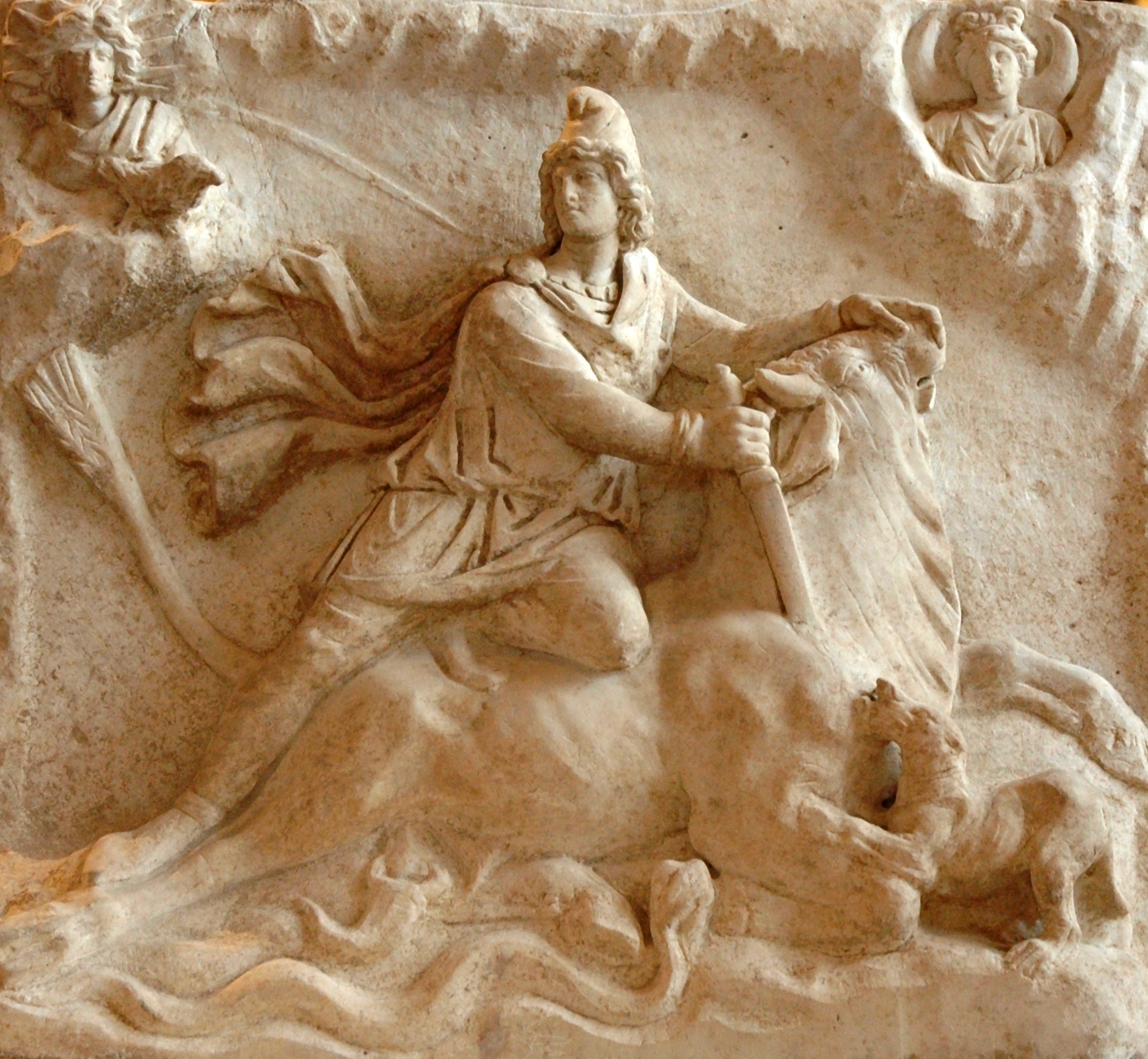
Tauroctony scene on side A of a two-sided Roman bas-relief. 2nd or 3rd century, found at Fiano Romano, near Rome, now on display in the Louvre.
Götz König discusses the origin and roots of some “Iranian words” in Mithraism under the Roman Empire from linguistic and philological point of view . Begining with the question of “Mithra” or “Mithras”, he addresses the history of scholarship regarding of “Mithraic Studies” connected with ancient Iranian studies. Other sub-chapters of his article is dedicated to analytical investigation of some Iranian linguistic materials, namely the greeting nama, the terms sebesio and nabarze, as well as the divine names Arimanius, Cautēs/Cautopatēs/ ˚is, Atar, Ōromazdēs and Miθra and also the liturgical term amara.
About the Author:
Götz König is a scholar of the Ancient and Middle Iranian Studies and presently the substitute head of the Institute of Iranian Studies, Freie Universität Berlin.

 Elsner, Jas. 2017. Images of Mithra (Visual Conversations In Art And Archaeology 1). New York, NY: Oxford University Press.