Tag: Middle Iranian

  • Syriac into Middle Iranian

    Detail from the Manuscript Chaldean Cathedral of Mardin (CCM) 13, f. 120r

    Barbati, Chiara. 2015. Syriac into Middle Iranian: A Translation Studies Approach to Sogdian and Pahlavi Manuscripts within the Church of the East. Open Linguistics 1(1). 444–457.

    Based on a corpus coming from the Turfan oasis (in present-day Xinjiang, People’s Republic of China) and consisting of Christian Middle Iranian literature in several languages (Middle Persian, Syriac and Sogdian) and scripts (East Syriac, Pahlavi and secular Sogdian), the present paper is aimed at identifying and outlining the translation techniques for the transmission of religious knowledge, based on a literary tradition as well as on a manuscript tradition, from one context to another. The religious knowledge is that which belongs to the “Church of the East” and which is written in its official liturgical language, i.e. Syriac in East Syriac script. The general context is that of the missionary activities of the “Church of the East” along the Silk road between late Antiquity and early Middle Age. The particular context is that of the converted Iranian communities.
    About the Author:
    Chiara Barbati (PhD 2009) is a scholar of Ancient and Middle Iranian languages in the Institute of Iranian Studies, Austrian Academy of Sciences, Vienna (ÖAW).
  • Studies on the Pre-Islamic Iranian World

    Krasnowolska, Anna & Renata Rusek-Kowalska (eds.). 2015. Studies on the Iranian World I. Before Islam. Krakow: Jagiellonian University Press.
    This volume is the proceedings of the Seventh Conference of Iranian Studies of the Societas Iranologica Europaea (ECIS7), organized by Societas Iranologica Europaea (SIE), which took place in Cracow, September 7-10, 2011. The first of the two volumes of the ECIS7 proceedings is dedicated to the pre-Islamic Iranian studies.
    Table of Contents
    Linguistics:
    • Maria Carmela Benvenuto, Flavia Pompeo: “The Old Persian Genetive. A Study of a Syncretic Case
    • Saloumeh Gholami: “Nominal Compound Strategies in Middle Iranian Languages”
    • Paolo Ognibene: “Alan Place-names in Western Europe”
    • Christiane Reck: “Work in Progress: The Catalogue of the Buddhist Sogdian Fragments of the Berlin Turgan Collection”
    • Arash Zeini: “Preliminary Remarks on Middle Persian <nc> in the Pahlavi Documents”
    Literature:
    • Elham Afzalian: “Autoritäten im Mādayānī Hazār Dādestān”
    • Iris Colditz: “Two Snake-Brothers on their Way — Mani’s Scripture as a Source of Manichaean Central Asian Parabels?”
    • Seyyedeh Fatemeh Musavi: “Fictional Structure of the Middle Persian Ayādgār ī Zarērān
    Religion:
    • Desmond Durkin-Meisterernst: “Aspects of Hymnology in Manichaean Community in Turfan”
    • Raffaella Frascarelli: “Arǝdvī Sūrā Anāhitā: Considerations on the Greek ἀρχἡ”
    • Judith Josephson: “Ohrmazd’s Plan for Creation according to Book Three of the Denkard”
    • Götz König: “The Pahlavi Translation of Yašt 3″
    • Kianosh Rezania: “On the Old Iranian Social Space and its Relation to the Time Ordering System”
    History:
    Archaeology:
    • Alireza Askari Chaversi: “In Search of the Elusive Town of Persepolis”
    • Jukian Bogdani, Luca Colliva, Sven Stefano Tilia: “The Citadel of Erbil. The Italian Archaeological and Topographic Activities”
    • Carlo G. Cereti, Gianfilippo Terribili, Alessandro Tilia: “Pāikūlī in its Geographical Context”
    • Niccolò Manassero: “New Sealings from Old Nisa”
    • Vito Messina, Jafar Mehr Kian: “The Hong-e Azhdar Parthian Rock Relief Reconsidered”
     About the Editors:

    Anna Krasnowolska is a professor at the Institute of Oriental Studies, Jagiellonian University.

    Renata Rusek-Kowalska is an assistant professor at the Institute of Oriental Studies, Jagiellonian University.

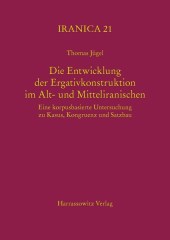
  • Ergativity in Old and Middle Iranian languages

    Ergativity is a grammatical phenomenon that has been discussed controversially in linguistics in general and in the Iranian Studies in particular. The scientific debate is characterized by a lack of consideration of the Old and Middle Iranian data. In many cases, the selected examples, which their position in the respective language system is  still unclear, are associated with theory-driven assumptions about a hypothetical model of development, which is to be plausible, but not verifiable.

    The present study provides a solution through the complete analyzing of the Avestan , Old Persian, Bactrian and Parthian documents as well as an extensive study of Middle Persian evidences (approximately 12,500 Middle Persian cases). In addition to the relevant ergativity aspects such case, congruence, word order,  and reflexivity both the development of syntactic structures (e.g. relative clauses) as well as the verbal and nominal system (e.g. the temporal aspect system or the function of enclitic personal pronouns) are discussed .

    Results are illustrated with relevant evidences  (over 1,400 examples alone in the main part), whose validity is constantly checked and  based critically on detailed philological discussion. The material part also serves as a vademecum, which can be used in parallel with the reading of the main part, as well as a separate reference book that systematically illustrates the history of the object in ergative languages.

    The volume presents the most exhaustive investigation on ergativity in within the Old and Middle Iranian languages.

    The detaild Table of Content of this book and the English Summery are availabe. (more…)