This review article discusses various issues raised by the two reports of the Italian missions to the Yaghnob Valley in Tajikistan. It aims to provide a critical review of the publications, which present a broad variety of new research on the Yaghnobi people, as well as a more general discussion of the methodology involved in studying this group.
The volume edited by Mohamad Tavakoli-Targhi brings together twenty nine articles by the leading scholar of Iranian studies, Prof. Ehsan Yarshater on the various subjects of Iranian history, culture, religions, literature, dialects and philology. It presents a valuable collection of important articles, which many of them were not easily accessible. The collection represents the author’s most important contributions, written in Persian language in the period between 1327š/1947-48 to 1380š/2001-02. Even the papers are concerned with a range of different subjects, they are pretty much interconnected, as it is possible to trace lines of ideas originating in one article which the author develops in latter writings. All these are carefully and illuminating described by the editor in his preface to this volume. The papers are categorized into four thematic chapters: 1. Autobiography and Obituary (with three articles), 2. World Art and Literature (with four articles), 3. Language and Civilization (with nine articles), 3. Civilization and the Secret of Survival (with thirteen article).
Mohamad Tavakoli-Targhi is Professor of History and Near and Middle Eastern Civilizations at the University of Toronto and the Founding chair of the Department of Historical Studies at the University of Toronto-Mississauga.
This book contains a critical edition of the Avestan language composition known as the Rašn Yašt, or ‘Hymn to Justice’. The text is accompanied by an English translation, philological commentary and glossary. In addition, the main themes of the Rašn Yašt are taken up for detailed discussion, covering the Zoroastrian deity Rašnu, ancient Iranian cosmography, and the use of ordeal rituals in pre-Islamic Iran.
About the Author: Dr. Leon Goldman was born in 1981 in London, England. Having obtained a B.A. (Hons.) degree from the University of Queensland (Australia) in 2004, with a particular focus on Indian religions and Sanskrit, he returned to London to pursue an M.A. in Iranian and Zoroastrian studies at SOAS. In 2012, he was awarded a Ph.D. from SOAS for his doctoral thesis entitled: Rašn Yašt. The Avestan Hymn to ‘Justice’. Text, Translation and Commentary. From 2012 to 2015, he held the post of British Academy Postdoctoral Fellow at SOAS with a project devoted to the Sanskrit version of the Zoroastrian Yasna liturgy.
Achaemenid religion” was the religion of the rulers of Iran in the second half of the first millennium BCE and the local form of Zoroastrianism, the ancient religion of the Iranians. The earliest form of Zoroastrianism is known from the Avesta, their sacred texts, which probably originated in the last half of the second and first half of the first millennium BCE, but were transmitted only orally until priests began writing them down in the seventh century. The “Achaemenid religion” is known from cuneiform inscriptions in the local Iranian language, Old Persian, and from tablets in Elamite found at Persepolis, as well as from other sources. It was a dualist religion, postulating the existence of good and evil from the beginning, as well as a polytheistic religion, but with one god, Ahura-Mazdā, outranking the others. Scholarly discussion has centered on the question whether the Achaemenids were real Zoroastrians, in the sense of following the reformed teachings of the historical Zarathustra. As the assumed historicity of Zarathustra and his reform are increasingly being questioned, scholars are now focusing on the interpretation of the inscriptions, notably from the point of view of the orality of Iranian traditions and their relationship with the Avesta, but also increasingly on the editing of the Elamite tablets and mining them for information.
Bukhara, No. 107 (Memorial Volume for Chahryar Adle). Tehran. 2015.- Via Ehsan Shavarebi.
The 107th issue of Bukhara Magazine (July-August 2015) is dedicated to the memory of the late Professor Chahryar Adle (1944-2015). Chahryar Adle, Iranian archaeologist specialised in art and architecture of Iran and Central Asia during the Islamic period, passed away in Paris on 21 June.
This volume, edited by Ali Dehbashi, includes more than 50 papers in memory of the late Prof. Adle, by such scholars as Firouz Bagherzadeh, Mahmoud Mousavi, Rémy Boucharlat, Carlo G. Cereti, Marie-Christine David, Hekmatollah Mollasalehi, Ehsan Eshraghi, Rajab-Ali Labbaf-Khaniki, Ali Mousavi, Mehrdad Malekzadeh, Nader Nasiri-Moghaddam, Shahram Zare, Mohammad Taghi Ataee, Ehsan Shavarebi, etc. Also several papers and interviews of Prof. Adle are republished in this volume.
The volume is in Persian and consists of 513 pages.
This collection comprises a collective study of the genesis and development of Iranian Studies, or Iranology, in imperial Russia and subsequently in the Soviet Union. It takes as its specific point of departure the controversies regarding whether Russian, or post-1917 Soviet, scholars and administrators and the discourses they produced on the Persophone world were Orientalist in the sense made famous by Edward Said.
DABIR: Digital Archive of Brief notes & Iran Review, 2015, Vol 1, No. 1.
The first issue of the Digital Archive of Brief notes & Iran Review (DABIR) has been published and is available from the official website of DABIR.
The Digital Archive of Brief notes & Iran Review (DABIR) is an open access, peer-reviewed online open access journal published by the Dr. Samuel M. Jordan Center for Persian Studies and Culture at the University of California, Irvine. DABIR aims to quickly and efficiently publish brief notes and reviews relating to the pre-modern world in contact with Iran and Persianate cultures. The journal accepts submissions on art history, archaeology, history, linguistics, literature, manuscript studies, numismatics, philology and religion, from Jaxartes to the Mediterranean and from the Sumerian period through to the Safavid era (3500 BCE-1500 CE). Work dealing with later periods can be considered on request.
Table of Contents: Articles
Saber Amiri Pariyan: “A re-examination of two terms in the Elamite version of the Behistun inscription”
Touraj Daryaee: “Alexander and the Arsacids in the manuscript MU29”
Shervin Farridnejad: “Take care of the xrafstars! A note on Nēr. 7.5″
Leonardo Gregoratti: “The kings of Parthia and Persia: Some considerations on the ‘Iranic’ identity in the Parthian Empire”
Götz König: “Brief comments on the so-called Xorde Avesta (1)”
Ali Mousavi: “Some thoughts on the rock-reliefs of ancient Iran”
Khodadad Rezakhani: “A note on the Alkhan coin type 39 and its legend”
Shai Secunda: “Relieving monthly sexual needs: On Pahlavi daštān-māh wizārdan“
Arash Zeini: “Preliminary observations on word order correspondence in the Zand”
Reviews
Sajad Amiri Bavandpoor: “Review of Smith, Kyle. 2014. The Martyrdom and History of Blessed Simeon bar Sabba’e”
Lloyd Llewellyn-Jones: “Review of Mayor, Adrienne. 2014. The Amazons. Lives and Legends of Warrior Women Across the Ancient World”
Yazdan Safaee: “Llewellyn-Jones, Lloyd & James Robson. 2010. CTESIAS’ History of Persia: Tales of the Orient”
Special Issue
Bruce Lincoln “Of dirt, diet, and religious others”
DABIR
Editor-in-Chief: Touraj Daryaee (University of California, Irvine)
Editors: Parsa Daneshmand (Oxford University) and Arash Zeini (University of St Andrews)
Book Review Editor: Shervin Farridnejad (Freie Universität Berlin)
König, Götz. 2015. Iranisches im römischen Mithraskult: Iranische Wörter. In Richard Faber & Achim Lichtenberger (eds.), Ein pluriverses Universum: Zivilisationen und Religonen im antiken Mittelmeerraum, 301–331. (Mittelmeerstudien 7). Wilhelm Fink.
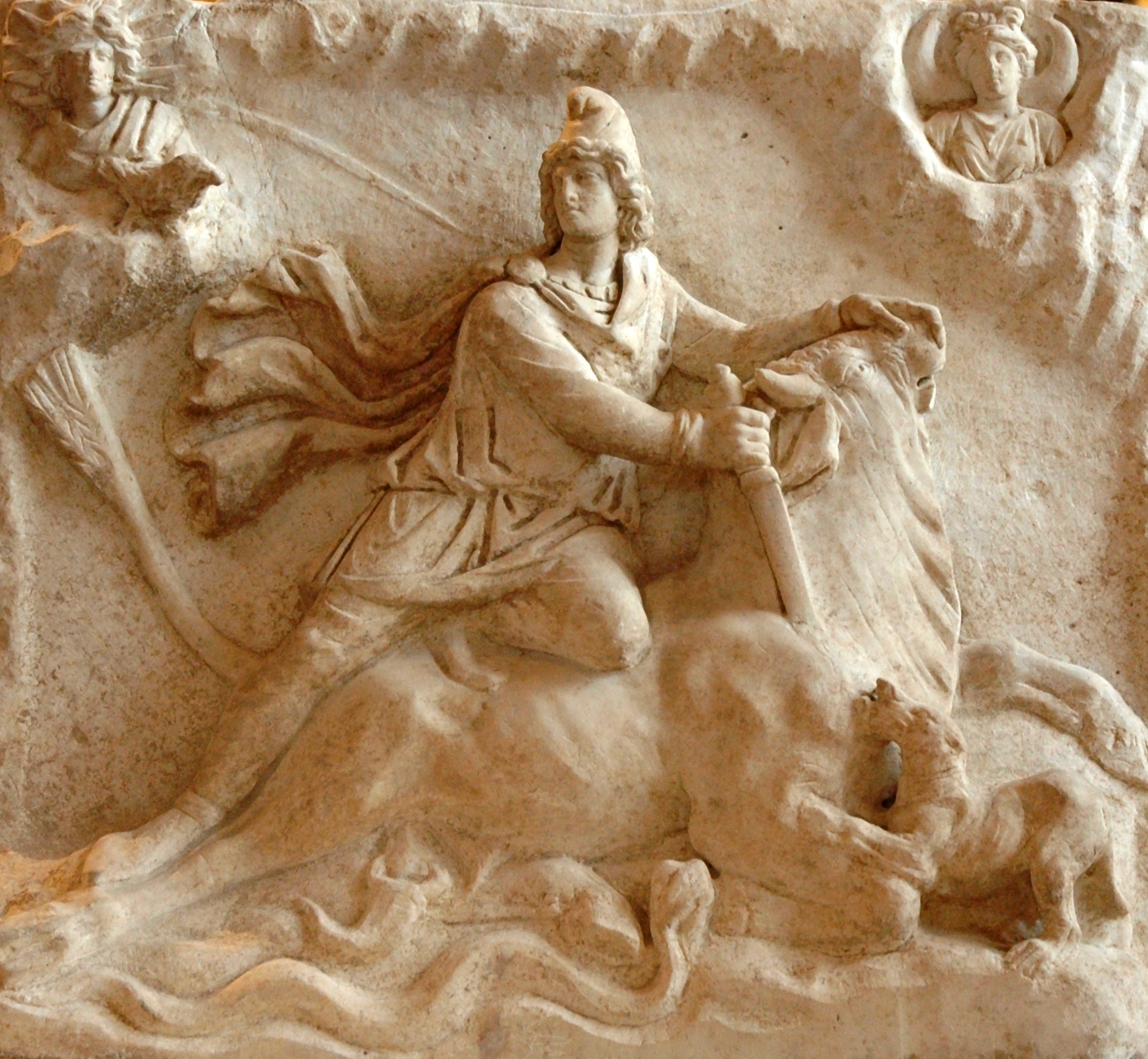
Tauroctony scene on side A of a two-sided Roman bas-relief. 2nd or 3rd century, found at Fiano Romano, near Rome, now on display in the Louvre.
Götz König discusses the origin and roots of some “Iranian words” in Mithraism under the Roman Empire from linguistic and philological point of view . Begining with the question of “Mithra” or “Mithras”, he addresses the history of scholarship regarding of “Mithraic Studies” connected with ancient Iranian studies. Other sub-chapters of his article is dedicated to analytical investigation of some Iranian linguistic materials, namely the greeting nama, the terms sebesio and nabarze, as well as the divine names Arimanius, Cautēs/Cautopatēs/ ˚is, Atar, Ōromazdēs and Miθra and also the liturgical term amara.
About the Author:
Götz König is a scholar of the Ancient and Middle Iranian Studies and presently the substitute head of the Institute of Iranian Studies, Freie Universität Berlin.
This manual for Iranian Studies presents a comprehensive survey ofstatus and trends of current research in the filed of Iranian Studies. In 34 contributions, the most important disciplines of the field, namely history, literature, religion and language were examined by 33 authors on almost 500 pages. It comprised both the current state of Iran as well as the Iranian cultural sphere in its geographic breadth and historical depth, from Anatolia to Central Asia and from the early history (7th millennium BC) Until today. The manual aims to provide a methodical presentation of research developments and tries to answer the questions such as: what research questions are fresh and interesting? why and in which research contexts they are important?
All contributions of the manual are divided into three sections A, B and C. The section A guides the reader through fundamental and self-reflexive methodological considerations to approach the subject. The section B provides a research overview, and the section C gives an alphabetical bibliography on each subject.


 Goldman, Leon. 2015.