Tag: Avestan

  • Journal of the American Oriental Society

    The latest issue of the Journal of the American Oriental Society, Vol. 135(3), has several articles and reviews of interest to scholars of ancient Iran. We have already announced Michael Shenkar’s Rethinking Sasanian Iconoclasm in a previous post. Among the reviews three stand out for their direct relevance for Iranian Studies:

    The full JSTOR Table of Contents is available here.

  • Repetition Analysis Function and the Avestan Manuscripts

    The Avestan Manuscript J2, fol. 5 Y.07c-Y.09a. Yasna with Its Pahlavi Translation (A.D. 1323). © TITUS, Frankfurt 2001-2002

    Jügel, Thomas. 2015. Repetition analysis function (ReAF) I. Indogermanische Forschungen 120(1).177–208.

    Repetitions are relevant for several aspects of historical philology. With regard to Avestan, they may allow for the identification of ceremonial frames or opening and closing sections revealing the compositional structure of a ceremony. In case of manuscript comparison, the question arises whether a variant appears only once or in all of its repetitive passages. Furthermore, by analysing the compositional structure we may be able to detect ceremonial structures different to the practice of today. A secondary aspect relates to the interpretation of the grammaticality of Young Avestan passages. The repetition analysis provides evidence that passages which are hitherto considered ill-formed actually follow the rules of Avestan grammar. The scope of this study is to investigate computational means for detecting repetitive sequences. It represents a case study of the manuscript J2 by means of tools that were set up in the LOEWE priority programme Digital Humanities at the Goethe University Frankfurt am Main: a digital lexicon, a letter discrimination matrix for Avestan, and the programme Repetition Analysis Function. The article ReAF I offers some basic observations on repetitive sequences in the manuscript J2 and lays the foundation for ReAF II (Jügel forthc.), where the results of the repetition analyses will be used to discuss the compositional structure of the Yasna.
  • Studies on the Pre-Islamic Iranian World

    Krasnowolska, Anna & Renata Rusek-Kowalska (eds.). 2015. Studies on the Iranian World I. Before Islam. Krakow: Jagiellonian University Press.
    This volume is the proceedings of the Seventh Conference of Iranian Studies of the Societas Iranologica Europaea (ECIS7), organized by Societas Iranologica Europaea (SIE), which took place in Cracow, September 7-10, 2011. The first of the two volumes of the ECIS7 proceedings is dedicated to the pre-Islamic Iranian studies.
    Table of Contents
    Linguistics:
    • Maria Carmela Benvenuto, Flavia Pompeo: “The Old Persian Genetive. A Study of a Syncretic Case
    • Saloumeh Gholami: “Nominal Compound Strategies in Middle Iranian Languages”
    • Paolo Ognibene: “Alan Place-names in Western Europe”
    • Christiane Reck: “Work in Progress: The Catalogue of the Buddhist Sogdian Fragments of the Berlin Turgan Collection”
    • Arash Zeini: “Preliminary Remarks on Middle Persian <nc> in the Pahlavi Documents”
    Literature:
    • Elham Afzalian: “Autoritäten im Mādayānī Hazār Dādestān”
    • Iris Colditz: “Two Snake-Brothers on their Way — Mani’s Scripture as a Source of Manichaean Central Asian Parabels?”
    • Seyyedeh Fatemeh Musavi: “Fictional Structure of the Middle Persian Ayādgār ī Zarērān
    Religion:
    • Desmond Durkin-Meisterernst: “Aspects of Hymnology in Manichaean Community in Turfan”
    • Raffaella Frascarelli: “Arǝdvī Sūrā Anāhitā: Considerations on the Greek ἀρχἡ”
    • Judith Josephson: “Ohrmazd’s Plan for Creation according to Book Three of the Denkard”
    • Götz König: “The Pahlavi Translation of Yašt 3″
    • Kianosh Rezania: “On the Old Iranian Social Space and its Relation to the Time Ordering System”
    History:
    Archaeology:
    • Alireza Askari Chaversi: “In Search of the Elusive Town of Persepolis”
    • Jukian Bogdani, Luca Colliva, Sven Stefano Tilia: “The Citadel of Erbil. The Italian Archaeological and Topographic Activities”
    • Carlo G. Cereti, Gianfilippo Terribili, Alessandro Tilia: “Pāikūlī in its Geographical Context”
    • Niccolò Manassero: “New Sealings from Old Nisa”
    • Vito Messina, Jafar Mehr Kian: “The Hong-e Azhdar Parthian Rock Relief Reconsidered”
     About the Editors:

    Anna Krasnowolska is a professor at the Institute of Oriental Studies, Jagiellonian University.

    Renata Rusek-Kowalska is an assistant professor at the Institute of Oriental Studies, Jagiellonian University.

  • The Avestan hymn to ‘Justice’

    Goldman, Leon. 2015. Rašn Yašt: The Avestan hymn to ‘Justice’ (Beiträge zur Iranistik 39). Wiesbaden: Reichert Verlag.

    This book contains a critical edition of the Avestan language composition known as the Rašn Yašt, or ‘Hymn to Justice’. The text is accompanied by an English translation, philological commentary and glossary. In addition, the main themes of the Rašn Yašt are taken up for detailed discussion, covering the Zoroastrian deity Rašnu, ancient Iranian cosmography, and the use of ordeal rituals in pre-Islamic Iran.

    Preface
    Table of Contents
    Sample

    About the Author: Dr. Leon Goldman was born in 1981 in London, England. Having obtained a B.A. (Hons.) degree from the University of Queensland (Australia) in 2004, with a particular focus on Indian religions and Sanskrit, he returned to London to pursue an M.A. in Iranian and Zoroastrian studies at SOAS. In 2012, he was awarded a Ph.D. from SOAS for his doctoral thesis entitled: Rašn Yašt. The Avestan Hymn to ‘Justice’. Text, Translation and Commentary. From 2012 to 2015, he held the post of British Academy Postdoctoral Fellow at SOAS with a project devoted to the Sanskrit version of the Zoroastrian Yasna liturgy.

  • Ergativity in Old and Middle Iranian languages

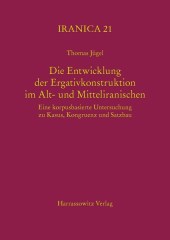
    Ergativity is a grammatical phenomenon that has been discussed controversially in linguistics in general and in the Iranian Studies in particular. The scientific debate is characterized by a lack of consideration of the Old and Middle Iranian data. In many cases, the selected examples, which their position in the respective language system is  still unclear, are associated with theory-driven assumptions about a hypothetical model of development, which is to be plausible, but not verifiable.

    The present study provides a solution through the complete analyzing of the Avestan , Old Persian, Bactrian and Parthian documents as well as an extensive study of Middle Persian evidences (approximately 12,500 Middle Persian cases). In addition to the relevant ergativity aspects such case, congruence, word order,  and reflexivity both the development of syntactic structures (e.g. relative clauses) as well as the verbal and nominal system (e.g. the temporal aspect system or the function of enclitic personal pronouns) are discussed .

    Results are illustrated with relevant evidences  (over 1,400 examples alone in the main part), whose validity is constantly checked and  based critically on detailed philological discussion. The material part also serves as a vademecum, which can be used in parallel with the reading of the main part, as well as a separate reference book that systematically illustrates the history of the object in ergative languages.

    The volume presents the most exhaustive investigation on ergativity in within the Old and Middle Iranian languages.

    The detaild Table of Content of this book and the English Summery are availabe. (more…)

  • Daēuuas vertreibende Worte

    Cantera, Alberto. 2015. Daēuuas vertreibende Worte: Die Läuterungsrituale in V9–12. In Philippe Swennen (ed.), Démons iraniens: actes du colloque international organisé à la Université de Liège les 5 et 6 février 2009 à l’occasion des 65 ans de Jean Kellens, 77–96. Liège: Presses Universitaires de Liège.

    Many Avestan texts are considered to have a great protective capacity against the daēuuas, especially the names of the Amәѕa Spәta, their Yašts and the Staota Yesniia (above all the Ahuna Vairiia). They are combined in different forms to provide bāǰ „prayers that accompany the ritual action“ and keep the daēuuas away from the ritual. Most ritual actions are accompanied by three bāǰ: one opening, one closing and one accompanying bāǰ. The use of such bāǰ is especially frequent in the purification rituals. V10 and 11 are examined under this perspective and it is concluded that V10 presents probably the alternative accompa­nying bāǰ for a baršnum-ceremony and V11 for a purification ritual for different elements.

  • Vandidād-e Jahānbaxši

    ms. 4161
    Fol. 2r, Vidēvdād manuscript ms. 4161 (Vandidad-e Jahānbaxši), Tehran University © Avestan Digital Archive

    Cantera, A., & Mazdapour, K. (Eds). (2015). The Liturgical Widēwdād manuscript ms. 4161 (Vandidad-e Jahānbaxši). Salamanca; Tehran: Sociedad de Estudios Iranios y Turanios.

    The ms. 4161 belonged to the Jahānbaxši family and was purchased by the Avestan Digital Archive in 2012. Since then it is hosted in the Central Library of the Tehran University as a long-term loan. It contains the longest version of the Yasna ceremony, which consists of the Yasna with the Wisperad and Widēwdād intercalations together with instructions in Middle Persian for the right performance of the ritual. An exclusive feature of this manuscript is that it includes on the margin and written by a second hand the description of the contents of the Widēwdād that appear in the eighth book of the Dēnkard.
    We have chosen this manuscript for the first volume of the series because of its importance for the Avestan textual criticism. Most of the known Avestan manuscripts produced in Iran were written by members of the learned family of Marzbān Frēdōn or were copied from manuscripts produced within this family. Ms. 4161 does not belong to this group, although it was written only some years after the oldest preserved manuscripts of the Marzbān family. It is closer to a very famous manuscript hosted in the Cama Oriental Institute, the ms. 4020 (Mf2), and other manuscripts discovered recently. But, whereas Mf2 is an Indian copy of an Iranian original sent to India, ms. 4161 is the only manuscript of this group that was still produced in Iran and is therefore not affected by the influence of the Indian environment.
    The book contains one English preface written in English by Katayoun Mazdapour and two introductions: one in Persian, by Katayoun Mazdāpour and one in English by Alberto Cantera. In these introductions, it is dealt with different aspects of the history of the manuscript and its position among other Avestan manuscripts of the same class. The main section of the book is the high-quality colour facsimile of the 268 folios of the manuscript with indexing in the margins.
  • Ancient Iranian and Zoroastrian Astral Mythology, Astronomy and Astrology

    Panaino, Antonio. 2014. Sidera Viva. Studi Iranici di Storia della Mitologia Astrale, dell’Astronomia e dell’Astrologia Antica. (Ed.) Andrea Gariboldi, Paolo Ognibene & Velizar Sadovski. . 2 vols. Milano: Mimesis.
    This comprehensive two-volume set is a collection of the wide range of articles and short writings written by Antonio Panaino during last decades. The articles are already appeared in academic journals and collected volumes, often not easily accessible to a wider audience. These studies are all dedicated to the different areas of research developed by the author, in particular on the history of ancient Iranian as well as Zoroastrian astral mythology, astronomy and astrology, from the earliest period of Indo-Iranian and Iranian history through the late antiquity up to the High Middle Ages as well as early Islamic era.
    About the Author:
    Antonio Panaino is professor of ancient Iranian philology and hitory of religion at the University of Bologna.
  • The Transmission of the Avesta

    Cantera, Alberto (ed.). 2012. The Transmission of the Avesta. (Iranica 20). Wiesbaden: Harrassowitz.
    The Avesta is a collection of liturgical texts considered as their sacred book by the Zoroastrian community. It contains the recitatives of the Zoroastrian liturgies still celebrated in the 17th century, some of them even celebrated until today. The texts integrated in these ceremonies were composed in different places and at different times, and transmitted orally for centuries. The exact date of the fixation of the ceremonies in the shape in which they are presented in the manuscripts and the creation of the different manuscripts is unknown. But today it is proven that even after the creation of the first manuscripts, the transmission of these liturgical texts was the result of a complicated process in which not only the process of copying manuscripts but also the ritual practice and the ritual teaching were involved. The only deep analysis of the written transmission of the Avesta was made by K. F. Geldner as Prolegomena to his edition of the Avesta. Since then, many new manuscripts have appeared. In The Transmission of the Avesta contributions by the main experts in this field are gathered: the oral transmission, the fixation of the different collections, the first writing down, and the manuscripts. Special interest is devoted to the manuscripts. Some contributions of the volume were presented at the correspondent colloquium held in Salamanca, September 2009; others were added in order to make of the volume a comprehensive work on the different aspects of the Avestan transmission.

    (more…)