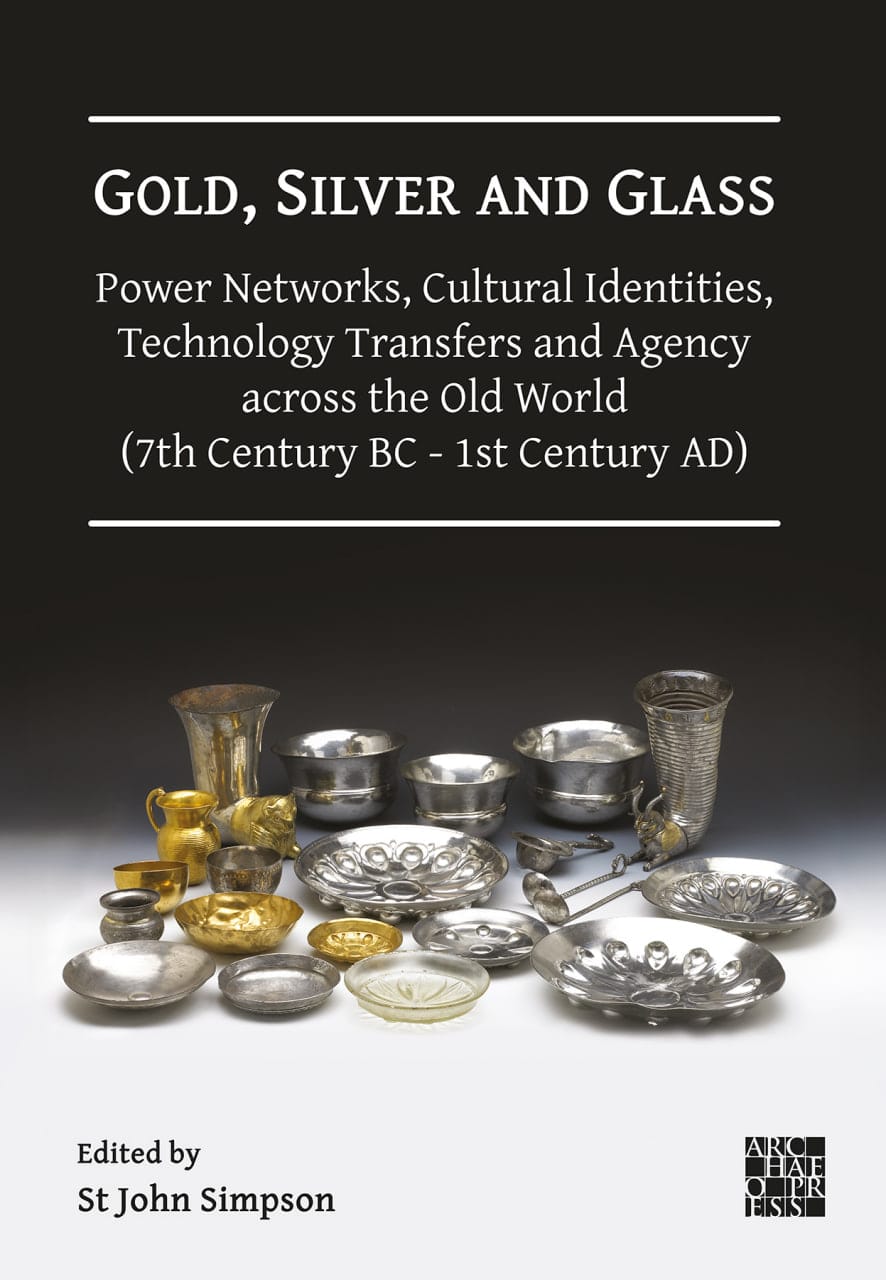
Simpson, St John (ed.). 2026. Gold, Silver and Glass: Power Networks, Cultural Identities, Technology Transfers and Agency across the Old World (7th Century BC – 1st Century AD). Bicester: Archaeopress.
This volume explores how precious materials shaped power, identity and cultural exchange in the ancient world from the 7th century BC to early Roman times. Growing out of the British Museum special exhibition Luxury and Power: Persia to Greece, it brings together new perspectives on technology, value and artistic interaction from Greece to China.
Table of Contents
List of Figures and Tables
Introduction – St John Simpson
Acknowledgements
Did Buddhist Concepts Reach Iron Age Scandinavia? The Gundestrup Cauldron, the 14-Spoked Wheel and the ‘Axial Age’ – Timothy Taylor
The Persian Parthenon – Thomas Harrison
Persian and Greek Arts in the World of the Scythian Warriors of Asia: from Monuments to Bodies, the Choice of the Nomads – Henri-Paul Francfort
On the Problem of the Artistic and Manufacturing Centres in the Eurasian Nomadic World – Elena Korolkova
Dragons in the Scythian Fantastic Bestiary – Sergey Polin and Marina Daragan
Objects Made from Human Crania in Scythian Burials in the Northern Black Sea Region – Marina Daragan and Sergei Polin
Ancient Armenia: Historical and Cultural Connections Based on the Collections in the History Museum of Armenia – Nzhdeh Yeranyan, Ruben Vardanyan, Armine Zohrabyan, Hasmik Margaryan
Persian Gold – Jack Ogden
Metrology 40 years on – M. Vickers
Achaemenid Silver: An Essay on the Fungibility of Meaning – Henry P. Colburn
An Achaemenid Silver ‘Rattling Bowl’ – Julien Cuny, Benoît Mille, Agnès Lattuati-Derieux
Achaemenid-Style Silverware and Gold Ornaments: a Taste for Luxury in Early Imperial China – Yan Liu
Money Talks, Wealth Whispers: Iron Age Saka Microbead Goldsmithing Technology – Saltanat Amir, Rinat Zhumatayev, Samat Shakenov, Akbar Yergabylov, Rebecca Roberts, Marcos Martinón-Torres
Transparent Glass for an Elite Greek Society – Despina Ignatiadou
Cut Gold Leaf Decoration on Hellenistic–Early Roman Glass and Marble Antiquities:a Comparison with the Kirikane Cut Gold Leaf Technique of Far Eastern Buddhist Art – Yasuko Fujii and Hidetoshi Namiki
Conclusions – St John Simpson
The Contributors
Bibliography
Index