
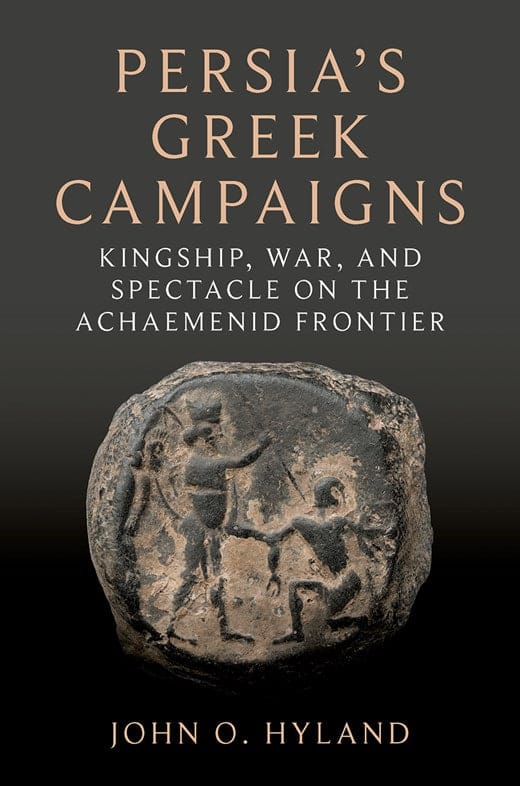
Hyland, John O. 2025. Persia’s Greek campaigns: Kingship, war, and spectacle on the Achaemenid frontier. Oxford: Oxford University Press.
Persia’s Greek Campaigns offers a bold reassessment of the wars between the Achaemenid Persian kings and the Greek city-states (c. 499–449 bce). These conflicts, and especially Xerxes’s invasion of Greece (480–479 bce), are remembered as foundational events in Greek history, but the “Persian version” remains neglected. The Persians left no campaign narratives to compare with the Greek accounts of Herodotus and Aeschylus—but their documents, artwork, and artifacts offer the foundations for a new interpretive study. Achaemenid royal inscriptions, seals and documents from Persepolis, and texts from earlier Near Eastern empires illuminate Persian worldviews and approaches to frontier warfare. Persia’s Greek campaigns did not emerge from policies of infinite expansion or “East-West” struggle, but drew on a long tradition of Near Eastern royal display through expeditions to distant frontiers. Such campaigns advertised a king’s heroic credentials, possession of divine favor, and achievement of universal power. Xerxes’s journey from Iran to Athens marked the pinnacle of this tradition, combining ideological spectacles with masterful logistical preparation. It achieved its principal goals through the seizure and burning of Athens, but its unexpected and embarrassing defeats at Salamis and Plataea undermined the intended image of royal grandeur. The resulting transition to an era of diplomatic consolidation marked a vital step in the evolution of history’s first “world empire.”