The latest issue of Antiquité Tardive (30/2022) is out, which is a special issue dedicated to Sasanian history: “Les Sassanides en conflit: géopolitique de l’empire perse tardo-antique.”
TABLE OF CONTENTS
Les Sassanides en conflit : géopolitique de l’empire perse tardo-antique
Philip Huyze, Introduction générale : l’empire sassanide dans le monde interconnecté de l’Antiquité tardive/ General introduction: the Sasanian empire in the interconnected world of Late Antiquity
Samra Azarnouche, Présentation du dossier Les Sassanides en conflit : géopolitique de l’empire perse tardo-antique
Hervé Inglebert, La place de l’empire sassanide dans les débats sur l’Antiquité tardive/ What place for the Sasanian Empire in the debates about Late Antiquity?
This book considers Gandhāran art in relation to its religious contexts and meanings within ancient Buddhism. Addressing the responses of patrons and worshippers at the monasteries and shrines of Gandhāra, papers seek to understand more about why Gandhāran art was made and what its iconographical repertoire meant to ancient viewers.
But we would like to take this opportunity to mention ‘Zoroastrianism: History, Religion and Belief‘, which has been designed by Dr Sarah Stewart and Dr Céline Redard and is offered as a free online course (MOOC).
From the archaeologists and smugglers of the Raj to the museums of post-partition Pakistan and India, from coin-forgers and contraband to modern Buddhism and contemporary art, this fourth volume of the Gandhāra Connections project presents the most recent research on the factors that mediate our encounter with Gandhāran art.
The so-called “Daiva inscription” of Xerxes found at Persepolis addresses the activity of this Achaemenid Persian king in two lands, one of which is said to have been in commotion, while the other is alleged to have been characterized by unacceptable religious practices. Xerxes stresses his involvement in the restoration of order in both countries but does not mention their names. Egypt, Babylon, Greece and Bactria were all adduced as candidates by twentieth century scholars, while the recent mainstream of scholarship tends to interpret the same accounts as abstract ideological statements without an anchor in time or space. The new approach advocated in this paper assumes that Xerxes resorted to historical narratives only in order to provide his own apologetic version of embarrassing events. In particular, his self-professed involvement in the destruction of the cults of evil gods is to be interpreted as a twisted account of the destruction of the Acropolis of Athens by the Persian army in 480 BC. In the wake of the disastrous war against the Greeks, Xerxes strove to present it as a successful special operation against the Greek deities.
The collection of essays in this book focuses on the highlands of Iran in pre-modern times, reaching from the Paleolithic to the medieval period. What holds the diverse contributions together is an issue that is closely related to debates in our own times: crises and how societies in the past dealt with them. We start from the premise that general circumstances in the fractured topographic structure of the Iranian highlands led to unique relations between ecological, social, economic and political conditions.
In three sections entitled “Climate and palaeoenvironment”, “Settlement, subsistence and mobility” und “Political and economic institutions”, the authors ask what sorts of crises afflicted past societies in the Iranian highlands, to what extent they proved resilient, and especially what strategies they developed for enhancing the resilience of their ways of life. Looking for answers in paleoenvironmental proxy data, archaeological findings and written sources, the authors examine subsistence economies, political institutions, religious beliefs, everyday routines and economic specialization in different temporal, spatial and organizational scales.
This book is the first volume of a series published by the German-Iranian research cooperation “The Iranian Highlands: Resiliences and Integration in Premodern Societies”. The goal of the research project is to shine a new light on communities and societies that populated the Iranian highlands and their more or less successful strategies to cope with the many vagaries, the constant changes and risks of their natural and humanly shaped environments.
Yaghmaee, Esmail & Samira Imeni. 2022. Achaemenid Residences from Persepolis to Susa [Manzelgāh-hāye Haḵāmanešī az Taḵt-I Ğamšīd tā Šūš]. Tehran: Karnamak (in Persian).
This book results from a series of archaeological surveys in south Iran, notably Fars province, which led to the recognition of structures remaining of palaces or pavilions. The authors discuss that these structures were residences of the king and members of the royal house who resided in these houses, which were surrounded by agricultural lands and plantations for royal hunts. Besides the hills and other archaeological finds, the column bases are considered an indicator of such residences. The residence in Dašt-i Gohar near Persepolis and the column base now kept in Rām Hormoz are considered, respectively, the first and last of these residences.
The latest issue of Iran and the Caucasus (26.4) contains several interesting contributions.
Table of contents:
Li Sifei: Tubo-Sogdian Relations along the Silk Road: On an Enigmatic Gold Plaque from Dulan (Qinghai, China)
Sebastian Bitsch: Hell’s Kitchen: The Banquet in the Hereafter and the Reflexion of Zoroastrian Eschatological Motifs in the Qurʾān
Alex MacFarlane: The City of Brass and Alexander’s Narrow Grave: Translation and Commentary of Kafas added to Manuscript M7709 (Part 2)
Richard Foltz: The Survival of Ossetians in Turkey
Marco Fattori: The Elamite Version of A2Ha and the Verb vidiyā- in Old Persian
John D. Bengtson and Corinna Leschber: On Criticism of S. L. Nikolayev/S. A. Starostin, A North Caucasian Etymological Dictionary
Victoria Arakelova: The Talishis on Opposite Banks of the Araxes River: Identity Issues
Arsen K. Shahinyan: The Southern Boundaries of the Southern Caucasus
Adrian C. Pirtea: [Review of] Samuel N. C. Lieu, Glen L. Thompson (eds.), The Church of the East in Central Asia and China (China and the Mediterranean World, 1), Turnhout: “Brepols”, 2020.—xiii + 245 pp.
This paper presents the publication of two new owners’ graffiti discovered in Phanagoria in 2015. The first one, Ἀράτριος ἡ κύλιξ (the kylix of Aratris), dates back to the end of the first quarter of the 5th century BC. The name Aratris demonstrates obvious parallels to the ethnic name Aratrii mentioned in The Periplus of the Erythraean Sea (Peripl. M. Rubr.). The second graffito is Ἀρπάτρις (Arpatris). It dates back to the end of the 6th-first third of the 5th century BC. It is possible to suggest that it is a composite name of Scythian origin and it should be translated as ‘the Keeper of Fire’.
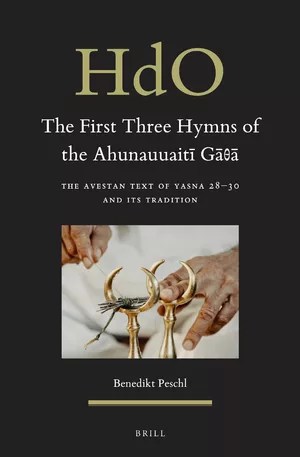
At the center of this book stands a text-critical edition of three chapters of the Gāthās, exemplifying the editorial methodology developed by the “Multimedia Yasna” (MUYA) project and its application to the Old Avestan parts of the Yasna liturgy. Proceeding from this edition, the book explores aspects of the transmission and ritual embedding of the text, and of its late antique exegetical reception in the Middle Persian (Pahlavi) tradition. Drawing also on a contemporary performance of the Yasna that was filmed by MUYA in Mumbai in 2017, the book aims to convey a sense of the Avestan language in its role as a central element of continuity around which the Zoroastrian tradition has evolved from its prehistoric roots up to the modern era.
Table of Contents
Part 1 Editing Old Avestan in the Context of the MUYA Project
Manuscripts Collated
Methodology of the Collation Process (1): Transcription of the Manuscripts
Methodology of the Collation Process (2): Regularisation of Variant Readings
Scope of the Constituted
Editorial Decisions Regarding Non-Trivial Phonetic and Orthographic Alternations
Part 2 Yasna 28–30: Text, Translation, Selected Commentaries and Glossary
Preliminaries to the Edition of the Avestan Text
Yasna 28: Edition of the Avestan Text
Yasna 29: Edition of the Avestan Text
Yasna 30: Edition of the Avestan Text
Yasna 28: Constituted Text and Translation
Yasna 29: Constituted Text and Translation
Yasna 30: Constituted Text and Translation
Notes on the Translation of the Avestan Text
Selected Commentary Essays Proceeding from the Avestan Text
Glossary of the Avestan text of Yasna 28–30
Part 3 Studies on the Ritual Setting of the Ahunauuaitī Gāθā (Yasna 28–34)
Ritual Actions During the Recitation of the Ahunauuaitī Gāθā
Considerations on the Rationale Behind Specific Ritual Actions
Ritual Directions Accompanying Yasna 28–30 in the Manuscript Tradition
Studies on the Exegetical Reception of Yasna 28
Re-approaching the Pahlavi Gāθās
Edition and Translation of Pahlavi Yasna 28
Pahlavi Yasna 28: Commentary
On the Marginal Headings Accompanying the Old Avesta in the Exegetical Manuscripts of the Yasna
Yasna 28.11, Yašt 1.26 and the Warštamānsar Nask: Untangling an Intertextual Network
Appendix to Part 4: Edition and Translation of the Commentary on Yasna 28 in the Dēnkard Epitome of the Warštamānsar Nask (Dk 9.28)
Concluding Thoughts: Advancing a Holistic Approach to the Zoroastrian Textual Tradition
Benedikt Peschl holds a BA in General and Indo-European Linguistics from the University of Munich, an MA in Religions of Asia and Africa from SOAS University of London, and a PhD in Study of Religions from SOAS (2021). He now works as a postdoctoral researcher at the Institute of Iranian Studies of Freie Universität Berlin.