• The Bundahišn: a new translation

    Agostini, Domenico & Samuel Thrope (eds.). 2020. The Bundahišn: The Zoroastrian Book of Creation. A new translation. New York: Oxford University Press.

    The Bundahisn, meaning primal or foundational creation, is the central Zoroastrian account of creation, cosmology, and eschatology. Compiled sometime in the ninth century CE, it is one of the most important surviving testaments to Zoroastrian literature in the Middle Persian language and to pre-Islamic Iranian culture. Despite having been composed some two millennia after the Prophet Zoroaster’s revelation, it is nonetheless a concise compendium of ancient Zoroastrian knowledge that draws on and reshapes earlier layers of the tradition.

    Well known in the field of Iranian Studies as an essential primary source for scholars of ancient Iran’s history, religions, literatures, and languages, the Bundahisn is also a great work of literature in and of itself, ranking alongside the creation myths of other ancient traditions. The book’s thirty-six diverse chapters, which touch on astronomy, eschatology, zoology, medicine, and more, are composed in a variety of styles, registers, and genres, from spare lists and concise commentaries to philosophical discourses and poetic eschatological visions. This new translation, the first in English in nearly a century, highlights the aesthetic quality, literary style, and complexity and raises the profile of pre-Islamic Zoroastrian literature.

    (more…)
  • Turkic-Iranian relationships: Uighur newcomers of the Qočo kingdom

    Piras, Andrea. 2019. Khan uiguri del regno di Qočo (850-1250) nelle fonti di Turfan. In Giorgio Comai, Carlo Frappi, Giovanni Pedrini & Elena Rova (eds.), Armenia, Caucaso e Asia Centrale (Eurasiatica 12), 145–161. Venice: Edizioni Ca’ Foscari.

    This article firstly deals with a general survey of the Turkic-Iranian relationships, from the VI century onwards, by the point of view of epigraphic evidences and sparse linguistic references within the Indo-Iranian borderlands and Central Asia. Secondly, it focuses on Turkic words (onomastic, epithets, titles) recorded in Middle Persian texts of the Manichean religion, in order to highlight the cultural contacts between the Uighur newcomers of the Qočo kingdom and the local population, both sharing common religious beliefs such as Manichaeism and Buddhism. Given the Manichaean faith of the Uighur élites, the Middle Persian Manichaean texts show an appreciation of the Turkic rulership, attested by the panegyrical tone of many compositions dedicated to the khans and their entourages.

  • The Art of Empire in Achaemenid Persia

    Dusinberre Elspeth R.M., Mark B. Garrison & Wouter Henkelman (eds.). 2020. The Art of empire in Achaemenid Persia: Studies in honour of Margaret Cool Root (Achaemenid History 16). Leiden: Nederlands Instituut voor het Nabije Oosten & Leuven: Peeters.

    This volume in honour of Margaret Cool Root gathers seventeen contributions on Achaemenid Persian art, ranging from the European re-discovery of Persepolis, via Achaemenid glyphic art, evidence of polychrome sculpture, and Achaemenid impact in the satrapies, to possible reflections of Persepolitan art in Classical Greece. The contributors are colleagues and, in a number of cases, former students of Margaret Root. As a whole, the volume reflects the wide range of Root’s interests and her impact on the field of Achaemenid studies.

    (more…)
  • The Neo-Aramaic Verbal Root GŠQ ‘to Look’ and its Middle Iranian Origin

    Mutzafi, Hezy. 2020. The Neo-Aramaic verbal root GŠQ ‘to Look’ and its Middle Iranian origin. Le Muséon 133 (1-2), 1-12.

    The Neo-Aramaic verbal root gšq ‘to look’, known since the 19th century to occur in the Christian NENA (North-Eastern Neo-Aramaic) dialects of Urmi and Salmas in Iranian Azerbaijan, has thus far remained without an established, or at least plausible, etymology. The etymology proposed in this paper considers gšq to be inherited from an earlier NENA layer, in which it was a denominative derivative of a noun akin to Mandaic gušqa ‘spy’, a Middle Iranian loanword. This etymology is buttressed by parallel cases in Neo-Aramaic and other languages of the world as regards semantic changes and affinities between the meanings ‘to spy’ and ‘to look’, as well as similar processes of word-formation in NENA, namely denominative verbs derived from borrowed nouns and inflected in the neo-pa”el verbal pattern.

  • Rethinking the Life of Mani

    Gardner, Iain. 2020. The founder of Manichaeism: Rethinking the life of Mani. New York: Cambridge University Press.

    Mani, a third-century preacher, healer and public sage from Sasanian Mesopotamia, lived at a pivotal time and place in the development of the major religions. He frequented the courts of the Persian Empire, debating with rivals from the Judaeo-Christian tradition, philosophers and gnostics, Zoroastrians from Iran and Buddhists from India. The community he founded spread from north Africa to south China and lasted for over a thousand years. Yet the genuine biography of its founder, his life and thought, was in good part lost until a series of spectacular discoveries have begun to transform our knowledge of Mani’s crucial role in the spread of religious ideas and practices along the trade-routes of Eurasia. This book utilises the latest historical and textual research to examine how Mani was remembered by his followers, caricatured by his opponents, and has been invented and re-invented according to the vagaries of scholarly fashion.

    (more…)
  • Artifact, Text, Context

    Tang, Li & Dietmar W. Winkler (eds.). 2020. Artifact, text, context: Studies on Syriac Christianity in China and Central Asia (orientalia – patristica – oecumenica 17). LIT Verlag.

    This volume is a collection of papers highlighting recent researches on Syriac Christianity in China and Central Asia. The topics range from artifacts to texts and their historical contexts, covering the period from the 7th to the 18th century. As the studies on Syriac Christianity in China and Central advance, focus has shifted from a general historical survey and textual translation to a more micro and meticulous study of specific concepts and terms and particular names of persons and places.

  • Achaemenid Anatolia

    Dahlén, Ashk P. (ed). 2020. Achaemenid Anatolia: Persian presence and impact in the Western Satrapies 546-330 BC. Proceedings of an international symposium at the Swedish Research Institure in Istanbul, 7-8 September, 2017. Boreas: Uppsala Studies in Ancient Mediterranean and Near Eastern Civilizations.

    The mid-sixth century bc saw the formation of one of the ancient world’s largest and richest empires, the first Persian Empire under the Achaemenid dynasty. After the conquests of Cyrus the Great its vast realms stretched from the Aegean Sea in the west to the Jaxartes River in the east. The empire’s cosmopolitan policies, based on a shared economic relationship and a pluralistic administrative structure, heralded a period of astonishing cross-cultural fertilisation and innovation in different spheres of culture, trade and learning. These new developments were embraced and carried out in, among other regions, the highly multicultural setting of Achaemenid Anatolia.

    Achaemenid Anatolia contains twelve articles from an international symposium (2017) on the relationships between the Iranian world and Anatolia in the Achaemenid period with an emphasis on Persian structures, presence and impacts on local populations and cultures. The contributions discuss a wide range of topics and address a variety of perspectives, from material culture, archaeology, architecture, and art history to philology, history, literature, numismatics, and religion.

    (more…)
  • Short-term Empires in World History

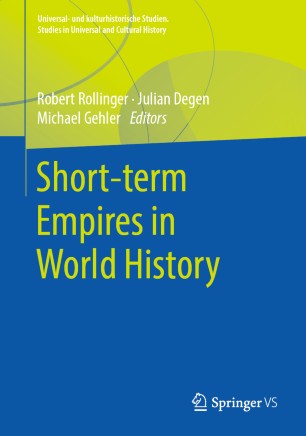
    Rollinger,Robert, Julian Degen & Michael Gehler (eds.). 2020. Short-term empires in world history. Wiesbaden: Springer.

    The volume will focus on a comparative level on a specific group of states that are commonly labelled as “empires” and that we encounter through all historical periods. Although they are very successful at the very beginning, like most empires are, this success is very ephemeral and transient. The era of conquest is never followed by a period of consolidation. Collapse and/or reduction to much smaller dimension run as fast as the process of wide-ranging conquest and expansion. The volume singles out a series of such “short-term empires” and aims to provide a methodologically clearly structured as well as a uniform and consistent approach by developing a general set of questions that guarantee the possibility to compare and distinguish. This way it intends to examine not only already well established empires but also to illuminate forgotten ones.

    (more…)
  • Indian storytelling and the romance genre in Persian and Urdu

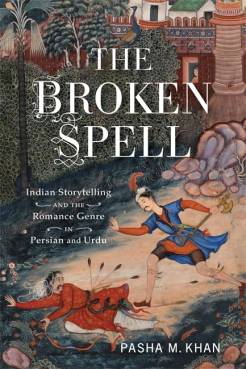
    Khan, Pasha M. 2019. The broken spell: Indian storytelling and the romance genre in Persian and Urdu (Series in Fairy-Tale Studies). Detroit: Wayne State University Press.

    The Broken Spell: Indian Storytelling and the Romance Genre in Persian and Urdu is a monograph on the rise and fall in popularity of “romances” (qissah)—tales of wonder and magic told by storytellers at princely courts and in public spaces in India from the sixteenth century to the twentieth. Using literary genre theory, author Pasha M. Khan points to the worldviews underlying the popularity of Urdu and Persian romances, before pre-existing Islamicate rationalist traditions gained traction and Western colonialism came to prominence in India.

    In the introduction, Khan explains that it was around the end of the nineteenth century that these marvelous tales became devalued by Orientalists and intellectually colonized Indian elites, while at the same time a new genre, the novel, gained legitimacy. Khan goes on to narrate the life histories of professional storytellers, many of them émigrés from Iran to Mughal-ruled India, and considers how they raised their own worth and that of the romance in the face of changes in the economics, culture, and patronage of India. Khan shows the methods whereby such storytellers performed and how they promoted themselves and their art. The dividing line between marvelous tales and history is examined, showing how and why the boundary was porous. The study historicizes the Western understanding of the qissah as a local manifestation of a worldwide romance genre, showing that this genre equation had profound ideological effects. The book’s appendix contains a translation of an important text for understanding Iranian and Indian storytelling methods: the unpublished introductory portions to Fakhr al-Zamani’s manual for storytellers.

  • Iran and the Deccan

    Keelan Overton (ed.). 2019. Iran and the Deccan: Persianate art, culture, and talent in circulation, 1400-1700. Bloomington: Indiana University Press.

    Beginning in the early 1400s, large numbers of Iranian elites began migrating to the Deccan plateau of southern India. Lured to the region for many reasons, these poets, traders, statesmen, and artists of all kinds left an indelible mark on the Islamic sultanates that ruled the Deccan until the late seventeenth century. The result was the creation of a robust transregional Persianate network linking such distant cities as Bidar and Shiraz, Bijapur and Isfahan, and Golconda and Mashhad.
    Iran and the Deccan explores the circulation of art, culture, and talent between Iran and the Deccan over a three hundred year period. Its interdisciplinary contributions consider the factors that prompted migration, the physical and intellectual poles of connectivity between the two regions, and processes of adaptation and response. Placing the Deccan at the center of Indo-Persian and early modern global history, Iran and the Deccan reveals how mobility, liminality, and cultural translation nuance the traditional methods and boundaries of the humanities.

    Source: Iran and the Deccan

    Keelan Overton is an independent scholar and historian of art specializing in the eastern Islamic world from Iran to South Asia. She is author of “Book Culture, Royal Libraries, and Persianate Painting in Bijapur, circa 1580-1630” in Muqarnas and “Filming, Photographing and Purveying in ‘the New Iran:’ The Legacy of Stephen H. Nyman, ca. 1937–42” in Arthur Upham Pope and A New Survey of Persian Art.