• Studies on the History of the Achaimenids

    Wiesehöfer, Josef. 2022. Iran – Zentralasien – Mittelmeer Gesammelte Schriften, Teil I: Studien zur Geschichte der Achaimeniden. (Philippika – Altertumswissenschaftliche Abhandlungen). (Ed.) Robert Rollinger & Kai Ruffing. Wiesbaden: Harrassowitz Verlag.

    Josef Wiesehöfer is one of the leading German-speaking historians of ancient history and is a world-renowned scholar, who has made outstanding achievements in his fields of research. In keeping with the diversity of his research interests, especially in the field of Iran and the Iranian Great Empires as well as the history of scholarship of the field, four thematically volumes of his “Kleine Schriften” are planned. These Kleine Schriften are intended to provide an insight into his scholarly work and contain a selection of the 250 scholarly articles Wiesehöfer has published to date in over 45 years of research.

    Volume 1, edited by Robert Rollinger and Kai Ruffing, focuses on the history of the Achaimenid Empire and brings together 14 essays, some of which were published in more remote places. The contributions are indexed and Josef Wiesehöfer himself has added a short commentary on the progress of research. The following volumes will be devoted to Hellenism and the Arsacids, the Sasanian and finally the history of scholarship of the field.

    (more…)
  • Sometimes Sasanian, Always Ēr

    Gyselen, Rika (ed.). 2022. Sometimes Sasanian, Always Ēr (Res Orientales 29). Bures-sur-Yvette: Groupe pour l’Étude de la Civilisation du Moyen-Orient.

    Volume 29 of the Res Orientales, edited by Rika Gyselen is now published. The preface to this volume is available online here.

    Table of Contents:

    Rika Gyselen: “Un objet insolite avec une inscription moyen-perse”

    Mateusz M. P. Klagisz: “Bābāye Dehqān in Central Asian ethnography , and the literary and iconographic motif of the ploughman with two oxen in Sasanian times”

    Yousef Moradi an d Almut Hintze: “The main administrative seal of the sanctuary of A.dur Gusnasp and some other sealings from Takt-e Solayman”

    L’archive du Tabarestan (VIII° siècle de notre ère)

    Dieter Weber: “Pahlavi Legal Documents from Tabarestan: The Documents Tab.16, 19, 20, 22bis and 25: A Philological Approach”

    Maria Macuch: “Pahlavi Legal Docun1ents from Tabarestan: The Juristic Context of Tab.16, 19, 20, 22bis and 25”

    Maria Macuch: “Pahlavi Legal Documents from Tabarestan: The Juristic Context of Tab.12 and 26”

  • Empires to be remembered

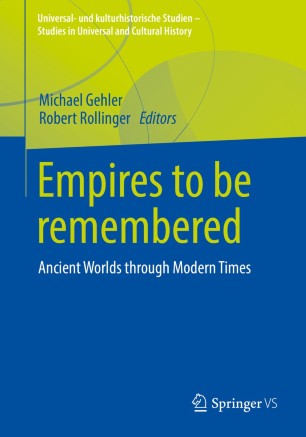
    Gehler, Michael & Robert Rollinger (eds.). 2022. Empires to be remembered. Ancient Worlds through Modern Times. Wiesbaden: Springer.

    By applying a comparative approach the volume focuses on a select group of „empires“ which are generally not in the focus of empires studies. They are studied in detail and analyzed due to a strict concept that takes into account real history and reception history as well. Reception history becomes more and more an important element in empire studies although this topic is still often more or less underdeveloped. The volume singles out a series of such “forgotten empires”. It aims to provide a methodologically clearly structured as well as a uniform and consistent approach. It develops a general set of questions that help to compare and distinguish these entities. This way the volume intends to examine and to illuminate empires that are generally ignored by modern scholarship.

    (more…)
  • Elephantine in Context

    Kratz, Reinhard G & Bernd U. Schipper (eds.). 2022. Elephantine in Context: Studies on the History, Religion and Literature of the Judeans in Persian Period Egypt (Forschungen zum Alten Testament, 155). Tübingen: Mohr Siebeck.

    The Persian period has long been considered a »dark era« in Israel’s history. For this reason, research has mainly focused on how it is depicted in the Hebrew Bible. A spectacular discovery of archaeological relics and epigraphic sources was hence hardly noticed: the military colony located on the island of Elephantine in the Nile, on the border between Egypt and present-day Sudan. The basic approach of this volume, which documents a three-year Deutsche Forschungsgemeinschaft project, is to break with a research tradition focusing on the Judeans (Jews) mentioned in the Aramaic papyri from Elephantine and instead investigate the military colony in a broader historical context also documented by Demotic and Egyptian-hieratic evidence found at Elephantine. The studies presented focus on three main subject areas: society and administration, religion, and literature. They show that historically the island of Elephantine hosted a multicultural society with several interactions between the Egyptians and the other inhabitants, and that it was also an important administrative centre for the Persian authorities.

  • نوروز پیروز و شاد باد

    برای همه خوانندگان وبگاه بیبلیوگرافیا ایرانیکا، دوستان و همکاران خوبمان سالی سرشار از تندرستی و شادی آرزو میکنیم.

    We wish all our readers, colleagues and friends a Happy Nowruz.

    نوروزتان پیروز!

    Nowruz 1400
  • Summer Course in Zoroastrian Studies

    The University of Bergen (Norway) and the Shapoorji Pallonji Institute of Zoroastrian Studies at SOAS, are jointly offering international students the opportunity to immerse themselves in the study of Zoroastrianism in modern and contemporary Iran.

    The course will take place in Rome, starting 20 June 2022, and the deadline for applications is 27 March 2022. The instructors are Prof. Michael Stausberg (Univ. of Bergen), Dr Sarah Stewart (SOAS) and Dr Jenny Rose (Claremont University). You can find more information by visitng the summer school’s website.

  • Iran, Volume 60, Issue 1 (2022)

    The table of contents of the latest issue (60/1) of the journal Iran:

    • Marta Ameri: Who Holds the Keys? Identifying Female Administrators at Shahr-i Sokhta
    • Soheila Hadipour Moradi & Bita Sodaei: Two Bronze Coins of Alexander Balas Recently Discovered in Luristan (Iran)
    • Bertille Lyonnet: New Insights into Sogdiana during the Classical Period (from the end of the 4th c. BCE to the 3rd c. CE)
    • Ruben S. Nikoghosyan: Where Did the Battle Between Wištāsp and Arǰāsp Take Place?
    • Andrea Squitieri: The Sasanian Cemetery of Gird-i Bazar in the Peshdar Plain (Iraqi Kurdistan)
    • Atri Hatef Naiemi: The Ilkhanid City of Sultaniyya: Some Remarks on the Citadel and the Outer City
    • Soli Shahvar: “Abbas Mirza’s Invitation to Europeans to Settle in Nineteenth-Century Iranian Azerbaijan: Reasons, Causes and Motives”
    • Ladislav Charouz: Naser al-Din Shah’s 1873 Visit to the World’s Fair in Vienna
  • The Intersection of Gods and Kings in Achaemenid Iran

    Tuplin, Christopher. 2022. The intersection of gods and kings in Achaemenid Iran. In: Eleni Pachoumi (ed.), Conceptualising divine unions in the Greek and Near Eastern worlds, 45-73. Leiden & Boston: Brill.

    From the introduction of the chapter:

    I start with two premises. First, among conceptions of divinity those around royal divinity have a strong claim to interest. Second, there is no evidence that the Achaemenid king was categorized or worshipped as a god in the imperial heartland. The (rather few) Greek sources that directly suggested this were wrong. (The ones that spoke of an isotheos king or skated round the issue in other ways are, of course, another matter.) But our business here is with intersections between king and divinity other than simple identification of the king as a god or attribution of his success to the help of a god. Is Achaemenid royal exceptionalism due not just to divine favour but to an inherent divine quality? There has been a growing tendency to perceive mitigations of the king’s human status, even in the heartland. I have discussed these matters in an earlier essay (Tuplin 2017). Here I elaborate on some material that appears more briefly there. I do so in three sections: (1) A tale of two statues. (2) Royal rhetoric in the heartland religious environment. (3) Image, light and daimōn: royal divine aura in Greek texts.

  • Pottery Making and Communities During the 5th Millennium BCE in Fars

    Miki, Takehiro. 2022. Pottery making and communities during the 5th millennium BCE in Fars province, Southwestern Iran. Oxford: Archaeopress.

    This book explores pottery making and communities during the Bakun period (c. 5000 – 4000 BCE) in the Kur River Basin, Fars province, southwestern Iran, through the analysis of ceramic materials collected at Tall-e Jari A, Tall-e Gap, and Tall-e Bakun A & B. Firstly, it reconsiders the stratigraphy and radiocarbon dates of the four sites by reviewing the descriptions of excavation trenches, then presents a new chronological relationship between the sites. The book sets out diachronic changes in the the Bakun pottery quantitatively, namely the increase of black-on-buff ware and the gradual shift of vessel forms. It also presents analyses of pottery-making techniques, painting skills, petrography, and geochemistry and clarifies minor changes in the chaînes opératoires and major changes in painting skill. Finally, the book discusses the organisation of pottery production from a relational perspective. It concludes that the more fixed community of pottery making imposed longer apprenticeship periods and that social inequality also increased.

  • The Elamite Version of XPl?

    Delshad, Soheil. 2022. An unpublished stone fragment in Achaemenid Elamite: The Elamite version of XPl? Arta 2022.001.

    Description, edition, and identification of an inscribed grey limestone tablet in the reserves of the Persepolis Museum. The author argues that the fragment’s text belongs to the Elamite version of XPl. In addition, some problems of the Elamite version of DNb are discussed.