• Zoroastrian Embroidery

    Parsi Zoroastrian Embroidery © UNESCO Parzor
    Parsi Zoroastrian Embroidery © UNESCO Parzor

    Cama, Shernaz. 2014. Parsi Embroidery: An Intercultural Amalgam. In Zhao Feng, Marie-Louise Nosch & Lotika Varadarajan (eds.), Global Textile Encounters, 263–274. (Ancient Textiles Series). Oxford: Oxbow Books.

    From early history, textiles have woven together the tapestry of humanity. The Parsi Zoroastrians, now a tiny minority of under 65,000 individuals in India, have saved, in their cupboards and trunks, this proof of our world’s multicutural history. Cpmplex roots and routes lie behind what we call “Parsi Embroidery” today. The tradition grew  from Achaemenian Iran, travelled through the Silk Route into China and then came back with Indian and European influences, to its originators, the Parsi Zoroastrians of India.
    Shernaz Cama is asociate professor at Lady Shri Ram College, Delhi University, India.
  • Zoroastrian Law and Identity

    Sharafi, Mitra. 2014. Law and identity in colonial South Asia: Parsi legal culture, 1772-1947. (Studies in Legal History). New York, NY: Cambridge University Press.

    This book explores the legal culture of the Parsis, or Zoroastrians, an ethnoreligious community unusually invested in the colonial legal system of British India and Burma. Rather than trying to maintain collective autonomy and integrity by avoiding interaction with the state, the Parsis sank deep into the colonial legal system itself. From the late eighteenth century until India’s independence in 1947, they became heavy users of colonial law, acting as lawyers, judges, litigants, lobbyists, and legislators. They de-Anglicized the law that governed them and enshrined in law their own distinctive models of the family and community by two routes: frequent intra-group litigation often managed by Parsi legal professionals in the areas of marriage, inheritance, religious trusts, and libel, and the creation of legislation that would become Parsi personal law. Other South Asian communities also turned to law, but none seems to have done so earlier or in more pronounced ways than the Parsis.

    This book is based upon previously unexamined primary sources from archives rediscovered over the past decade: the Bombay High Court (Mumbai) and the Judicial Committee of the Privy Council (London) as well as takes case law seriously, while most work on South Asian legal history focuses on legislatio. It presents one of the first studies in South Asian legal history by a scholar trained both in law and in history.

    See here the ToC of this book.

    Mitra Sharafi is an Assistant Professor at the University of Wisconsin Law School, with an affiliation appointment in history at the University of Wisconsin, Madison.

  • Corpus of Alanic Marginal Notes

    Lubotsky, A. (2015). Alanic marginal notes in a Greek liturgical manuscript. Veröffentlichungen zur Iranistik 76. Wien: Verlag der Österreichischen Akademie der Wissenschaften.
    The book represents the first publication of the complete corpus of Alanic marginal notes in a 13th century Byzantine manuscript from the Library of the Academy of Sciences in Saint Petersburg. This manuscript is a Greek Old Testament lectionary, or Prophetologion, which at one point was owned and used by an Alanic priest who had learned to read and write Greek, but felt the need to identify the feasts in the margin of his manuscript, because he could not easily find them by skimming the text. For this purpose, he wrote an abbreviated heading of his own in the margin, next to the full heading of the manuscript. There are altogether 34 marginal notes in the manuscript (24 Alanic, 9 Greek, and 1 mixed). In this edition, every note is followed by the Greek heading, to which the note refers, its translation, and a black-and-white photograph. Then, a short outline of the liturgical context is provided, when necessary, followed by paleographic comments and an analysis of the meaning of the note and its linguistic structure. The edition of the notes ends with a discussion of the spelling conventions and the language of the notes and with an appendix on the Alanic text in Tzetzes’ Theogonia. The book is further provided with full-color photographs of all pages containing marginal notes.
    See the Table of the Contents here.
    Alexander Lubotsky is Professor of Comparative Indo-European Linguistics at Leiden University.
  • Call for contributions

    For_BiblioIranicaWe would like to invite publishers, colleagues and our readers to send us information about upcoming publications that are relevant to Bibliographia Iranica’s field of interest. Please use the ‘Contact‘ page to send us the bibliographic information. Your submission will be reviewed by our team and published in due course.

    Contributed bibliographic posts will be marked as such with the name of the contributor.

    Please share this call widely on social media.

  • Ergativity in Old and Middle Iranian languages

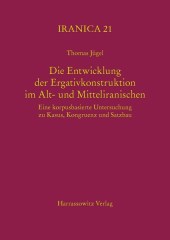
    Ergativity is a grammatical phenomenon that has been discussed controversially in linguistics in general and in the Iranian Studies in particular. The scientific debate is characterized by a lack of consideration of the Old and Middle Iranian data. In many cases, the selected examples, which their position in the respective language system is  still unclear, are associated with theory-driven assumptions about a hypothetical model of development, which is to be plausible, but not verifiable.

    The present study provides a solution through the complete analyzing of the Avestan , Old Persian, Bactrian and Parthian documents as well as an extensive study of Middle Persian evidences (approximately 12,500 Middle Persian cases). In addition to the relevant ergativity aspects such case, congruence, word order,  and reflexivity both the development of syntactic structures (e.g. relative clauses) as well as the verbal and nominal system (e.g. the temporal aspect system or the function of enclitic personal pronouns) are discussed .

    Results are illustrated with relevant evidences  (over 1,400 examples alone in the main part), whose validity is constantly checked and  based critically on detailed philological discussion. The material part also serves as a vademecum, which can be used in parallel with the reading of the main part, as well as a separate reference book that systematically illustrates the history of the object in ergative languages.

    The volume presents the most exhaustive investigation on ergativity in within the Old and Middle Iranian languages.

    The detaild Table of Content of this book and the English Summery are availabe. (more…)

  • Herodotus: Histories, Books 1-4

    Herodotus: Histories, Books 1-4 (Herodoti Historiae: Libri I-IV), Edited by N. G. Wilson, 2015, Oxford Classical Texts.

    New edition of 1902 original text, last revised in 1927
    Accompanied by extensive commentary volume, Herodotea
    New to this edition

    Features extensively revised apparatus criticus
    Incorporates new findings and research, including the readings of over 80 papyri and two medieval manuscripts
    In this new edition of Herodotus’ Histories, Nigel Wilson has revised the original Oxford Classical Text by the Danish scholar C. Hude, published in 1906 and last revised in 1927. As well as incorporating much of the valuable work on the text that has been conducted since the original edition, in particular that of J. Enoch Powell and Paul Maas, Wilson has taken into account new readings from over 80 papyri. In addition, clarity in the apparatus criticus has been improved by the collation of two previously neglected medieval manuscripts, which belong to the so-called Roman family.

    A number of passages remain puzzling, and Wilson proposes new solutions and provides plausible emendations wherever possible. This new edition is accompanied by a commentary, Herodotea, written by the editor, in which he explains many of the editorial decisions he made while revising this key classical text.

  • Zoroastrian Manuscripts in Russia

    The article introduces unique Persian manuscripts in the collection of the IOM, RAS specially devoted to Zoroastrian matters. In short Zoroastrian scriptures composed in New Persian during the 12th–17th centuries, were not literal translations from the Pahlavi, but free interpretations of the old sources, adapted to the changing circumstances of life.

    The artcile is available to download here.

    Aly Ivanovich Kolesnikov is Leading Researcher at the Institute of Oriental Manuscripts, Russian Academy of Sciences.

  • Memorial Volume for Chahryar Adle

    bokhara 107

    Bukhara, No. 107 (Memorial Volume for Chahryar Adle). Tehran. 2015.- Via Ehsan Shavarebi.

    The 107th issue of Bukhara Magazine (July-August 2015) is dedicated to the memory of the late Professor Chahryar Adle (1944-2015). Chahryar Adle, Iranian archaeologist specialised in art and architecture of Iran and Central Asia during the Islamic period, passed away in Paris on 21 June.
    This volume, edited by Ali Dehbashi, includes more than 50 papers in memory of the late Prof. Adle, by such scholars as Firouz Bagherzadeh, Mahmoud Mousavi, Rémy Boucharlat, Carlo G. Cereti, Marie-Christine David, Hekmatollah Mollasalehi, Ehsan Eshraghi, Rajab-Ali Labbaf-Khaniki, Ali Mousavi, Mehrdad Malekzadeh, Nader Nasiri-Moghaddam, Shahram Zare, Mohammad Taghi Ataee, Ehsan Shavarebi, etc. Also several papers and interviews of Prof. Adle are republished in this volume.
    The volume is in Persian and consists of 513 pages.

  • Pahlavi Epistolary Formulae

    Chunakova, Olga Mikhailovna. 2015. Pahlavi Epistolary Formulae. Written Monuments of the Orient 1(1). 32–37.

    The paper focuses on the Pahlavi text dealing with the correct way to write letters published in: JAMASP-ASANA (ed.) 1913, 132–140. The text contains a series of formulae to be used in letters to various persons. The reading and interpretation of the formulae were translated differently by previous scholars. The key to the understanding of these formulae is the opposition of two terms—xwadāy and bandag—meaning the addressee and the sender of a letter. The constructions with an attribute compound and its synonym, and a determinative compound and its synonym following these two terms refer to the addressee and the sender respectively.

    The artcile is available to download here.

    Olga Mikhailovna Chunakova is Head of the Section of Middle Eastern Studies at the Institute of Oriental Manuscripts, Russian Academy of Sciences.

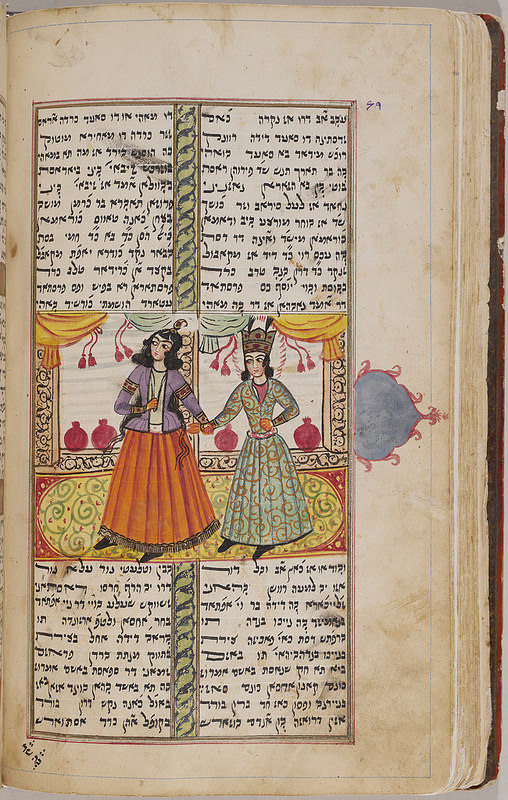
  • On Judeo-Persian 2

    McCollum, Adam. 2015. On Judeo-Persian language and literature. Part Two: Texts and Bibliography. Ancient Jew Review.

    In a two-part series, Dr. Adam McCollum addresses the possibilities for the field of Judeo-Persian language and literature. Part One addresses the state of the field and Part Two includes a helpful bibliography and four text samples.

    You can find out more about Adam McCollum and his work over at his blog, hmmlorientalia, or at his highly recommended Twitter account: @adamcmccollum.