• Sexuality in the Babylonian Talmud: Christian and Sasanian Contexts in Late Antiquity

    Kiel, Yshai. 2016.  Sexuality in the Babylonian Talmud: Christian and Sasanian Contexts in Late Antiquity. New York: Cambridge University Press.

    Within this close textual analysis of the Babylonian Talmud, Yishai Kiel explores rabbinic discussions of sex in light of cultural assumptions and dispositions that pervaded the cultures of late antiquity and particularly the Iranian world. By negotiating the Iranian context of the rabbinic discussion alongside the Christian backdrop, this groundbreaking volume presents a balanced and nuanced portrayal of the rabbinic discourse on sexuality and situates rabbinic discussions of sex more broadly at the crossroads of late antique cultures. The study is divided into two thematic sections: the first centers on the broader aspects of rabbinic discourse on sexuality while the second hones in on rabbinic discussions of sexual prohibitions and the classification of permissible and prohibited partnerships, with particular attention to rabbinic discussions of incest. Essential reading for scholars and graduate students of Judaic studies, early Christianity, and Iranian studies, as well as those interested in religious studies and comparative religion.


  • “Five Courses” on Yašts of the Avesta

    Kellens, Jean. 2016. Cinq Cours Sur les Yašts de l’Avesta. (Cahiers de Studia Iranica, 59). Paris: Peeters.

    This volume includes “five courses” devoted to the Yasts, that Jean Kellens held at the College de France. They are divided into two series, each corresponding to a special period. The first three took place between 1997 and 2000: De la naissance des montagnes a la fin du temps: le Yast 19 and the two Promenade dans les Yasts a la lumiere de travaux recents, which appear here under the new titles La maintenance du monde and Le catalogue des sacrifiants. The last two titles, La notion d’ame preexistante and Le pantheon mazdeen, written in the years 2008-2011, represent a more recent reflection. Three other contributions have been added, which complete or explain more in details some reflections of the “five courses”: Caracteres differentiels du Mihr Yast, Les saisons des rivieres and Les Fravasi.


  • The battle of Arbela in 331 BCE

    Rollinger, Robert. 2016. “The battle of Arbela in 331 BCE, Disloyal “Orientals” and the Alleged “Panic” in the Persian Army: from Neo-Assyrian kings to Alexander III“, in: Saana Svärd and Robert Rollinger (eds.), Cross-cultural Studies in Near Eastern History and Literature, 213-242, Münster.

  • The Legacy of the Ancient Kings

    The Legacy of the Ancient Kings. Ctesiphon and the Persian Sources of Islamic Art

    15.11.2016 to 02.04.2017
    Pergamonmuseum

    How did Islamic cultures and Islamic art arise? Where do their roots lie? Like the Islamic religion itself, Islamic art also built on its predecessors in the Middle East. Focussing on Ctesiphon, a vast landscape of ruins south of Baghdad, this exhibition is devoted to the Persian legacy inherited by Islam.

    Dominated by the monumental vaulted hall of the royal palace, the Taq-e Kesra, the city today is an emblem of the grandeur and downfall of the mighty Sassanid empire, a great power in ancient Persia about which little is known today. For centuries it competed with Rome and Byzantium. In the 7th century CE, however, the conquests by the Arab armies fundamentally changed the political balance of power. Culturally, too, a transformation took place – “Islamic art” was born. But had everything really changed?

    (more…)

  • Greek perspectives on the Achaemenid Empire

    Morgan, Janett. 2016. Greek perspectives on the Achaemenid Empire: Persia through the looking glass. Edinburgh University Press.

    The Greek’s view of Persia and the Persians changed radically throughout the archaic and classical period as the Persians turned from noble warriors to peacock-loving cross-dressers. This book traces the development of a range of responses to the Achaemenids and their empire through a study of ancient texts and material evidence from the archaic and classical periods. Janett Morgan investigates the historical, political and social factors that inspired and manipulated different identities for Persia and the Persians within Greece. She offers unique insights into the role of Greek social elites and political communities in creating different representations of the Achaemenid Persians and their empire.

    About the author: Janett Morgan is an interdisciplinary ancient Greek historian. Her research focuses on material culture and its representation in ancient texts, investigating the ways in which individuals, groups and communities in Greece and Achaemenid Iran used architecture and artefacts to create religious, social and political identities and to express differences. She is the author of The Classical Greek House (Bristol Phoenix Press, 2010).

  • Greek Echos in Pahlavi Literature

    Agostini, Domenico . 2016. Greek echoes in Pahlavi literature. A preliminary survey of calques and foreign terms. Linguarum Varietas 5. 13–24.

    The vast majority of the extant Pahlavi literature was written or compiled during the Islamic period (mainly during the 9th-10th centuries) and deals with religious themes of theological and scholastic interest. Only a few examples of Sasanian imaginative, scientific and philosophical works have survived, despite the rich testimony towards their existence found in Syriac, Arabic, and Persian sources, as well as references in some Pahlavi texts. In particular, some of them teach us that Greek philosophical systems, astrology, astronomy and medicine penetrated Iranian thought already in the Sasanian period. These new ideas were necessarily reworked as they entered Zoroastrian writings. It is not always easy to
    pinpoint when and where certain aspects of the Pahlavi literature rely on Greek culture, although it is quite clear that the latter had a heavy influence on the formation of Iranian, and especially Zoroastrian, thinking in Sasanian period. This article aims to present some evidence of the presence of Greek thought and lexicon in the Pahlavi literature through the textual analysis of some passages belonging to the Zoroastrian literary tradition.

  • Studia Iranica 45(1)

    The first issue of Studia Iranica 45 (2016) has been published. For a table of contents and access to individual articles, see below or visit this page.

    7 – 15 –Unité et diversité du rite avestique
    KELLENS, Jean
    abstract details download pdf
    17 – 38 –Zāwulistān, Kāwulistān and the Land Bosi
    On the Question of a Sasanian Court-in-Exile in the Southern Hindukush
    AGOSTINI, Domenico, STARK, Sören
    abstract details download pdf
    39 – 52 –A Unique Pahlavi Papyrus from Vienna (P.Pehl. 562)
    ZEINI, Arash
    abstract details download pdf
    53 – 64 –A Pamir Cereal Name in Medieval Greek Sources
    WITCZAK, Krzysztof Tomasz, NOVÁK, L’ubomír
    abstract details download pdf
    65 – 88 –Institutional Metamorphosis or Clerical status quo?
    New Insights into the Career and Work of Sayyid Mīr Muḥammad Bāqir Khātūnābādī
    MOAZZEN, Maryam
    abstract details download pdf
    89 – 126 –The Authentic Layout of the Main Avenue of Fin Garden in Kashan
    JAYHANI, Hamidreza, REZAEIPOUR, Maryam
    abstract details download pdf
    In memoriam
    129 – 132 –Malek Iradj Mochiri (1927-2015)
    GYSELEN, Rika
    abstract details download pdf
    Comptes rendus
    135 – 155 –Comptes rendusabstract details download pdf
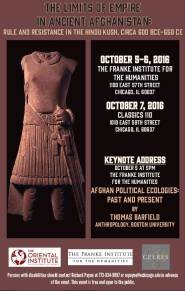
  • Symposium: The Limits of Empire in Afghanistan

    The Oriental Institute and the Franke Institute for the Humanities, University of Chicago, announce a conference to be held October 5-7, 2016.

    The Limits of Empire in Afghanistan: Rule and Resistance in the Hindu Kush, circa 600 BCE-650 CE

    In the first millennia BCE and CE, successive empires sought to incorporate the archipelago of territories in and around the Hindu Kush and to install their structures of rule. The Achaemenians, Seleucids, and Sasanians endeavored — and sometimes pretended — to rule regions of Afghanistan from their courts located in the Near Eastern core, upward of 2500 km distant. The Kushans, for their part, made Bactra and Begram the bases of an empire that extended far beyond into India and Central Asia. Apart from distance, these empires confronted a political geography in the Hindu Kush that was — like the Caucasus — uniquely unfavorable to imperial governance, as well as populations with disparate cultures, social structures, and political traditions. Afghanistan thus provides a test of the capacities of ancient imperial regimes to overcome distance, verticality, and difference to integrate territories into their trans-regional and trans-cultural orders. As even a passing familiarity with the history of the region suggests, efforts at empire failed at least as often as they succeeded in a geographical and cultural landscape highly conducive what James Scott calls the “art[s] of not being governed.” The conference aims to focus on the limits of empire in Afghanistan, as a means of better comprehending the workings of the regimes that laid claim to its territories and the responses of its populations.

    The conference convenes archaeologists, art historians, historians, philologists, and numismatists to debate current research in the context of ongoing theoretical debates concerning the formation, endurance, and limits of imperial systems within a highland political ecology.

    For a detailed programme and abstracts, see Symposium: The Limits of Empire in Afghanistan | The Oriental Institute of the University of Chicago.

  • Authority and Identity in Medieval Islamic Historiography

    Hanaoka, Mimi. 2016. Authority and identity in medieval Islamic historiography: Persian histories from the peripheries. Cambridge University Press.

    Intriguing dreams, improbable myths, fanciful genealogies, and suspect etymologies. These were all key elements of the historical texts composed by scholars and bureaucrats on the peripheries of Islamic empires between the tenth and fifteenth centuries. But how are historians to interpret such narratives? And what can these more literary histories tell us about the people who wrote them and the times in which they lived? In this book, Mimi Hanaoka offers an innovative, interdisciplinary method of approaching these sorts of local histories from the Persianate world. By paying attention to the purpose and intention behind a text’s creation, her book highlights the preoccupation with authority to rule and legitimacy within disparate regional, provincial, ethnic, sectarian, ideological and professional communities. By reading these texts in such a way, Hanaoka transforms the literary patterns of these fantastic histories into rich sources of information about identity, rhetoric, authority, legitimacy, and centre-periphery relations.

    About the author: Mimi Hanaoka is Assistant Professor of Religious Studies at the University of Richmond, where she is a scholar of history and religion. Her publications include scholarly journal articles on Persian and Islamic history and historiography. Her work as a social and cultural historian focuses on Iran and the Persianate world from the tenth to fifteenth centuries, concentrating on issues of authority and identity. In the field of global history, she concentrates on interactions between the Middle East and East Asia, focusing on the history of Iran-Japan relations.