
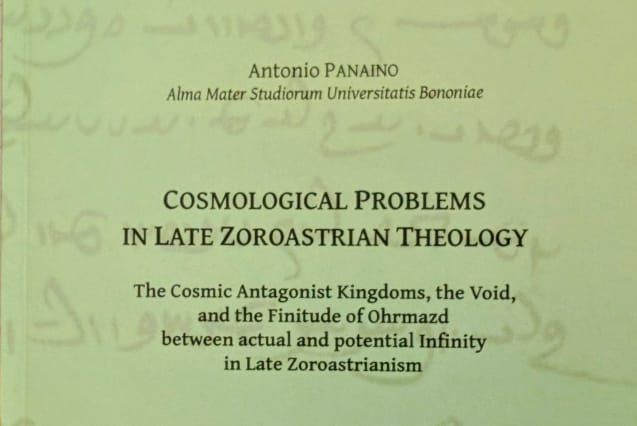
Panaino, Antonio. 2026. Cosmological problems in late Zoroastrian theology (Publications d’Études Indo-Iraniennes 6). Strasbourg: Université de Strasbourg.
This volume addresses some of the most challenging and neglected problems of Zoroastrian cosmology: through a systematic reexamination of the Pahlavi and Pāzand sources, the text shows how Mazdean theologians developed a remarkably sophisticated model in which three primordial potentially infinite cosmic domains were ultimately unified within a single divine order, although by means of a cosmic conflict. This framework provided the basis for reconciling the “existence” of evil, the finitude of the material world, and the perfection of God, taken as ontologically limited, without compromising either divine omniscience or eschatological certainty. Particular attention is devoted to the nature of infinite and limited time, the structure of the heavens, the function of the cosmic “trap” designed for the defeat of Ahreman, and the philosophical implications of the final renovation (Frašgird). The study further demonstrates how Zoroastrian thinkers resolved the apparent paradox of Ahreman’s destiny by rejecting the possibility of a surviving external realm of darkness or of void, and by elaborating a coherent doctrine of the irreversible neutralisation of evil. By illuminating the cosmological and theological net underlying these doctrines, this book reveals an intellectual achievement of far greater complexity than is usually acknowledged and offers a new perspective on one of the most original metaphysical systems of Late Antiquity.