Category: Online resources

  • Between the Tigris and Zagros

    Between the Tigris and Zagros

    Peyronel, Luca. 2025. Entre le Tigre et le Zagros. Les recherches archéologiques de la mission italienne de l’Université de Milan dans la plaine d’Erbil (Kurdistan irakien). ArchéOrient – Le Blog.

    About ArchéOrient – Le Blog

    ArchéOrient-Le Blog is run by members of the « Archéorient » research centre of the University of Lyon 2 (CNRS/University Lyon 2), based at the Maison de l’Orient et de la Méditerranée (Lyon, France). The blog aims to promote exchanges and to give greater visibility to new scientific information in the field of archaeology and history of societies and environments during the Holocene in the Mediterranean, the Near and Middle East, the Caucasus and Central Asia, and more recently, the Horn of Africa and West Africa. This Blog is open to all representatives of the international scientific community and welcomes contributions in French and English.

  • Zoroastrian Hermeneutics in Late Antiquity

    Zoroastrian Hermeneutics in Late Antiquity

    Pourdavoud Lecture Series

    Zoroastrian Hermeneutics in Late Antiquity

    The Sūdgar Nask of Dēnkard Book 9

    Wednesday, April 2, 2025 at 4:00pm Pacific
    Royce Hall 306

    Hybrid Zoom option available
    Registration required

    Speaker: Yuhan Sohrab-Dinshaw Vevaina

    The Sūdgar Nask of Dēnkard Book 9 is a commentary on the ‘Old Avesta’ of the 2nd millennium BCE produced in Pahlavi (Zoroastrian Middle Persian) in the Sasanian (224–651 CE) and early Islamic centuries. This commentary is a value-laden, ideologically motivated discourse that displays a rich panoply of tradition-constituted forms of allegoresis. It mobilizes complex forms of citation, allusion, and intertextuality from the inherited Avestan world of myth and ritual in order to engage with and react to the profound changes occurring in Iranian society. Despite its value and importance for developing our nascent understanding of Zoroastrian hermeneutics and the self-conception of the Zoroastrian priesthood in Late Antiquity, this primary source has attracted scant scholarly attention due to the extreme difficulty of its subject matter and the lack of a reliable translation. This 2-volume work represents the first critical edition, translation, and commentary of this formidable text which will contribute to the philological, theological, and historiographical study of Zoroastrianism in a pivotal moment in its rich and illustrious history. Reading the Sūdgar Nask is a hermeneutic process of traversing texts, genres, and rituals in both the Avestan and Pahlavi corpora, thus activating nodes in a web or network of textual and meta-textual relations that establish new forms of allegoreses or meaning making. It is argued that this entire hermeneutical complex of weaving a ‘new’ text composed of implicit proof text and explicit commentary renews, extends, and, ultimately, makes tradition.

  • Emamzadeh Yahya

    Emamzadeh Yahya

    The Emamzadeh Yahya at Varamin: An Online Exhibition of an Iranian Shrine

    امامزاده یحیی ورامین‌: نمایشگاهی آنلاین از زیارتگاهی ایرانی

    This project website was brought to our attention by its curator, Keelan Overton. While it falls outside the scope of our work, we present it here for its innovative approach and valuable contributions to the field. We encourage you to explore the bilingual website to discover its diverse range of content. ~AZ

    The Emamzadeh Yahya shrine complex is simultaneously the sacred tomb of Emamzadeh Yahya (d. 869–70), a destination for ziyarat (pious visitation), an architectural monument of the Ilkhanid period (1256–1353), the main community center and cemetery of the Kohneh Gel neighborhood, a cultural heritage site, and the source of luster tiles displayed in around fifty museums worldwide. In this exhibition, which is also an exhibition catalog and an academic edited volume, we trace the complex’s many looks, functions, users, and stories over seven hundred years. Through our detailed study of one site, we offer a general exploration of Persian art and Iranian culture from the medieval period to the present.

    We invite you to explore the exhibition’s Six Thematic Galleries and read the Introduction by curator Keelan Overton.

  • Cyrus the Great

    Cyrus the Great

    The BBC’s podcast In Our Time explores Cyrus the Great in this fascinating episode.

    Melvyn Bragg and guests explore the history and reputation of the Persian ruler Cyrus the Great. Cyrus the Second of Persia as he was known then was born in the sixth century BCE in Persis which is now in Iran. He was the founder of the first Persian Empire, the largest empire at that point in history, spanning more than two million square miles.

    His story was told by the Greek historians Herodotus and Xenophon, and in the Hebrew bible he is praised for freeing the Jewish captives in Babylon.

    But the historical facts are intertwined with fiction.

    Cyrus proclaimed himself ‘king of the four corners of the world’ in the famous Cyrus Cylinder, one of the most admired objects in the British Museum. It’s been called by some the first bill of human rights, but that’s a label which has been disputed by most scholars today.

    With Lindsay Allen, Mateen Arghandehpour, and Lynette Mitchell.

  • On Middle Persian Documents

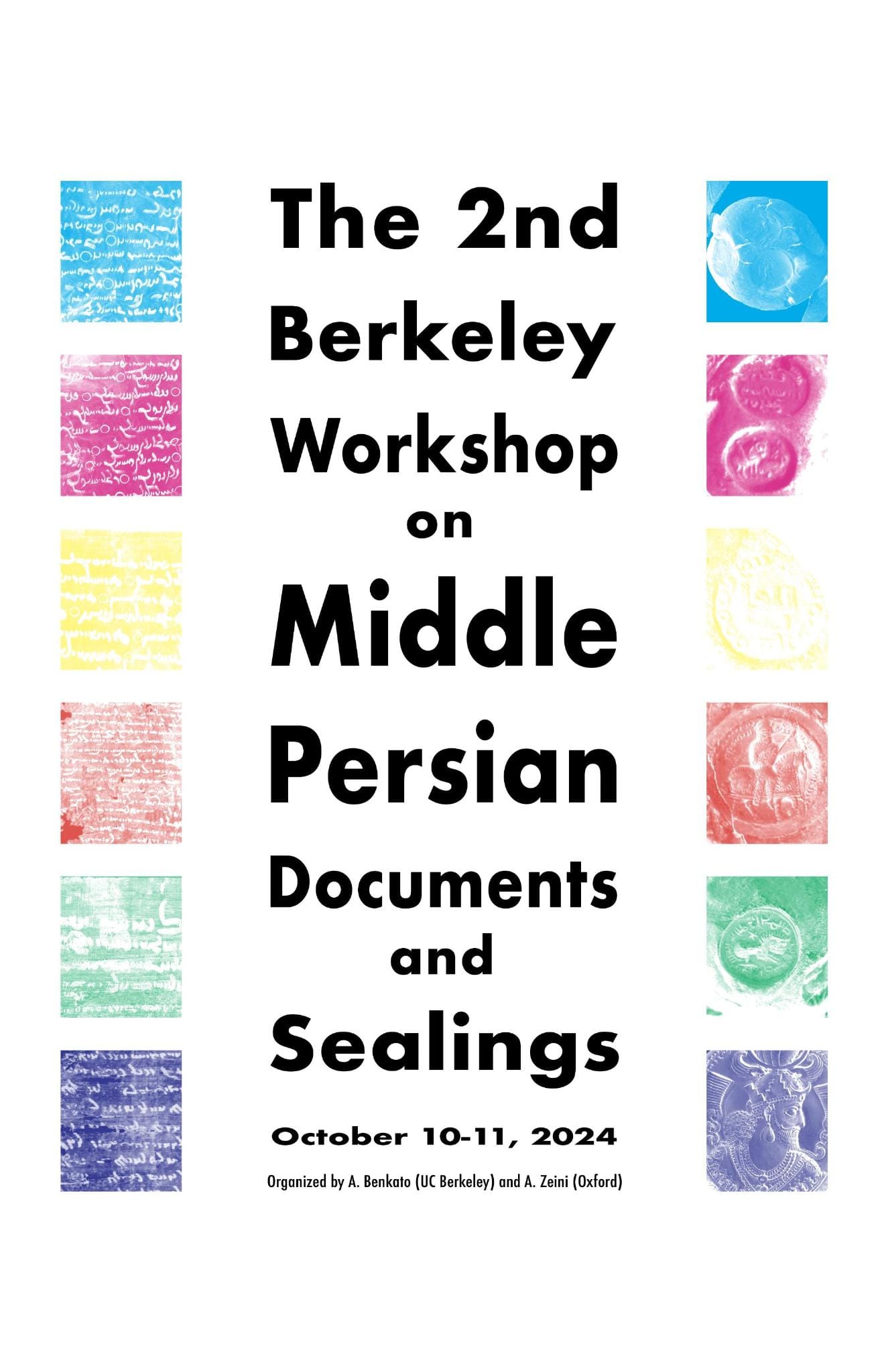
    The 2nd Berkeley Workshop on Middle Persian Documents and Sealings

    This is the second workshop in a series that began in Spring 2023 with the idea of bringing together scholars around the world who were actively working on, or interested in working on Middle Persian documents and sealings. The workshop is organised by Adam Benkato (UC Berkeley) and Arash Zeini (University of Oxford).

    To attend the workshop, which takes place on Zoom, register here. The programme is below.

  • TISS-Parzor Academic Programme

    ‘Parzor is delighted to announce its long awaited TISS-Parzor Online Academic Programme on Culture & Heritage Studies’. As part of this programme, you can ‘learn, gain credits, explore exciting issues of environment and sociology, craft, art, literature, theatre, cuisine as well as business and philanthropy’.

    Dr. Shernaz Cama announces the start of the TISS Parzor Online Academic Programme on Culture & Heritage Studies.

    For admissions and programme details, visit the TISS Website. Admissions are open till 31st August and open to all! Apply now!

  • New issue of Indiran

    The latest issue of Indiran, the newsletter of the Ancient India & Iran Trust, is now online.

    Established in 1978, the Ancient India & Iran Trust occupies a unique position as an independent charity concerned with the study of early South Asia, Iran and Central Asia, promoting both scholarly research and popular interest in the area.

    From About Us

    An archive of past issues of Indiran, is available here.

  • Archaeological Gazetteer of Iran

    The Pourdavoud Center at the UCLA operates the Archaeological Gazetteer of Iran, a great resource which we think should be more widely known.

    The Archaeological Gazetteer of Iran: An Online Encyclopedia of Iranian Archaeological Sites

    The Archaeological Gazetteer of Iran is a research tool for scholars in all branches of humanities, including anthropology, art history, and history, but more specifically for those working on the archaeology of Iran and the ancient Near East. The Gazetteer is a free, open access resource and will be hosted and maintained by the University of California, Los Angeles, which will ensure its up-to-date, long-term use and availability.

    From the Introduction
  • The 9th Ratanbai Katrak Lectures

    Prof. Dr. Alberto Cantera (Freie Universität Berlin) will deliver the final three Ratanbai Katrak Lectures this autumn in Oxford.

    These lectures are convened by Prof. Yuhan Sohrab-Dinshaw Vevaina for the Faculty of Asian and Middle Eastern Studies.

    The talks will also be on Zoom.

    (more…)
  • The 9th Ratanbai Katrak Lectures

    Prof. Dr. Alberto Cantera (Freie Universität Berlin) will deliver the 9th Ratanbai Katrak Lectures 101 years after the inauguration of the Ratanbai Katrak Lecturership at the University of Oxford.

    Convened by Prof. Yuhan Sohrab-Dinshaw Vevaina for the Faculty of Asian and Middle Eastern Studies.

    ‘With which Yasna shall I worship you (kana θβąm yasna yazāne)?
    Zoroastrian Rituals in the Antique and Late Antique Iranian world’

    Please use this link to attend the lectures on Zoom.

    Lecture 1: Manuscripts and Rituals: The Written Transmission of the Zoroastrian Rituals
    11 May 2023, 5:30pm – 7:00pm; Wolfson College, Linton Road, Oxford OX2 6UD

    Lecture 2: The Questioned Antiquity of the Zoroastrian Rituals: Their Reception in Western Academia
    18 May 2023, 5:30pm – 7:00pm; Wolfson College, Linton Road, Oxford OX2 6UD

    Lecture 3: The Ritual System: Modularity and Productivity
    25 May 2023, 5:30pm – 7:00pm; Ertegun House, 37A St. Giles’, Oxford OX1 3LD