Author: Yazdan Safaee

  • Eating and Drinking in the Ancient Near East

    Eating and Drinking in the Ancient Near East

    Martino, Stefano de, Elena Devecchi and Maurizio Viano (eds.). 2024. Eating and drinking in the ancient Near East: Proceedings of the 67th Rencontre Assyriologique Internationale, Turin, July 12–16, 2021 (dubsar 33). Münster: Zaphon.

    This volume comprises many of the papers presented at the 67th Rencontre Assyriologique Internationale in July 2021 in Turin. Due to pandemic restrictions the participants of the conference could not meet in person. The encompassing topic “Eating and Drinking in the Ancient Near East” is broad and declinable under different perspectives. Key lectures (1) have been delivered by Cécile Michel on “Gender Aspects in Food and Drink Preparation” and by Theo van den Hout on “Hittite Foodways: The King as the Provider of his People”. Subsequent lectures grouped around the following sections: (2) Food Production, (3.) Resource Management, (4.) Rituality, Banquet and Commensality, (5.) Medicine and Literature, (6.) Philological and Archaeological Researches, (7.) Varia. The lections feature both philological as well as archaeological topics, presenting new insights into well-known texts as well as hitherto unpublished material. Among others Paola Paoletti examines “Butter and Cheese Production in the Third Millennium BCE Babylonia”, Juliette Mas “Funerary Drinking Vessels in Early and Middle Bronze Age Upper Mesopotamian Burials”, while Ludovico Portuese pursues “The Assyrian Royal Banquet”, and Jan Tavernier “The Use of Eggs in Mesopotamian Medicine and beyond”, to list just a few of the 35 articles.

    Two contributions investigate topics that are related to ancient Iran:

    • Francesca Giusto: Dairy Production in SW Iran from the Middle Elamite to the Neo-Elamite Period
    • Trudy Kawami: What Fine Ceramics Can Tell Us About Social Drinking in Iron Age Iran
  • Late Achaemenid Texts from Šāṭer

    Late Achaemenid Texts from Šāṭer

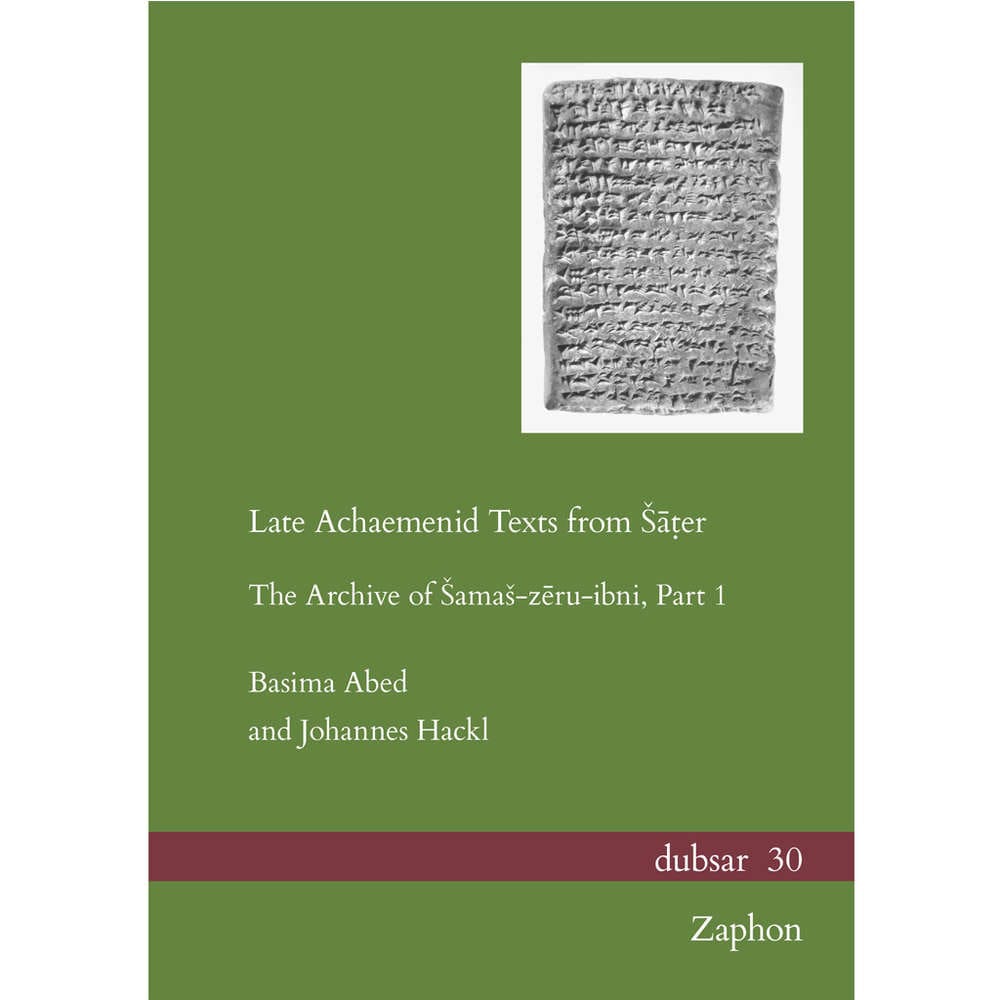
    Abed, Basima & Johannes Hackl. 2024. Late Achaemenid texts from Šāṭer: The archive of Šamaš-zēru-ibni, Part 1 (dubsar 30). Münster: Zaphon.

    The 67 texts presented in this volume are part of a larger group of (Babylonian) Late Achaemenid legal documents from Šāṭer, a city that is believed to be located somewhere in the area northwest of Uruk up to the outskirts of Nippur. Together with a brief introduction and indices, it included transliterations, autographed copies and photographs of a group of texts that were confiscated from illicit excavators by the Iraqi Antiquity Authorities as part of a larger group of texts now housed in the Iraq Museum. The common element that ties these texts together is their identical archival and commercial context; they can be identified as certain components of the archive belonging to Šamaš-zēru-ibni, son of Ayyanaˀad, an agricultural entrepreneur who was active in and around the Southern Babylonian city Šāṭer during the second half of the fifth century BCE.

  • Contributions on History and Culture of Elam and its Neighbouring Regions

    Contributions on History and Culture of Elam and its Neighbouring Regions

    Mofidi-Nasrabadi, Behzad (ed.). 2024. Contributions on History and Culture of Elam and its Neighbouring Regions (Elamica 14). Hildesheim: Franzbecker.

    The new book in the series Elamica is out and it contains three contributions:

    • T. Brandes & D. Prechel: Keilschrifttexte aus Haft Tappeh (KHT) der Ausgrabungen zwischen 2005 und 2012. Teil 3
    • B. Mofidi-Nasrabadi: Supplementum zu den Tontafeln der rezenten Ausgrabungen in Haft Tappeh
    • B. Rafiei-Alavi & M.-A. Emami: A Diachronic View of Copper-Alloys in the Elamite Metallurgy, A Reassessment of Susa Copper-Based Metal

  • Bridging the Gap: Disciplines, Times, and Spaces in Dialogue

    Bridging the Gap: Disciplines, Times, and Spaces in Dialogue

    Kallas, Nathalie (ed.). 2025. Bridging the gap: Disciplines, times, and spaces in dialogue. Vol. 2. Oxford: Archaeopress.

    This volume gathers the papers presented at sessions 3, 7 and 8 from the conference Broadening Horizons 6, held at the Freie Universität Berlin, 24–28 June 2019, and is available in open access.

    The second volume compiles papers presented in three enlightening sessions: Session 3 – Visual and Textual Forms of Communication; Session 7 – The Future of the Past. Archaeologists and Historians in Cultural Heritage Studies; and Session 8 – Produce, Consume, Repeat. History and Archaeology of Ancient Near Eastern Economies. Within this volume, the 20 papers traverse diverse topics spanning multiple periods, from the 5th millennium BCE to the Roman Empire, and encompass a wide array of geographical regions within the Near East.

    Among other relevant contributions, the following papers deal with aspects of ancient Iranian history and culture:

    • Delphine Poinsot: Sexuation of animals’ bodies in the bullae from Qasr-I Abu Nasr
    • Olivia Ramble: Generations of Writing: The Secondary Inscriptions of Darius’ tacara at Persepolis
    • Takehiro Miki: Deciphering the Skills of the Prehistoric Painting Technique: Case Study of the Painted Pottery of the 5th Millennium BCE from Tall-e Bakun A (Fars province, Iran)
    • Yazdan Safaee: Persian Female Weavers in the Persepolis Economy
  • The ‘Two Eyes’ Rivalry of Byzantium and Sasanian Persia

    The ‘Two Eyes’ Rivalry of Byzantium and Sasanian Persia

    Blachford, Kevin. 2024. World order in Late Antiquity: The ‘Two Eyes’ rivalry of Byzantium and Sasanian Persia. Oxford: Oxford University Press.

    The East Romans of Byzantium and the Sasanian Persians competed as geopolitical rivals for over four centuries between 224 and 628 ad. Through a series of intractable conflicts, these two great empires would develop a dual hierarchy that sought to divide the known world between them. Despite competing claims to universal rule, mutual spheres of interest arose as both empires sought to create rules, norms, and standard practices of diplomatic behaviour to regulate their inter-imperial rivalry. Defined by contemporaries as the ‘Two Eyes’ of the Earth, this suzerain order aimed to hierarchically organize those considered ‘barbarians’. This period of late antiquity is rarely considered within the discipline of international relations. Through an English School approach, this work examines the diverse suzerain order of late antiquity as ‘barbarous’ nomadic tribes challenged the hierarchical ambitions of two rival empires who both claimed a unique role in the maintenance of world order.

  • Sasanian Coin Legends

    Sasanian Coin Legends

    Matloubkari, Esmaeil. 2024. Sasanian Coin Legends: A Linguistic Approach to Historical Analysis. Tehran: Negah-e Moaser.

    Epigraphic sources and historical texts indicate that the political ideology of the Sasanians underwent significant transformations over time. If we consider Sasanian coins as the most important—and sometimes the only—expressions of Sasanian kingship ideology, then the linguistic study of coin legends becomes a key method for understanding the socio-political significance of these titles.

    The titles inscribed on Sasanian coins during the 3rd and 4th centuries AD appear to have been rooted in native traditions, either imitated and reconstructed by the Sasanians or influenced by external traditions transmitted through the Parthians, Hellenistic states, and Kushans. The formalization of Zoroastrianism as the state religion in the 4th century AD led to Middle Persian becoming the sole official language, resulting in the gradual removal of non-native titles from Sasanian coinage. Nevertheless, such titles continued to exist in a localized form within the political sphere and the propaganda of the Sasanian government.
    Lexical analysis suggests that most of the titles and honorifics found on Sasanian coins originated from religious contexts, often adapted—with modifications—from Old or Middle Iranian texts. From the 5th to the 7th century, these titles increasingly reflected Zoroastrian religious traditions while also showing traces of the ancient Iranian bureaucratic system. The titulature found on Sasanian coins and inscriptions was a crucial instrument for legitimizing Sasanian kingship, and changes in these titles provide valuable insights into the evolution of political thought during the Sasanian era.
    Given the scarcity of contemporary Sasanian texts, coin legends remain among the few available sources that reference the “King of Kings,” the court, and the state. By examining the etymology of these terms in Old and Middle Iranian texts, historians can gain a deeper understanding of their meanings, thereby shedding light on the socio-political structures of the Sasanian period.

  • Medieval Georgian Manuscripts of Shahnameh Translations

    Giunashvili, Helen. 2025. Medieval Georgian Manuscripts of Shahnameh Translations with Miniatures at the National Centre of Manuscripts of Georgia (“Rostomiani”). Digitalorientalist.

    The Georgian manuscript tradition and book art have a 16-century-long history. Their origin (the most ancient Georgian handwritten monuments are dated from V-VI cc AD) and subsequent transformation relate to many aspects of the development of civic life in Georgia: religion and political orientation, social relations, educational trends, development of artistic thought, and material culture.  

    Abu’l-Qāsem Ferdowsi’s (940-1020) monumental poem “Shahnameh” was well-known for Georgian intellectuals of the time the poem was created. Presumably, it was translated into Georgian rather early (probably at the 12th century), but this translation has not reached us. Only the 15th-18th century Georgian versions of the ‘Shahnameh’, both written in prose and poetry, are recognized today.

  • Kushano-Sasanian copper coins

    Schindel, Nikolaus. 2025. Schatzfunde kushano-sasanidischer Kupfermünzen und ihr Beitrag zur Kenntnis von Prägesystem und Geldumlauf im kushano-sasanidischen Herrschaftsbereich. In Kooperation mit Shakir Pidaev. Wien: Österreichische Akademie der Wissenschaften.

    Der vorliegende Band dokumentiert acht Schatzfunde spätkushanischer und kushano-sasanidischer Kupfermünzen aus unterschiedlichen Quellen. Neben der Vorstellung des Materials werden unterschiedliche Themen wie Prägeherren, Münzstätten, Metrologie und Beizeichen im Detail besprochen. Vor allem aber wird zum ersten Mal seit Robert Göbls Studien aus den Jahren 1984 und 1993 der Versuch unternommen, auf der Grundlage einer umfassenden Rekonstruktion des Prägesystems die kushano-sasanidischen AE-Münzen in den historischen Kontext der spätantiken Geschichte Ostirans einzuordnen, wobei auch die immer noch umstrittene Frage nach der Datierung des Jahres Eins des Kushankönigs Kanishka I. behandelt wird. Dies ist der zweite Band der Reihe „Fundmünzen aus Usbekistan“.

  • The Tomb of Two Priestesses?

    Wicks, Yasmina & Gian Pietro Basello. 2024. The tomb of two priestesses? The late Neo-Elamite Jubaji Tomb in a religious-royal context. Asia Anteriore Antica. Journal of Ancient Near Eastern Cultures 6: 107-143.

    This article revisits one of the most significant archaeological discoveries in southwest Iran in recent decades, a rich early-mid 6th century BCE tomb of two women, unearthed near the village of Jubaji on the Ramhormoz plain in 2007. Based on the sumptuous grave assemblages and the inclusion of a gold ceremonial ‘ring’ inscribed with the name of a late Neo-Elamite king, Šutur-Nahunte son of Intata, the tomb’s excavator, Arman Shishegar, reasonably interpreted the women – one aged under 17 years, the other 30-35 years – as princesses. Here it is argued that the women may have been important figures in a religious institution based on a combination of the context of the tomb, which seems to have been in an association with a monumental structure, and certain elements of the assemblages. While none of the individual items is significant in isolation, when put together they are highly suggestive of a cultic environment. These include several semiprecious stone beads, including two inscribed eye-stones, that were already very ancient when deposited, special ritual paraphernalia, the bronze coffins that held the women’s remains, the inscribed gold ‘ring’ naming Šutur-Nahunte son of Intata, and an inscribed gold object (perhaps a bracelet) of a cult officiant. This is not to say that the roles of princess and priestess were by any means mutually exclusive, but it is the religious aspect that has yet to be investigated. A reassessment here of the significance of the inscribed objects from the Jubaji tomb in a religious context is taken as an occasion to publish new transliterations, translations, and analyses of the inscriptions by Gian Pietro Basello.

  • Old Avestan Dictionary

    Old Avestan Dictionary

    Uesugi, Heindio & Adam Alvah Catt (eds.). 2024. Old Avestan dictionary (Asian and African Lexicon, 67). Tokyo: Research Institute for Languages and Cultures of Asia and Africa.

    The Old Avestan Dictionary (OAD) is an attempt at a lexicographic synthesis of Old Avestan studies since the Altiranisches Wörterbuch (1904) by Christian Bartholomae (1855-1925) with a particular focus on aiding the elucidation of the Gāthās based on the line of analysis laid down by Helmut Humbach (1921-2017). The dictionary is accompanied by a new annotated translation of the Gāthās to further facilitate the general reader in discerning the sense behind the respective terms and passages when reading, reciting, or studying the original Avestan texts.

    The book is freely available for download as an open-access resource.

    Contents

    Part I: Dictionary
    Acknowledgements
    Preface
    Symbols and Abbreviations
    Introduction to Part I
    References
    Dictionary

    Part II: Text and Translation
    Symbols and Abbreviations
    Introduction to Part II
    Yasna 27.13-15: Three Sacred Formulas
    Yasna 28-34: Ahunauuaitī Gāϑā
    Yasna 43-46: Uštauuaitī Gāϑā
    Yasna 47-50: Spəṇtā.mainiiū Gāϑā
    Yasna 51: Vohu.xšaϑrā Gāϑā/HāitiGāϑā/Hāiti
    Yasna 54.1: Ā Airiiə̄mā Išiiō