A workshop organised by Tommy Benfey (Tübingen) and Richard Payne (Chicago).

Friday, October 25, 2024
The workshop is co-sponsored by the University of Chicago and the University of Tübingen.

A predominantly bibliographic blog for Iranian Studies
The workshop is co-sponsored by the University of Chicago and the University of Tübingen.
Antonetti, Claudia, Bryan De Notariis & Marco Enrico (eds.). 2024. Wine cultures: Gandhāra and beyond (Antichistica 40). Venezia: Venice University Press.

(more…)The volume Wine Cultures. Gandhāra and Beyond represents the primary outcome of the MALIWI project (SPIN Ca’ Foscari 2021) directed by Claudia Antonetti. Adopting an interdisciplinary approach, this work seeks to explore the production techniques, social functions, and cultural significance of intoxicating drinks with particular reference to wine – an extraordinary beverage that has been intertwined with human history for millennia. This volume gathers contributions by scholars interested in studying wine and drinking culture in Gandhāra and neighbouring regions, including Ancient Assyria, Arachosia, and present-day India. The topic is explored from three fundamental perspectives, employing a diverse range of sources, including literary and historical texts, as well as linguistic, iconographic, archaeological, and anthropological evidence.
Abstract
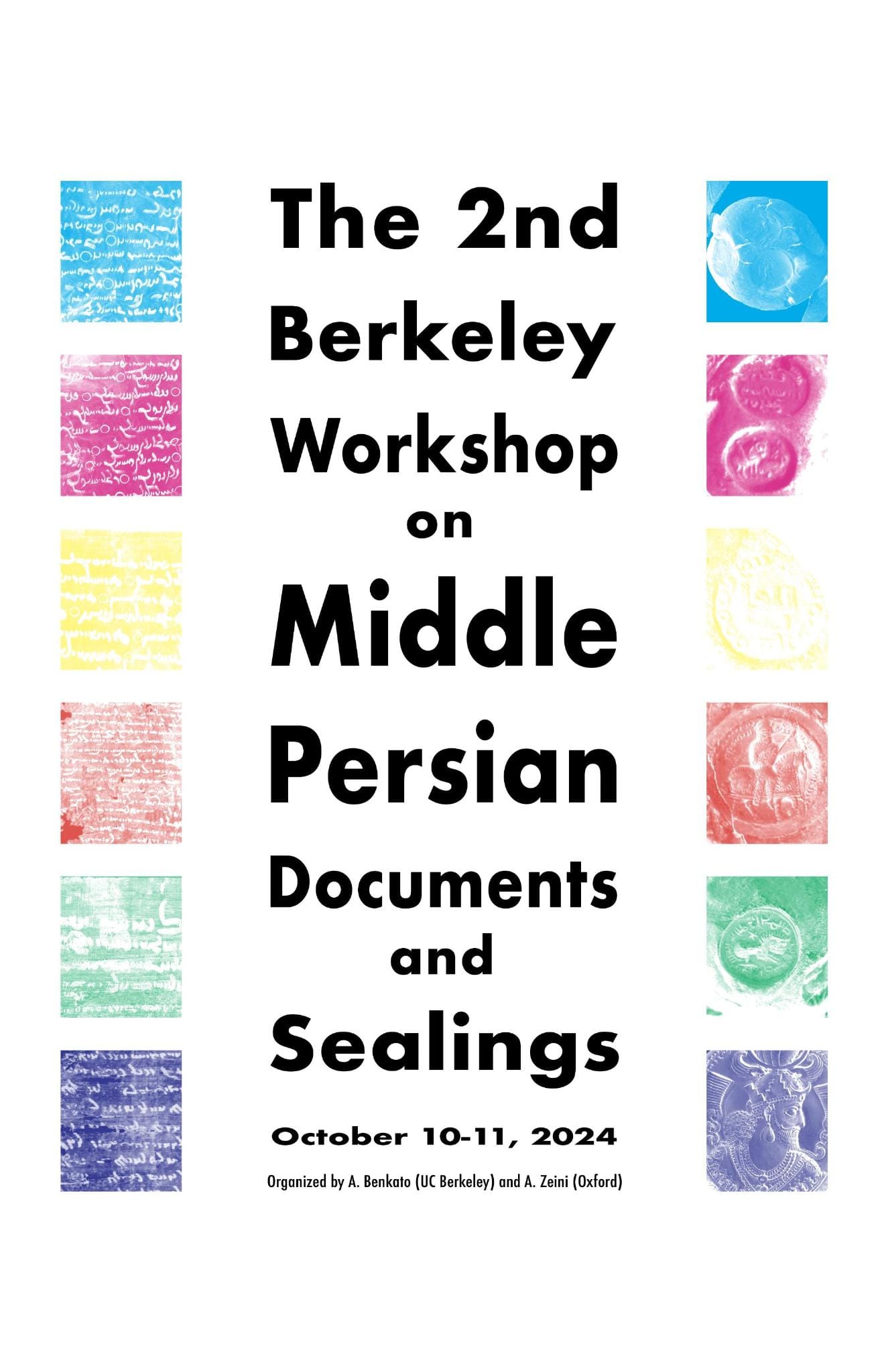
This is the second workshop in a series that began in Spring 2023 with the idea of bringing together scholars around the world who were actively working on, or interested in working on Middle Persian documents and sealings. The workshop is organised by Adam Benkato (UC Berkeley) and Arash Zeini (University of Oxford).
To attend the workshop, which takes place on Zoom, register here. The programme is below.
A lecture by Saloumeh Gholami, University of Cambridge, and Mehraban Pouladi, Mōbedān Council (Iran), entitled:

Friday 18 October 5:30pm, AIIT, Cambridge.
This lecture offers an exploration of the complex history of the Zoroastrian community in Ahvaz, a city in the province of Khuzestan in Iran. Because of economic hardship and agricultural decline in Yazd, Zoroastrians started migrating there in the early 20th century. Earlier censuses from the 19th century, such as those by Hataria in 1854 and Houtum-Schindler in 1882, record no Zoroastrian presence in Ahvaz. The earliest mention of Zoroastrians in the city appears in the 1963 census, which was prepared for the National Zoroastrian Congress held in Kerman that same year. The Zoroastrian community in Ahvaz has so far found little, if any scholarly attention due to the dearth of documentation. However, as a result of new archival evidence from the Pouladi Collection, unearthed by the speakers in 2016, new data has emerged that throws light on the reasons for the migration from Yazd to Ahvaz. The new documents provide evidence that Zoroastrian settlements were established in the 1920s along the Karun River through the agricultural enterprise, the Mazdyasnān Company. This lecture examines how the Zoroastrian community of Ahvaz flourished in their new home, contributing to the prosperity of the region, but later, despite its successes, gradually declined. This development raises critical questions regarding the preservation of minority heritage in Iran.
Summary
This year’s biannual Conférences d’études iraniennes «Ehsan et Latifeh Yarshater» will be delivered by David Durand-Guédy, Universität Hamburg, on the topic of space at the time of the first Turkic and Mongol dynasties.
This a CeRMI event, organised by Samra Azarnouche and Justine Landau.
For more information, see the flyer and the programme:
Societies, Politics and Cultures of the Iranian World (2024–2025), a monthly multidisciplinary research seminar hosted by the Centre de recherche sur le monde iranien (CeRMI), presents recent research on Iran and the Iranian world from antiquity to the present day. This seminar series is organised by Samra Azarnouche and Justine Landau.
The programme of the series:

Professor Samra Azarnouche (L’École Pratique des Hautes Études – Paris Sciences & Lettres) and Yuhan Sohrab-Dinshaw Vevaina will be co-convening a workshop on the Dēnkard. Co-sponsored by EPHE, Paris and AMES, University of Oxford, this two-day Workshop on literature, theology, and scholasticism of the Zoroastrian community in the 9th century CE, is to be held on Thursday and Friday, 17–18 October 2024 in the Buttery at Wolfson College.
The Dēnkard, the towering achievement of Zoroastrian scholasticism in Late Antiquity and compiled in the 9th century CE, serves as a comprehensive compendium of Zoroastrian beliefs, practices, and doctrines. In its nine books, the Dēnkard, at 169,000 words, covers a staggering range of topics, including cosmology, ethics, rituals, jurisprudence, and the history of Zoroastrianism and its textual transmission. The work addresses various theological questions, offering explanations for the nature of good and evil, the existence of the spiritual world, and the role of humanity in the cosmic struggle between Ohrmazd, the god of light and order, and Ahrimen, the principle of darkness and chaos. Through its challenging rhetorical structures and hermeneutical interpretations, the Dēnkard provides unique insight into the dualistic Zoroastrian world-view and its influence on ancient and medieval Iranian society. As a crucial source of Zoroastrian thought and tradition, the Dēnkard not only informs contemporary practitioners but also scholars and researchers interested in the history of religion, Iranian studies, and comparative theology. Its significance lies in its preservation of Zoroastrian theology and its role in shaping the religious and cultural landscape of the pre-Islamic Iranian world.
The Announcement
The Workshop will be conducted based on pre-circulated papers which will explore the nature and character of a particular book of the Dēnkard, structural and intertextual connections between different books, and the broader questions of transmission and historical context. The workshop will feature a variety of distinguished scholars from the UK, continental Europe, and North America working on Zoroastrianism in Late Antiquity and the early Islamic period.
Azarnouche, Samra. 2024. Tectonique des mythes. Croyances et théories zoroastriennes sur le tremblement de terre. Revue de l’histoire des religions 241(2). 275–297.

While the earthquake is primarily a cosmogonic act provoked by the intrusion of Evil into Ohrmazd’s world, the Zoroastrian accounts describing the phenomenon also bear witness to a striking confluence of myth, mechanistic theories and biological analogies. The tradition conveyed by the texts (Bundahišn 21e, Dēnkard III.93 and Dādestān ī Dēnīg 69) attributes the earthquake sometimes to the demon Čišmag and his atmospheric acolytes, sometimes to the sorcerer Frāsyāb, two figures who also have in common that they are associated with drought. Some episodes featuring them also include a mysterious appearance by Spandarmad, the Earth goddess. These elements indicate that the Zoroastrian aetiology of earthquakes was far more narratively complex than the texts handed down to us give us to understand.
Abstract
The above article is part of an issue dedicated to earthquakes:
Azarnouche, Samra, Muriel Debié & Vassa Kontouma (eds.). 2024. Quand la terre tremble: apprivoiser le choc des séismes dans les temps anciens. Revue de l’histoire des religions 241(2).
Rezania, Kianoosh. 2024. Eschatologia Iranica I: From Zoroastrian cosmos to Abbasid Madīnat al-Salām: A journey through utopia and heterotopia. Religions 15(10).
The history of imperial dynasties in West Asia is replete with examples of remarkable urban foundations. Two notable instances are the Sasanian Ardašīr-xwarrah and the Abbasid Madīnat al-Salām, which can be classified as cosmic cities or heterotopias. This article examines the utopian foundations of these heterotopias. To this end, it analyzes four religious and imperial spaces: the representation of the earth and sky in the Zoroastrian cosmography, Yima’s Vara according to the Avestan texts, Ardašīr-xwarrah, and finally, Madīnat al-Salām. This investigation aims to ascertain the extent to which the spatial characteristics of each of these spaces have been utilized in the production of the subsequent architectural forms. Similarly, it examines the development of the cosmological and eschatological paradise in relation to the Achaemenian and Sasanian royal gardens. The theoretical framework of this study is based on Michael Foucault’s notion of heterotopia, which has been further developed by Henri Lefebvre’s theory of space. The conceptual metaphor theory offers a cognitive linguistic foundation for elucidating the projections of utopias and heterotopias onto one another. To this end, the article focuses on the conceptual metaphor GOD IS A KING.
Abstract
Benkato, Adam. 2024. Lost Turfan fragments from the Nachlass of W.B. Henning. Bulletin of the School of Oriental and African Studies, FirstView. 1–17.

During the Second World War, a number of manuscript fragments in Iranian languages from the Berlin Turfan collections were lost. Photographs of these fragments preserved in the Nachlass of Walter B. Henning bring to light their contents and fill gaps in the record of Turfan texts. These photographs are published here for the first time, together with a description of the fragments and their contents.
Abstract