• Summer school in the Turfanforschung: Sogdians and Turks on the Silk Road

    Manichaean priests writing Sogdian manuscripts, in Khocho, Tarim Basin, ca. 8th/9th century AD
    Manichaean priests writing Sogdian manuscripts, in Khocho, Tarim Basin, ca. 8th/9th century AD

    Summer school in the Turfanforschung:

    “Sogdians and Turks on the Silk Road”

    August 22 – September 2, 2016

    Duration: two weeks, daily four seminars each 90 min.
    Location: Berlin Brandenburg Academy of Sciences and Humanities


    A detailed programme is available here: “Sogdians and Turks on the Silk Road” Summer School”

    Participation is free.

    The Turfanforschung (Turfan Studies) at the Berlin Brandenburg Academy of Sciences and Humanities offers in 2016 a summer school providing an introduction to the field of Turfan Studies, which deals with the many languages and scripts used along the Silk Road as well as the histories and cultures of those who used them. The summer school will center around the two main languages of Turfan research. Sogdian, a middle Iranian language, was widely used as a lingua franca in Central Asia since the 1st c. A.C. Old Turkic was the language of Turkic nomads which had a strong influence on the Silk Road since the middle of the 6th c. After the migration of the Uyghurs it was also used as the main language in the Turfan area under Uyghur rule until 14th c.

    The courses in this summer school will be given by the staff of the Turfanforschung and the Katalogisierung der Orientalischen Handschriften in Deutschland (Arbeitsstelle Berlin): A. Benkato, D. Durkin-Meisterernst, Y. Kasai, S.- Ch. Raschmann, C. Reck, A. Yakup. There will also be guest lectures by I. Colditz, M. Peyrot and L. Sander.

    Berlin Brandenburg Academy of Sciences and Humanities, Jägerstraße 22-23,
    10117 Berlin

    Topics:
    1. Scripts

    • Sogdian script
    • Uyghur script
    • Turkic Runic
    • Nestorian script
    • Manichaean script
    • Brāhmī script

    2. Language: Old Turkic

    • language course with reading
    • lecture for linguistics

    3. Language: Sogdian

    • language course with reading
    • lecture for linguistics

    4. Language: Tocharian

    5. Turfan studies

    • history of the Turfan expeditions
    • Central Asian book culture
    • history
    • religions
    • research history

    Because a minimum number of participants are required for the summer school to take place, we ask for a binding registration by 20th May 2016 at rabuske@bbaw.de or in writing at: Berlin-Brandenburgische Akademie der Wissenschaften AV Turfanforschung, Jägerstraße 22-23, D-10117, Berlin.


  • Iranica Antiqua, Volume 51

    The table of contents of the latest issue (51) of the journal Iranica Antiqua:


  • Ardwahišt Yašt

    Yast_3_KönigKönig, Götz. 2016. Yašt 3. Der avestische Text und seine mittel- und neupersische Übersetzungen. Einleitung, Text, Kommentar. (Estudios Iranios Y Turanios. Supplementa 1). Girona: Sociedad de estudios iranios y turanios (SEIT).
    The third Yašt (“hymn”) in the collection of the 21 (22) YAv Yašts is dedicated to (the deity, prayer and the divine correspondence of the fire) Aša Vahišta “Best Order”. The text formulates an (eschatologically significant) ritual context and a magical (= medical) charm. Due to the ritual and medical importance of Yt 3, various translations into Middle and New Persian can be found. They provide insights into the interpretation of the text by the later Zoroastrians.
    Ardwahišt Yašt is the third in the series of Avestan hymns addressed to individual divinities. It is devoted to one of the greatest of the Zoroastrian Aməša Spəntas, Aša Vahišta. The Ardwahišt Yašt is itself accordingly recited in rituals to cure the sick.

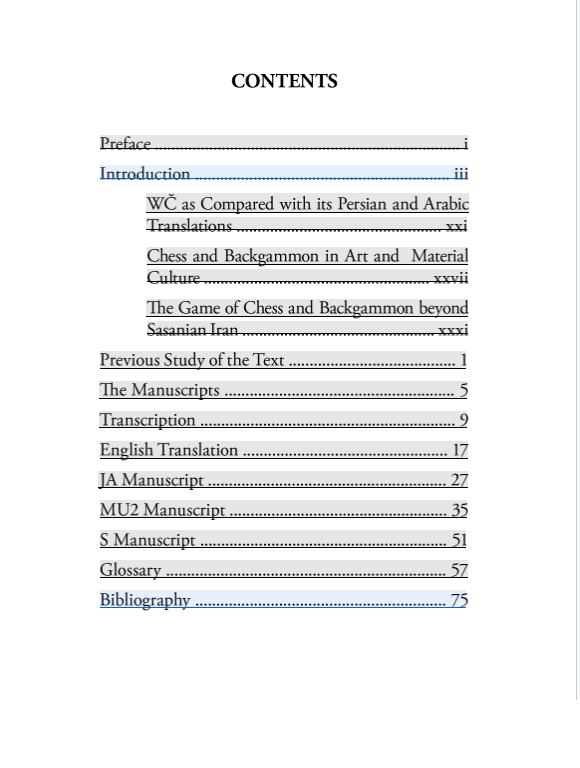
    See the table of contents here.


     Götz König is a scholar of Zoroastrianism and a philologist working on ancient and Middle Iranian languages. He is currently a deputy professor at the Institute of Iranian Studies, Free University of Berlin, Germany. He has made important contributions to the study of Old, Middle and New Iranian Zoroastrian literature. His two monographs, “Die Erzählung von Tahmuras und Gamšid” (Wiesbaden 2008) and “Geschlechtsmoral und Gleichgeschlechtlichkeit im Zoroastrismus” (Wiesbaden 2010), have to be highlighted. They convey an impression of his refined philological technique which is at the service of a history of Iranian culture.
  • Sex, Death, and aristocratic empire

    Bahram huntingPayne, Richard. 2016. Sex, death, and aristocratic empire: Iranian jurisprudence in late antiquity. Comparative Studies in Society and History 58(2). 519–549.

    The article is also available from the author’s Academia.edu page here.

    Sex, Death, and Aristocratic Empire: Iranian Jurisprudence in Late Antiquity

    (more…)

  • A half century of Syriac studies

    Image source: http://www.syri.ac/chronicles

    Brock, Sebastian. 2016. A half century of Syriac studies. Byzantine and Modern Greek Studies 40(1). 38–48.

    In 1964, when Anthony Bryer and I both started teaching at Birmingham University, Syriac studies were generally considered to be little more than an appendage to Biblical Studies, and any idea of a journal or a conference specifically focused on them was unthinkable. Fifty years later the situation has changed dramatically for the better, although the number of universities (at least in Britain) where Syriac is taught has lamentably decreased.

    A half century of Syriac studies
  • Closure of ‘small Humanities programmes’!

    Stop the Cuts
    Image source: http://3909.cupe.ca/files/2013/05/Stop-the-Cuts.jpg

    At BiblioIranica, we usually do not  comment on issues beyond our academic interests in ancient Iran.  However, it would be wrong, if we did not express our disappointment after hearing the news of the closure of ‘small Humanities programmes’ at the University of Copenhagen. As the University Post reports, the “Faculty of Humanities at the University of Copenhagen will shut down five smaller study programmes permanently”. A full list of the threatened programmes, and the university’s plans are published here.

    Oriental Studies have a long tradition in Denmark, and Danish scholars have made and continue to make significant contributions to Oriental and Iranian Studies. It is very distressing to read that some of the ‘small’ programmes will be closed, among which are Indology and Tibetology.

    See the following links for the history of Iranian Studies in Denmark:

  • The concept of Iran

    Sasanian SilkThe Concept of Iran in Zoroastrian and Other Traditions

    Professor François de Blois (AHRC Research Fellow, UCL)

    Date: 21 April 2016Time: 6:00 PM
    Finishes: 21 April 2016Time: 8:00 PM
    Venue: Russell Square: College Buildings
    Room: Khalili Lecture Theatre

    Series: Dastur Dr Sohrab Hormasji Kutar Memorial Lecture Series

    (more…)

  • ZOROASTRIANS OF IRAN vi. Linguistic Documentation

    Saloumeh Gholami, “ZOROASTRIANS OF IRAN vi. Linguistic Documentation,” Encyclopædia Iranica, online edition, 2016, available at http://www.iranicaonline.org/articles/zoroastrians-in-iran-06 (accessed on 27 January 2016).

    This article focuses on the importance of documenting the Zoroastrian dialects of Yazd and Kerman, also known as Zoroastrian Dari (a term not to be confused with classical Persian Dari or Dari in Afghanistan).

  • Zoroastrian Dari (Behdini) in Kerman

    Gholami 2016Gholami, Saloumeh & Armita Farahmand. 2016. Zoroastrian Dari (Behdini) in Kerman. (Estudios Iranios Y Turanios. Supplementa Didactica 1). Girona: Sociedad de estudios iranios y turanios (SEIT).

     Dari (also known as Behdīnī, Gavrī, or Gavrūnī), the topic of the present book is a critically endangered Iranian language. The study of Zoroastrian Dari is of particular importance for Iranian dialectology and comparative linguistics. This language is used in a parallel way to the Persian language of the Muslim population, and one can observe strong influence from Persian, especially in the domain of the lexicon. But Dari also differs from Persian, having special characteristics common to the languages of the North-West Iranian group. Sharing of both North-West and South-West features draws our attention to the fact that the immigrants to Yazd and Kerman originally came from different regions of Iran. The primary aim of this book is to teach Kermani Dari as a living language. This book offers basic materials for those who are interested in learning Dari. The focus is not only on grammar but also includes sections on learning vocabulary, listening to original documented materials, and also writing and understanding texts. The book consists of seven chapters.

    See the table of contents here.


    Saloumeh Gholami is a scholar of Iranian linguistics at the Institute of Empirical Linguistics at the Goethe University of Frankfurt, Germany.

    Armita Farahmand is a member of the Zoroastrian community in Kerman and a scholar of Zoroastrianism.

  • Richard Frye and the Tajiks

    Foltz, Richard. 2016. Richard Frye and the history of the Tajiks (Ancient Iran Series 4).

    This series is published by the Jordan Center for Persian Studies, University of California, Irvine.