• Judeans in the Land of the Nile

    Judeans in the Land of the Nile

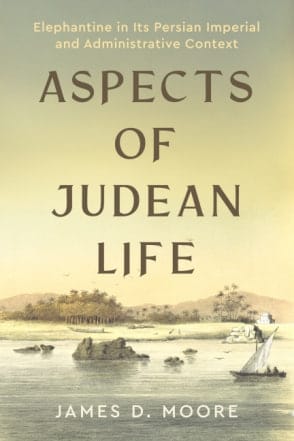
    Ziemba, Kacper & Frederik Poulsen (eds.). 2026. Judeans in the Land of the Nile: Papers on Achaemenid Egypt, Elephantine, and the Hebrew Bible Presented in Copenhagen, August 19–20, 2024 (Ägypten und Altes Testament 136). Münster: Zaphon.

    The significance of Egypt for the history of the Judeans in the 1st millennium BCE is difficult to overestimate. The geographical proximity of the land of the Nile and Judah meant that their political and cultural fates were intertwined. This is evidenced by the attempts of Egyptian rulers to extend their dominance over Judah or, more broadly, Palestine. Egypt was also home to Judeans and communities originating from Judah. Before it became one of the largest centers of the diaspora in the Hellenistic period, there was a Judean community living in Elephantine-Syene on the Nile. This was at a time when Egypt and Judah were under the rule of the Persian Empire. We know of it thanks to an Aramaic archive of papyri and ostraca from the Persian era that originate from this area. These texts – mainly private, legal, and administrative documents – allow us to reconstruct various aspects of the lives of members of this Judean community. Egypt is also the source of Papyrus Amherst 63, a text written in Demotic script in Aramaic and containing certain themes that invite us to link it with the presence of Judeans in Egypt. Moreover, Egypt and its relations with Israelites/Judeans are important topics in the Hebrew Bible. Egypt is not only the land of first exile (the Exodus story) and the topic of prophetic invectives (e.g., Isa 19; Jer 46; Ezek 29–32) but also the country where Judeans could find shelter and prosper (Patriarchal narratives; Joseph Story). It is equally remarkable that biblical authors, unlike Judeans in Babylonia, often do not mention their co-religionists living in Egypt during the Persian period; the negative assessment of Judeans living there (Jer 42–44) underlines this fact. In light of the Elephantine papyri, this silence is even more puzzling.

    These issues were the focus of papers presented at the workshop ‘Judean Diaspora and Biblical Texts in Achaemenid Egypt,’ organized at the University of Copenhagen on August 19 and 20, 2024, as part of the research project Divergent Views of Diaspora in Ancient Judaism. The contributions are organized into three thematic sections: Egypt under Persian rule; Elephantine and Papyrus Amherst 63; and representations of Egypt in the Hebrew Bible.

    Table of contents:

    Ziemba / Poulsen: Introduction: Judeans in the Land of the Nile

    Part I: Egypt under Persian Rule

    Colburn: What Have the Persians Ever Done for Us? The Study of Achaemenid Imperialism in Egypt

    Wasmuth: Persian Period Elephantine/Syene in Context: The Natural, Pharaonic Socio-Cultural, and Persian Period Urban Environment       

    Part II: Elephantine and Papyrus Amherst

    Moore: A Supposed Diaspora Community at Elephantine or How the Persians Reinvented Judean-ness  

    Ziemba: Elusive Soldiers: The Military Nature of the ‘Judean Troop’ at Persian-period Elephantine

    Holm: “I Come from Judah, My Brother Has Been Brought from Samaria” (Aramaic P. Amherst 63): The Judean and Samarian Arrival in Egypt

    Hjelm: What Can Elephantine Teach Us about Ancient Samari(t)ans

    Granerød: “What Indeed Has Papyrus Amherst 63 To Do with Elephantine?” The Amherst Papyrus’s Relevance to the Question of the Elephantine Judean Community’s Historical Background and Identity    

    Part III: Representations of Egypt in the Hebrew Bible

    Poulsen: Defining Diaspora in the Joseph Story

    Youssef: Isaiah 19 and the Persian Period

    Liebermann: Jeremiah and YHWH in Egypt: Divine Presence, Prophetic Pain, and the Presentation of History

    Fry: A Quest for This Historical “Queen of Heaven”: Connecting the Biblical and Non-Biblical in and through Diaspora

  • Iran (2025 & 2026)

    Iran (2025 & 2026)

    Among the papers published in the journal Iran over the past two years, the following deal with various aspects of ancient Iran:

    • Mozhgan Jayez & Roghayeh Rahimi Sorkhani: The flaked stone assemblage of Soha Chay Tepe and the chalcolithic chipped stone industries of the Zagros Region
    • Zohreh Zehbari: The men who wrought the metals: On Achaemenid-era metalworkers based on the Persepolis tablets
    • Ali A. Vahdati, Raffaele Biscione, Roberto Dan & Marie-Claude Trémouille: Grave 12 at Chalow: The Burial of a Young Lady of the “Greater Khorasan Civilization”
    • A. Mani Irannejad: The Indo-Iranian Approach to Greater Iran
    • Gad Barnea: Some Achaemenid Zoroastrian Echoes in Early Yahwistic Sources
    • Marco Fattori & Marco F. Ferrari: Zeus Pharnauas and Persian Mazdaism in Cappadocia
    • Farzaneh Tajabadi: Persian Loanwords in Qurʾānic Arabic
    • Nolwen Rol, Reinhard Bernbeck, Lisa Wolff-Heger, Hassan Akbari, Morteza Hessari, Susan Pollock & Daniel Schäfer: Chalcolithic Painted Pottery of the Sialk III Period: Quantifying Stylistic Continuities and Changes on the Northern Central Plateau
    • A. Mani Irannejad: The Old Avesta and Birth of Iranian Identity
    • Behrouz Khanmohammadi, Annarita Stefania Bonfanti & Roberto Dan: A New Decorated Bronze Belt from Orumiyeh Region, North-Western Iran
    • Mehrdad Malekzadeh, Reza Naseri, Somaye Boroomandara, Andrea Cesaretti & Roberto Dan: Preliminary Report of the First Season of Excavation at the Achaemenid Period (Iron Age IV) Cemetery in Mersin, Semnan Province, Iran
    • Rhyne King: Trips to the King, Taxation, and the New Year in the Persepolis Fortification Archive
    • Meysam Labbaf-Khaniki: Discovering a Fire Temple in Qalʿe-ye Dokhtar of Bazeh Hur and Some Remarks on Ādur Burzēn-Mihr
    • Fatemeh Karimi & Abed Taghavi: Zoroastrians in the Economy of Yazd During the Qajar and Pahlavi I Dynasties

  • Journal of Iranian Linguistics

    Journal of Iranian Linguistics

    The Journal of Iranian Linguistics (JIL) is a platform uniting scholars worldwide to explore Iranian linguistic diversity. With a commitment to interdisciplinary discourse, JIL covers syntax, morphology, phonology, phonetics, semantics, sociolinguistics, language policy, and language acquisition. The user-friendly website, part of Yerevan State University’s journal system, ensures easy access to high-quality, diverse research. Join us in propelling Iranian linguistics to new heights!

    The latest issue (Vol. 3, Issue 1) is now available here.

    Table of contents:

    • Tereza Amryan: “Black Day, White Face”: Color Terms in Kurmanji Kurdish Phraseology
    • Hakob Avchyan: Who Owns What? Possessive Constructions in Northern Talyshi (Anbarāni and Lankarāni Dialects)
    • Noonik Darbinyan: Identifying Daš Maštis in Pre-Revolutionary Iranian Cinema: A Linguistic-Semiotic Study
    • Youli A. Ioannesyan: The Position of the Verbal Derivational Prefixes in the Sentence as a Distinguishing Feature of Persian Dialects from Other South-Western Iranian Dialects
    • Enrico Morano: Two Fragments from a Middle Persian Codex in Manichaean Script with Hymns to the Sun God and to Mani
  • The Temple of Ištar-of-Akkad in Babylon from the Neo-Assyrian until the Persian Period

    The Temple of Ištar-of-Akkad in Babylon from the Neo-Assyrian until the Persian Period

    Boivin, Odette. 2026. The Temple of Ištar-of-Akkad in Babylon from the Neo-Assyrian until the Persian Period. The Archival Texts (Abhandlungen der Deutschen Orient-Gesellschaft 33). Wiesbaden: Harrassowitz.

    The Temple of Ištar-of-Akkad in Babylon from the Neo-Assyrian until the Persian Period is the third volume of the ADOG sub-series named Babil and dedicated to the study of Babylon. It contains the edition of 86 texts uncovered during the excavations directed by Robert Koldewey and carried out between 1899 and 1917 by the Deutsche Orient-Gesellschaft in Babylon.

    The cuneiform tablets presented in this volume are primarily everyday archival documents and were uncovered in the temple of Ištar-of-Akkad and east of it (in the northern Merkes area); they belong to the text groups N8 and N9 in O. Pedersén, Archive und Bibliotheken in Babylon, ADOG 25 published in 2005. The texts are dated to the period between the mid-7th and the 5th centuries BCE. They provide information about the individuals and families who had connections to the temple of Ištar-of-Akkad in Babylon or were within its sphere of influence. Through an in-depth analysis of the archaeological context of the tablets, the brief history of the temple in this neighbourhood is reconstructed, which provides new insights in the history of Babylon during the Neo-Assyrian, Neo-Babylonian, and Persian periods.

  • Hybrid Kingships in the East from Alexander to the Sasanians

    Hybrid Kingships in the East from Alexander to the Sasanians

    Cefalo, Generoso & Alessandro Magnani (eds.). Le regalità ibride in Oriente da Alessandro ai Sasanidi. Urbino: Uniurb University Press.

    Il volume propone una riflessione sulle forme della sovranità sviluppatesi nello spazio eurasiatico tra l’età di Alessandro Magno e l’ascesa dell’impero sasanide. Attraverso un approccio interdisciplinare che integra fonti letterarie, epigrafiche, numismatiche, iconografiche e archeologiche, i contributi indagano i processi di interazione, adattamento e rielaborazione che caratterizzarono la costruzione dell’autorità regia in contesti multiculturali.

    Dall’eredità achemenide e macedone ai regni ellenistici dell’Asia centrale, dai sovrani indo-greci e seleucidi fino alle esperienze del mondo romano e sasanide, il volume analizza le strategie di legittimazione del potere e le molteplici forme di autorappresentazione dei monarchi. Ne emerge un quadro dinamico di “regalità ibride”, in cui tradizioni greche, iraniche, romane e locali si intrecciano dando vita a modelli politici e culturali originali, capaci di influenzare profondamente la storia del Mediterraneo e dell’Asia antica.

    This volume is open-access.

  • Linear Elamite Texts from Susa

    Linear Elamite Texts from Susa

    François Desset, Kambiz Tabibzadeh, Gian Pietro Basello and Gianni Marchesi with the collaboration of Laurent Colonna d’Istria. 2026. Linear Elamite Inscriptions and Related Cuneiform Texts I: Linear Elamite Texts from Susa (OrientLab Series Maior 10). Bologna: Ante Quem.

    The present volume is the first of a three-volume series devoted to the publication of the Linear Elamite corpus and related cuneiform texts. It constitutes the natural continuation of our work on the decipherment of Linear Elamite, published in 2022. Two further volumes will follow, containing the remaining Linear Elamite texts (Vol. II) and the corpus of Old Elamite royal inscriptions in cuneiform (Vol. III).

    The book is available for download here.

  • David Stronach and British Archaeology in the Middle East

    David Stronach and British Archaeology in the Middle East

    Maras, Sabrina. 2026. David Stronach and British Archaeology in the Middle East. London: Bloomsbury Academic.

    Drawn from interviews conducted between 2007 and 2020, this account of the life of renowned archaeologist and former director of the British Institute of Persian Studies, David Brian Stronach, reveals a lost period in international archaeology within Iran, when BIPS was founded and acted as a unique intellectual hub for archaeologists, expats, scholars and foreigners

    It describes the challenges he faced establishing the Institute and his experiences working with some of the 20th century’s most fascinating personalities in archaeology, such as James Mellaart, Max Mallowan, Seton Lloyd and Agatha Christie. It also provides a new account of the effects of the Iranian revolution of 1979 on Stronach’s own life’s work, on the Institute he built, and on the international world of Iranian archaeology.

  • Ancient West & East 24

    The new volume of Ancient West & East (2025) is out and contains several relevant studies pertaining to ancient Iran:

    • Julian DEGEN: Argead Macedonia in the Western Borderland of the Achaemenid Empire
    • Roberto DAN: The Hişet Fortress in (V)ostan/Gevaş An Urartian, Orontid, Arsacid and Mediaeval Site on the Southern Shore of Lake Van
    • Arvin MAGHSOUDLOU: A Palace Built into a Mountain Exploring the Modes of Audience Interaction and Reception at the Great Ayvan of Taq-e Bustan in Late Antiquity
  • Proto-Elamite

    Proto-Elamite

    Kelley, Kathryn. 2026. Proto-Elamite. Writing and society in early Iran. Cambridge: Cambridge University Press.

    Proto-Elamite is one of the world’s earliest scripts and it remains only very partly deciphered. Excavations have uncovered c. 1,700 clay tablets from Iran, dating c. 3300–2900 BCE. The tablets use a complex system involving hundreds of symbols to count commodities, people, and institutions. Despite holding a privileged place in the history of writing, the study of proto-Elamite falls outside modern disciplinary boundaries and has received very limited scholarly attention since its discovery over a century ago. Nonetheless, a handful of scholars have shown that there is much we can learn about proto-Elamite and the people who used it, especially by taking interdisciplinary approaches. The ongoing decipherment project combines mathematics, a range of comparative studies, and a sustained effort to digitize the corpus and apply new tools from computer science.

  • Archäologische Mitteilungen aus Iran und Turan (AMIT): Vol. 50

    Archäologische Mitteilungen aus Iran und Turan (AMIT): Vol. 50

    Archäologische Mitteilungen aus Iran und Turan (AMIT): Vol. 50, 2018 [2026], ed. by German Archaeological Institute (DAI), Tehran Branch of the Eurasia Department, is now pubished.

    Table of Contents:

    • Articles:
    • Morteza Zamani Dadaneh, Sirvan Mohammadi Ghasrian and Steve Renette: Late Neolithic to Early Chalcolithic Settlements on the Marivan Plain of western Iran
    • Elena Rova, Davit Kvavadze, Flavia Amato, Elisabetta Boaretto, Giovanni Boschian, Giovanni Siracusano and Laura Tonetto: Tsiteli Gorebi 5, a New Early Chalcolithic Site in Eastern Georgia, Results of the 2018-2019 Excavations by the “Georgian-Italian Lagodekhi Archaeological Project”
    • Behzad Hoseyni Sarbisheh: A brief report of the rescue excavation at Kuy-e Keyvan Tepe in the Azna Plain, Lorestan, Iran
    • Rouhollah Shirazi, Zahra Jalali and Siamak Sarlak : Roudān’s Cultural interactions with neighboring regions in the Bronze Age based on excavations at Tom-e Māroun
    • Enrico Ascalone: The Bronze Age Oxus-Jiroft-Elam Integrated Cultural System
    • Steffen Kraus, Ahmadzhon Sh. Ahmedshaev, Hamza A. Saipov and Nikolaus Boroffka: On the Use of Uzbek Copper Ores in the Prehistory of Central Asia
    • Mehrdad Ghodrat-Dizaji: The Collapse of Sasanian Central and Provincial Authority (AD 623-633): Literary and Numismatic Evidence
    • Ara Avagyan, Tim Kinnaird, Achim Lichtenberger, Lilit Sahakyan, Torben Schreiber and Mkrtich H. Zardaryan: Evidence of a historical earthquake in Artaxata-Artashat in the Ararat Basin of Armenia
    • Hans-Ulrich Seidt und Paul Bucherer-Dietschi: Die Buddhas von Bamiyan: Erkenntnisse und Erfahrungen. Der Nachlass von Edmund Melzl (1937-2015) in der Stiftung BIBLIOTHECA AFGHANICA.
    • Nachruf / Obituary
    • In Memoriam Wolfram Kleiss (Stephan Kroll)
    • In Erinnerung an Michaeil N. Fedorov (Alexander M. Kamishev)
    • Buchbesprechungen / Reviews
    • Arzhantseva Khorezm (Nikolaus Boroffka)
    • Zwei neue Grundlagen-Publikationen zur Archaologie Afghanistans (Nikolaus Boroffka)