Tag: Sogdian

  • Summer school in the Turfanforschung: Sogdians and Turks on the Silk Road

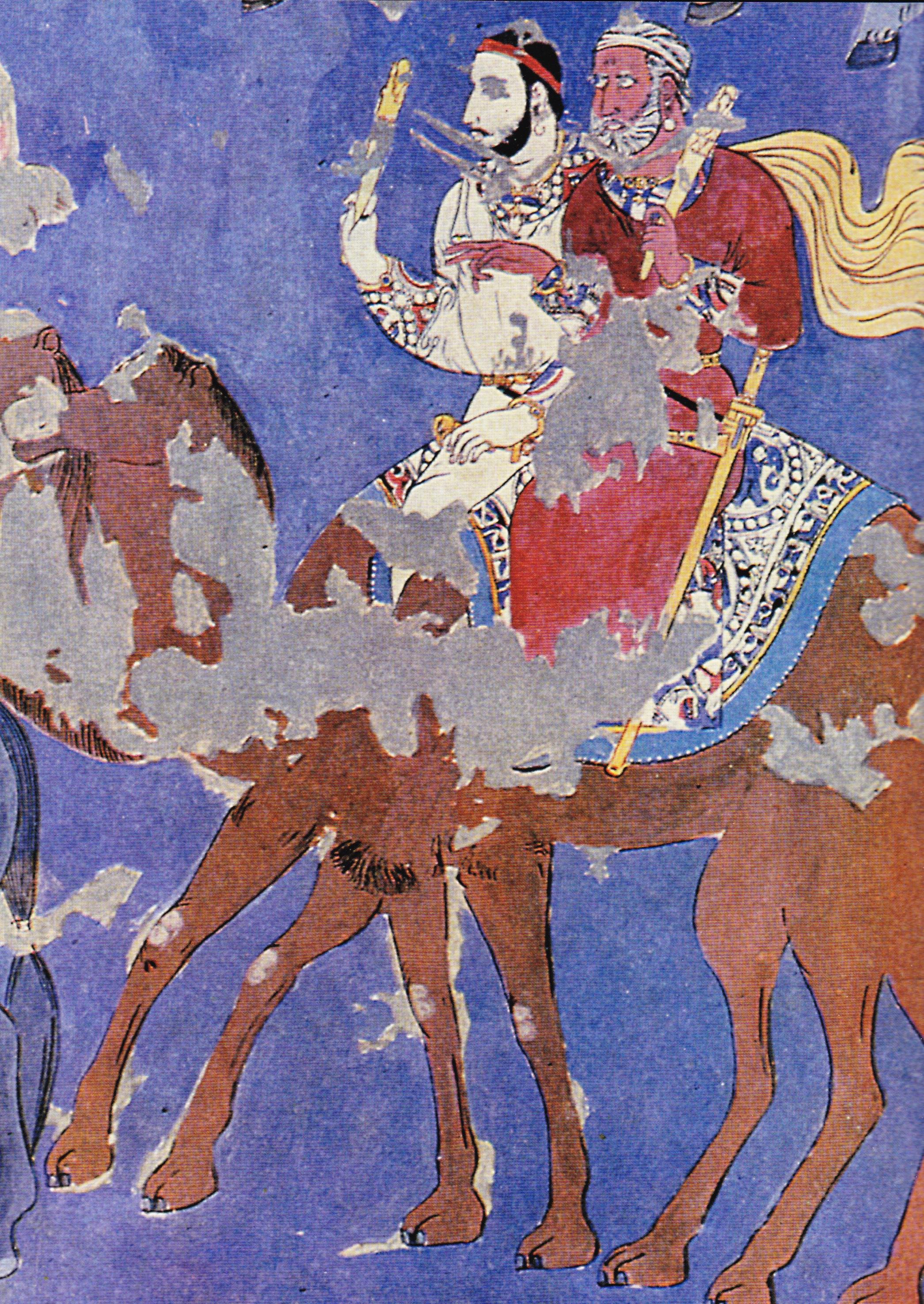
    Manichaean priests writing Sogdian manuscripts, in Khocho, Tarim Basin, ca. 8th/9th century AD
    Manichaean priests writing Sogdian manuscripts, in Khocho, Tarim Basin, ca. 8th/9th century AD

    Summer school in the Turfanforschung:

    “Sogdians and Turks on the Silk Road”

    August 22 – September 2, 2016

    Duration: two weeks, daily four seminars each 90 min.
    Location: Berlin Brandenburg Academy of Sciences and Humanities


    A detailed programme is available here: “Sogdians and Turks on the Silk Road” Summer School”

    Participation is free.

    The Turfanforschung (Turfan Studies) at the Berlin Brandenburg Academy of Sciences and Humanities offers in 2016 a summer school providing an introduction to the field of Turfan Studies, which deals with the many languages and scripts used along the Silk Road as well as the histories and cultures of those who used them. The summer school will center around the two main languages of Turfan research. Sogdian, a middle Iranian language, was widely used as a lingua franca in Central Asia since the 1st c. A.C. Old Turkic was the language of Turkic nomads which had a strong influence on the Silk Road since the middle of the 6th c. After the migration of the Uyghurs it was also used as the main language in the Turfan area under Uyghur rule until 14th c.

    The courses in this summer school will be given by the staff of the Turfanforschung and the Katalogisierung der Orientalischen Handschriften in Deutschland (Arbeitsstelle Berlin): A. Benkato, D. Durkin-Meisterernst, Y. Kasai, S.- Ch. Raschmann, C. Reck, A. Yakup. There will also be guest lectures by I. Colditz, M. Peyrot and L. Sander.

    Berlin Brandenburg Academy of Sciences and Humanities, Jägerstraße 22-23,
    10117 Berlin

    Topics:
    1. Scripts

    • Sogdian script
    • Uyghur script
    • Turkic Runic
    • Nestorian script
    • Manichaean script
    • Brāhmī script

    2. Language: Old Turkic

    • language course with reading
    • lecture for linguistics

    3. Language: Sogdian

    • language course with reading
    • lecture for linguistics

    4. Language: Tocharian

    5. Turfan studies

    • history of the Turfan expeditions
    • Central Asian book culture
    • history
    • religions
    • research history

    Because a minimum number of participants are required for the summer school to take place, we ask for a binding registration by 20th May 2016 at rabuske@bbaw.de or in writing at: Berlin-Brandenburgische Akademie der Wissenschaften AV Turfanforschung, Jägerstraße 22-23, D-10117, Berlin.


  • Turks and Iranians: Interactions in Language and History

    Csató, Éva, Lars Johanson, András Róna-Tas & Bo Utas (eds.). 2016. Turks and Iranians: Interactions in language and history (Turcologica 105). Wiesbaden: Harrassowitz Verlag.

    The contributions by an international group of leading scholars discuss the historical and cultural relations of old and modern Turkic and Iranian languages. A main topic is how contacts of spoken and written languages from pre-Islamic times until various periods of the Islamic era have influenced the emergence and development of Iranian and Turkic varieties. The purpose is to contribute to a better understanding of the interrelations between cultural-historical contacts and linguistic processes, and to stress the necessity of cooperation between experts of Turkic and Iranian studies.

    -See the Table of the Contents here

  • Sogdian Art and Archaelogy in China

    Wertmann, Patrick. 2015. Sogdians in China. Archaeological and art historical analyses of tombs and texts from the 3rd to the 10th century AD. Deutschen Archäologischen Institut, Eurasien-Abteilung, Außenstelle Peking. (Archaeology in China and East Asia 5). Philipp von Zabern.

    Sogdians, originating from present-day Uzbekistan and Tajikistan, dominated one of history’s greatest trade empires, extending from Constantinople to Korea between the 6th and 8th centuries AD. They established settlements in China and were granted positions of the highest rank at the imperial court. In recent years, richly equipped tombs attributed to members of the Sogdian diaspora were discovered in north and west China. The burial objects and inscriptions in these tombs offer surprising insights into the lives of these Central Asians. Patrick Wertmann followed the routes of the Sogdian traders and documented for his dissertation their traces in 54 museums and collections in eight countries, particularly in China. This fifth volume of the series Archaeology in China and East Asia offers the most comprehensive overview of Sogdian artefacts thus far assembled, with numerous colour photographs by the author.

    The book has 347 pages with 116 full-page plates and 15 tables.

     About the Author:
    Patrick Wertmann (PhD 2013) .is a specialist in East Asian art history and now working in the Sino-German cooperation project “Silk Road Fashion” of the Beijing Branch Office, Eurasia Department, German Archaeological Institute.
  • The life of Serapion in Sogdian

    Sims-Williams, Nicholas (ed.). 2015. The life of Serapion and other Christian Sogdian texts from the manuscripts E25 and E26. (Berliner Turfantexte 35). Turnhout: Brepols.
    The Sogdian texts published in this volume are of interest and importance in various ways. The Life of Serapion is particularly significant from a linguistic point of view, being a close translation of a known Syriac text, so that its rare words and unusual grammatical forms can be interpreted with confidence. The Life of John of Dailam, on the other hand, differs substantially from the surviving Syriac versions and preserves details unrecorded elsewhere concerning the history of western Iran in the early Islamic period. A text on omens represents an extremely ancient, pre-Christian survival, with clear parallels not only in Syriac but even in Babylonian omen texts, while a refutation of Manichaeism sheds light on the attitude of the Christian community in the Turfan oasis towards their Manichaean neighbours. All these texts are provided with translation and detailed commentary, and the volume concludes with grammatical notes, complete glossary, bibliography, index of words discussed, and eleven plates. This work will be of interest to specialists in Iranian languages, mediaeval Iran and Central Asia, Syriac literature and the history of the “Church of the East”.
  • Biblical and Christian Sogdian texts

    Sims-Williams, Nicholas, Martin Schwartz & William J. Pittard (eds.). 2014. Biblical and other Christian Sogdian texts from the Turfan collection. (Berliner Turfantexte 32). Turnhout: Brepols.
    This volume in the series Berliner Turfantexte contains the edition, with translation and detailed commentary, of a series of important Christian texts in Sogdian, most of them previously unpublished. The emphasis is on Biblical texts translated into Sogdian from the Syriac Peshitta version: a Psalter in Sogdian script, fragments of Gospel lectionaries, and a double-folio from a lectionary of the Pauline Epistles. Other texts edited in the volume include a retelling of the story of Daniel, a text on the Dormition of the Virgin Mary, and the “Wisdom of Ahiqar”, all of them in recensions which differ significantly from any known Syriac version. Two analytical glossaries, one for the Psalter and other texts in Sogdian script and one for the texts in Syriac script, cover not only the works edited in this book but also a number of Christian Sogdian texts published by the author in scattered articles over the last twenty years or so. The volume concludes with a bibliography, an index of words discussed in the commentary, and seventeen plates. This work will be of interest to specialists in Iranian languages, mediaeval Central Asia, Biblical studies, Syriac literature, and the history of the “Church of the East”.
  • Syriac into Middle Iranian

    Detail from the Manuscript Chaldean Cathedral of Mardin (CCM) 13, f. 120r

    Barbati, Chiara. 2015. Syriac into Middle Iranian: A Translation Studies Approach to Sogdian and Pahlavi Manuscripts within the Church of the East. Open Linguistics 1(1). 444–457.

    Based on a corpus coming from the Turfan oasis (in present-day Xinjiang, People’s Republic of China) and consisting of Christian Middle Iranian literature in several languages (Middle Persian, Syriac and Sogdian) and scripts (East Syriac, Pahlavi and secular Sogdian), the present paper is aimed at identifying and outlining the translation techniques for the transmission of religious knowledge, based on a literary tradition as well as on a manuscript tradition, from one context to another. The religious knowledge is that which belongs to the “Church of the East” and which is written in its official liturgical language, i.e. Syriac in East Syriac script. The general context is that of the missionary activities of the “Church of the East” along the Silk road between late Antiquity and early Middle Age. The particular context is that of the converted Iranian communities.
    About the Author:
    Chiara Barbati (PhD 2009) is a scholar of Ancient and Middle Iranian languages in the Institute of Iranian Studies, Austrian Academy of Sciences, Vienna (ÖAW).
  • Studies on the Pre-Islamic Iranian World

    Krasnowolska, Anna & Renata Rusek-Kowalska (eds.). 2015. Studies on the Iranian World I. Before Islam. Krakow: Jagiellonian University Press.
    This volume is the proceedings of the Seventh Conference of Iranian Studies of the Societas Iranologica Europaea (ECIS7), organized by Societas Iranologica Europaea (SIE), which took place in Cracow, September 7-10, 2011. The first of the two volumes of the ECIS7 proceedings is dedicated to the pre-Islamic Iranian studies.
    Table of Contents
    Linguistics:
    • Maria Carmela Benvenuto, Flavia Pompeo: “The Old Persian Genetive. A Study of a Syncretic Case
    • Saloumeh Gholami: “Nominal Compound Strategies in Middle Iranian Languages”
    • Paolo Ognibene: “Alan Place-names in Western Europe”
    • Christiane Reck: “Work in Progress: The Catalogue of the Buddhist Sogdian Fragments of the Berlin Turgan Collection”
    • Arash Zeini: “Preliminary Remarks on Middle Persian <nc> in the Pahlavi Documents”
    Literature:
    • Elham Afzalian: “Autoritäten im Mādayānī Hazār Dādestān”
    • Iris Colditz: “Two Snake-Brothers on their Way — Mani’s Scripture as a Source of Manichaean Central Asian Parabels?”
    • Seyyedeh Fatemeh Musavi: “Fictional Structure of the Middle Persian Ayādgār ī Zarērān
    Religion:
    • Desmond Durkin-Meisterernst: “Aspects of Hymnology in Manichaean Community in Turfan”
    • Raffaella Frascarelli: “Arǝdvī Sūrā Anāhitā: Considerations on the Greek ἀρχἡ”
    • Judith Josephson: “Ohrmazd’s Plan for Creation according to Book Three of the Denkard”
    • Götz König: “The Pahlavi Translation of Yašt 3″
    • Kianosh Rezania: “On the Old Iranian Social Space and its Relation to the Time Ordering System”
    History:
    Archaeology:
    • Alireza Askari Chaversi: “In Search of the Elusive Town of Persepolis”
    • Jukian Bogdani, Luca Colliva, Sven Stefano Tilia: “The Citadel of Erbil. The Italian Archaeological and Topographic Activities”
    • Carlo G. Cereti, Gianfilippo Terribili, Alessandro Tilia: “Pāikūlī in its Geographical Context”
    • Niccolò Manassero: “New Sealings from Old Nisa”
    • Vito Messina, Jafar Mehr Kian: “The Hong-e Azhdar Parthian Rock Relief Reconsidered”
     About the Editors:

    Anna Krasnowolska is a professor at the Institute of Oriental Studies, Jagiellonian University.

    Renata Rusek-Kowalska is an assistant professor at the Institute of Oriental Studies, Jagiellonian University.

  • Samarkand and Soghd During the Abbasid Period: Political and Social History

    Karev, Yuri. 2015. Samarqand et le Sughd à l’époque ‘abbasside: Histoire politique et sociale. (Cahiers de Studia Iranica 55). Paris. Peeters.

    During the Abbasid period (750-820), the vast territories beyond the Amu Darya river (the Mawara’annahr), conquered by the Umayyad generals in the first half of the eighth century, entered definitively into the cultural sphere of Islam. The comparative analysis of medieval Arabic, Persian, and Chinese sources, supplemented by materials from unpublished manuscripts, as well as the latest results yielded by archaeological excavations at Samarkand, have made it possible to establish a fine-grained chronology of this turning point in the history of Central Asia. Examined in this new light are complex and irreversible processes that resulted in a changed political and religious fabric, transformations of the Sogdian and Muslim elite, and the evolution of the state’s system of controlling territories on its borders, within a context of confrontations and diplomatic relations between the caliphate, the Tang empire in China, and the Turks.

    For more information, see the Table of Contents of this volume.

  • Paintings of afrāsyāb

    Details of a copy of mural called The Ambassordors’ Painting, found in the hall of the ruin of an aristocratic house in Afrasiab, commissioned by the king of Samarkand, Varkhuman (ca. 650)

    Compareti, Matteo. 2015. Samarkand the center of the world: proposals for the indentification of the afrasyab paintings. Costa Mesa: Mazda Publishers.

     In antiquity Samarkand was the capital of the Persian province of Sogdiana. Its language, culture, and “Zoroastrian” religion closely approximated those of the Persians. Following its conquest by Alexander, its strategic position and fertile soil made Sogdiana a coveted prize for Late Antique invaders of Central Asia. Around 660 CE — at the dawn of Arab invasion — local king Varkhuman promoted the execution of a unique painted program in one of his private rooms. Each wall was dedicated to a specific population: the north wall, the Chinese; the west, the Sogdians themselves; the east, the Indians and possibly the Turks. The south wall is probably the continuation of the scene on the west wall. In Chinese written sources, some support for this concept of the “division of the world” can be found. Accidentally discovered during Soviet times, the room was named “Hall of the Ambassadors” due to the representations of different peoples. However, many aspects of its painted program remain obscure. This study offers new ideas for better identifications of the rituals celebrated by the people on the different walls during precise moments of the year.
    About the Author:
    Matteo Compareti (PhD 2005) is adjunct assistant professor in Department of Near Eastern Studies, University of California-Berkeley.
  • The Mount Mugh Documents and Sogdian Epigraphy

    Livshits 2015Livshits, Vladimir A. 2015. Sogdian epigraphy of Central Asia and Semirech’e. (Ed.) Nicholas Sims-Williams. (Trans.) Tom Stableford. (Corpus Inscriptionum Iranicarum. Part II Inscriptions of the Seleucid and Parthian Periods and of Eastern Iran and Central Asia Vol. III. Sogdian). London: School of Oriental and African Studies (SOAS).
    This volume presents the Emglish translations of some very important and major works of  Vladimir Aronovich Livshits on the Sogdian language, culture and sources. The volume is arranged in two parts. The first part is a translation of Sogdian documents from Mount Mug (kuh-e moḡ), site of the 7th-8th-century refuge of the rulers of Penjikent in Sogdiana, located in the upper reaches of the Zeravshan in northern Tajikistan, where an important archive of documents written in Sogdian was discovered by A. A. Freiman’s 1933 expedition. Livshits has taken part  first and foremost, in the deciphering of the Mnt. Mug archive of Sogdian documents from Mount Mug.
    The second part of the volume, dedicated to the English translations of some ten important articles of Livshits, concerning the Sogdian epigraphy, in which he examines “not only the purely philological problems but also questions of the history and culture of Sogd, aided by his frequent participation in archaeological excavations and journeys to the lands of historical Sogdiana in Tajikistan, Uzbekistan and Kirgizia”.

    (more…)