• Dabir (vol. 10)

    Volume 10 of Dabir, dated 2023, is now available with two issues.

    Issue 1:

    • Nima Asefi: Open Access Frāy in Seven Documents from the Pahlavi Archive of Hastijan
    • Majid Daneshgar: Anthologies of Persian Poetry Inscribed in Indonesia: A Handlist of Rare Manuscripts
    • Mustafa Dehqan: Restricted Access From Historian to Poet: A Checklist of the Persian Poems of Idrīs Bidlīsī (Hašt Bihišt VI, Nuruosmaniye 3209)
    • Marco Ferrario: Before Skunḫa. A (Trans)Local Perspective on the Rise of the Teispid-Achaemenid Frontiers in Baktria, Sogdiana, and Beyond
    • Saloumeh Gholami: The Zoroastrian Manuscripts of the Rostam Jāmāsb’s Family and a New Dating of Videvdād 4100
    • Book Review:
    • David Gilinsky: ‘Shirat Moshe: A Complete Hebrew translation of Shahin’s Musa Nameh – the greatest poet of Iranian Jewry’ [Hebrew] , written by Baruch Pickel

    Issue 2:

    • Negar Habibi: On Persian Design and Fashion in Twentieth-Century France: The 1930 Jean Pozzi Catalogue of Persian Art
    • Stefan Härtel: Thoughts on the Iconography of the Sophytos Coinage
    • Götz König: On the Yašt Gāhān (= Gāh Sārnā)
    • Nina Mazhjoo: Taking the Bull by His Horn: Augustus Slays the Mithraic Bull
    • Daniel T. Potts: Restricted Access The Tassels of Royal and Divine Sasanian Horses
    • Enrico G. Raffaelli: Restricted Access Dahmān Āfrīn and Srōš: Analyzing a Connection
    • Book Reviews:
    • Khodadad Rezakhani: the Age of the Great Kings , written by Lloyd Llwellyn-Jones
    • Hossein Sheikh: Hunnic peoples in Central and South Asia: sources for their origin and history , edited by Dániel Balogh
  • TISS-Parzor Academic Programme

    ‘Parzor is delighted to announce its long awaited TISS-Parzor Online Academic Programme on Culture & Heritage Studies’. As part of this programme, you can ‘learn, gain credits, explore exciting issues of environment and sociology, craft, art, literature, theatre, cuisine as well as business and philanthropy’.

    Dr. Shernaz Cama announces the start of the TISS Parzor Online Academic Programme on Culture & Heritage Studies.

    For admissions and programme details, visit the TISS Website. Admissions are open till 31st August and open to all! Apply now!

  • The Art of Teaching Persian Literature

    Lewis, Franklin,Asghar Seyed-Gohrab & Pouneh Shabani-Jadidi (eds.). 2024. The Art of Teaching Persian Literature: From Theory to Practice. Leiden: Brill.

    This unique book is the first publication on the art of teaching Persian literature in English, consisting of 18 chapters by prominent early-career, mid-career and established scholars, who generously share their experiences and methodologies in teaching both classical and modern Persian literature across various academic traditions in the world. The volume is divided into three parts: the background to teaching Persian literature: pedagogy, translation and canon, and thematic and topical approaches to the Persian literature class. It includes such topics as the history of teaching Persian literature, the traditional teaching of Persian literature, the political and ideological intentions revealed in the formation of the Persian literature curriculum, the necessity to include marginalized modern Persian literature, such as women’s or diaspora literature, and more applied approaches to curriculum development and teaching.

  • In Search of Cultural Identities in West and Central Asia

    Colburn, Henry P., Betty Hensellek & Judith A. Lerner (eds.). 2023. In Search of Cultural Identities in West and Central Asia: A Festschrift for Prudence Oliver Harper (Inner and Central Asian Art and Archaeology 3). Turnhout: Brepols.

    How do we reconstruct ancient societies’ cultural and visual identities? Prudence Oliver Harper has dedicated her scholarly and curatorial career to piecing together the material culture of communities across ancient Western Asia, Iran, and Central Asia. A number of her colleagues – art historians, archaeologists, philologists, and conservators – have contributed essays to this volume to reflect Harper’s range of contributions throughout her six-decade career. Many of the essays focus on ancient metalwork, Harper’s major expertise, while others on glyptics, ivory, or glass, three of her other interests. The essays aim to make sense of this region’s diverse cultural identities, many of which are the results of cross-cultural exchange. Some authors have employed iconographical or socio-historical approaches; others have complementarily opened new facets of cultural identities through technical and scientific analyses, collection history, and provenance research.

  • Varia Manichaica

    Varia Manichaica

    Morano, Enrico & Samuel N. C. Lieu (eds.). 2024. Varia Manichaica (Corpus Fontium Manichaeorum. Analecta Manichaica 3). Turnhout: Brepols.

    This volume brings together the works of some of the best known and most established scholars in Gnostic and Manichaean studies, Iranologists and art historians. It contains two important and indispensable catalogues of Turfan texts and also studies covering topics such as cosmogony, hymnology and manuscript illumination. A number of Turfan texts in Sogdian and Uygur are published here for the first time.

    Table of Contents

    • Sergio Basso: “Manichaean fragments related to the ‘Barlaam and Ioasaph saga’”
    • Adam BenkatoA Fragment of an Iranian Manichaean ‘Oral Tradition’
    • Fernando Bermejo-RubioMani as a paradigm of the Manichaean Church in the Cologne Mani Codex
    • Şehnaz Biçer and Betül ÖzbayThe Lotus illustration in a Manichaean manuscript
    • Iris Colditz: Strategies for success. Manichaeism under the early Sasanians
    • Desmond Durkin-MeisterernstAn update of Boyce’s Catalogue of Manichaean Middle Persian and Parthian 
    • Eduard IricinschiHow Do Wisdom, Law, and Revelation a Religion Make? Appropriation and Displacement in the ‘Chapters of the Wisdom of My Lord Mani’
    • Samuel N.C. LieuA catalogue of the Uygur Manichaean texts 
    • Enrico MoranoUygur in the Manichaean Sogdian texts in Manichaean script from the Berlin Turfan Collection 
    • Nicholas Sims-WilliamsThe “seven adversities” in a Manichaean Sogdian hymn
    • Michel TardieuLa métaphore de l’auberge
    • Peter Zieme: “Worte für die Seele”. Altuigurische manichäische Fragmente with an appendix by Yutaka Yoshida
  • Zoroastrian Iconographies from Pre-Islamic Persia and Central Asia

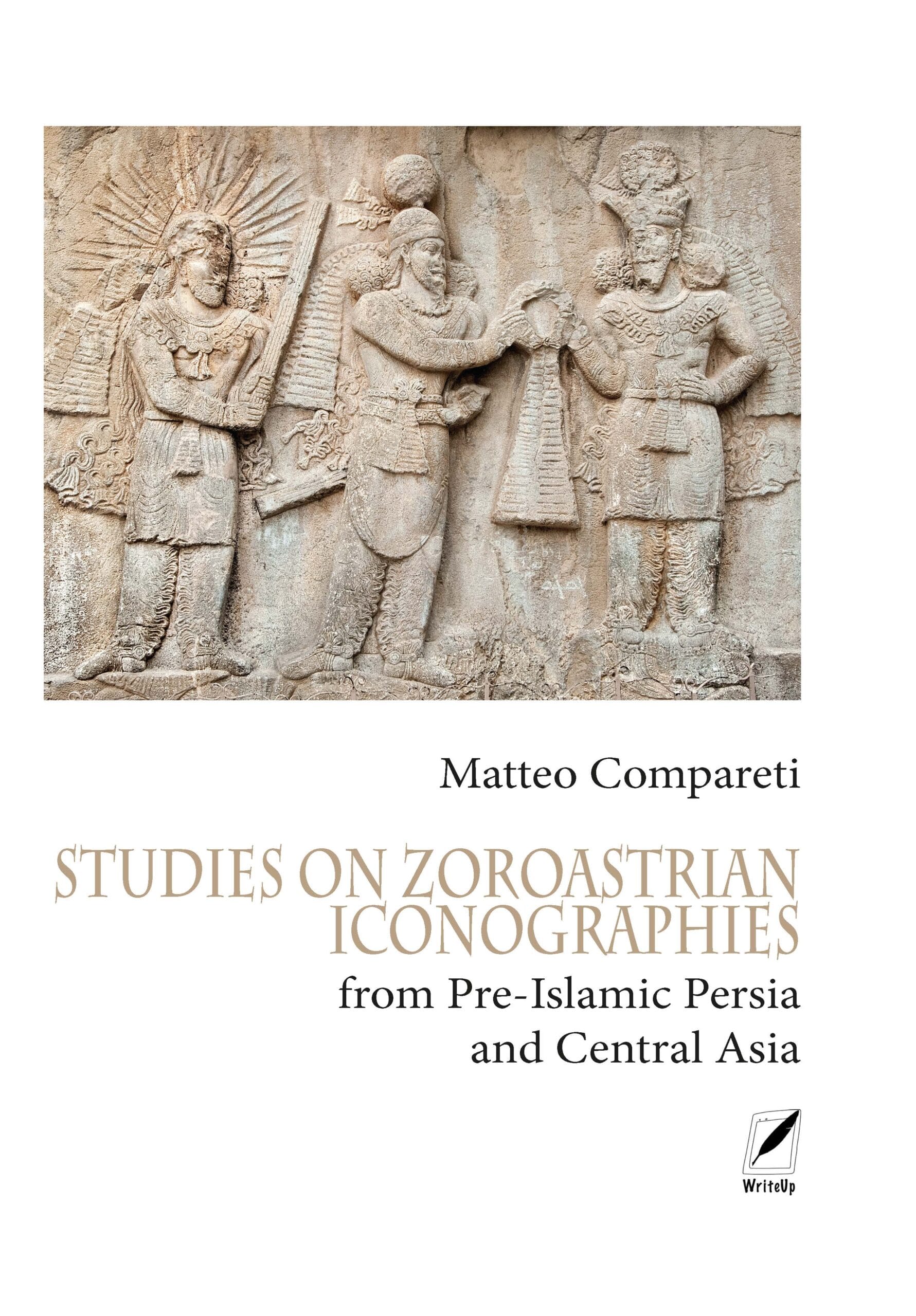
    Compareti, Matteo. 2024. Studies on Zoroastrian Iconographies from Pre-Islamic Persia and Central Asia. Roma: WriteUp.

    Sogdiana was an Eastern Iranian land situated in the territories of modern Uzbekistan and Tajikistan. It never formed a significant political or military force although, between the 6th-9th centuries, Sogdians became the main actors in the caravan and maritime trade networks commonly called the “Silk Road”. Most of archaeological and artistic materials about Sogdians come from excavations in ex-Soviet Central Asia, especially the site of Penjikent (Tajikistan). Wall paintings from this important Sogdian site show a native polytheistic faith with Zoroastrian background, which is still puzzling experts of Iranian studies. During the centuries, local artists adopted external cultural elements that – once individuated – could help to shed light on unidentified deities of the Sogdian pantheon. Their comparison with Zoroastrian deities depicted in pre-Islamic Persian arts represents an invaluable instrument to improving our knowledge of this fascinating but still enigmatic field of studies.

  • Landscapes, Scriptures, Symbols and Architectures of Ancient Iran

    The volume 26 of the journal ISIMU is now out and it is dedicated to aspects of ancient Iranian architecture and culture: Landscapes, Scriptures, Symbols and Architectures of Ancient Iran.

    • Fernando Escribano Martín, Carmen del Cerro Linares, Carlos Fernández Rodríguez y Francisco L. Borrego Gallardo: Presentación
    • Silvia Balatti: I materiali scrittori dell’Iran achemenide
    • Pierfrancesco Callieri: Babilonesi a Persepoli. Nuovi studi sull’architettura dell’Antica Persia
    • Fernando Escribano Martín: El jardín persa, intento de explicación y búsqueda de orígenes y trascendencias
    • Carlos Fernández Rodríguez: La gestión del agua y la habitabilidad del sur de Irán durante la Edad del Hierro
    • Zahara Gharehkhani: Criaturas híbridas de la Persia preislámica. Reflexiones y simbolismo
    • Sébastien Gondet: Observations on the environmental setting of the agricultural development and occupational history of Achaemenid Persepolis
    • Alireza Khounani: The Vineyards of Parthian Arsacid Nisa (151–15 BCE): Rent Farming and Cash Crop Agriculture from the Perspective of the Ostraca
    • Giulio Maresca: An overview of the pottery from Sistan in the Late Iron Age/Achaemenid period
    • Negin Miri and Cyrus Nasrollahzadeh: Another bulla of Weh-Šāpur, ĒrānSpāhbed of Kust-i-Nēmrōz from the Treasury of Mostazafan Foundation’s Cultural Institution of Museums in Tehran
    • Davide Salaris and Roberto Dan: Exploring the archaeology and significance of Masjed-e Soleyman: a reassessment of the Elymaean Temple and its socio-cultural context in southwestern Iran
  • Iranian Art

    Blair, Sheila, Jonathan M. Bloom & Sandra Williams (eds.). 2024. Iranian art from the Sasanians to the Islamic Republic. Essays in honour of Linda Komaroff (Edinburgh Studies in Islamic Art). Edinburgh: Edinburgh University Press.

    Introduces Iranian art from classical to contemporary media, showing how art can be a source for history and politics

    • Takes a broad view of the Persianate world
    • Opens a traditional field in new directions
    • Presents a combination of senior scholars and younger voices, and includes perspectives from Asia, Europe and the USA
    • Combines views from the academy, the museum and the laboratory, ranging from the practical to the theoretical
  • Contextualizing Herodotus

    Degen, Julian, Hilmar Klinkott, Robert Rollinger, Kai Ruffing & Truschnegg Brigitte (eds.). 2024. Ancient World in Perspective: Contextualizing Herodotus (Philippika 150). Wiesbaden: Harrassowitz.

    This volume is a collection of papers presented at a workshop commemorating the 20th anniversary of Reinhold Bichler’s monograph Herodots Welt.

    It convenes a group of international specialists discussing Herodotus’ work from different perspectives. From the backdrop of ongoing scholarly debates, this volume seeks to offer a fresh look on the Histories. The various contributions present a nuanced portrayal of Herodotus as an author and the Histories as a literary cosmos, enhancing our comprehension of one of the most significant surviving texts from the Classical period. The topics cover a wide range of themes, including the structure of Herodotus’ historiographical narrative, his responses to the politics of Athens as well as the Achaemenid Empire, and the reception of his work. Finally, Herodotus’ description of the “world”, his conceptual ideas on regions and human culture and also the ongoing problems of how to deal with the Histories as a historical source are central questions addressed in this volume.

    For a ToC, click here.