• Recent Studies on Persian-Greek Relations

    Recent Studies on Persian-Greek Relations

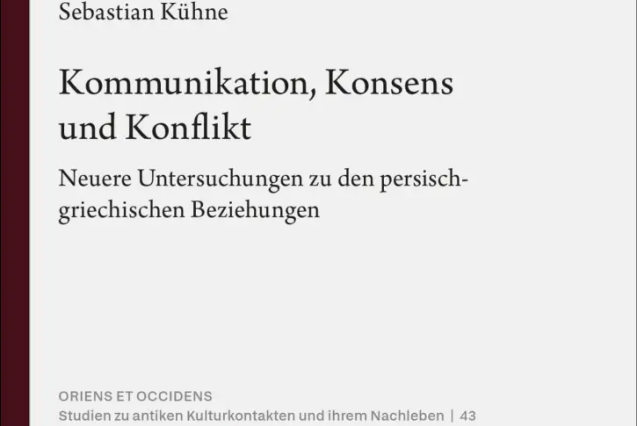
    Kühne, Sebastian. 2024. Kommunikation, Konsens und Konflikt: neuere Untersuchungen zu den persisch-griechischen Beziehungen (Oriens et occidens 43). Stuttgart: Franz Steiner Verlag.

    Sebastian Kühne addresses selected aspects of the political interactions between the Greek city-states of the 5th and 4th centuries BCE and the Achaemenid Empire. He examines the relationships that developed between these two powers from a consistently Persian perspective. The study focuses on the mechanisms of diplomatic exchange between the Greek poleis and the Persian Great Kings and, building on this, the outcomes of these political interactions, which have gone down in history as the “King’s Peace” and the “Peace of Pelopidas.” Finally, the analysis highlights the tools available to the Achaemenid rulers to assert their interests vis-à-vis the Greek city-states. Through his analysis, the author revises older scholarly views that have dominated previous studies on Greek-Persian agreements and military conflicts, bringing to light new aspects regarding the diplomatic exchanges between Greece and the Achaemenid Empire.

    For the table of contents see here.

  • New Voices in Iranian Archaeology

    New Voices in Iranian Archaeology

    Alizadeh, Karim & Megan Cifarelli (eds.). 2024. New voices in Iranian archaeology. Barnsley: Oxbow Books.

    This volume highlights the excellent, wide-ranging work of a diverse collection of Iranian archaeologists, the new voices in Iranian archaeology. Archaeology in Iran has developed in lockstep with the discipline of archaeology itself, in part due to the colonial endeavors that provided impetus for Europeans to travel to distant lands and extract antiquities and other commodities. But centuries before western archaeologists broke ground on excavations in the lands that would in 1935 be called Iran, a deep and meaningful engagement with and reverence for the past was a thread running through Iranian culture since antiquity. For millennia, the residents and rulers of ancient Iranian lands have admired, interacted with, inscribed, invented stories about, and imitated the visible, often ruined, monuments of their ancestors that dotted the landscape

    Description
  • Parthica (vol. 25)

    Parthica (vol. 25)

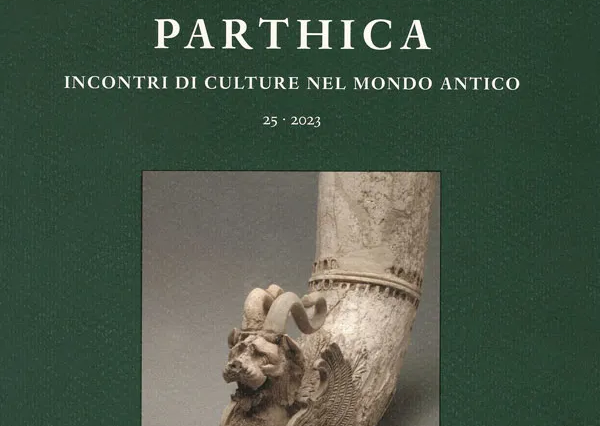
    Volume 25 of the journal Parthica (2023) contains several contributions of relevance to Iranian Studies.

    • Ronald Wallenfels: On the reuse of personal seals in the Hellenistic Near East
    • Robert S. Wójcikowski, Daniele Morandi Bonacossi, Michał Marciak, Bartłomiej Szypuła: Memorials of the battle of Gaugamela in the Navkur Plain
    • Roberto Dan: Hellenistic/Artaxiad remains in the Van fortress? Some thoughts on trench A6 excavated by the American expedition (1938-1939)
    • Francesca Michetti: Antroponimi battriani sulla monetazione pre-kušānide: tre proposte di etimologia
    • Edward Dąbrowa: Arsacid crudelitas: some observations
    • Enrico Foietta: A new altar with an enthroned goddess from Hatra (Iraq)
    • Valentina Gallerani: Parthian and sasanian settlement patterns in the Qadis survey area (Qadisiyah, Iraq)
  • Social Biographies of the Ancient World

    Social Biographies of the Ancient World

    The latest issue of Journal of Ancient History (volume 12, issue 2) is a special issue: Social Biographies of the Ancient World with Jason M. Silverman as guest editor. Below is the list of articles:

    • Jason M. Silverman, Alex Aissaoui, Rotem Avneri Meir, Jutta Jokiranta, Nina Nikki, Adrianne Spunaugle, Joanna Töyräänvuori, Caroline Wallis, Melanie Wasmuth: Social Biographies of the Ancient World. Studying Ahatabu, Jonathan, and Babatha through a Bourdieusian Approach: Towards a New Historiographical Habitus
    • Adrianne Spunaugle: Ancient Near Eastern Field Theory: Adapting Bourdieu for Social Biographies of the Ancient World
    • Jason M. Silverman, Joanna Töyräänvuori, Melanie Wasmuth: Ahatabu and her Stela (ÄM 7707): Funerary Habitus in Achaemenid Egypt
    • Rotem Avneri Meir, Jutta Jokiranta, Adrianne Spunaugle: Functional Differentiation in 1 Maccabees: Exploring Second Century BCE Judean Society Through the Character of Jonathan Apphus
    • Caroline Wallis, Alex Aissaoui, Nina Nikki: Falling Out with the In-Laws. Understanding the Babatha Archive with Pierre Bourdieu’s Field Theory and Theory of Practice.
    • Emanuel Pfoh: Ancient Individuals and Bourdieu in Context: A Historical Anthropological Response
    • Olga Zeveleva: A Sociological Response: Challenging the Modernity-centrism of Pierre Bourdieu’s Field Approach
    • Helen Dixon: A Levantine Archaeological Response: Thinking with Bourdieu though Limited Data and Explicit Assumptions
  • The Medieval Persian Gulf

    The Medieval Persian Gulf

    Ulrich, Brian. 2023. The Medieval Persian Gulf. Leeds: Arc-Humanities.

    The Persian Gulf today is home to multiple cosmopolitan urban hubs of globalization. This did not start with the discovery of oil. This book tells of the Gulf from the rise of Islam until the coming of the Portuguese, when port cities such as Siraf, Sohar, and Hormuz were entrepots for trading pearls, horses, spices, and other products across much of Asia and eastern Africa. Indeed, products traded there became a key part of the material culture of medieval Islamic civilization, and the Gulf region itself was a crucial membrane between the Middle East and the world of the broader Indian Ocean. The book also highlights the long-term presence of communities of South Asian and African ancestry, as well as patterns of religious change among Jews, Christians, Zoroastrians, and Muslims that belie the image of a region long polarized between Arabs and Persians and Sunnis and Shi’ites.

  • Cosmos, society, religion

    Maurer, Moritz. 2024. Kosmos, Gesellschaft, Religion: Zoroastrische und manichäische Sozialordnungsdiskurse in der langen Spätantike (Religionsgeschichtliche Versuche und Vorarbeiten 80). Berlin: De Gruyter.

    For over 400 years, the Sasanian Empire was one of late antiquity’s most powerful empires. Zoroastrian religious specialists came up with a system to order its complex society. By looking at numerous primary sources, this volume reconstructs that process in the context of Sasanian social and economic history and examines its afterlife in Zoroastrian texts.

    About
  • Herodotus: Book III

    Longley, Georgina. 2024. Herodotus: Book III. London: Bloomsbury.

    This accessible edition for students presents Herodotus as one of the most fascinating and colourful authors from the ancient world. Book III of Herodotus’ nine-book work is one of the richest in its exploration of themes, such as the practices and customs of different peoples and the nature of political power, issues still much debated today.

    This commentary illuminates the geographical and even anthropological scope of Herodotus’ history, and enables students to confidently tackle the text in the original Greek. Bringing together a full introduction, text, commentary and translation, Longley makes Herodotus accessible to students of ancient Greek. This guide shows us why Herodotus is still considered the ‘Father of History’.


  • Mannea and beyond

    Naseri, Reza, Mehrdad Malekzadeh, Andrea Cesaretti & Roberto Dan. 2024. Mannea and beyond: A study of Iron Age and later pottery from Zanjan in the National Museum of Iran. Antilia.

    The volume Mannea and Beyond: A Study of Iron Age and Later Pottery from Zanjan in the National Museum of Iran presents a systematic analysis of a ceramic assemblage from Zanjan, stored in Iran’s National Museum. Due to the lack of archaeological context—these artefacts were retrieved through illegal excavations—the study focuses on typology, preservation, and precise comparisons with neighbouring sites. The assemblage is heterogeneous, largely from the Iron Age with some medieval pieces, with several items linked to the Mannaean culture, enriching our understanding of this relatively obscure cultural horizon. The excellent preservation suggests that the materials may originate from a necropolis with unknown position.

    Source: Reza Naseri’s social media page.

  • Mani’s Living Gospel and the Ewangelyōnīg Hymns

    Shokri-Foumeshi, Mohammad (ed.). 2025. Mani’s Living Gospel and the Ewangelyōnīg hymns. Edition, reconstruction and commentary with a codicological and textual approach based on Manichaean Turfan fragments in the Berlin Collection (Corpus Fontium Manichaeorum. Series Iranica 3). Turnhout: Brepols.

    This work deals with the manuscript fragments of Maniʼs Living Gospel and the Ewangeliōnīg Hymns of his followers in the eastern Manichaean churches. The author identifies new fragments and improves the previous reconstructions. In this context, he analyzes all the Manichaean and non-Manichaean documents. This book is designed to enlarge our understanding of the Turfan texts by presenting new texts and interpretations.

    Summary

    TABLE OF CONTENTS

    Acknowledgements
     
    CHAPTER ONE INTRODUCTION
    1.1 Aim, Plan, and Strategy
    1.2 Material and Content of the Living Gospel and Ewangelyōnīg Hymns
    1.3 Outline of This Study
    1.4 History of Prior Research

    (more…)
  • Indogermanische Forschungen

    The recent issue of Indogermanische Forschungen (129/2024) contains several interesting papers.