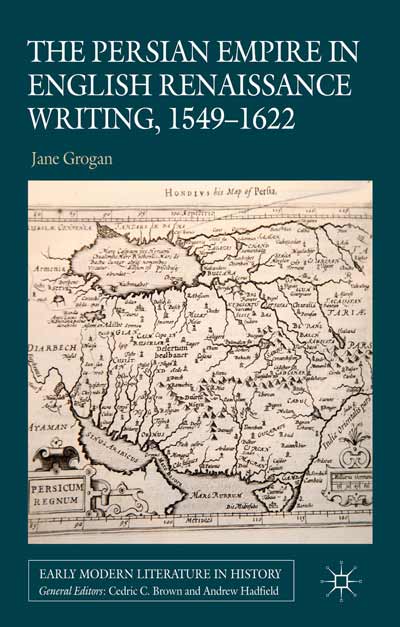
• The Persian Empire in England

    Grogan, Jane. 2014. The Persian empire in English Renaissance writing, 1549 – 1622. (Early Modern Literature in History). Basingstoke: Palgrave Macmillan.
    The Persian Empire in English Renaissance Writing, 1549-1622 studies the conception of Persia in the literary, political and pedagogic writings of Renaissance England and Britain. It argues that writers of all kinds debated the means and merits of English empire through their intellectual engagement with the ancient Persian empire. It studies the reception of Xenophon’s Cyropaedia and the Histories of Herodotus, the bedrock of English conceptions of Persia and the Persian empire, in plays, poetry and political thought. Covering the period from the beginnings of Anglo-Persian relations under the auspices of the Muscovy Company in the 1560s and 1570s to the first Anglo-Persian military alliance in 1622, it traces the changing conception and uses of Persia – both Islamic and ancient – in the English literary and political imaginary, and demonstrates the contemporary uses of an idealized image of Persia rooted in the classical legacy.
    Table of Contents:
    • Introduction: Reading Persia in Renaissance England
    • Classical Persia: Making Kings and Empires
    • Romance Persia: ‘Nourse of Pompous Pride’
    • Staging Persia: ‘To ride in triumph through Persepolis’
    • Sherley Persia: ‘Agible things’
    • Epilogue: Ormuz

    About the Author:

    Jane Grogan is a Lecturer in Renaissance Literature at the School of English, Drama and Film at University College Dublin, Ireland.

  • The deconstruction of the Silk Road

    de la Vaissière, Etienne. 2014. Trans-asian trade or the Silk Road deconstructed. In Neal, Larry & Jeffrey Williamson (eds.), The Cambridge history of capitalism. Volume 1. The rise of capitalism: From ancient origins to 1848, 101–124. Cambridge University Press.

    The first volume of The Cambridge History of Capitalism provides a comprehensive account of the evolution of capitalism from its earliest beginnings. Starting with its distant origins in ancient Babylon, successive chapters trace progression up to the ‘Promised Land’ of capitalism in America. Adopting a wide geographical coverage and comparative perspective, the international team of authors discuss the contributions of Greek, Roman, and Asian civilizations to the development of capitalism, as well as the Chinese, Indian and Arab empires. They determine what features of modern capitalism were present at each time and place, and why the various precursors of capitalism did not survive. Looking at the eventual success of medieval Europe and the examples of city-states in northern Italy and the Low Countries, the authors address how British mercantilism led to European imitations and American successes, and ultimately, how capitalism became global.

  • Indo-Persian State Secretary

    Kinra, Rajeev. 2015. Writing self, writing empire: Chandar Bhan Brahman and the cultural world of the Indo-Persian state secretary. (South Asia across the Disciplines). Oakland, California: University of California Press.


    Writing Self, Writing Empire examines the life, career, and writings of the Mughal state secretary, or munshi, Chandar Bhan Brahman (d. ca. 1670), one of the great Indo-Persian poets and prose stylists of early modern South Asia. Chandar Bhan’s life spanned the reigns of four emperors: Akbar (1556–1605), Jahangir (1605–1627), Shah Jahan (1628–1658), and Aurangzeb ‘Alamgir (1658–1707), the last of the “Great Mughals” whose courts dominated the culture and politics of the subcontinent at the height of the empire’s power, territorial reach, and global influence.

    Chandar Bhan was a high-caste Hindu who worked for a series of Muslim monarchs and other officials, forming powerful friendships along the way; his experience bears vivid testimony to the pluralistic atmosphere of the Mughal court, particularly during the reign of Shah Jahan, the celebrated builder of the Taj Mahal. But his widely circulated and emulated works also touch on a range of topics central to our understanding of the court’s literary, mystical, administrative, and ethical cultures, while his letters and autobiographical writings provide tantalizing examples of early modern Indo-Persian modes of self-fashioning. Chandar Bhan’s oeuvre is a valuable window onto a crucial, though surprisingly neglected, period of Mughal cultural and political history.

    You can download* and read the book here.

    (more…)

  • Religious Appropriation of National Symbols in Iran: Searching for Cyrus the Great

    Merhavy, Menahem. 2015. Religious Appropriation of National Symbols in Iran: Searching for Cyrus the GreatIranian Studies. 48(6), 933-948.

    In this article I examine the debate over the character of Cyrus the Great in Iran during the last four decades, using it as a prism to view the struggle over the desired balance between religious and ethnic components of Iranian identity. Heated polemics over the historical figure of Cyrus and his legacy reveal undercurrents of Iranian identity dilemmas as well as different and conflicting views of Iranian identity. Beyond a mere historical or religious controversy, the debate over the “right” memory of Cyrus presents an interesting case of shifting emphasis on identity and sources of political inspiration in Iranian society from the late 1960s to the present. Moreover, putting the debate over the ancient king in perspective, there emerges a wider picture of religious adaptation and embrace of what once seemed pagan or secular.

  • Ethics of War and Peace in the Shahnameh of Ferdowsi

    Mahalati, Mohammad Jafar Amir. 2015. Ethics of War and Peace in the Shahnameh of FerdowsiIranian Studies. 48(6), 905-931.


    This article provides an overview of the ethics of war and peace in the most important and normatively influential work of epic literature known in the eastern lands of Islam, namely the shahnameh of Ferdowsi (d. 1020 CE). As one of the greatest sources of the Iranian cultural identity for over a millennium, Shahnameh (lit. The book of kings) defines normative ideals in the ethics of war and peace within narratives that connect the ancient history of Iran to its mythical eras and in effect to both the medieval time of the epic’s authorship and modern Iranian identity. By identifying limits, standards and legitimacy for war and peace in Shahnameh, this article aims to facilitate an Iranian contribution to the global literature and practice on peacemaking that has deep roots in the Islamo-Persian tradition.

  • Iranian Jews in Israel

    Cecolin, Alessandra. 2015.Iranian Jews in Israel: Between Persian Cultural Identity and Israeli Nationalism. (Library of Modern Middle East Studies). London: I.B. Tauris.
    Since the establishment of the State of Israel in May 1948, more than 40,000 Iranian Jews have moved to Israel, with the last big wave arriving after the Iranian Revolution of 1978/79. As the governments of these two states continue to display animosity towards each other, an examination of the Jews of Iran who now live in Israel provides important insights into the nature of the relationship between these two key countries in the Middle East. Alessandra Cecolin combines a historical approach to the patterns of Iranian Jewish emigration to Israel with a political analysis of Iranian-Israeli relations, exploring how the political and diplomatic interactions between the two have shaped the processes of emigration and integration of Iranian Jewry in Israel. In this book she explores how this community is often caught between a Persian cultural identity and Israeli nationality, and draws out the implications this has both for the community in Israel and for the wider region.
    About the Ahuthor
    Alessandra Cecolin (PhD 2013) is a scholar of Jewish history in the Department of History, Goldsmiths, University of London.
  • Approaches to Social Complexity in Kura-Araxes Culture

    Alizadeh, Karim, Hamed Eghbal, and Siavash Samei. 2015. Approaches to Social Complexity in Kura-Araxes Culture: A View from Köhne Shahar (Ravaz) in Chaldran, Iranian Azerbaijan, Paléorient. 41(1),37-54.

    Due to increasing investigations and studies of the Kura-Araxes cultural communities, our information about this enigmatic
    archaeological culture has increased in many respects. Its interactions and regional variations in terms of cultural materials have been analyzed by many scholars. However, our knowledge about its societal variations is still very limited. We do not yet know much about social dynamics behind its material culture that spread out through vast regions in the Caucasus and the Near East. Indeed, there are some fundamental questions about the Kura-Araxes cultural communities that need further investigation. To address these questions, we focus on data collected from Köhne Shahar, a Kura-Araxes site in the Chaldran area of the Iranian Azerbaijan. We concentrate on two major features of the site that we have explored during the past three years: the fortification wall and the stratigraphy. Analysis of the site’s large fortification wall suggests that external threat and conflict could have played a role in the development of political complexity at Köhne Shahar. We further argue that there is a great potential at Köhne Shahar for addressing social complexity and suggest that further investigations at the site may shed more light on social dynamics in the Kura-Araxes cultural communities.

  • Studies on the Pre-Islamic Iranian World

    Krasnowolska, Anna & Renata Rusek-Kowalska (eds.). 2015. Studies on the Iranian World I. Before Islam. Krakow: Jagiellonian University Press.
    This volume is the proceedings of the Seventh Conference of Iranian Studies of the Societas Iranologica Europaea (ECIS7), organized by Societas Iranologica Europaea (SIE), which took place in Cracow, September 7-10, 2011. The first of the two volumes of the ECIS7 proceedings is dedicated to the pre-Islamic Iranian studies.
    Table of Contents
    Linguistics:
    • Maria Carmela Benvenuto, Flavia Pompeo: “The Old Persian Genetive. A Study of a Syncretic Case
    • Saloumeh Gholami: “Nominal Compound Strategies in Middle Iranian Languages”
    • Paolo Ognibene: “Alan Place-names in Western Europe”
    • Christiane Reck: “Work in Progress: The Catalogue of the Buddhist Sogdian Fragments of the Berlin Turgan Collection”
    • Arash Zeini: “Preliminary Remarks on Middle Persian <nc> in the Pahlavi Documents”
    Literature:
    • Elham Afzalian: “Autoritäten im Mādayānī Hazār Dādestān”
    • Iris Colditz: “Two Snake-Brothers on their Way — Mani’s Scripture as a Source of Manichaean Central Asian Parabels?”
    • Seyyedeh Fatemeh Musavi: “Fictional Structure of the Middle Persian Ayādgār ī Zarērān
    Religion:
    • Desmond Durkin-Meisterernst: “Aspects of Hymnology in Manichaean Community in Turfan”
    • Raffaella Frascarelli: “Arǝdvī Sūrā Anāhitā: Considerations on the Greek ἀρχἡ”
    • Judith Josephson: “Ohrmazd’s Plan for Creation according to Book Three of the Denkard”
    • Götz König: “The Pahlavi Translation of Yašt 3″
    • Kianosh Rezania: “On the Old Iranian Social Space and its Relation to the Time Ordering System”
    History:
    Archaeology:
    • Alireza Askari Chaversi: “In Search of the Elusive Town of Persepolis”
    • Jukian Bogdani, Luca Colliva, Sven Stefano Tilia: “The Citadel of Erbil. The Italian Archaeological and Topographic Activities”
    • Carlo G. Cereti, Gianfilippo Terribili, Alessandro Tilia: “Pāikūlī in its Geographical Context”
    • Niccolò Manassero: “New Sealings from Old Nisa”
    • Vito Messina, Jafar Mehr Kian: “The Hong-e Azhdar Parthian Rock Relief Reconsidered”
     About the Editors:

    Anna Krasnowolska is a professor at the Institute of Oriental Studies, Jagiellonian University.

    Renata Rusek-Kowalska is an assistant professor at the Institute of Oriental Studies, Jagiellonian University.

  • CfP: Endangered Iranian Languages

    ISEIL 2016

    Second International Symposium on “Endangered Iranian Languages

    8 – 9  JULY  2016, PARIS, FRANCE

    CNRS, Université Sorbonne Nouvelle, INALCO, EPHE

    The International Symposium on Endangered Iranian Languages (ISEIL) proudly announces the second symposium to be held at the University of Paris III: Sorbonne Nouvelle, France, from 8 to 9 July 2016, as part of a cooperation between the Empirical Linguistics, at the Goethe University Frankfurt, Germany and UMR “Mondes iranien et indien” (CNRS, Université Sorbonne Nouvelle, INALCO, EPHE).

    The Symposium is the most significant gathering of scholars from all the regions of the world and across different disciplinary interests in the field “Endangered Iranian Languages”. It serves as a platform for presenting new knowledge and insights. (more…)

  • Selected Works of Ehsan Yarshater

    Civilizational Wisdom- Selected Works of Ehsan Yarshater CoverYarshater, Ehsan. 2015. Civilizational Wisdom: Selected Works of Ehsan Yarshater. (Ed.) Mohamad Tavakoli-Targhi. (IranNameh Books 2). Toronto: Foundation for Iranian Studies.

    The volume edited by Mohamad Tavakoli-Targhi brings together twenty nine articles by the leading scholar of Iranian studies, Prof. Ehsan Yarshater on the various subjects of Iranian history, culture, religions, literature, dialects and philology. It presents a valuable collection of important articles, which many of them were not easily accessible. The collection represents the author’s most important contributions, written in Persian language in the period between 1327š/1947-48 to 1380š/2001-02. Even the papers are concerned with a range of different subjects, they are pretty much interconnected, as it is possible to trace lines of ideas originating in one article which the author develops in latter writings. All these are carefully and illuminating described by the editor in his preface to this volume. The papers are categorized into four thematic chapters: 1. Autobiography and Obituary (with three articles), 2. World Art and Literature (with four articles), 3. Language and Civilization (with nine articles), 3. Civilization and the Secret of Survival (with thirteen article).


    To learn more read the Preface of the Editor and see the Table of Contents. To order the book see here.

    About the Editor:

    Mohamad Tavakoli-Targhi is Professor of History and Near and Middle Eastern Civilizations at the University of Toronto and the Founding chair of the Department of Historical Studies at the University of Toronto-Mississauga.