• Christian Slavery in Fars

    Christian Slavery in Fars

    Stadel, Seth M. 2025. The legal constructions of Christian slavery in Fars at the end of Late Antiquity. Journal of Late Antiquity 18(2). 401–422.

    In the seventh and eighth centuries, the Church of the East community in Fars (southwest Iran) slowly developed a distinctive identity in response to the political, religious, and cultural changes that transformed the region in the wake of the Arab conquest of Iran in the early to mid-seventh century. One facet of this emerging identity centered around the institution of slavery. The only known witnesses preserving details of the practice of Christian slavery in Fars are the lawbooks of Church of the East metropolitan bishops Simeon of Revardashir (mid-seventh century) and Isho‘bokht of Revardashir (late eighth century), each of whom produced their respective legal work for the Christian community in this region. This article examines the legal constructions of Christian slavery in Fars in the context of extant Sasanian slave laws and documentary evidence. It also discusses the extent to which these two metropolitan bishops developed Sasanian slave laws for the purpose of establishing legal boundaries that demarcated Christian slavery from non-Christian slavery in Fars, and it considers the probable reasons that motivated their production of slave regulations for Christians in this region at the end of Late Antiquity.

    Abstract
  • Persian Mazdaism in Cappadocia

    Persian Mazdaism in Cappadocia

    Fattori, Marco & Marco F. Ferrari. 2025. Zeus Pharnauas and Persian Mazdaism in Cappadocia. Iran 1–16.

    This article deals with the spread of Iranian religion in the western regions of the Achaemenid Empire by means of a combined analysis of historical and linguistic data. The core of the discussion is about the word Φαρνάουας, which appears as an epithet of Zeus in a Greek inscription from Roman Cappadocia. After showing, on linguistic grounds, that this epithet must have originated in the empire heartland during the Achaemenid period, some reflections are offered on the way by which Persian religious elements ended up in Cappadocia. In the framework of a survey of the traces of Iranian religion in Achaemenid and post-Achaemenid Cappadocia, another interesting point of contact between Cappadocia and the local cultic reality of Persia is pointed out – the female theonym *R̥tāna fravr̥tiš “Frauuaṣ̌i of the Righteous”, both attested in the Cappadocian calendar and the Elamite administrative documents from Persepolis.

  • Achaemenid Zoroastrian Echoes

    Achaemenid Zoroastrian Echoes

    Barnea, Gad. 2025. Some Achaemenid Zoroastrian echoes in early Yahwistic sources. Iran. 1–10.

    In her magnum opus, A History of Zoroastrianism, Mary Boyce perceptively noted that often, in the history of this Iranian religion, “developments within Iran itself have to be deduced from the ripples which they caused abroad”. This is certainly true of the history of Achaemenid-era Zoroastrianism, the characteristics (and in some circles even the existence) of which, continue to be a matter of debate even as more and more information regarding its possible features continues to emerge. This article aims to complement the current body of knowledge with data gathered from Yahwistic sources outside of Iran to enhance and solidify our understanding of Achaemenid-era Zoroastrianism and its contours. It reviews the current state of scholarship and the significant progress that has been made in the recent decades and studies some Zoroastrian/Avestan echoes preserved in Yahwistic sources in Upper Egypt, mostly at Elephantine, which provide first-hand documentation of Zoroastrian devotion.

    Abstract
  • Ahreman’s Ascent

    Ahreman’s Ascent

    Panaino, Antonio. 2025. Ahreman’s ascent and the direction of his primordial aggression. With an excursus about the cosmic egg (Publications d’Études Indo-Iraniennes 4). Strasbourg: Université de Strasbourg.

    This study analyses the problem of the trajectory taken by Ahreman during his aggression against the Good Creation. In the Pahlavi texts, this attack moves from the bottom of the universe to the top, passing throughout the intermediate void. This means that the heaven of the stars, pierced by the demonic army in the circumpolar area, was not spherical at that moment, and that the cosmos did not follow a homocentric model, or Ahreman, coming from the outer space, would have aggressed directly Ohrmazd, whose paradisiacal sphere would have been the most external one. Actually, the cosmos assumed a homocentric shape only after the aggression, and this shows that the Sasanian theologians mixed an earlier non spherical model with a later spherical one with contradictory results. Parallel problems emerge with reference to certain narrations concerning Ahreman’s expulsion from the lowest heaven, whose effects would have produced the transfer of the antagonist not out of the universe, but in a superior sphere. The present book discusses this and other uranographic problems in connection with the complex evolution of Zoroastrian cosmology since the Avestan period till the later phases, when the Mazdeans were living within a dominating Islamic cultural framework.

    Summary
  • An Old Khotanese Reader

    An Old Khotanese Reader

    Sims-Williams, Nicholas, with contributions by Jonathan A. Silk. 2025. An Old Khotanese Reader: The Tale of Bhadra (Beiträge zur Iranistik 53). Wiesbaden: Reichert.

    This reader contains the complete text of the Buddhist ‘Tale of Bhadra’, the second chapter of the Old Khotanese Book of Zambasta, accompanied by a translation, commentary and glossary. All morphological forms occurring in the text are identified in the glossary and in the introduction, which also includes a survey by Jonathan A. Silk of sources and parallels in other languages. The volume thus provides everything required to make this text accessible either to a student who has already worked through the ‘Introduction to Khotanese’ which forms the first part of R. E. Emmerick’s Handbook of Khotanese (BzI 51, 2024) or even to a complete beginner. It also contains substantial original material, particularly in the commentary and the etymological notes in the glossary, which will be of interest to specialists in Khotanese and in Iranian and Indo-European languages in general.

  • Zoroastrian Women

    Zoroastrian Women

    Niechciał, Paulina. 2025. Zoroastrian Women in the United States of America: Practicing Lived Zoroastrianism in a Diaspora (The Vastness of Culture). Kraków: Jagiellonian University Press.

    This book examines how ancient Zoroastrianism is practiced in the US diaspora and how it has evolved dynamically. As it developed in the patriarchal cultures of Iran and India, to move beyond the dominant male perspective, this book focuses on women. The lived religion approach demonstrates that Zoroastrianism in their everyday experiences is more than just a religion, but is a spiritual path, an ethnic tradition, and a cultural identity. Some women challenge old patterns, and Zoroastrianism in the diaspora turns out to be multifaceted and vibrant, despite the fear held by some community members that it may become extinct.

    Richly illustrated with the narratives of subsequent generations of Iranian and Parsi immigrants as well as photos, the book gives a taste of the diverse Zoroastrian life across the US. It not only broadens the picture of the ethnoreligious landscape in the country and expands interest in Zoroastrian studies, but also highlights the role of social practice theory in the study of religion, demonstrating how it may apply to qualitative field research, stimulating further discussion.

  • 30 Years of “Iran and the Caucasus”: A Proud Milestone

    30 Years of “Iran and the Caucasus”: A Proud Milestone

    International Conference Dedicated to the 30th Anniversary of Iran and the Caucasus


    19-21 September, 2026
    Armenia

    The Editorial Board of Iran and the Caucasus, in collaboration with De Gruyter Brill, is pleased to announce an international conference marking the 30th anniversary of the journal’s founding.

    Since its inception in 1997, Iran and the Caucasus has emerged as a leading interdisciplinary platform for scholarly engagement with the diverse historical, linguistic, literary, folkloric, textual, religious, archaeological, economic, and political dimensions of Irano-Caucasica—an expansive geo-cultural region extending from Asia Minor to the Indian subcontinent, encompassing Central Asia, Afghanistan and other territories historically situated within Greater Iran’s political orbit, inhabited by Iranian peoples, or profoundly influenced by Iranian cultural traditions including Northern Pakistan and the North Caucasus.

    We extend a cordial invitation to scholars worldwide to contribute to this academic gathering by submitting papers that critically engage with the journal’s legacy, present original research consonant with its thematic scope, and articulate new analytical perspectives on the region’s historical trajectories, contemporary dynamics, and future perspectives.

    Publication

    Selected papers will be considered for publication, after undergoing peer review, in the journal Iran and the Caucasus or as a separate volume of the conference proceedings in the Series Iran and the Caucasus Monographs.

    Individual and Panel Presentation Format

    Abstract submissions must be anonymized and should not exceed 400 words. Submissions must be sent in both Word and PDF formats. A separate file should include the following information:

    • Full name(s)
    • Institutional affiliation(s)
    • Email address(es)
    • ORCID iD(s)

    This requirement also applies to panel proposals, which may include a maximum of four participants.

    All submissions will undergo blind peer review.

    • Keynote Speeches: 40 minutes, followed by 20 minutes of discussion
    • Individual Presentations: 20 minutes, followed by 10 minutes of discussion

    Working Language: English

    Conference Email Address: iranandthecaucasus30@gmail.com

    Important Dates

    • Abstract Submission Deadline: 31 March 2026
    • Notification of Acceptance: 30 April 2026
    • Registration: 30 June 2026

    Participation Fee

    The conference participation fee is EUR 400, which includes:

    • Accommodation;
    • Lunches and refreshments;
    • Two banquets (opening and closing) and one dinner;
    • A cultural programme during the conference;
    • Transportation from the conference venue to Yerevan.
  • Two articles by Arish Dastur

    Two articles by Arish Dastur

    Dastur, Arish. 2025. Imbued with the essence of the Gods: The intersection between Zoroastrian theology and the Old Avestan possessive adjectives derived from personal pronouns. Bulletin of SOAS, FirstView 1–34.

    The Gāϑās of Zaraϑuštra provide us with the Old Avestan attestations of the adjectives mauuaṇt-, ϑβāuuaṇt– and xšmāuuaṇt-/yūšmāuuaṇt-. The adjective mauuaṇt– occurs twice in the Gāϑās, while ϑβāuuaṇt– occurs five times and xšmāuuaṇt-/yūšmāuuaṇt– occurs seven times. Over the years, little effort has been put into studying the broader context in which these words are situated or into understanding the specific use and significance of these words in the Gāϑās. The basis for their translation has mostly been exogenous, with the early Avestan scholars using the readily available meanings of the Vedic equivalents mā́vat-, tvā́vat– and yuṣmā́vat– for this purpose. In contrast, this article endeavours to understand the meaning and significance of the words mauuaṇt-, ϑβāuuaṇt– and xšmāuuaṇt-/yūšmāuuaṇt– in the context of Zoroastrian theology. It further seeks to examine the morphological basis of their meaning, to offer updated translation options for them and to situate these updated translations into the Gāϑic stanzas in which they occur.

    Abstract

    Dastur, Arish. 2024. Contending for the cosmos: A Zoroastrian poet’s mysterious rival. Journal of the Royal Asiatic Society 34(1). 79–108.

    The ancient Zoroastrian hymn of worship dedicated to the frauuaṣ̌i-s (affirmative choices) of righteous mortals and divinities refers to an important discourse that takes place between an unnamed Zoroastrian poet-sage and his mysterious rival, named Gaōtəma. The figure of Gaōtəma has intrigued Avestan scholars through the years, but the significance and the implications of Gaōtəma’s identity, and of his presence in the hymn, has to date not been seriously studied. This article first examines the context in which Gaōtəma is presented in the hymn. Building upon this, it then evaluates four potential identities for Gaōtəma: Avestan, Turanian, Buddhist, and Vedic. Conducting a multidisciplinary and comparative assessment, the article eventually argues in favour of a Vedic identity for Gaōtəma, specifically that of a poet-sage who was a proponent of the Rig Vedic divinity Indra. This investigation into Gaōtəma’s identity concomitantly provides important perspectives on certain aspects of the Zoroastrian religion, and often in a comparative context.

    Abstract
  • Studia Persica 23

    Studia Persica 23

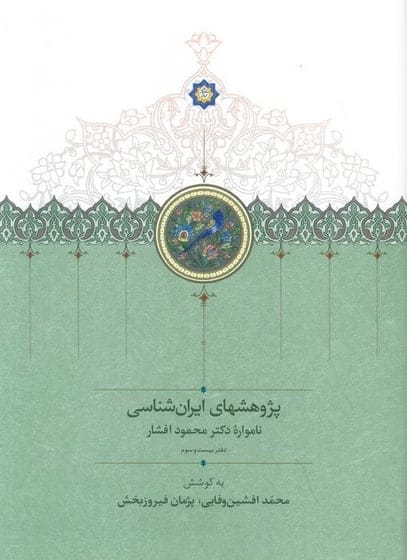
    Afshin-Vafaie, Mohammad & Pejman Firoozbakhsh (eds.). 2024. Studia Persica in memory of Dr. Mahmoud Afshar Yazdi, volume 23. Tehran: Dr. Mahmoud Afshar Endowment Foundation.

    The volume contains several interesting papers on different aspects of Iranian Studies. Here is the table of contents:

    • S. ALIYARI BABOLGHANI: Old Persian <θ> /θ₁, θ₂/: Phonetic Value(s) and Phonological Development(s) into Middle Persian
    • D. DURAND-GUÉDY: The State of the Rum Saljuqs as Reflected in the Honorific Titles (alqāb) of its Servants: Edition and Commentary of the khiṭāb Section of Ms. Marʿashī 11136 (Qiṣṣa-yi salāṭīn)
    • A. A. KHOSRAVI: Pahlavi Inscriptions in the Name of Yazdgird III on Silk Textiles Found in China
    • D. STILO: The Category of Stative in Three Iranian Languages
    • A. A. TONOYAN & V. S. VOSKANIAN: Caucasian Persian (Tati): History of Study, Current State and Perspectives
    • S. AYDENLOO: A Reconsideration of the Infinitive čaftan and its Use in the Shahnameh
    • A. ARGHAVAN: Saʿdī’s Tomb and the Oldest Representations of the Čahāršanba-sūrī Festival in Shahnameh Manuscripts
    • I. AFSHAR: Bookbinding
    • M. AFSHIN-VAFAIE: Dodarz madōz: Concerning One of Ḫusraw Anōširwān’s Dicta
    • M. OMIDSALAR: Nibelungenlied as a Folk Epic and the Shahnameh as a Literary Epic
    • B. IMANI: Anwār al-Rawḍat wa Asrār al-Bayḍat: Similes of Sayf al-Dīn Isparanganī’s Lost Work, Rawḍat al-Quds wa Bayḍat al-Uns
    • H. BORJIAN: Persian Lexemes in the 14th-Century Rasulid Hexoglot
    • J. BASHARI: The Compendia of Asʿad b. Aḥmad Kātib, a Shirazi Sufi from the 15th Century CE
    • A. R. BAHARLOO & K. MOTAGHEDI: The Šikl-i Šāh Relief at Tanga-yi Band-i Burīda: The Last Qajar Rock-carving from the Time of Naser-al-Din Shah
    • S. SAJJADI: Zaryāb, the Creative Cultural Architect
    • Y. SAADAT: The Origin of the Philosophical Senses of Middle Persian Words ǰahišn and ǰadag and the Arabic Word ʿaraḍ
    • M. R. SHAFI’I KADKANI: Qazvin’s Public and Private Libraries from the beginning to the 13th Century CE
    • E. SHEYKH-OL-HOKAMAEE & P. AKBARI: The Mosque of the Šayḫ al-Islām Madrasa in Qazvin and its Endowment Document, dated 1903
    • A. A. SADEGHI: On Muṣāḥib’s Persian Encyclopedia
    • A. SAFARI AGH-GHALEH: The Background of the Wāq Figure in Iranian Art and its Relationship to the Wāq-Wāq and Zaqqūm Trees
    • A. TABIBZADEH: Šammarān or Hāmāwarān? A Toponym in Iranian Mythical and Historical Sources
    • M. ABDEAMIN & B. ABOUTORABIAN: Tehran Arg Mosque, Also Known as Masǧid-i Mādar-i Fatḥʿalī-Šāh
    • M. EMADI HAERI: Three Ascetic Verses from the 11th Century CE: Newly-found Verses by Abū al-Muẓaffar Tirmadī and Ḫwāǧa Imām-i Zāhid
    • P. FIROOZBAKHSH: The Persian Translation of al-Fātiḥa Attributed to Salmān-i Fārsī
    • A. R. QAEMMAQAMI & V. IDGAH TORGHABEHI: The Word, bīmār: A Study of its Etymology and Pronunciation
    • M. MOHAMMADI: On the Fahlavi Origin of the Wīs u Rāmīn
    • D. MONCHI-ZADEH: Die Fabelwesen (Persian translation by A. R. QAEMMAQAMI)
    • R. MOUSAVI TABARI: An Investigation of Two Persian Words: low and lāw
  • East and West (vol. 64)

    East and West (vol. 64)

    The latest volume of East and West contains several interesting articles, some of which deal with aspects of ancient Iran.

    • M. Minardi, A. Bekbauliev: Report on the First Campaign of Excavations of 2023 at Bazar-kala, with Additional Considerations on the Urbanism of Ancient Chorasmia
    • S. Tusa, M. Vidale, I. Caldana, E. Lant, Faizur Rahman, L.M. Olivieri: A “Bactrian Lady” and Other Terracotta Figurines from Aligrama, Swat
    • S. Aliyari Babolghani: A Short Note on the So-called Conjugation IIm in Achaemenid Elamite
    • M.C. Benvenuto: Notes on the Bactrian Personal Name Σανδο
    • E. Filippone: Paratactic and Hypotactic Strategies in the Discourse Organization of the Multilingual Achaemenid Texts
    • F. Pompeo: Who are They Rebelling against? The Constructions of hamiçiya- bav- in the Achaemenid Royal Texts
    • A.V. Rossi: Rüdiger Schmitt and Achaemenid Iran