• Iran 59 (1)

    Volume 59, issue 1 of Iran, Journal of the British Institute of Persian Studies is out. Here is the table of contents:

    • Michael Roaf & Vesta Sarkhosh Curtis: Professor David B. Stronach, OBE 1931–2020
    • Kyle G. Olson & Christopher P. Thornton: Tureng Tepe, a Bronze Age Centre in Northeastern Iran Revisited
    • Sepideh Maziar & Ali Zalaghi: Exploring Beyond the River and Inside the Valleys: Settlement Development and Cultural Landscape of the Araxes River Basin Through Time
    • Sheler Amelirad & Eghbal Azizi: Kani Koter, Iron Age Cemetery From Iranian Kurdistan
    • Yaghoub Mohamadifar, Esmail Hemati Azandaryani, Alireza Dailar, Somayeh Hasanlou & Javad Babapiri: Parthian Burials in the Hamedan City, Western Iran
    • Mitra Panahipour: Land Use and Environment in a Zone of Uncertainty: A Case of the Sasanian Expansion in Eastern Iraq – Western Iran
    • Amir-Hossein Karimy & Parviz Holakooei: Looking Like Silver: Mica as a Pigment in Mid-Seventeenth Century Persian Wall Decorations
    • Massoumeh (Nahid) Assemi: The Panel of Dervishes at the Tekkiyeh Moʿaven al-Molk in Kermanshah (Figure 1)
    • Mojtaba Ebrahimian: Vaqaye‘-e Ettefaqiyeh (1851–1861) and the Education of the Iranian Nation in the Middle of the Nineteenth Century
  • Early Arsakid Parthia (ca. 250-165 B.C.)

    Olbrycht, Marek Jan. 2021. Early Arsakid Parthia (ca. 250-165 B.C.): At the crossroads of Iranian, Hellenistic, and Central Asian history (Mnemosyne, Supplements 4040). Leiden: Brill.

    In his new monograph Early Arsakid Parthia (ca. 250-165 B.C.): At the Crossroads of Iranian, Hellenistic, and Central Asian History, Marek Jan Olbrycht explores the early history of the Arsakid Parthian state. Making use of literary and epigraphic evidence as well numismatic and archaeological sources, Olbrycht convincingly depicts how the Arsakid dynasty created a kingdom (248 B.C.-A.D. 226), small at first, which, within a century after its founding, came to dominate the Iranian Plateau and portions of Central Asia as well as Mesopotamia. The “Parthian genius” lay in the Arsakids’ ability to have blended their steppe legacy with that of sedentary Iranians, and to have absorbed post-Achaemenid Iranian and Seleukid socio-economic, political, and cultural traditions.

  • 15th Leiden Summer School in Languages and Linguistics

    The 15th Leiden Summer School in Languages and Linguistics will take place online from 12–23 July 2021. Registration is now open.

    The Leiden Summer School in Languages and Linguistics offers a varied program of specialised courses in Descriptive linguistics, in Chinese, Germanic, Indo-European, Indian, Iranian, Semitic languages and linguistics, as well as a number of introductory linguistic courses.
    During these two weeks of intense learning, you will be able to deepen and broaden your knowledge, at the same time enjoy the company of linguistics students and enthusiasts from all over the world.

    The summer school includes Avestan, Sogdian, Bactrian and Modern Persian, but also discussions of Indo-European myths and rituals. You will find the programme and registration information by following the link above.

    این مدرسه تابستانی شامل کلاسهای اوستایی، سغدی، باختری و فارسی نوین است، و همچنین کلاسهایی در مورد افسانه‌ها و آیین‌های هند و اروپایی. با دنبال کردن پیوند بالا، اطلاعات برنامه و ثبت نام را پیدا خواهید کرد.

  • Simurgh and Pseudo-Simurgh in Iranian Arts

    Compareti, Matteo. 2021. The elusive Persian Phoenix. Simurgh and Pseudo-Simurgh in Iranian arts (Studia Persica 3). Bologna: Paolo Emilio Persiani.

    The reign of the Sasanian Dynasty (224–651 AD) received great attention in the works of Muslim authors who usually referred to this period as the “golden age” of pre-Islamic Persia. It is however worth noting that artifacts incontrovertibly attributable to the Sasanians are not very numerous. Among recent finds of dubious origin, some ongoing archeological excavations uncovered Sasanian coins and seals that in some cases showed fabulous creatures composed of parts of different animals. Starting from the ambiguity of these creatures, some scholars proposed to identify them according to ancient Persian mythology and literature. A composite winged creature with a dog’s head, lion’s paws, and a peacock’s tail that is considered to be typically Sasanian, was said to be the “Iranian phoenix” (Avestan saena marega, Middle Persian senmurv, Persian simurgh). As it can be observed on seventh century pre-Islamic Central Asian coins, this composite winged creature was quite explicitly associated with the Iranian concept of glory that was imported into Persia at the end of the Sasanian period from a region between modern Afghanistan and Tajikistan. Slightly later that creature started to appear in western arts too, going from the Byzantine Empire and the Islamic Caliphate to the whole of Europe until the early 13th century. Its exact meaning among Muslims is still a matter of debate although it was definitely considered by Christians as a very appropriate decoration for religious and secular purposes. Eighth-century Sogdian mural paintings from Penjikent and Mongol period Islamic book illustrations seem to support the identifications proposed in this study.

  • The Parthians: The Forgotten Empire

    Ellerbrock, Uwe. 2021. The Parthians: The forgotten empire. London & New York: Routledge.

    This volume provides a comprehensive overview of the history and culture of the Parthian Empire, which existed for almost 500 years from 247 BC to 224 AD.

    The Parthians were Rome’s great opponents in the east, but comparatively little is known about them. The Parthians focuses on the rise, expansion, flowering and decline of the Parthian Empire and covers both the wars with the Romans in the west and the nomads in the east. Sources include the small amount from the Empire itself, as well as those from outside the Parthian world, such as Greek, Roman and Chinese documents. Ellerbrock also explores the Parthian military, social history, religions, art, architecture and numismatics, all supported by a great number of images and maps.

    The Parthians is an invaluable resource for those studying the Ancient Near East during the period of the Parthian Empire, as well as for more general readers interested in this era.

    Table of Contents:

    (more…)
  • Études offertes à Pierre Briant

    Agut-Labordère, Damien, Rémy Boucharlat, Francis Joannès, Amélie Kuhrt & Matthew W. Stolper (éds). 2021. Achemenet. Vingt ans après: Études offertes à Pierre Briant à l’occasion des vingt ans du Programme Achemenet (Persika 21). Leuven: Peeters.

    En créant le programme international Achemenet en 2000, l’année où il inaugurait la chaire «Histoire et civilisation du monde achéménide et de l’empire d’Alexandre» au Collège de France, Pierre Briant avait pour objectif de rassembler les données primaires sur l’Empire perse achéménide à travers les territoires immenses qu’il a couverts en Orient. Vingt ans après, le site achemenet.com met à la disposition des spécialistes, des étudiants et du grand public une dizaine de milliers de textes, des données archéologiques et près de cent mille images d’objets conservés dans une vingtaine de musées du monde entier.

    À ces vastes corpus documentaires sont venues s’ajouter la collection Persika, en 2001, dont ce volume porte le numéro 21, et une revue en ligne, ARTA (Achaemenid Research on Texts and Archaeology), seul périodique consacré aux études achéménides.

    Les auteurs de cet ouvrage célèbrent les vingt ans d’Achemenet et rendent, du même coup, hommage à son fondateur. Tous sont des spécialistes dans différents domaines des recherches achéménides et leurs contributions illustrent l’immensité géographique de cet empire-monde et la diversité des disciplines que requiert son étude.

    For the table of contents, see here.

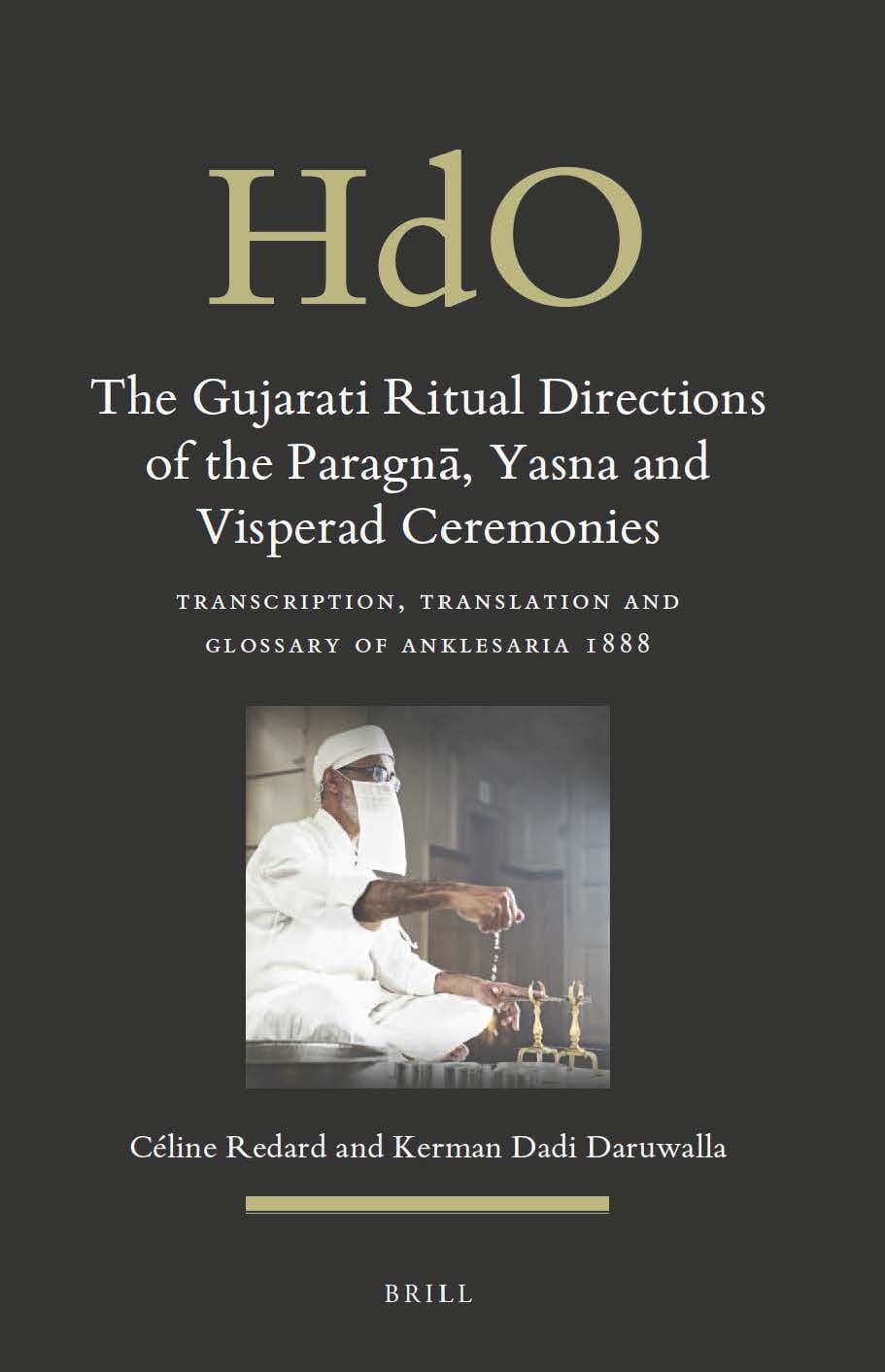
  • The Gujarati ritual directions of the Paragnā, Yasna and Visperad

    Redard, Céline and Kerman Dadi Daruwalla (eds.). 2021. The Gujarati ritual directions of the Paragnā, Yasna and Visperad ceremonies: Transcription, translation and glossary of Anklesaria 1888 (Corpus Avesticum 2). Leiden: Brill.

    This edition gives a transcription of Anklesaria’s text, an English translation, a Gujarati-English glossary, an introduction to Gujarati-language works on ritual directions and a study on the relationship between Anklesaria’s text and the liturgical manuscripts in Yasna 3–8. Unlocking the meaning and performative aspects in this first-ever edition in any European language, of these core Zoroastrian rituals in India, Céline Redard and Kerman Dadi Daruwalla open up the Indian tradition for future research and highlight its importance.

  • نوروز پیروز

    نوروز پیروز

    We wish all our readers, colleagues and friends a Happy Nowruz. May year 1400 bring us all health and happiness.

    برای همه خوانندگان ، دوستان و همکاران سال نویی خوب، سرشار از تندرستی و شادی آرزو میکنیم.

    نوروزتان پیروز!

  • Ethnic Groups along the Silk Road

    Reckel, Johannes & Merle Schatz (eds.). 2021. Ancient texts and languages of ethnic groups along the Silk Road. Göttingen: Universitätsverlag Göttingen.

    Note: This volume is licensed under a Creative Commons Attribution-ShareAlike 4.0 International License and can be downloaded here.

    Central Asia has been dominated by Mongolian and Turkic speaking nations for the past 1300 years. Uyghurs and Uzbeks were the most important traders on the Central Asian Silk Roads. Earlier Sogdians and Tokharians and other ethnic groups speaking Indo-Germanic (Indo-Iranian) languages were active on these ancient trade routes. In the 18th and 19th century a Tungus language, Manchu, became important for Sinkiang, Mongolia and the whole of China. Expansion policy of different realms, comprehensive commercial activities and the spread of religious ideas facilitated the exchange of (cultural) knowledge along the Silk Road. Texts and scripts tell us not only about the different groups that were in contact, but also reflect details of diplomatic, religious, and economic ambitions and the languages that were used for these different forms of communication. Several examples of contact induced language change or specific linguistic influence as a result of contacts along the Silk Road invite us to understand more about the frequency, intensity and intention of contacts that took place in very different regions connected by the Silk Road.

  • Achaemenid Echoes in the Wall Paintings of Akchakhan-Kala

    Minardi, Michele. 2020. Achaemenid Echoes in the Wall Paintings of Akchakhan-Kala, Chorasmia, and their Broader Significance for Central Asia. Journal of Asian Civilizations 43(2).

    (from Minardi 2020, fig. 5.)

    In recent years the Karakalpak-Australian Expedition (KAE) carried out archaeological fieldwork at the royal Chorasmian seat of Akchakhan-kala unearthing a large corpus of wall paintings. This imagery was made during Stage 3 of the life of the site’s main complex, beginning between the 1st century BC and the 1st century AD and ending in the early 2nd century AD. Among the formal elements employed in this imagery, an unanticipated use of Achaemenid iconographic models is apparent. Most of these archetypes have already been introduced in recently published articles. However, the question regarding their source and ways of transmission was left open to further inquiry. This paper aims to refine the argument and to give way to further analysis and discussion in attempting a clarification of what has already been sustained. Eastern Iranian Chorasmia once was under the Achaemenid sway, and its very foundation as a polity was quite probably due to an intervention of the Persians. But the Akchakhan-kala’s paintings were produced much later than the time of the Achaemenid Empire’s demise. What we may therefore be witnessing is the persistence of Achaemenid iconography as an artistic legacy, the origins of which would be reasonable to track in a centre of the “Upper Satrapies”. Despite the scarcity of available evidence on the very existence of an Achaemenid aulic art and heritage in the East, it is here argued that it might be possible to consider the new Chorasmian evidence as its “echo”, although the chronology of the original transmission into the polity of such a legacy is still elusive. This paper will also introduce a further, and previously neglected, element issuing from the Akchakhan-kala’s mural art and belonging to the set of Achaemenid visual “echoes”: the motif of the stylized lion’s heads with curled mane. Of clear Achaemenid ascendency, this motif decorates the shoulder area of the kandys worn by one of the colossal Avestan deities from the site’s columned throne hall. This painted fabric decoration confirms the substantiality of the basic interpretation of the “Achaemenid echoes” coming from Chorasmia, allowing at the same time to development of some further assumptions.