• Lost Turfan Fragments

    Benkato, Adam. 2024. Lost Turfan fragments from the Nachlass of W.B. Henning. Bulletin of the School of Oriental and African Studies, FirstView. 1–17.

    During the Second World War, a number of manuscript fragments in Iranian languages from the Berlin Turfan collections were lost. Photographs of these fragments preserved in the Nachlass of Walter B. Henning bring to light their contents and fill gaps in the record of Turfan texts. These photographs are published here for the first time, together with a description of the fragments and their contents.

    Abstract
  • Mystical Landscapes

    Keshavarz, Fatemeh & Ahmet T. Karamustafa (eds.). 2024. Mystical landscapes in medieval Persian literature. Edinburgh: Edinburgh University Press.

    In this collection, Fatemeh Keshavarz and Ahmet T. Karamustafa bring together leading researchers from comparative literature, history, literary criticism and religious studies to explore the major authors and genres of medieval Persian mystical literature. Breaking out of the all-inclusive literary history framework, the contributors write on topics that have energised their scholarship over time and address areas where the literary and the mystical have mingled and led to paradigmatic creations. How can you interpret the climactic conclusion to the framing narrative of The Speech of the Birds of ‘Attar of Nishapur? How did ‘Aziz Nasafi understand the concept of religion? What do Rumi’s conversations with the Divine tell us about his teachings and his poetry? How do medieval Persian Sufi commentators add to our understanding the Qur’an? How can we utilise Sufi manuals, life stories and utterances? All of these explorations and more bring the depth and eloquence of Persian mystical literature to life in this volume.

    Editor note: This books falls outside our known comfort zone, but not by such a wide margin that we can ignore it. ~AZ

  • Zoroastrian Esotericism

    Zoroastrian Esotericism is a special issue of Religiographies, vol. 3, no. 1, edited by Mariano Errichiello, Daniel J. Sheffield, and Yuhan Sohrab-Dinshaw Vevaina.

    Table of contents

    Editorial

    New Perspectives on the Study of Esotericism and Zoroastrianism
    Mariano Errichiello, SOAS University of London
    Francesco Piraino, Giorgio Cini Foundation / Harvard Divinity School
    Yuhan Sohrab-Dinshaw Vevaina, University of Oxford
    [PDF] 1-6

    Articles

    The Mazdean Esoteric Dimension between Ritual and Theology
    Antonio Panaino, University of Bologna
    [PDF] 7-26

    Exploring Zoroastrianism and Esotericism in the Context of Global Religious History
    Moritz Maurer, Institut für Religionswissenschaft, Universität Heidelberg
    [PDF] 27-43

    (more…)
  • Zoroastrian Apocalypticism in The Maʿnī-yi Vahman Yasht

    Zoroastrian Apocalypticism in The Maʿnī-yi Vahman Yasht

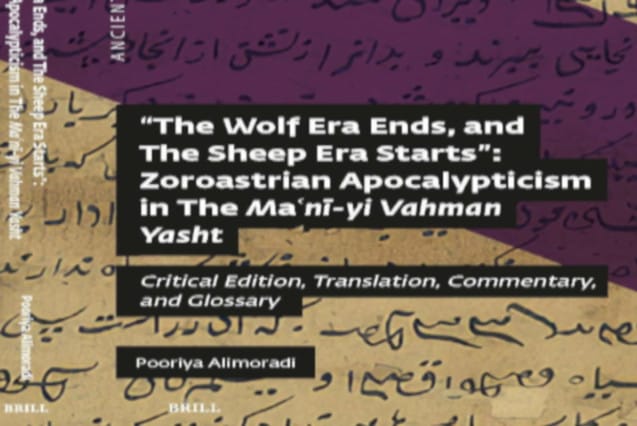
    Alimoradi, Pooriya. 2024. “The wolf era ends, and the sheep era starts”: Zoroastrian apocalypticism in the Maʿnī-yi Vahman Yasht. Leiden: Brill.

    This book studies, for the first time, the Maʿnī-yi Vahman Yasht , the New Persian version of the Zand ī Wahman Yašt , the most important Zoroastrian text in apocalyptic genre. Through offering a critical edition, translation, and commentary, Alimoradi argues that the MVY is not a translation of the extant Pahlavi ZWY and is derived from another recension of apocalyptic materials in Pahlavi. He also offers suggestions in identifying several unspecified characters and events referred to in the text whose identities have been debated for decades. The book is relevant to those interested in Zoroastrianism, Iranian apocalyptic traditions, and anyone studying the Arab conquests in Western and Central Asia in 6ᵗʰ to 9ᵗʰ c. CE.

  • Ideological Variants in Persian Texts

    Alsancakli, Sasha & Philip Bockholt. 2023. Authorship and textual transmission in the manuscript age: Contextualising ideological variants in Persian texts (Cahiers de Studia Iranica, 64). Leuven: Peeters.

    The present volume addresses dynamic and collective authorship by examining how authors and scribes in the Persianate parts of the Islamic world produced, copied, and interpreted texts during the manuscript age within specific cultural contexts, out of political necessity and as a result of professional choices. The processes of scribal adaptation faced by scholars studying the Islamic world in the pre-modern period took many different forms, most of which are still unexplored. The changes applied consist of minor corrections and amendments, as well as full-fledged reworkings of a text and modifications to its core ideological components. Under the label “ideological variations”, this volume intends to discuss any deliberate changes in content, rather than form, made by authors, copyists, and readers intervening at various stages in the process of textual production and transmission.

  • Domestic Slaves in Zoroastrianism

    Foroutan, Kiyan. 2024. On the question of domestic slaves in late medieval and early modern Zoroastrianism. Bulletin of the School of Oriental and African Studies, FirstView. 1–25.

    This article collects and analyses passages about male and female domestic slaves in the Persian Rivāyats. The Rivāyats consist of correspondence between Iranian and Indian Zoroastrians (Parsis) from the late fifteenth to the eighteenth centuries ce. In these letters, Parsis sought the opinions of Iranian Zoroastrians on various doctrinal and ritual issues. The passages in question cover a range of subjects, including the issue of converting household slaves to Zoroastrianism, their participation in domestic religious ceremonies, the exposure of their dead bodies in the towers of silence, and marrying female slaves. These references to slaves challenge the conventional narrative that pre-modern Zoroastrians were oppressed, marginalized, and poor communities. This narrative has overshadowed these pieces of evidence and has caused them not to be studied seriously. This paper seeks to go beyond this traditional reconstruction by examining these texts based on their context. The passages reflect the actual socio-religious issues of Zoroastrians, especially Parsis, and demonstrate their participation in the slave-owning milieu of late medieval and early modern Gujarat and Iran rather than mere anachronistic elements or rhetorical tools reflecting a scholastic treatment of a defunct legal question.

    Abstract
  • Contributions to Iranian Etymology II

    Fattori, Marco. 2024. Contributions to Iranian Etymology II: Three Iranian Loanwords in Armenian and a Note on OIr. *abigna- ‘helper’. Iran and the Caucasus 28 (3), 289-300.

    In this article the possible Iranian etymology of three hitherto unexplained Old Armenian words is discussed: Arm. aptak ‘slap, blow’ < Ir. *apitāka-, to be compared with Man.Parth. and MP abdāg ‘assailant’; Arm. žapawēn ‘hem, border’ compound of Parth. *žī(h), equivalent of NP zeh ‘string, hem, decoration’ + Arm. apawēn ‘cover, shelter, refuge’; Arm. xawsim ‘to speak’ from a metathetic form of MIr. *wā̆xs-, inchoative formation from the root *vac- ‘to speak’. Finally, Szemerényi’s convincing explanation of Arm. awgnem ‘to help’ and zawravign ‘aid, helper, defender’ as related to an OIr. noun *abigna- ‘helper’ attested in several anthroponyms (e.g. OP Bagābigna-) is reaffirmed and substantiated since it remained mostly unnoticed in the subsequent literature.

  • Bodyguards in the Ancient Mediterranean

    Hebblewhite, Mark & Conor Whately (eds.). 2023. Brill’s Companion to Bodyguards in the Ancient Mediterranean. Leiden: Brill.

    Among other interesting papers, two contributions are related to ancient Iranian history:

    • Michael Charles: Apple Bearers and Kinsmen Cavalry: Guards Units of the Kings of Achaemenid Persia
    • Jeffrey Rop: The Four Hundred and the Ten Thousand: The Politics of Greek Bodyguard Service in the Achaemenid Empire
  • Religious Conversion

    Vol. 15, no. 2 of the open access journal Entangled Religions is a special issue dedicated to the question of Religious Conversion in a Religiously Plural World.

    Religious conversion is a phenomenon that has intrigued scholars, theologians, and sociologists for centuries. As the conscious choice of a particular form of religion over another, it is eminently a form of religious contact. Religious conversion may be approached psychologically, sociologically, and conceptually. The contributions of this special issue show all three approaches and cover a wide array of geographical, social, and religious contexts.

    Benedikt Römer has an article on Neo-Zoroastrianism, titled Reversion, Revival, Resistance: Framing Iranian Neo-Zoroastrian Religiosities

  • Sino-Iranian and Sino-Arabian Relations in Late Antiquity

    Kotyk, Jeffrey. 2024. Sino-Iranian and Sino-Arabian relations in Late Antiquity: China and the Parthians, Sasanians, and Arabs in the first millennium (Crossroads – History of Interactions across the Silk Routes 8). Leiden: Brill.

    What type of exchanges occurred between West and East Asia in the first millennium CE? What sort of connections existed between Persia and China? What did the Chinese know of early Islam?
    This study offers an overview of the cultural, diplomatic, commercial, and religious relationships that flourished between Iran and China, building on the pioneering work of Berthold Laufer’s Sino-Iranica (1919) while utilizing a diverse array of Classical Chinese sources to tell the story of Sino-Iran in a fresh light to highlight the significance of transcultural networks across Asia in late antiquity.

    Website Summary