• Yahwism under the Achaemenid Empire

    Barnea, Gad & Reinhard G. Kratz (eds.). 2024. Yahwism under the Achaemenid Empire: Professor Shaul Shaked in memoriam (Beihefte zur Zeitschrift für die alttestamentliche Wissenschaft 548). Berlin: De Gruyter.

    The Achaemenid period (550–330 BCE) is rightly seen as one of the most formative periods in Judaism. It is the period in which large portions of the Bible were edited and redacted and others were authored—yet no dedicated interdisciplinary study has been undertaken to present a consistent picture of this decisive time period.
    This book is dedicated to the study of the touchpoints between Yahwistic communities throughout the Achaemenid empire and the Iranian attributes of the empire that ruled over them for about two centuries. Its approach is fundamentally interdisciplinary. It brings together scholars of Achaemenid history, literature and religion, Iranian linguistics, historians of the Ancient Near East, archeologists, biblical scholars and Semiticists. The goal is to better understand the interchange of ideas, expressions and concepts as well as the experience of historical events between Yahwists and the empire that ruled over them for over two centuries. The book will open up a holisitic perspective on this important era to scholars of a wide variety of fields in the study of Judaism in the Ancient Near East.

    About this book
  • Deciphering the Illegible

    Macuch, Maria & Arash Zeini (eds.). 2024. Deciphering the illegible: Festschrift in honour of Dieter Weber (Iranica 33). Wiesbaden: Harrassowitz Verlag.

    The commemorative publication Deciphering the Illegible is dedicated to Dieter Weber, one of the most important scholars in the field of Iranian Studies, who is best known for his work on deciphering original documents in the extremely ambiguous Pahlavi cursive script, which was long considered ‘illegible’. In addition to an appreciation of his research and a bibliography of his publications, the volume contains twenty-eight contributions by renowned experts, reflecting the broad spectrum of the dedicatee’s academic interests and research work. The articles cover a wide range of topics and offer many new insights and original perspectives on religious, linguistic and historical problems, including several editions of previously unpublished texts.

    Abstract

    Table of Contents

    • Dieter Weber — A Scholarly Profile
    • Publications of Dieter Weber . . . . . . . . . . . . . . . . . . . . . . . . .
    • Miguel Ángel Andrés-Toledo: Three Zoroastrian Manuscripts in Armenia
    • Thomas Benfey: Windādag’s Orders: Ten Unpublished Middle Persian Ostracafrom Chāl Ṭarkhān-ʿEshqābād
    • Adam Benkato: A Manichaean Remedy for Headaches
    • Alberto Cantera: The Passive Suffix -ī̆h̆– in Middle Persian
    • Carlo G. Cereti: From the Zamyād Yašt to the Seventh Book of the Dēnkard, Some Notes on Sistan and Zoroastrian Eschatology
    • Iris Colditz: How to Make Clarified Butter in Sogdian
    • Touraj Daryaee: The Owl in the Zoroastrian Tradition: Contribution to Iranian Bestiary I
    • Desmond Durkin-Meisterernst: Hübschmann and the Middle Iranian Part on Armenian Loanwords
    • Shervin Farridnejad and Arash Zeini: “Who Will Protect the Cattle”? On Dogs and the Sin of Meat Consumption in Zoroastrianism
    • Ela Filippone: A Contribution to Pahlavi Lexicography: The Case of ⟨twk(‘)⟩ and ⟨twp(‘)⟩ in the Pahlavi Corpus and their Possible Cognates in Modern Iranian Languages
    • Philippe Gignoux †: Sur l’argenterie sassanide, relectures et nouveautés
    • Rika Gyselen: Le y final et le trait final en moyen-perse: le cas des sceaux des administrations territoriales
    • Almut Hintze: The Pahlavi Psalter in its Historical Context
    • Philip Huyse: Klimawandel und die spätantike Pest im sasanidischen Reich
    • Götz König: Notizen zur Überlieferung und zum Gebrauch der Yašts
    • Pavel B. Lurje and Boris Zheleznyakov: “Let Buyruq Sangun Live Long and be Divinely Blessed” Another Sogdian Dedicatory Inscription
    • Maria Macuch: Trading with Infidels: A Balancing Act in Zoroastrian Legal Reasoning
    • Mauro Maggi: Blowing out saṃsāra in Khotan.
    • Jaime Martínez Porro: A Brief Note on an Avestan Quotation in the Wizī̆rgerd ī̆ Dēnī̆g
    • Enrico Morano: Fragments from a Sogdian Cosmogonical Manuscript in Manichaean Script.
    • Antonio Panaino: The ‘starred’ Frawahr and the ‘Katasterization’ of Humanity
    • Anna-Grethe Rischel: Studies of ‘Watermarks of Technology’ from the Turfan Collection in Berlin
    • Adriano V. Rossi: Minima Iranica for Dieter
    • Nikolaus Schindel: Zur Bronzeprägung des Ohrmazd IV.
    • Martin Schwartz: Mnemonica Iranica
    • Nicholas Sims-Williams: Further Notes on Sogdians in Khotan
    • Yutaka Yoshida: Training of Scribes along the Silk Road: A Case from Manichaean Sogdian
    • Arash Zeini: The Covenant that Binds: Ownership of Life in Late Antique Zoroastrianism
  • Cities, Trade, and Roads

    Two new volumes of Anabasis are out; vols. 12–13 (2021-2022) are special issues with thematic papers edited by Marek Jan Olbrycht and Sabine Müller: Cities, trade, and roads: From the Mediterranean to Iran and the Indus Valley.

    (more…)
  • Persian Metalwork along the Silk Road

    Entangled Objects of Eurasia: Persian Metalwork along the Silk Road

    Wednesday 16 October 2024

    • Matthew Canepa | University of California, Irvine

    Scriptive Things and Commensal Warfare: Luxury Vessels across post-Achaemenid Asia

    • Yukio Lippit | Harvard University

    Echoes of Persian Silverware in the Shosoin Treasury

    • Yuka Kadoi  | University of Vienna          

    Silver in the Mongol Empire: Alternative Nomadic Aesthetics

    • Johannes Preiser-Kapeller | ÖAW – IMAFO

    Chair and moderator

    Zoom registration required (anton.matejicka@univie.ac.at)

    (more…)
  • Land and Power in the Sasanian Empire

    A workshop organised by Tommy Benfey (Tübingen) and Richard Payne (Chicago).

    Middle Persian ostracon dealing with bread rations from Chāl Ṭarkhān-Eshqābād, photograph courtesy of ISAC Museum, Chicago
    Friday, October 25, 2024

    The workshop is co-sponsored by the University of Chicago and the University of Tübingen.


  • Male Homoerotic Practices in Achaemenid Persia

    Treuk Medeiros de Araujo, Matheus. 2024. Male homoerotic practices in Achaemenid Persia: An overview. Archai 34, e03415.

    Descriptions of Ancient Persian male homoeroticism come mainly from Classical sources, which, however, seem to present divergent testimonies regarding this practice. Some authors apparently provide proof for its widespread acceptance, whereas others, particularly later authors, emphasized its prohibition. Considering the many difficulties involved in the reconstruction of Persian history through the eyes of classical Greeks and Romans, this article aims to provide a brief overview of the subject, with some clues to the question of the origin, form, and tolerance of same-sex love in Achaemenid Persia. We agree that homoerotic practices were attested and likely accepted at some level in Achaemenid Persia. However, we believe that the evidence available to us is not enough to obtain a full understanding of this phenomenon. It is also stressed that not every Greek or Roman reference to Persian male homoeroticism should be taken at face value, as some are distorted and fictitious or lack firsthand knowledge. Finally, we briefly address the image of eunuchs as sexual partners of Achaemenid kings.

  • Navigating the Worlds of History

    Ruffing, Kai, Brigitte Truschnegg, Andreas Rudigier, Julian Degen, Sebastian Fink & Kordula Schnegg (eds.). 2024. Navigating the worlds of history. Studies in honor of Robert Rollinger on the occasion of his 60th birthday. Wiesbaden: Harrassowitz.

    These studies in honor of Robert Rollinger, a scholar who dedicated and dedicates himself to the study of the Ancient Worlds and their Afro-Eurasian entanglements, are published on the occasion of his 60th birthday. Accordingly, the three volumes bring together contributions from friends, colleagues, and students of Robert Rollinger. The themes of these some 80 articles are in line with Rollinger’s research foci. Therefore, there are articles dealing with themes from the field of classical studies and thus the ancient Mediterranean world, the Ancient Near East and Persia as well as Iran. In addition – also in line with Robert Rollinger’s academic activities and his own research interests – there are essays on the history of Austria, in particular on that of Vorarlberg, the honoree’s homeland. Old America is also given thematic consideration. Moreover, the reception of the Ancient Worlds is also addressed.

    The work consists of three volumes and is divided into five sections. The first deals with the classical world and its entanglement with the Ancient Near East; the second section focusses on the Ancient Near East. The third section is dedicated to the Iranian world in its imperial longue durée, while the fourth section looks at the global as well as the local history taking into account the perspective of Global and Universal History. Finally, the fifth and last section is dedicated to the dialogue between the ancient world and the present.

  • Wine Cultures

    Antonetti, Claudia, Bryan De Notariis & Marco Enrico (eds.). 2024. Wine cultures: Gandhāra and beyond (Antichistica 40). Venezia: Venice University Press.

    The volume Wine Cultures. Gandhāra and Beyond represents the primary outcome of the MALIWI project (SPIN Ca’ Foscari 2021) directed by Claudia Antonetti. Adopting an interdisciplinary approach, this work seeks to explore the production techniques, social functions, and cultural significance of intoxicating drinks with particular reference to wine – an extraordinary beverage that has been intertwined with human history for millennia. This volume gathers contributions by scholars interested in studying wine and drinking culture in Gandhāra and neighbouring regions, including Ancient Assyria, Arachosia, and present-day India. The topic is explored from three fundamental perspectives, employing a diverse range of sources, including literary and historical texts, as well as linguistic, iconographic, archaeological, and anthropological evidence.

    Abstract
    (more…)
  • On Middle Persian Documents

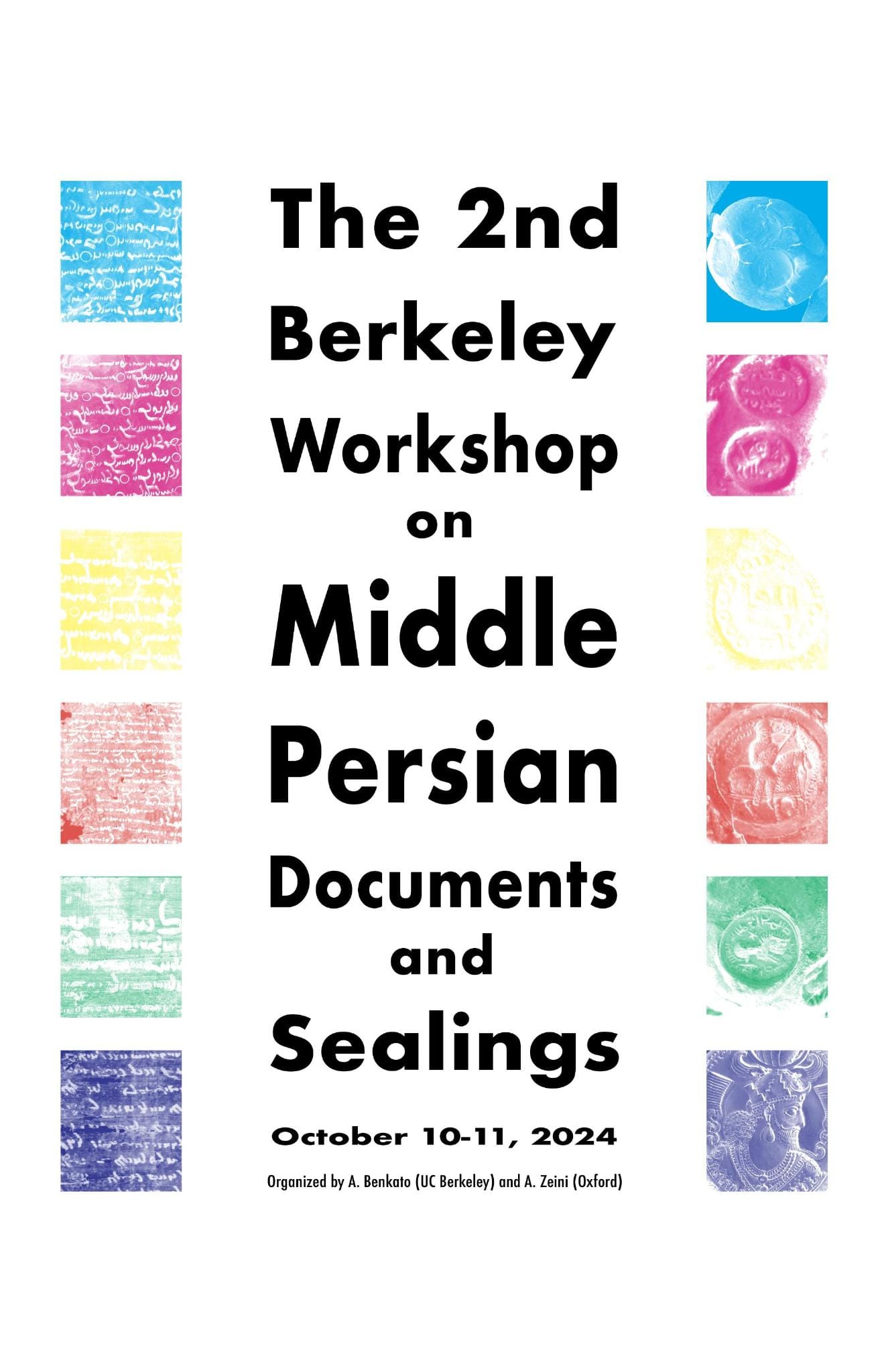
    The 2nd Berkeley Workshop on Middle Persian Documents and Sealings

    This is the second workshop in a series that began in Spring 2023 with the idea of bringing together scholars around the world who were actively working on, or interested in working on Middle Persian documents and sealings. The workshop is organised by Adam Benkato (UC Berkeley) and Arash Zeini (University of Oxford).

    To attend the workshop, which takes place on Zoom, register here. The programme is below.

  • Gorani in its Historical and Linguistic Context

    Karim, Shuan Osman & Saloumeh Gholami (eds.). 2024. Gorani in its historical and linguistic context (Trends in Linguistics. Documentation 41) Berlin: De Gruyter.

    Gorani refers to under-documented, endangered varieties spoken in a cluster within the Zagros mountains (Iran/Iraq). These varieties possess conservative features of importance to linguists. However, their study has been plagued by nomenclature and taxonomy issues. Traditional names for these languages have been supplanted first by orientalists’ prescriptions and then by their linguist heirs. Inaccurate terminology has sewn discord between speaker communities, disturbing the sociolinguistic landscape. This volume represents the state of the art of Gorani’s historical and socio-linguistics, documentation, and literature, as well as an effort to aid the “decolonization” of Gorani linguistics.

    (more…)