• Becoming Zarathustra

    Kellens, Jean. 2018. Becoming Zarathustra. In Hugh B. Urban & Greg Johnson (eds.), Irreverence and the sacred: Critical studies in the history of religions, 185–193. New York: Oxford University Press.

    This chapter examines the role of ritual and sacrifice in the most sacred Zoroastrian literature, the Gâthâs in order to explore the complex relationship between the figure of Zarathustra and the human ritual officiant. The chapter presents a very Lincoln-ian sort of history of the field of Zoroastrian studies itself, interrogating the contexts and biases of particular scholars in their various readings and misreadings of the tradition. At the same time, it offers a new way of thinking about the figure of Zarathustra himself, who is best understood not as the semi-historical “founder” of Zoroastrianism but rather as the mythical personality into which the human officiant is himself transfigured through the ritual operations.

  • Indo-Iranian lexicon and phraseology in the ritual poetry of the Avesta, Veda and Beyond

    Sadovski, Velizar. 2017. The columns of R̥ta: Indo-Iranian lexicon and phraseology in the ritual poetry of the Avesta, Veda and Beyond. In Ivo Hajnal, Daniel Kölligan & Katharina Zipser (eds.), Miscellanea Indogermanica: Festschrift für José Luis García Ramón zum 65. Geburtstag (Innsbrucker Beiträge zur Sprachwissenschaft 154), 715–743. Innsbruck: Institut für Sprachen und Literaturen der Universität Innsbruck.

    The focus of the present article […] is laid on the phraseological and poetical combinatorics of the word for ‘pillar, column’, Ved. sthū́ṇā-, YAv. stū̆nā-, OPers. stūnā-, fem. […], which as a common appellative designates a constructive element of the Vedic and Avestan house (incl. the ‘mobile house’, the [migration] wagon) and functions, as well, as a key metaphor in hymns of house, e.g. in the ceremony of ‘ascending the pillar’ (by the beams) in the ritual of building a new home […]. Both in its everyday usage and in its metaphoric applications in texts of ritual character, the word seems to belong to a common lexical stratum of Indic and Iranian.

  • Art History and Achaemenid History

    Bull’s head on the northern portico of the Throne Hall of Xerxes (5th century BC), Persepolis, Iran

    Draycott, Catherine. 2019. Art History and Achaemenid History: or, what you can get out of the back end of a bull. In C. M. Draycott, R. Raja, K. Welch, and W. Wootton (eds.), Visual Histories of the Classical World. Essays in Honour of R.R.R. Smith , 16-33, Turnhout: Brepols Publishers.


    In a recent review of a book entitled Critical Approaches to Ancient Near Eastern Art, Daniel T. Potts raises the question of whether, regardless of the fact that one can speak of a discipline of Ancient Near Eastern Art History, one should.  He explains that he is not concerned with denying the necessity of studying art or imagery as a part of Ancient Near Eastern History, but that it is insufficient for ‘a deep understanding of the ancient Near East’.  This worry picks up an ongoing tension between ‘ancient historians’ and ‘art historians’ (or archaeologists who work with imagery) that seemingly survives the pictorial turn and the use of ‘visual culture’ as a term emphasizing the whole visual sphere as historical source material, and revolves around the extent to which the ‘larger historical picture’ is sufficiently seen as an end goal. As Potts notes, dress and ornamentation, the ‘wigs, powder, perfume and silk’ of the French Revolution period, for example, can be considered epiphenomena.  On the other hand, ‘Warfare, fiercely contested battles for hegemony and struggles over access to irrigation water and arable land all formed part of the crucible in which Early Dynastic society and its hyper-competitive city state system were forged.’  Serious stuff, not to mention masculine, giving one pause to consider in the context of this book how the fate and trajectory of ‘art history’ within various sub-disciplines might depend on historically gendered scholarship cultures….

  • Religious change among the Safavids

    Stickel, Farida. 2019. Zwischen Chiliasmus und Staatsraeson: Religiöser Wandel unter den Safaviden (Religionsgeschichtliche Versuche und Vorarbeiten 70). Boston, MA: De Gruyter.

    Die Arbeit geht dem religiösen Wandel in Iran unter den Safaviden nach. Dabei wird nicht die Verkündung der Schia als offizieller Religion 1501 in den Mittelpunkt gestellt. Vielmehr werden die Safaviden kontextualisiert, der religiöse Wandel selbst anhand beteiligter Akteure, Auswirkungen auf religiöse Institutionen und Legitimation von Herrschaft sowie der Übersetzung in Architektur und Performanz von Ritualen nachgezeichnet.

  • Xerxes and Babylonia

    Waerzeggers , Caroline (ed.). 2018. Xerxes and Babylonia: The Cuneiform Evidence. Leuven: Peeters.


    In the summer of 484 BCE Babylonia revolted against Xerxes, king of Persia. In recent years, a debate has crystallized around the nature of Xerxes’ response to this challenge. This volume continues and expands this debate. It collects nine essays on the cuneiform text corpus dated to the period before, during and after the revolts. This material enables the authors to evaluate the nature of Xerxes’ policies in the sphere of society, science, religion, law, administration and economy against the long-term history of the region. The contributions are by Paul-Alain Beaulieu, Johannes Hackl, Michael Jursa, Karlheinz Kessler, Mathieu Ossendrijver, Reinhard Pirngruber, Malgorzata Sandowicz and Caroline Waerzeggers.

  • Die Grenzen des Großkönigs?

    Börm, Henning. 2018. Die Grenzen des Großkönigs? Überlegungen zur arsakidisch-sasanidischen Politik gegenüber Rom. In Frank Schleicher, Timo Stickler & Udo Hartmann (eds.), Iberien zwischen Rom und Iran. Beiträge zur Geschichte und Kultur Transkaukasiens in der Antike (Oriens et Occidens 29). Stuttgart: Franz Steiner Verlag.

    Dreizehn Jahre lang beherrschte Severus Alexander das Reich in tadelloser Weise, soweit es ihn betraf. Im vierzehnten Jahr aber trafen unerwartet Berichte der Statthalter Syriens und Mesopotamiens ein und enthüllten, dass Artaxerxes, der König der Perser, die Parther besiegt und ihr östliches Reich erobert hatte (…). Er blieb nun aber nicht ruhig auf seiner Seite des Tigris, sondern (…) überrannte Mesopotamien und bedrohte Syrien. Er wollte nämlich die ganze Landmasse, die Europa gegenüberliegt und durch die Ägäis und das Marmarameer von ihm getrennt wird, und das ‚Asien‘ genannte Gebiet für das Persische Reich zurückgewinnen. In dem Glauben, diese Gegenden von seinen Vorfahren geerbt zu haben, erklärte er, alle Länder dieses Gebietes, einschließlich Ionien und Karien, seien einst von persischen Statthaltern regiert worden, von der Herrschaft des Kyros, der als erster das Medische zum Persischen Reich gemacht hatte, bis zu Dareios, dem letzten Perserkönig, dessen Reich Alexander der Makedone zerstört hatte.

    About the book:

    Die Geschichte und Kultur Transkaukasiens in der Antike steht im Fokus dieses Bandes, der die neuesten Forschungsergebnisse aus der Alten Geschichte, der Archäologie und der Orientalistik vereint. Ziel ist es, das antike Kaukasien stärker in den Fokus der Forschung zu rücken: Die Region liegt zwar an der Peripherie der alten Welt, stellt zugleich aber auch eine zentrale Kontakt- und Konfliktzone zwischen Rom und Iran dar.

    Im ersten Teil des Bandes stehen historische Fragen im Vordergrund, die von Problemen der Chronologie und Herrscherlisten über die Machtausdehnung der Römer und Perser bis zu deren Politik gegenüber den kaukasischen Völkern reichen. Im zweiten Teil geht es um Aspekte der religiösen Entwicklung, insbesondere um die Christianisierung Iberiens (heute Georgien) seit dem vierten Jahrhundert und die Rückwirkung dieser Vorgänge auf die beiden spätantiken Imperien. Der dritte Teil ist den neuesten archäologischen Befunden gewidmet.


  • A Sogdian Fragment from Niya

    Sims-Williams, Nicholas & Bi Bo. 2018. A Sogdian fragment from Niya. In Huaiyu Chen & Xinjiang Rong (eds.), Great journeys across the Pamir mountains (Brill’s Inner Asian Library 37), 83–104. Leiden: Brill.

    In 1994, the Sino-Japanese Niya Expedition Team excavated an artifact (93A27F1:3) at Niya. It is a small brown package or pouch made from a piece of paper (originally mistaken for parchment) fastened by a woolen string. Traces of writing were visible, so the artifact was provisionally referred to as “A Kharoṣṭhī text written on parchment” in the preliminary report of its discovery. In 2007, when the Xinjiang Institute of Archaeology’s research group on Niya was editing the third volume of the Report on the Sino-Japanese Joint Expedition in Niya, they carefully examined this “parchment text.” After the string was untied, it was found that the paper had been used to wrap up a powder of vegetable origin, perhaps spices or medicine. When the powder was removed, a text written in black ink in a clear script was visible. Noting that the writing appeared to be the same as that of the Sogdian “Ancient Letters” found near Dunhuang, which were written in the early fourth century, and other Sogdian fragments of similar date found at Loulan, the local archaeologists were able to determine that this new fragment was also written in early Sogdian script.

  • Ritual Formulae, Structures, and Activities in Vedic and Avestan Liturgies

    Sadovski, Velizar. 2018. Ritual formulae, structures, and activities in Vedic and Avestan liturgies. Münchener Studien zur Sprachwissenschaft 71/1. 81134.

    Die Arbeit präsentiert Untersuchungen zu einer Reihe von Begriffen aus dem Bereich des indoiranischen Kultus bzw. Rituals einerseits in ihrem Kontext innerhalb der vedischen und avestischen Ritualdichtung und -praxis und andererseits vom Standpunkt ihrer mythologischen Relevanz, insbesondere in Bezug auf ihre Rolle für die „Mythopoia“ in den Sakraltexten von Indern und Iraniern. So werden einerseits Personifikationen bzw. Deifikationen derartiger Kultbegriffe geschildert, andererseits verschiedene Mechanismen ihrer Kombinatorik auf syntagmatischer, intra-textueller Ebene (innerhalb des Kontexts eines liturgischen Hymnus/Vorgangs) bzw. auf inter-textueller Ebene, im Rahmen des Hypertexts der aus zahlreichen einzelnen Litaneien bestehenden Ritualhymnen und in den aus ganzen solchen Einzelliturgien bestehenden Ritualkomplexen dargestellt. – Der vorliegende Aufsatz entwickelt dabei die Idee über die fundamentale Rolle von Katalogen, Listen und Enumerationen als poetische, aber auch als mythologische und kosmologische Form: Basierend auf mehreren früheren Studien des Verfassers, die das Funktionieren solcher intertextuell verbundenen Textcorpora in der indoiranischen Ritualdichtung vor allem textlinguistisch, vom formalen, kompositionellen und kognitiven Standpunkt behandeln, gibt nun das Thema „Ritus im Mythos“ die Gelegenheit, die katalogisch aufgebauten Formen von Litaneien und Liturgien in den vedischen Sakraltexten vom RV an (insbesondere in den RV-Khilas und dem Yajurveda) und in der ‚Langen Liturgie‘ des Avesta sowie ihre Bedeutung sowohl zur rituellen „Wieder-Erschaffung des Universums“ mit jedem Kultakt und -text als auch zur Mythologisierung entsprechender Begriffe mit rituellem Inhalt zu untersuchen.

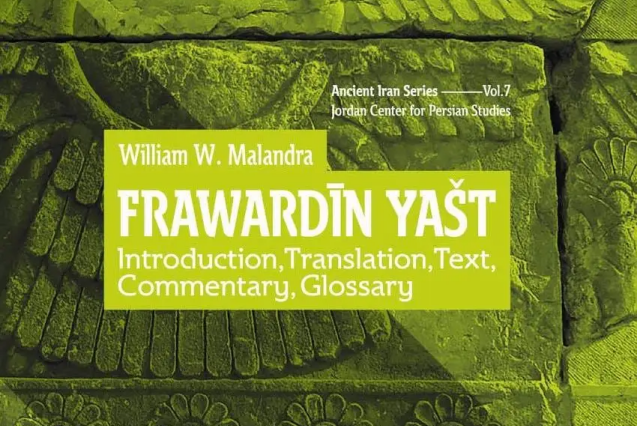
  • The Frawardīn Yašt

    The Frawardīn Yašt

    Malandra, William W. 2018. The Frawardīn Yašt. Introduction, translation, text, commentary and glossary (Ancient Iran Series 7). Irvine: Jordan Center for Persian Studies.

    With the encouragement of Professor Touraj Daryaee, I have undertaken a new edition of my old The Fravaši Yašt: Introduction, Text, Translation and Commentary, diss. University of Pennsylvania, 1971 [University Microfilms, Ann Arbor]. At the time when I wrote the dissertation I was very much under the influence of W. B. Henning’s “The Disintegration of the Avesta Studies” and the then recent book by I. Gershevitch The Avestan Hymn to Mithra. I expressed my misgivings concerning Henning’s stress-accent theory in my Preface, but was not prepared to tackle the issue, and thus treated the text as if it were prose. In the years since it has become abundantly clear that much of the Yašts were originally composed in verse, as best articulated by K. F. Geldner in his Über die Metrik des jüngeren Avesta (1877). Thus, Part II of the present work is devoted to a study of metrics and their importance for understanding the formation of the Yašts and particularly the Frawardīn. In order to make manifest the structure of Avestan poetry I have laid out the translation and text according to my construction of the Avestan.

    From the Preface
  • The Monumental Reliefs of the Elamite Highlands

    Javier Álvarez-Mon. 2019. The Monumental Reliefs of the Elamite Highlands: A Complete Inventory and Analysis (from the Seventeenth to the Sixth Century BC). Eisenbrauns.


    The Monumental Reliefs of the Elamite Highlands documents and analyzes for the first time a corpus of eighteen monumental highland reliefs from the Elamite civilization in ancient Iran, which—hitherto preserved by their remote location and anonymous existence—have recently become imperiled by an influx of tourists and the development of the surrounding landscapes. With this book, Javier Álvarez-Mon aims to safeguard this important part of Iran’s cultural heritage.
    The eighteen reliefs presented in this volume are spread across the valley of Izeh/Malamir (Xong-e Azdhar, Shah Savar, Shekaft-e Salman, and Kul-e Farah), the Ghale Tol plain (Qal-e Tul), the Mamasani Fahliyan river region (Kurangun), and the Marvdasht plain (Naqsh-e Rustam). In his analysis of these reliefs, Álvarez-Mon draws from the complementary disciplines of art history and archaeology, giving equal weight to the archaeological context of these artifacts and traditional methods of artistic analysis in order to determine the nature and significance of each artifact’s form and theme. At the same time, the book’s dual emphases on ritual-religious and aesthetic-ecological phenomena respond to the contemporary challenges of the dissociation of human existence from nature and the commodification of the environment on an unsustainable scale, presenting the preservation of this remarkable corpus of monumental art as a matter of urgency.


    Richly illustrated with hundreds of color photographs and line drawings, The Monumental Reliefs of the Elamite Highlands is sure to become an invaluable reference to scholars who study the Elamite and other ancient civilizations.