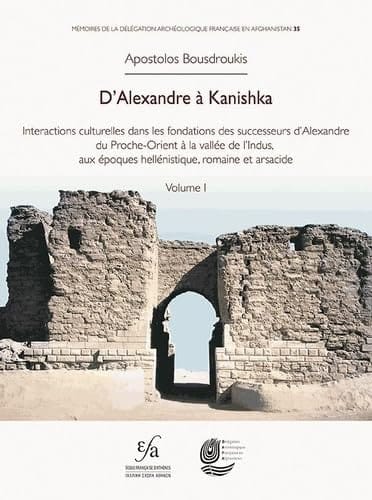
• From Alexander to Kanishka

    From Alexander to Kanishka

    Bousdroukis, Apostolos. 2025. D’Alexandre à Kanishka : Interactions culturelles dans les fondations des successeurs d’Alexandre, du Proche-Orient à la vallée de l’Indus, aux époques hellénistique, romaine et arsacide : Volume I & Volume II (MDAFA 35). Athens: École française d’Athènes.

    From the Eastern Mediterranean to the Indus Valley, the successors of Alexander the Great founded, as early as the 4th century BCE, an impressive network of cities inspired by Macedonian urban models. Who were their inhabitants? How did these cities function and evolve within such diverse cultural contexts as the Near East, Mesopotamia, or Bactria? In this two-volume work, Apostolos Bousdroukis invites us to rediscover these foundations through a scholarly investigation grounded in the most recent archaeological evidence. Civic institutions, public monuments, sanctuaries, domestic architecture, and religious practices are all examined, not only in their local particularities but also in their capacity to absorb, transform, or blend Greek and indigenous traditions. Far from offering a simple urban history, this study sheds light on the complex interactions between Greek settlers and local populations — encompassing processes of adoption, adaptation, and cultural hybridization. It reveals how these cities became dynamic centers of exchange and cultural innovation, contributing to the shaping of new identities in a world undergoing profound transformation.
  • The Assyrian Provincial Seal of Surkh Dom-i Luri, a pattern for Darius I’s Seal

    Alibaigi, Sajjad. 2025. A Clue to a Puzzle: The Assyrian Provincial Seal of Surkh Dom-i Luri, a pattern for Darius I’s Seal. Arta 2025.004.

    This short article examines the iconographic origins of the famous seal of Darius I, for which an Egyptian provenance has been proposed and now in the British Museum (BM 89132). Although the influence of the glyptic art of the first millennium BC on Achaemenid seal-carving is well evident, scholars have paid less attention to this influence on the cylinder seal of Darius I. Among the Assyrian seals and impressions of the second and first millennia BC, there are important examples that are iconographically similar to the seal of Darius, but the provincial seal of Surkh Dom provides the most clues to the connection between the seal of Darius and the Assyrian style seals. This seal, which was found from the excavations of the Surkh Dom shrine, is more similar to Darius’ seal than any other. It seems that the Assyrian provincial style of Surkh Dom-i Luri seal should also be added to the long list of influences of Neo-Assyrian art on Achaemenid and considered as a pattern for the seal of Darius I.

  • A Military Origin for New Persian?

    Vaissière, Étienne de La. 2025. A military origin for New Persian? Acta Orientalia Academiae Scientiarum Hungaricae. Akadémiai Kiadó 78(3). 471–489.

    The question of the transition from Middle Persian to New Persian has been hotly debated. This article attempts to answer two questions: who spoke New Persian before it was put into writing in the middle of the 9th c.? This social group is identified with the soldiers of the armies of Abū Muslim, i.e. peasants from Marw
    and their descendants. They came during one century to the forefront of Abbasid political and administrative life and imposed their specific dialect as a political language, in the shadow of Arabic. The second question is: what could have been the origins of the spoken language in the Marw oasis of the first half of the 8th c.? The article tries to demonstrate, on a much more tentative basis, that the demographic history of an oasis twice manned by soldiers from the South, first Middle Persian-speaking ones and then Arabic ones, both groups added to the local, Parthian-speaking population, is well reflected in the unique combination of
    Middle Persian, Arabic and Parthian characteristic of Early New Persian. Early New Persian is the language of 8th c. Marw, or more generally Outer Khurāsān. This Marw hypothesis, based on the presence of Parthian vocabulary, is however very cautious, as nothing is known of the grammar of spoken late Middle Persian and many of the linguistic differences between Middle and New Persian might have evolved separately in different historical processes.

    Abstract
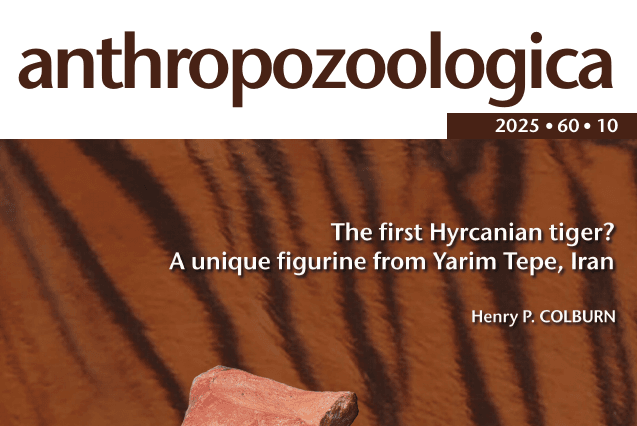
  • The first Hyrcanian tiger?

    The first Hyrcanian tiger?

    Colburn, Henry P. 2025. The first Hyrcanian tiger? A unique figurine from Yarim Tepe, Iran. Anthropozoologica 60(10). 131–142.

    The article is also available here.

    Tigers (Panthera tigris Linnaeus, 1758) are rare in ancient art outside of India and Central Asia. In the Mediterranean world they were associated with the East, and all the danger and exoticism that it entailed, especially with the region of Hyrcania (modern Gorgan), on the southeastern coast of the Caspian Sea. In Iran itself they do not appear until the Sasanian Empire (c. 224-651 CE), and their appearance has been attributed to influence from Central Asia. However, a ceramic figurine of a tiger was excavated at Yarim Tepe in Golestan Province, Iran (in the region of Gorgan) in 1960. It is made of a ceramic fabric known to archaeologists as “Caspian Black-on-Red Ware”, and based on its occurrence at other sites in northeastern Iran such as Shah Tepe, Tureng Tepe and Tepe Hissar, this type of pottery, and the tiger itself, likely dates to c. 3500 to 3100 BCE. This would make it among the oldest depictions of a tiger in the ancient world and certainly the earliest in Iran. Although the exact purpose of the figurine is unknown, it must have played a role in the identities of the people living at Yarim Tepe. As such, it stands at the head of a long line of images of tigers in later Iranian art and literature.

    Abstract
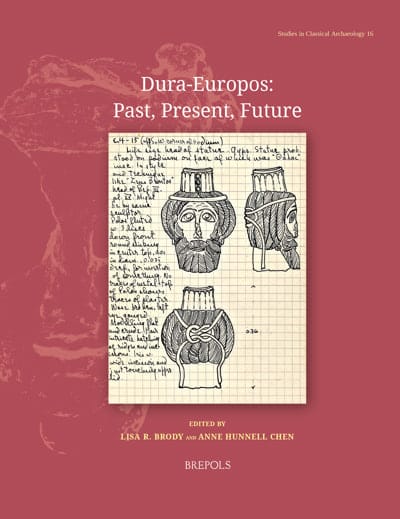
  • Dura-Europos: Past, Present, Future

    Dura-Europos: Past, Present, Future

    Brody, Lisa & Anne H. Chen (eds.). 2025. Dura-Europos: Past, Present, Future. Turnhout. Brepols.

    This volume brings together an international and interdisciplinary host of scholars to reflect on the complicated legacies of exploration at the archaeological site of Dura-Europos, situated on the western bank of the Euphrates River near modern Salihiyeh (Syria). A chance discovery after World War I kicked off a series of excavations that would span the next century and whose finds are today housed in collections worldwide, including the Yale University Art Gallery, the Louvre, and the National Museum in Damascus. Dura-Europos exemplifies a multiethnic frontier town at the crossroads of major trade routes. Its textual remains and remarkably-preserved Christian, Jewish, and polytheist religious sanctuaries provide key resources for the study of antiquity and attest to the cross-cultural interconnectivity that was demonstrably central to the ancient world but which has been too often obscured by Eurocentric historiographic traditions and siloed disciplinary divisions.

    Foreign-run, large-scale archaeological campaigns of the early twentieth century, like those at Dura-Europos, have created narratives of power and privilege that often exclude local communities. The significance of these imbalances is entangled with the destruction the site has experienced since the 2011 outbreak of conflict in Syria. As a step toward making knowledge descendant of early excavations more accessible, this volume includes Arabic summaries of each paper, following up on the simultaneous Arabic interpretation provided at the 2022 hybrid conference whose proceedings form the core of this publication. The papers address topics connected to essential themes in relation to Dura-Europos: long-distance trade relations and cross-border interactions in antiquity, including the exchange of technologies, people, and materials; Christianity, Judaism, and other religious practices, and their relations to one another; contemporary trafficking of looted artifacts; cultural heritage and the Islamic State; and the evolving role of museum collections, technologies, and archival materials for research.

  • Christian Slavery in Fars

    Christian Slavery in Fars

    Stadel, Seth M. 2025. The legal constructions of Christian slavery in Fars at the end of Late Antiquity. Journal of Late Antiquity 18(2). 401–422.

    In the seventh and eighth centuries, the Church of the East community in Fars (southwest Iran) slowly developed a distinctive identity in response to the political, religious, and cultural changes that transformed the region in the wake of the Arab conquest of Iran in the early to mid-seventh century. One facet of this emerging identity centered around the institution of slavery. The only known witnesses preserving details of the practice of Christian slavery in Fars are the lawbooks of Church of the East metropolitan bishops Simeon of Revardashir (mid-seventh century) and Isho‘bokht of Revardashir (late eighth century), each of whom produced their respective legal work for the Christian community in this region. This article examines the legal constructions of Christian slavery in Fars in the context of extant Sasanian slave laws and documentary evidence. It also discusses the extent to which these two metropolitan bishops developed Sasanian slave laws for the purpose of establishing legal boundaries that demarcated Christian slavery from non-Christian slavery in Fars, and it considers the probable reasons that motivated their production of slave regulations for Christians in this region at the end of Late Antiquity.

    Abstract
  • Persian Mazdaism in Cappadocia

    Persian Mazdaism in Cappadocia

    Fattori, Marco & Marco F. Ferrari. 2025. Zeus Pharnauas and Persian Mazdaism in Cappadocia. Iran 1–16.

    This article deals with the spread of Iranian religion in the western regions of the Achaemenid Empire by means of a combined analysis of historical and linguistic data. The core of the discussion is about the word Φαρνάουας, which appears as an epithet of Zeus in a Greek inscription from Roman Cappadocia. After showing, on linguistic grounds, that this epithet must have originated in the empire heartland during the Achaemenid period, some reflections are offered on the way by which Persian religious elements ended up in Cappadocia. In the framework of a survey of the traces of Iranian religion in Achaemenid and post-Achaemenid Cappadocia, another interesting point of contact between Cappadocia and the local cultic reality of Persia is pointed out – the female theonym *R̥tāna fravr̥tiš “Frauuaṣ̌i of the Righteous”, both attested in the Cappadocian calendar and the Elamite administrative documents from Persepolis.

  • Achaemenid Zoroastrian Echoes

    Achaemenid Zoroastrian Echoes

    Barnea, Gad. 2025. Some Achaemenid Zoroastrian echoes in early Yahwistic sources. Iran. 1–10.

    In her magnum opus, A History of Zoroastrianism, Mary Boyce perceptively noted that often, in the history of this Iranian religion, “developments within Iran itself have to be deduced from the ripples which they caused abroad”. This is certainly true of the history of Achaemenid-era Zoroastrianism, the characteristics (and in some circles even the existence) of which, continue to be a matter of debate even as more and more information regarding its possible features continues to emerge. This article aims to complement the current body of knowledge with data gathered from Yahwistic sources outside of Iran to enhance and solidify our understanding of Achaemenid-era Zoroastrianism and its contours. It reviews the current state of scholarship and the significant progress that has been made in the recent decades and studies some Zoroastrian/Avestan echoes preserved in Yahwistic sources in Upper Egypt, mostly at Elephantine, which provide first-hand documentation of Zoroastrian devotion.

    Abstract
  • Ahreman’s Ascent

    Ahreman’s Ascent

    Panaino, Antonio. 2025. Ahreman’s ascent and the direction of his primordial aggression. With an excursus about the cosmic egg (Publications d’Études Indo-Iraniennes 4). Strasbourg: Université de Strasbourg.

    This study analyses the problem of the trajectory taken by Ahreman during his aggression against the Good Creation. In the Pahlavi texts, this attack moves from the bottom of the universe to the top, passing throughout the intermediate void. This means that the heaven of the stars, pierced by the demonic army in the circumpolar area, was not spherical at that moment, and that the cosmos did not follow a homocentric model, or Ahreman, coming from the outer space, would have aggressed directly Ohrmazd, whose paradisiacal sphere would have been the most external one. Actually, the cosmos assumed a homocentric shape only after the aggression, and this shows that the Sasanian theologians mixed an earlier non spherical model with a later spherical one with contradictory results. Parallel problems emerge with reference to certain narrations concerning Ahreman’s expulsion from the lowest heaven, whose effects would have produced the transfer of the antagonist not out of the universe, but in a superior sphere. The present book discusses this and other uranographic problems in connection with the complex evolution of Zoroastrian cosmology since the Avestan period till the later phases, when the Mazdeans were living within a dominating Islamic cultural framework.

    Summary
  • An Old Khotanese Reader

    An Old Khotanese Reader

    Sims-Williams, Nicholas, with contributions by Jonathan A. Silk. 2025. An Old Khotanese Reader: The Tale of Bhadra (Beiträge zur Iranistik 53). Wiesbaden: Reichert.

    This reader contains the complete text of the Buddhist ‘Tale of Bhadra’, the second chapter of the Old Khotanese Book of Zambasta, accompanied by a translation, commentary and glossary. All morphological forms occurring in the text are identified in the glossary and in the introduction, which also includes a survey by Jonathan A. Silk of sources and parallels in other languages. The volume thus provides everything required to make this text accessible either to a student who has already worked through the ‘Introduction to Khotanese’ which forms the first part of R. E. Emmerick’s Handbook of Khotanese (BzI 51, 2024) or even to a complete beginner. It also contains substantial original material, particularly in the commentary and the etymological notes in the glossary, which will be of interest to specialists in Khotanese and in Iranian and Indo-European languages in general.