Bibliographia Iranica

Bibliographia Iranica

A predominantly bibliographic blog for Iranian Studies

  • Bibliographies
    • Some Data on Publications on Sogdian
  • Resources
  • Contributors
  • Contact
  • About
    • Privacy Policy
  • The Zoroastrian funeral ritual for living souls

    Nayebossadrian, Zhaleh. 2025. The Zoroastrian funeral ritual for living souls. Culture and Religion. 1-14.

    This study presents a comprehensive investigation into a Zoroastrian funerary rite, ‘Zīnda-ruwān-yaštan’, performed during their lifetime for the well-being of their living soul. The research draws on Zoroastrian scriptures and ethnographic sources to trace the origins and eventual decline of the ‘Zīnda-ruwāni’ ritual through a combination of historical, textual, and epigraphic analysis. The finding emphasises the ritual’s adaptability in response to evolving socio-political circumstances. Concentrating on ‘Srōš Yazata’, the divine entity believed to guide souls following death, the ceremonial practice underscores its profound spiritual import in assuaging death anxieties. The study makes a significant contribution to our understanding of the evolution of Zoroastrian funerary customs within various historical contexts. It demonstrates how Zīnda-ruwāni functioned to alleviate death-related anxieties within a dynamic socio-religious milieu, providing reassurance amid political and economic instability.
    24/10/2025
  • Achaemenid court logistics between royal capitals of Susa and Persepolis

    Achaemenid court logistics between royal capitals of Susa and Persepolis

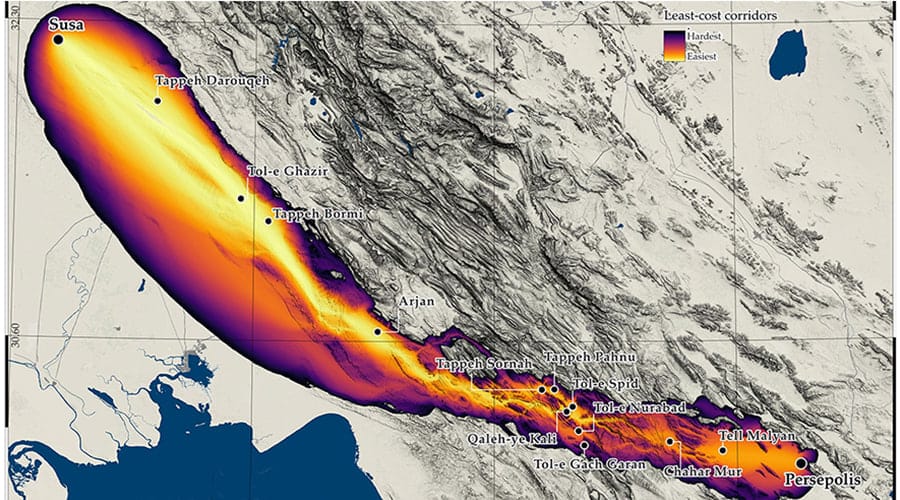
    Salaris, Davide. 2025. ‘Royal’ road, ‘royal’ needs: a GIS-based approach to Achaemenid court logistics between royal capitals of Susa and Persepolis. Antiquity. Published online 2025:1-8.

    This article redefines the concept of the Achaemenid ‘Royal’ Road using GIS-based route modelling to reconstruct possible roads between Susa and Persepolis. By integrating logistical and environmental parameters, it shows how royal mobility required a specialised infrastructure—distinct from ancillary roads—tailored to the operational scale of the Achaemenid court.

    22/10/2025
  • Parthica (vol. 26)

    Parthica (vol. 26)

    Volume 26 of the journal Parthica (2024) contains several contributions of relevance to Iranian Studies.

    • R. PALERMO – E. FRANCO – M. LA PORTA – C. RASMUSSEN: Exploring the Hellenistic period in North Mesopotamia landscape studies and excavations at Gird-I Matrab (Iraqi Kurdistan), p. 9
    • C. LIPPOLIS – V. MESSINA – G. PATRUCCO – A. SPANO: Rapid digital documentation of endangered archaeological contexts. A case-study from Seleucia on the Tigris (central Iraq), p. 29
    • M. MORIGGI: Aramaic graffiti in the houses of Hatra: The epigraphic point of view, p. 41
    • A.A. CHAVERDI: Two newly discovered artifacts from the city of Gur, Ardaxsir-Xwarrah, Firuzabad, p. 47
    • F. IZZI: Ain Sinu (Ninawa, Iraq): A military outpost on the Sasanian western limes? New studies on the military architecture of the Sasanian empire, p. 55
    • K. MAKSYMIUK – P. SKUPNIEWICZ: A silver plate with an ostrich hunt scene from the Wyvern Collection, p. 85
    • E. RASHIDIAN: The landscape elements of a dastgerd according to the Bozpar Valley and similar case studies in the Iranian highlands, p. 103
    21/10/2025
  • Zoroastrianism and contemporary philosophy

    Zoroastrianism and contemporary philosophy

    Nolan, Daniel. 2025. Zoroastrianism and contemporary philosophy (Elements in Global Philosophy of Religion). Cambridge: Cambridge University Press.

    Zoroastrianism is a religion with a long history, but it has been comparatively neglected by contemporary philosophers. This Element aims to bring aspects of its long intellectual history into conversation with contemporary Anglo-American philosophy. Section 1 provides an introduction to Zoroastrianism and its history, some of the important texts, and some contemporary philosophy engaged with Zoroastrian themes. Section 2 discusses distinctive contributions Zoroastrian thought can make to the problems of evil and suffering. And Section 3 discusses a ‘quasi-universalist’ approach to puzzles about heaven and salvation, inspired by Zoroastrian theological texts.

    Summary

    For those with access,this title is also available as open access on Cambridge Core.

    13/10/2025
  • The Achaemenid Dynastic Myth and Jewish Scribes in the Late Persian Period

    The Achaemenid Dynastic Myth and Jewish Scribes in the Late Persian Period

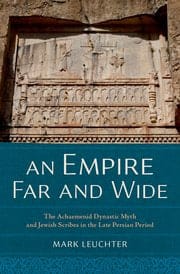
    Leuchter, Mark A. 2025. An Empire Far and Wide: The Achaemenid Dynastic Myth and Jewish Scribes in the Late Persian Period. Oxford: Oxford University Press.

    This book offers a new approach to evidence to examine Persian imperial ideology and surveys literary products of ancient Jewish scribes to analyze the influence of Persian imperialism on the development of Yehudite scribal ideology and presents an argument for the existence of Judaism in the Persian period.

    10/10/2025
  • Iran and the Caucasus 29 (3)

    Iran and the Caucasus 29 (3)

    We are grateful to the staff at Yale Classics Library (@yaleclassicslib.bsky.social), who have been wonderful collaborators, sharing publication information with us:

    Volume 29, issue 3, of Iran and the Caucasus has now been published.

    The following articles relate to the disciplinary focus of BiblioIranica:

    Did Arrian Ever Fight the Alans?

    Author: Fatima Foltz
    Pages: 233–246


    Who Hides under the Name “Šahrbarāz, Malik al-Bāb” by aṭ-Ṭabarī under 22 A.H. (642/3 A.D.)?

    Author: Arsen K. Shahinyan
    Pages: 247–259


    “Meinen Namen habe ich folgendermaßen inskulpiert”. Engelbert Kaempfer in Shirvan.

    Author: Daniel T. Potts
    Pages: 260–274


    Tiriya: A God Restyled

    Author: Martin Schwartz
    Pages: 275–281


    A Short Glossary of Northern Talishi

    Author: Garnik S. Asatrian
    Pages: 282–294


    Contributions to Zagrology: V.F. Minorsky and C.J. Edmonds Correspondence (1928–1965), by Gennady Kurin and Metin Atmaca (eds./annotation/introduction)

    Author: Victoria Arakelova
    Pages: 332–333

    09/10/2025
  • Zeitschrift der Deutschen Morgenländischen Gesellschaft

    Zeitschrift der Deutschen Morgenländischen Gesellschaft

    The latest issue (175.2) of the legendary Zeitschrift der Deutschen Morgenländischen Gesellschaft (ZDMG) has been published and is accessible here.

    Research articles

    Die ZDMG und ihre „Kinder“. Über die Rolle wissenschaftlicher Zeitschriften in der Geschichte der Orientalistik
    Thomas L. Gertzen
    Page 273 – 292


    Beyond Rage and Fear. Negative Emotions in Middle Babylonian Letters
    Jacob Jan de Ridder
    Page 293 – 310


    Ein christliches Liebesgedicht eines Muslims aus dem 10. Jahrhundert. Mudrik b. ʿAlī aš-Šaybānīs (st. 1000) muzdawiǧah über ʿAmr b. Yūhannā an-Naṣrānī
    Werner Diem
    Page 311 – 342


    Following the Path. On the Early Modern Commentary Tradition on Ibn al-Fāriḍ’s Poem of the Way
    Enrico Boccaccini
    Page 343 – 368


    Contributions to Iranian Etymology III
    Marco Fattori
    Page 369 – 395


    Was ist Iranistik? Eine fachgeschichtliche Würdigung von Bert G. Fragner (1941–2021)
    Christoph U. Werner
    Page 397 – 409


    The Yuktidīpikā on Yogins’ Perception
    Ołena Łucyszyna
    Page 411 – 435


    Das Menschen- und Kinderopfer im alten und modernen Indien – Material, Interpretation, Debatte
    Adelheid Herrmann-Pfandt
    Page 437 – 466


    Bringing Tibetan Buddhism Down to Earth. Part II: Gnam babs kyi dar ma bam po gcig go (IOL Tib J 370/6) Between Revelation and Legitimisation
    Joanna Bialek
    Page 467 – 492


    Were There Really Cham Muslims in Hainan and Guangzhou in the Late Tenth Century? A Re-Examination of Relevant Chinese Sources
    Johannes L. Kurz
    Page 493 – 518

    08/10/2025
  • Calque and Loanword in Early ʿAbbāsid Time (750–800 CE)

    Calque and Loanword in Early ʿAbbāsid Time (750–800 CE)

    Abedi, Milad & Johannes Thomann. 2024. The emergence of Arabic scientific terminology at the eastern contact zone: Calque and loanword in early ʿAbbāsid time (750–800 CE). Asiatische Studien – Études Asiatiques 78(4). 705-717.

    Superstratum languages often become substratum languages after military defeats. This was the case with Middle Persian in the Islamic Empire. There were different phases of interference between Middle Persian and Arabic. For example, Middle Persian terms, especially in administration and technology, were borrowed into Arabic. Later, in the first decades of Abbasid rule, a new scientific terminology was developed in Arabic based on translations of Sanskrit and Middle Persian texts in the fields of mathematics, astronomy, and medicine. Besides that, some scientific concepts of Chinese origin were received too. Most of these early Arabic scientific texts are lost, having been replaced later in the 3rd/9th century by translations of Greek scientific works. However, many fragments of them are preserved in secondary tradition, and such materials have been only partially studied. This paper will discuss cases of Arabic borrowings, including calques and loanwords from Sanskrit and Middle Persian.

    06/10/2025
  • Weaponry and a healed wound from the Parthian era

    Weaponry and a healed wound from the Parthian era

    Eghdami, Mohammad Reza, Majid Gholamzadeh Roudbordeh & Meysam Navaeiyan. 2025. Weaponry and a healed wound from the Parthian era (247 BCE to 224 CE): Insights from the Liyarsangbon cemetery, Guilan, Iran. International Journal of Osteoarchaeology Early View. 1–9.

    The current research examines the health and medical treatment implications associated with an iron arrowhead found among the skeletal remains of an individual unearthed from the Parthian cemetery at Liyarsangbon, Iran. This site is dated to the period between 247 bc and ad 224, as determined through relative dating methods. Non-invasive testing methods, including XRF and Quantometer analysis, established the elemental composition of grave artifacts, while CT Hounsfield scans assessed damage around the arrowhead within the bone. The soil exhibited a pH level of 8.67, signifying its alkaline nature. Among the metallic residues surrounding the subject of investigation, iron was identified as the predominant metal, with average concentrations of 89.93 (XRF) and 90.93 (Quantometer). A Hounsfield unit measurement of 4000 suggested a metallic object within the bone. This study focuses on the production of iron artifacts and examines their practical effectiveness. The intricate design of the arrowhead, characterized by its sharp precision, underscores the advanced level of craftsmanship within the toolmaking industry and reflects a high degree of expertise in metallurgy. Its ability to penetrate deeply into the lateral condyle of the right tibia serves as a testament to the skill and technological sophistication involved in its creation. Conversely, the inability to remove the embedded arrowhead from the bone reveals the constraints and shortcomings in the surgical practices of this particular society, shedding light on the limitations of medical techniques during that era.

    Abstract
    03/10/2025
  • Man, Landscape, and Society in Arsacid and Sasanian Iran

    Man, Landscape, and Society in Arsacid and Sasanian Iran

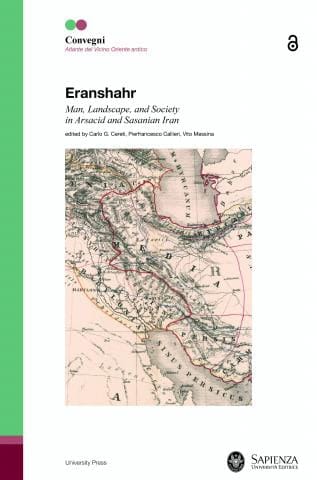
    Cereti, Carlo Giovanni, Pierfrancesco Callieri & Vito Messina (eds.). 2025. Eranshahr. Man, Landscape, and Society in Arsacid and Sasanian Iran (Collana Convegni 75). Rome: Sapienza Università Editrice.

    This fourth volume of the Atlas of the Ancient Near East (OCAVOA) collects 15 contributions by members of the three Units composing the PRIN 2017 ‘Eranshahr: Man Landscape and Society in Arsacid and Sasanian Iran. Texts, material culture, and society from Arsaces to Yazdegard III. Three case studies: Pars, Pahlaw and Khuzestan’ (2017PR34CS). These papers were presented during the conclusive workshop of the project, held in Ravenna on February 22-23, 2024. The project was conceived in 2017 and launched in 2018, representing a collaborative effort by a multidisciplinary team of scholars from Sapienza University of Rome, Alma Mater Studiorum University of Bologna, and Turin University, as well as several international partners. The project aimed to study the long millennium bridging two important transition periods in the history of western Asia, the first marking the passage from the Seleucid to the Arsacid era, the second being the fall of the Sasanian Empire and the rise of the Islamic Caliphate. In this framework, the book contains a set of archaeological, historical-geographical, and cultural studies on three ancient regions of western Iran during the Arsacid, Sasanian, and early Islamic periods, which combine into a coherent and innovative narration, shedding new light on the Iranian world in Antiquity, Late-Antiquity and the Early Middle Ages and opening the way for future investigations.

    02/10/2025
←Previous Page
1 … 5 6 7 8 9 … 177
Next Page→
Bibliographia Iranica

Bibliographia Iranica

A predominantly bibliographic blog for Iranian Studies

  • Articles
  • BiblioIranica
  • Books
  • Events
  • Journal
  • Online resources
  • Reviews
  • Translation
  • Bluesky
  • Facebook
  • Mastodon

Achaemenid Achaemenid Empire Achaemenid History Alexander the Great Ancient History Ancient Iran Archaeology Arsacid Art History Avestan Bactrian Central Asia Christianity Early Islamic Elam Empires History History of Iran History of Zoroastrianism Iranian Languages Iranian Studies Irano-Judaica Islam Late Antiquity Linguistics Literature Manichaeism Manuscripts Middle Iranian Middle Persian Numismatics Old Persian Pahlavi Documents Pahlavi Literature Parsis Parthian Persian Philology Rituals Sasanian Silk Roads Sogdian Study of Religions Syriac Zoroastrianism

© 2015–2026 Bibliographia Iranica

Designed with WordPress