• Zoroastrian theories on earthquakes

    Azarnouche, Samra. 2024. Tectonique des mythes. Croyances et théories zoroastriennes sur le tremblement de terre. Revue de l’histoire des religions 241(2). 275–297.

    Anselm Kiefer, Le Croissant fertile, 2010

    While the earthquake is primarily a cosmogonic act provoked by the intrusion of Evil into Ohrmazd’s world, the Zoroastrian accounts describing the phenomenon also bear witness to a striking confluence of myth, mechanistic theories and biological analogies. The tradition conveyed by the texts (Bundahišn 21e, Dēnkard III.93 and Dādestān ī Dēnīg 69) attributes the earthquake sometimes to the demon Čišmag and his atmospheric acolytes, sometimes to the sorcerer Frāsyāb, two figures who also have in common that they are associated with drought. Some episodes featuring them also include a mysterious appearance by Spandarmad, the Earth goddess. These elements indicate that the Zoroastrian aetiology of earthquakes was far more narratively complex than the texts handed down to us give us to understand.

    Abstract

    The above article is part of an issue dedicated to earthquakes:

    Azarnouche, Samra, Muriel Debié & Vassa Kontouma (eds.). 2024. Quand la terre tremble: apprivoiser le choc des séismes dans les temps anciens. Revue de l’histoire des religions 241(2).
  • Eschatologia Iranica I:

    Rezania, Kianoosh. 2024. Eschatologia Iranica I: From Zoroastrian cosmos to Abbasid Madīnat al-Salām: A journey through utopia and heterotopia. Religions 15(10).

    The history of imperial dynasties in West Asia is replete with examples of remarkable urban foundations. Two notable instances are the Sasanian Ardašīr-xwarrah and the Abbasid Madīnat al-Salām, which can be classified as cosmic cities or heterotopias. This article examines the utopian foundations of these heterotopias. To this end, it analyzes four religious and imperial spaces: the representation of the earth and sky in the Zoroastrian cosmography, Yima’s Vara according to the Avestan texts, Ardašīr-xwarrah, and finally, Madīnat al-Salām. This investigation aims to ascertain the extent to which the spatial characteristics of each of these spaces have been utilized in the production of the subsequent architectural forms. Similarly, it examines the development of the cosmological and eschatological paradise in relation to the Achaemenian and Sasanian royal gardens. The theoretical framework of this study is based on Michael Foucault’s notion of heterotopia, which has been further developed by Henri Lefebvre’s theory of space. The conceptual metaphor theory offers a cognitive linguistic foundation for elucidating the projections of utopias and heterotopias onto one another. To this end, the article focuses on the conceptual metaphor GOD IS A KING.

    Abstract
  • Written Middle Persian Literature under the Sasanids

    Written Middle Persian Literature under the Sasanids

    van Bladel, Kevin T. 2024. Written Middle Persian literature under the Sasanids (AOS Essay 16). New Haven: AOS.

    Although there was oral literature among speakers of ancient Iranic languages, the author argues that there is no valid reason to assume that Middle Persian speakers, alone among sedentary peoples of their time, never or seldom wrote literary works in their language. Not only are there many Middle Persian literary works surviving in translation, and sufficient testimonies to the existence of Middle Persian literary works now lost and to Sasanian Middle Persian literacy, there are also strong explanations for their general nonsurvival that eliminate the assumption of a theory of predominant literary orality and disinclination to write literature, an argumentum ex silentio. We may reasonably assume that it is wrong to propose that what happens to survive in the original language on stone and metal surfaces and in desert environments represents the true range of Sasanian Middle Persian—the odds are far against it. Especially when propped up by a concept of “ancient Iranians” and without any definition of literature or the literary, it has no sound basis and is contradicted by a variety of extant sources.

  • War in the Ancient Iranian Empires

    Hyland, John O. & Khodadad Rezakhani (eds.). 2024. Brill’s companion to war in the ancient Iranian empires (Brill’s Companions to Classical Studies: Warfare in the Ancient Mediterranean World 9). Leiden: Brill.

    Brill’s Companion to War in the Ancient Iranian Empires examines military structures and methods from the Elamite period through the Achaemenid, Seleucid, Arsacid, and Sasanian empires. War played a critical role in Iranian state formation and dynastic transitions, imperial ideologies and administration, and relations with neighbouring states and peoples from Central Asia to the Mediterranean. Twenty chapters by leading experts offer fresh approaches to the study of ancient Iranian armies, strategy, diplomacy, and battlefield methods, and contextualise famous conflicts with Greek and Roman opponents.

    Table of Contents

    (more…)
  • African Individuals and Groups in Texts from Chaldean and Achaemenid Babylonia

    Karlsson, Mattias. 2024. From Memphis to Babylon: African individuals and groups in texts from Chaldean and Achaemenid Babylonia (Ägypten und Altes Testament 125). Münster: Zaphon.

    Die ersten Zivilisationen der Weltgeschichte, Ägypten und Mesopotamien, werden oft getrennt untersucht. Diese Studie verfolgt einen anderen Ansatz und konzentriert sich auf die Beziehungen zwischen diesen beiden Flusskulturen. Sie befasst sich mit der afrikanisch-babylonischen Interaktion im Zeitraum 626–331 v. Chr., als Babylonien (der heutige Südirak) zunächst das Zentrum eines Staates war, der den alten Nahen Osten dominierte, und dann eine wichtige Provinz im achämenidischen Reich. Während dieser 300 Jahre führten Auseinandersetzungen zwischen dem saitischen Ägypten (664–525) und dem chaldäischen Babylonien (626–539) sowie die persische Eroberung Ägyptens zu einem Macht- und Bevölkerungstransfer „von Memphis nach Babylon“. Das übergeordnete Ziel dieser Arbeit ist die Erörterung der Beziehungen zwischen Afrika und Mesopotamien. Die genaueren Ziele dieser Studie bestehen darin, Afrikaner (Ägypter, Kuschiten, Libyer) in babylonischen Texten aus der chaldäischen (626–539) und achämenidischen (539–331) Zeit zu identifizieren und die Anwesenheit von Afrikanern im chaldäischen und achämenidischen Babylonien zu erörtern unter dem Gesichtspunkt individuell-biografischer und kollektiv-demografischer Ebenen und Perspektiven. Die folgenden Forschungsfragen werden gestellt: Wer waren diese Afrikaner (in Bezug auf ethnische Zugehörigkeit, Geschlecht/Gender, Alter und Klasse)? Was haben diese Leute (beruflich) gemacht? Wann lebten sie (im Hinblick auf die Regierungszeit oder den Zeitraum)? Wo lebten sie (in Bezug auf Dorf, Stadt und Region)? Wie wurden sie in das babylonische Reich eingegliedert (zwangsweise/freiwillig, erste/zweite Generation usw.)? – Die Anwesenheit der afrikanischen Beamten im Dienste des chaldäischen und achämenidischen Babyloniens weist auf einen komplexen Prozess hin, in dem sowohl Anpassung als auch Kooptation eine Rolle spielten. Der Wunsch oder das Bedürfnis des Einzelnen, sich anzupassen, um zu überleben, co-existierte zusammen mit einem externen Druck von staatlicher Seite, der darauf abzielte, die afrikanischen Deportierten zu loyalen und profitablen Untertanen zu machen. Der Transfer von Memphis nach Babylon musste eine kontinuierliche Neubewertung dessen mit sich gebracht haben, was es bedeutete, ein Teil der ägyptischen Zivilisation an den Flüssen Babylons zu sein.

  • Lost Turfan Fragments

    Benkato, Adam. 2024. Lost Turfan fragments from the Nachlass of W.B. Henning. Bulletin of the School of Oriental and African Studies, FirstView. 1–17.

    During the Second World War, a number of manuscript fragments in Iranian languages from the Berlin Turfan collections were lost. Photographs of these fragments preserved in the Nachlass of Walter B. Henning bring to light their contents and fill gaps in the record of Turfan texts. These photographs are published here for the first time, together with a description of the fragments and their contents.

    Abstract
  • Mystical Landscapes

    Keshavarz, Fatemeh & Ahmet T. Karamustafa (eds.). 2024. Mystical landscapes in medieval Persian literature. Edinburgh: Edinburgh University Press.

    In this collection, Fatemeh Keshavarz and Ahmet T. Karamustafa bring together leading researchers from comparative literature, history, literary criticism and religious studies to explore the major authors and genres of medieval Persian mystical literature. Breaking out of the all-inclusive literary history framework, the contributors write on topics that have energised their scholarship over time and address areas where the literary and the mystical have mingled and led to paradigmatic creations. How can you interpret the climactic conclusion to the framing narrative of The Speech of the Birds of ‘Attar of Nishapur? How did ‘Aziz Nasafi understand the concept of religion? What do Rumi’s conversations with the Divine tell us about his teachings and his poetry? How do medieval Persian Sufi commentators add to our understanding the Qur’an? How can we utilise Sufi manuals, life stories and utterances? All of these explorations and more bring the depth and eloquence of Persian mystical literature to life in this volume.

    Editor note: This books falls outside our known comfort zone, but not by such a wide margin that we can ignore it. ~AZ

  • Zoroastrian Esotericism

    Zoroastrian Esotericism is a special issue of Religiographies, vol. 3, no. 1, edited by Mariano Errichiello, Daniel J. Sheffield, and Yuhan Sohrab-Dinshaw Vevaina.

    Table of contents

    Editorial

    New Perspectives on the Study of Esotericism and Zoroastrianism
    Mariano Errichiello, SOAS University of London
    Francesco Piraino, Giorgio Cini Foundation / Harvard Divinity School
    Yuhan Sohrab-Dinshaw Vevaina, University of Oxford
    [PDF] 1-6

    Articles

    The Mazdean Esoteric Dimension between Ritual and Theology
    Antonio Panaino, University of Bologna
    [PDF] 7-26

    Exploring Zoroastrianism and Esotericism in the Context of Global Religious History
    Moritz Maurer, Institut für Religionswissenschaft, Universität Heidelberg
    [PDF] 27-43

    (more…)
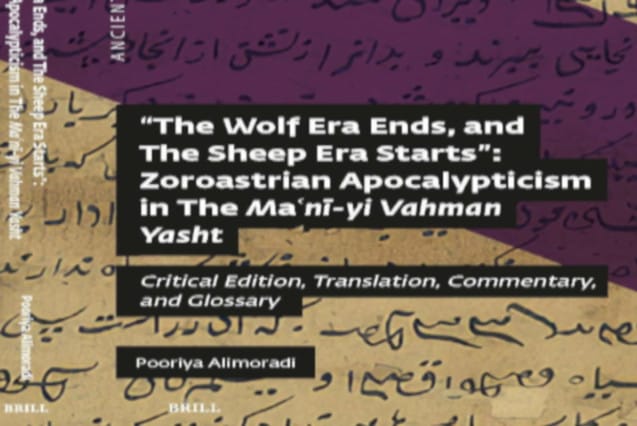
  • Zoroastrian Apocalypticism in The Maʿnī-yi Vahman Yasht

    Zoroastrian Apocalypticism in The Maʿnī-yi Vahman Yasht

    Alimoradi, Pooriya. 2024. “The wolf era ends, and the sheep era starts”: Zoroastrian apocalypticism in the Maʿnī-yi Vahman Yasht. Leiden: Brill.

    This book studies, for the first time, the Maʿnī-yi Vahman Yasht , the New Persian version of the Zand ī Wahman Yašt , the most important Zoroastrian text in apocalyptic genre. Through offering a critical edition, translation, and commentary, Alimoradi argues that the MVY is not a translation of the extant Pahlavi ZWY and is derived from another recension of apocalyptic materials in Pahlavi. He also offers suggestions in identifying several unspecified characters and events referred to in the text whose identities have been debated for decades. The book is relevant to those interested in Zoroastrianism, Iranian apocalyptic traditions, and anyone studying the Arab conquests in Western and Central Asia in 6ᵗʰ to 9ᵗʰ c. CE.

  • Ideological Variants in Persian Texts

    Alsancakli, Sasha & Philip Bockholt. 2023. Authorship and textual transmission in the manuscript age: Contextualising ideological variants in Persian texts (Cahiers de Studia Iranica, 64). Leuven: Peeters.

    The present volume addresses dynamic and collective authorship by examining how authors and scribes in the Persianate parts of the Islamic world produced, copied, and interpreted texts during the manuscript age within specific cultural contexts, out of political necessity and as a result of professional choices. The processes of scribal adaptation faced by scholars studying the Islamic world in the pre-modern period took many different forms, most of which are still unexplored. The changes applied consist of minor corrections and amendments, as well as full-fledged reworkings of a text and modifications to its core ideological components. Under the label “ideological variations”, this volume intends to discuss any deliberate changes in content, rather than form, made by authors, copyists, and readers intervening at various stages in the process of textual production and transmission.