• Male Homoerotic Practices in Achaemenid Persia

    Treuk Medeiros de Araujo, Matheus. 2024. Male homoerotic practices in Achaemenid Persia: An overview. Archai 34, e03415.

    Descriptions of Ancient Persian male homoeroticism come mainly from Classical sources, which, however, seem to present divergent testimonies regarding this practice. Some authors apparently provide proof for its widespread acceptance, whereas others, particularly later authors, emphasized its prohibition. Considering the many difficulties involved in the reconstruction of Persian history through the eyes of classical Greeks and Romans, this article aims to provide a brief overview of the subject, with some clues to the question of the origin, form, and tolerance of same-sex love in Achaemenid Persia. We agree that homoerotic practices were attested and likely accepted at some level in Achaemenid Persia. However, we believe that the evidence available to us is not enough to obtain a full understanding of this phenomenon. It is also stressed that not every Greek or Roman reference to Persian male homoeroticism should be taken at face value, as some are distorted and fictitious or lack firsthand knowledge. Finally, we briefly address the image of eunuchs as sexual partners of Achaemenid kings.

  • Navigating the Worlds of History

    Ruffing, Kai, Brigitte Truschnegg, Andreas Rudigier, Julian Degen, Sebastian Fink & Kordula Schnegg (eds.). 2024. Navigating the worlds of history. Studies in honor of Robert Rollinger on the occasion of his 60th birthday. Wiesbaden: Harrassowitz.

    These studies in honor of Robert Rollinger, a scholar who dedicated and dedicates himself to the study of the Ancient Worlds and their Afro-Eurasian entanglements, are published on the occasion of his 60th birthday. Accordingly, the three volumes bring together contributions from friends, colleagues, and students of Robert Rollinger. The themes of these some 80 articles are in line with Rollinger’s research foci. Therefore, there are articles dealing with themes from the field of classical studies and thus the ancient Mediterranean world, the Ancient Near East and Persia as well as Iran. In addition – also in line with Robert Rollinger’s academic activities and his own research interests – there are essays on the history of Austria, in particular on that of Vorarlberg, the honoree’s homeland. Old America is also given thematic consideration. Moreover, the reception of the Ancient Worlds is also addressed.

    The work consists of three volumes and is divided into five sections. The first deals with the classical world and its entanglement with the Ancient Near East; the second section focusses on the Ancient Near East. The third section is dedicated to the Iranian world in its imperial longue durée, while the fourth section looks at the global as well as the local history taking into account the perspective of Global and Universal History. Finally, the fifth and last section is dedicated to the dialogue between the ancient world and the present.

  • Wine Cultures

    Antonetti, Claudia, Bryan De Notariis & Marco Enrico (eds.). 2024. Wine cultures: Gandhāra and beyond (Antichistica 40). Venezia: Venice University Press.

    The volume Wine Cultures. Gandhāra and Beyond represents the primary outcome of the MALIWI project (SPIN Ca’ Foscari 2021) directed by Claudia Antonetti. Adopting an interdisciplinary approach, this work seeks to explore the production techniques, social functions, and cultural significance of intoxicating drinks with particular reference to wine – an extraordinary beverage that has been intertwined with human history for millennia. This volume gathers contributions by scholars interested in studying wine and drinking culture in Gandhāra and neighbouring regions, including Ancient Assyria, Arachosia, and present-day India. The topic is explored from three fundamental perspectives, employing a diverse range of sources, including literary and historical texts, as well as linguistic, iconographic, archaeological, and anthropological evidence.

    Abstract
    (more…)
  • On Middle Persian Documents

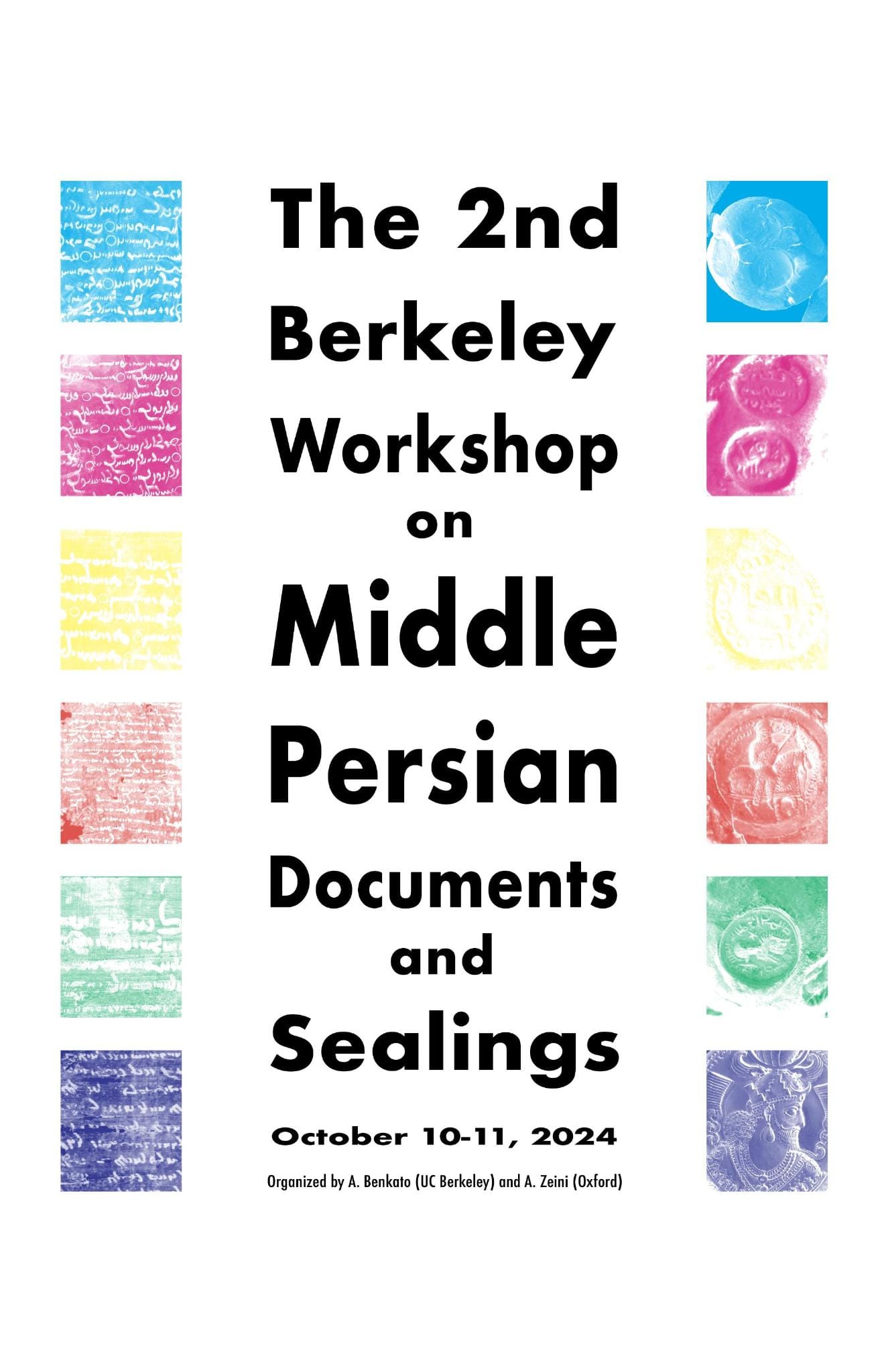
    The 2nd Berkeley Workshop on Middle Persian Documents and Sealings

    This is the second workshop in a series that began in Spring 2023 with the idea of bringing together scholars around the world who were actively working on, or interested in working on Middle Persian documents and sealings. The workshop is organised by Adam Benkato (UC Berkeley) and Arash Zeini (University of Oxford).

    To attend the workshop, which takes place on Zoom, register here. The programme is below.

  • Gorani in its Historical and Linguistic Context

    Karim, Shuan Osman & Saloumeh Gholami (eds.). 2024. Gorani in its historical and linguistic context (Trends in Linguistics. Documentation 41) Berlin: De Gruyter.

    Gorani refers to under-documented, endangered varieties spoken in a cluster within the Zagros mountains (Iran/Iraq). These varieties possess conservative features of importance to linguists. However, their study has been plagued by nomenclature and taxonomy issues. Traditional names for these languages have been supplanted first by orientalists’ prescriptions and then by their linguist heirs. Inaccurate terminology has sewn discord between speaker communities, disturbing the sociolinguistic landscape. This volume represents the state of the art of Gorani’s historical and socio-linguistics, documentation, and literature, as well as an effort to aid the “decolonization” of Gorani linguistics.

    (more…)
  • Contact Zones in the Eastern Mediterranean

    Niesiołowski-Spano, Łukasz & Kacper Ziemba (eds.). 2024. Contact zones in the Eastern Mediterranean: Judeans and their neighbours in intercultural contexts: places, middlemen, transcultural contacts. –– Sixth to second century BCE. Göttingen: Vandenhoeck & Ruprecht.

    Two contributions of this open-access volume investigate aspects of the Achaemenid Persian Empire:

    • Giulia Francesca Grassi: Religious Interactions in Achaemenid Elephantine and Syene as Reflected in the Aramaic Documents
    • Jason M. Silverman: Prolegomena to an Analysis of the Persian “Royal Road” as a Social Network in the Southern Levant
  • The Vanishing Zoroastrian Presence in Ahvaz

    A lecture by Saloumeh Gholami, University of Cambridge, and Mehraban Pouladi, Mōbedān Council (Iran), entitled:

    The vanishing Zoroastrian presence in Ahvaz: Historical evolution, migration and the threat to cultural heritage

    Mobed Sohrab Hengami and Mobed Mehraban Pouladi performing Gahanbar at the Hall of the Zoroastrian Association of Ahvaz, 2004.

    Friday 18 October 5:30pm, AIIT, Cambridge.

    This lecture offers an exploration of the complex history of the Zoroastrian community in Ahvaz, a city in the province of Khuzestan in Iran. Because of economic hardship and agricultural decline in Yazd, Zoroastrians started migrating there in the early 20th century. Earlier censuses from the 19th century, such as those by Hataria in 1854 and Houtum-Schindler in 1882, record no Zoroastrian presence in Ahvaz. The earliest mention of Zoroastrians in the city appears in the 1963 census, which was prepared for the National Zoroastrian Congress held in Kerman that same year. The Zoroastrian community in Ahvaz has so far found little, if any scholarly attention due to the dearth of documentation. However, as a result of new archival evidence from the Pouladi Collection, unearthed by the speakers in 2016, new data has emerged that throws light on the reasons for the migration from Yazd to Ahvaz. The new documents provide evidence that Zoroastrian settlements were established in the 1920s along the Karun River through the agricultural enterprise, the Mazdyasnān Company. This lecture examines how the Zoroastrian community of Ahvaz flourished in their new home, contributing to the prosperity of the region, but later, despite its successes, gradually declined. This development raises critical questions regarding the preservation of minority heritage in Iran.

    Summary
  • A History of Space

    Une histoire de l’espace à l’époque des premières dynasties turques et mongoles

    This year’s biannual Conférences d’études iraniennes «Ehsan et Latifeh Yarshater» will be delivered by David Durand-Guédy, Universität Hamburg, on the topic of space at the time of the first Turkic and Mongol dynasties.

    This a CeRMI event, organised by Samra Azarnouche and Justine Landau.

    For more information, see the flyer and the programme:

  • Societies, Politics and Cultures of the Iranian World

    Societies, Politics and Cultures of the Iranian World (2024–2025), a monthly multidisciplinary research seminar hosted by the Centre de recherche sur le monde iranien (CeRMI), presents recent research on Iran and the Iranian world from antiquity to the present day. This seminar series is organised by Samra Azarnouche and Justine Landau.

    The programme of the series:

  • A Workshop on the Dēnkard

    ‘A Spark of the Glimmer of the Original Light’: A Workshop on the Dēnkard as Literature, Theology, and Scholasticism
    17-18 Oct, Wolfson College
    University of Oxford

    Professor Samra Azarnouche (L’École Pratique des Hautes Études – Paris Sciences & Lettres) and Yuhan Sohrab-Dinshaw Vevaina will be co-convening a workshop on the Dēnkard. Co-sponsored by EPHE, Paris and AMES, University of Oxford, this two-day Workshop on literature, theology, and scholasticism of the Zoroastrian community in the 9th century CE, is to be held on Thursday and Friday, 17–18 October 2024 in the Buttery at Wolfson College.

    The Dēnkard, the towering achievement of Zoroastrian scholasticism in Late Antiquity and compiled in the 9th century CE, serves as a comprehensive compendium of Zoroastrian beliefs, practices, and doctrines. In its nine books, the Dēnkard, at 169,000 words, covers a staggering range of topics, including cosmology, ethics, rituals, jurisprudence, and the history of Zoroastrianism and its textual transmission. The work addresses various theological questions, offering explanations for the nature of good and evil, the existence of the spiritual world, and the role of humanity in the cosmic struggle between Ohrmazd, the god of light and order, and Ahrimen, the principle of darkness and chaos. Through its challenging rhetorical structures and hermeneutical interpretations, the Dēnkard provides unique insight into the dualistic Zoroastrian world-view and its influence on ancient and medieval Iranian society. As a crucial source of Zoroastrian thought and tradition, the Dēnkard not only informs contemporary practitioners but also scholars and researchers interested in the history of religion, Iranian studies, and comparative theology. Its significance lies in its preservation of Zoroastrian theology and its role in shaping the religious and cultural landscape of the pre-Islamic Iranian world.

    The Workshop will be conducted based on pre-circulated papers which will explore the nature and character of a particular book of the Dēnkard, structural and intertextual connections between different books, and the broader questions of transmission and historical context. The workshop will feature a variety of distinguished scholars from the UK, continental Europe, and North America working on Zoroastrianism in Late Antiquity and the early Islamic period.

    The Announcement