Heidemann, Stefan. 2014. A hoard from the time of the collapse of the Sasanian Empire (AD 638–9). Part II: Analysis of the minting system of Ardashir III. The Numismatic Chronicle 174. 333–351
Proto-Indo-European Lexicon
 Proto-Indo-European Lexicon
The generative etymological dictionary of Indo-European languages
The current version, PIE Lexicon Pilot 1.1, presents digitally generated data of hundred most ancient Indo-European languages with three hundred new etymologies for Old Anatolian languages, Hitttite, Palaic, Cuneiform Luwian and Hieroglyphic Luwian, arranged under two hundred Indo-European roots.
The correspondences contain data of all fourteen sub-branches of the Indo-European languages, Albanian, Anatolian, Armenian, Baltic, Celtic, Germanic, Greek, Indo-Aryan, Iranian, Italic, Old Balkan (Satem), Old Balkan (Centum), Slavic and Tocharian.
Iran in World History
 Foltz, Richard. 2016. Iran in world history. (New Oxford World History). New York: Oxford University Press.One of the world’s most ancient and enduring civilizations, Iran has long played a central role in human events and continues to do so today. This book traces the spread of Iranian culture among diverse populations ranging from the Mediterranean to the Indian Ocean, and along the Silk Roads as far as China, from prehistoric times up to the present day. From paradise gardens and Persian carpets to the mystical poetry of Rumi and Hafez, Iran’s contributions have earned it a place among history’s greatest and most influential civilizations. Encompassing the fields of religion, literature and the arts, politics, and higher learning, this book provides a holistic history of this important culture.
Six Polybian themes concerning Alexander the Great
Overtoom, Nikolaus L. 2013. Six Polybian themes concerning Alexander the Great. Classical World. 106 (4), 571-593.
This study discusses the image of Alexander the Great created by Polybius and reinvestigates the Polybian themes concerning the Macedonian. Richard Billows suggested that there are fi ve Polybian themes found in his analysis of Alexander. Yet our current assumptions about the scope of Polybius’ portrayal and his own conclusions require reconsideration. In fact, Polybius’ favorable comparison of Rome’s accomplishments to those of Alexander emerges as a possible sixth theme. This article examines these six Polybian themes, while demonstrating that Polybius does not disassociate his text completely from an apologetic tone and offers a generally positive opinion of Alexander the Great.
Paintings of afrāsyāb

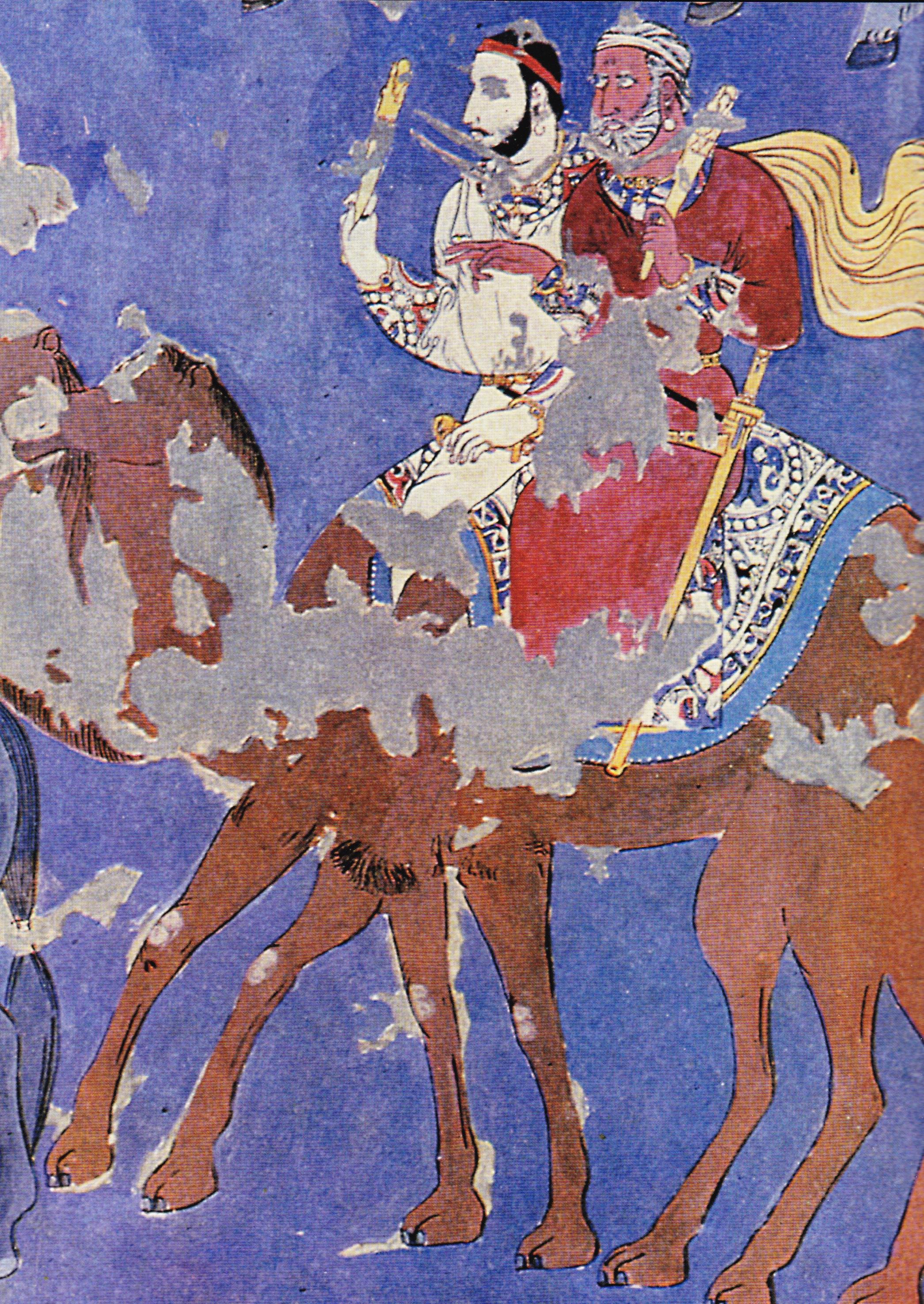
Details of a copy of mural called The Ambassordors’ Painting, found in the hall of the ruin of an aristocratic house in Afrasiab, commissioned by the king of Samarkand, Varkhuman (ca. 650) Compareti, Matteo. 2015. Samarkand the center of the world: proposals for the indentification of the afrasyab paintings. Costa Mesa: Mazda Publishers.
In antiquity Samarkand was the capital of the Persian province of Sogdiana. Its language, culture, and “Zoroastrian” religion closely approximated those of the Persians. Following its conquest by Alexander, its strategic position and fertile soil made Sogdiana a coveted prize for Late Antique invaders of Central Asia. Around 660 CE — at the dawn of Arab invasion — local king Varkhuman promoted the execution of a unique painted program in one of his private rooms. Each wall was dedicated to a specific population: the north wall, the Chinese; the west, the Sogdians themselves; the east, the Indians and possibly the Turks. The south wall is probably the continuation of the scene on the west wall. In Chinese written sources, some support for this concept of the “division of the world” can be found. Accidentally discovered during Soviet times, the room was named “Hall of the Ambassadors” due to the representations of different peoples. However, many aspects of its painted program remain obscure. This study offers new ideas for better identifications of the rituals celebrated by the people on the different walls during precise moments of the year.About the Author:Matteo Compareti (PhD 2005) is adjunct assistant professor in Department of Near Eastern Studies, University of California-Berkeley.The Religions of Ancient Iran
 Mazdapour, Katayoun et al. 2015. The Religions of Ancient Iran. Tehran: SAMT Publication.This book is an introduction to Ancient Iranian Religions. Each chapter of this book deals with one of the major religions or trends in the history of ancient Iranian religions or those religions which were influenced by ancient Iranian beliefs and views.Table of Contents:
- Zaraθuštra (Zoroaster) and the Zoroastrianism
- Mithraism
- Mani and Manichaeism
- Zurvanism
- Mazdakism
Mazdāpur, katāyun va digarān. 1394š/2015. adyān-o maẕāheb dar īrān-e bāstān. tehrān: entešārāt-e samt.In original:مزداپور، کتایون و دیگران. ۱۳۹۴. ادیان و مذاهب در ایران باستان. تهران: سمت
The Arsacids: Gods or Godlike Creatures?
Dabrowa, Edward. 2014. The Arsacids: Gods or Godlike Creatures?. In Tommaso Gnoli and Federicomaria Muccioli (eds.), Divinizzazione, culto del sovrano e apoteosi Tra Antichità e Medioevo, Bononia University Press, 149-159.
Edward Dabrowa is a Polish historian, Professor who graduated from the Faculty of Philosophy and History at the Jagiellonian University in 1972 and received the title of professor 1994. He is Currently head of the Department of Ancient History and the Institute of Jewish Studies at the Faculty of History at the Jagiellonian University
Iranian Materilas in Roman Mithraism
König, Götz. 2015. Iranisches im römischen Mithraskult: Iranische Wörter. In Richard Faber & Achim Lichtenberger (eds.), Ein pluriverses Universum: Zivilisationen und Religonen im antiken Mittelmeerraum, 301–331. (Mittelmeerstudien 7). Wilhelm Fink.
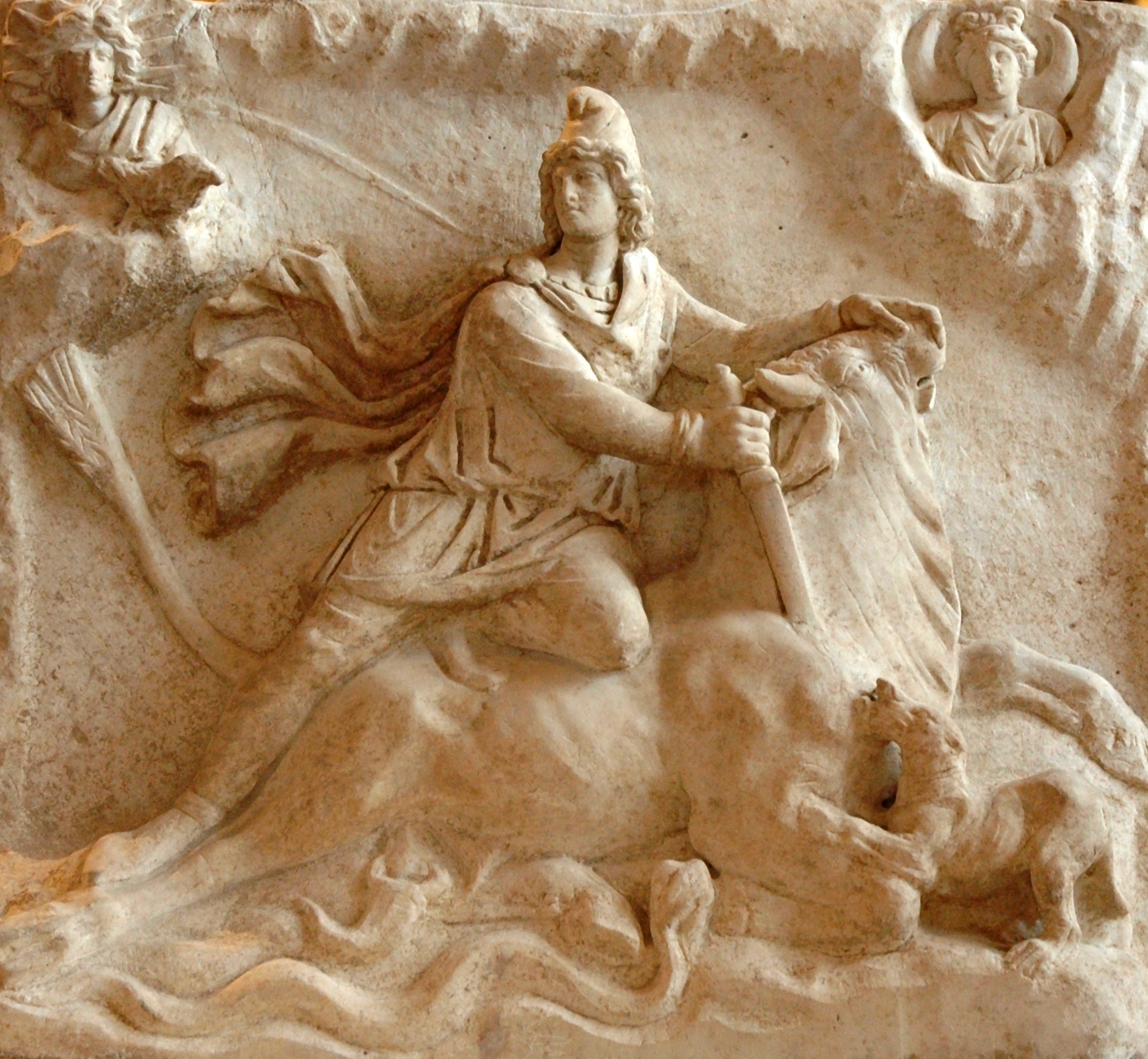
Tauroctony scene on side A of a two-sided Roman bas-relief. 2nd or 3rd century, found at Fiano Romano, near Rome, now on display in the Louvre. Götz König discusses the origin and roots of some “Iranian words” in Mithraism under the Roman Empire from linguistic and philological point of view . Begining with the question of “Mithra” or “Mithras”, he addresses the history of scholarship regarding of “Mithraic Studies” connected with ancient Iranian studies. Other sub-chapters of his article is dedicated to analytical investigation of some Iranian linguistic materials, namely the greeting nama, the terms sebesio and nabarze, as well as the divine names Arimanius, Cautēs/Cautopatēs/ ˚is, Atar, Ōromazdēs and Miθra and also the liturgical term amara.About the Author:Götz König is a scholar of the Ancient and Middle Iranian Studies and presently the substitute head of the Institute of Iranian Studies, Freie Universität Berlin.Re-establishment of Achaemenid History
Imanpour, Mohammad-Taqi. 2015. Re-establishment of Achaemenid History and its Development in the Nineteenth and Twentieth Centuries. Iranian Studies. 48(4), 515-530.
Iranians were aware of Sasanian history through traditional historical writings, but they knew nothing about Achaemenid history. Following European travelers to Persia from the fifteenth century, who were well prepared by reading the classical and biblical texts, Persepolis and Pasargadae were rediscovered and Achaemenid history re-established in the nineteenth century. The rise of Reza Khan to power and his grand emphasis on nationalism and ancient Iran that characterized his reign also left a deeper impact on Achaemenid studies in this period. In this paper the re-establishment of Achaemenid history and its development in nineteenth and twentieth centuries are discussed and reviewed.
Mohammad-Taqi Imanpour is Associate Professor of Ancient History of Iran at Ferdowsi University of Masshad, Iran.
The Susa Marriages
Van Oppen De Ruiter, Branko F. 2014. The Susa Marriages: A Historiographical Note. Ancient Society. 44, 25-41.
The Persian and Median noble women whom Alexander married to his Greek and Macedonian companions at Susa were all repudiated shortly after his death — so common opinion would have it. The present note aims to dispel this notion and to argue instead that Alexander’s Successors had no reason to abandon their Asiatic wives — even if they did eventually marry other women. If the Susan brides failed to make their presence in recorded history, that would be because ancient authors found nothing worth mentioning in their subsequent careers. Underlying modern assumptions, moreover, we will find misleading believes such as that the Macedonians were serially monogamous and that they resented their foreign wives. This article may thus serve as a warning about the intricacies of (early-) Hellenistic marital practices.
 Proto-Indo-European Lexicon