• Roman ‘Soldatenkaiser’ on the Triumphal Rock Reliefs of Shāpūr I

    Shavarebi, Ehsan. 2015. Roman ‘Soldatenkaiser’ on the Triumphal Rock Reliefs of Shāpūr I – A ReassessmentHISTORIA I ŚWIAT 4, 47-63.

    Five rock reliefs surviving in Persis/Fārs province in southern Iran represent the victories of Shāpūr I (241–272 AD), the second Sasanian King of Kings (Šāhānšāh), over the Roman Empire. The three Roman Emperors depicted on these reliefs have traditionally been identified as Gordian III (238–244), Philip I – known as ‘the Arab’ – (244–249) and Valerian I (253–260). From the 1960s onward, new interpretations are presented. In the most recent of these, Uranius Antoninus (253/254) is recognised on three of Shāpūr’s triumphal reliefs. The present paper aims to re-examine these new hypotheses by considering numismatic materials, including a unique gold coin of Shāpūr which bears an image of the same topic accompanying a legend on its reverse.

  • Central Asia and the Persianate World

    Peacock, Andrew C. S. & D. G. Tor (eds.). 2015. Medieval Central Asia and the Persianate world: Iranian tradition and Islamic civilisation. (I.B.Tauris & BIPS Persian Studies Series 7). London: I.B.Tauris.

    From the political dissolution of the Abbasid Caliphate in the mid-ninth century to the beginning of the thirteenth century, the Persianate dynasties of Islamic Central Asia constituted the political and military stronghold of Sunni Islam. It was in this region, historically known as Khurasan and Transoxiana, that many of the important religious and cultural developments of Islamic civilisation took place.

    The region first gave rise to the Abbasid Revolution, provided the troops for its success, and supplied the military slaves and auxiliaries that led to its political dissolution. From the second part of the ninth century and for the ensuing 400 years, the Sunni Persianate dynasties formed the mainstay of Islamic military might over the Islamic heartland, from India to Egypt.

    The period was also characterised by the cultural dominance of the Persian-speaking court, bringing about the acceptance of classical Persian as the second primary Islamic language of high culture. It produced the writing of many of Islamic civilisation’s greatest works of poetry, philosophy, biography, history, belles-lettres and religion, in both Arabic and Persian. This volume explores the origins and nature of this cultural and political authority and sheds light on one of the most formative yet unexplored eras of Islamic history.

    About the Editors:

    A.C.S. Peacock is Lecturer in Middle Eastern History at the University of St Andrews.

    D.G. Tor is Assistant Professor of Medieval Middle Eastern History at the University of Notre Dame.

  • Sasanian glassware

    Sasanian glassSimpson, St John. 2015. Sasanian glassware from Mesopotamia, Gilan, and the Caucasus. Journal of Glass Studies 57. 77–96.

    This paper was presented at The Corning Museum of Glass in March 2014 as part of the symposium dedicated to the memory of the late David Whitehouse and entitled “A Life in Archaeology and Glass: Honoring David Whitehouse (1941-2013)”. It is now published in the Journal of Glass Studies (57), 2015. The subject is a first attempt to understand the role of Sasanian glass in the Caucasus and suggest this is the source of much of the imported Sasanian glass reportedly found in graves in north-west Iran.

  • Syriac into Middle Iranian

    Detail from the Manuscript Chaldean Cathedral of Mardin (CCM) 13, f. 120r

    Barbati, Chiara. 2015. Syriac into Middle Iranian: A Translation Studies Approach to Sogdian and Pahlavi Manuscripts within the Church of the East. Open Linguistics 1(1). 444–457.

    Based on a corpus coming from the Turfan oasis (in present-day Xinjiang, People’s Republic of China) and consisting of Christian Middle Iranian literature in several languages (Middle Persian, Syriac and Sogdian) and scripts (East Syriac, Pahlavi and secular Sogdian), the present paper is aimed at identifying and outlining the translation techniques for the transmission of religious knowledge, based on a literary tradition as well as on a manuscript tradition, from one context to another. The religious knowledge is that which belongs to the “Church of the East” and which is written in its official liturgical language, i.e. Syriac in East Syriac script. The general context is that of the missionary activities of the “Church of the East” along the Silk road between late Antiquity and early Middle Age. The particular context is that of the converted Iranian communities.
    About the Author:
    Chiara Barbati (PhD 2009) is a scholar of Ancient and Middle Iranian languages in the Institute of Iranian Studies, Austrian Academy of Sciences, Vienna (ÖAW).
  • A new look at the Roman Empire of the fourth century

    Dijkstra, Roald ,  Sanne van Poppel & Daniëlle Slootjes (eds.). 2015. East and West in the Roman Empire of the fourth century. An end to unity? Brill.
    East and West in the Roman Empire of the Fourth Century examines the (dis)unity of the Roman Empire in the fourth century from different angles, in order to offer a broad perspective on the topic and avoid an overvaluation of the political division of the empire in 395.
    After a methodological key-paper on the concepts of unity, the other contributors elaborate on these notions from various geo-political perspectives: the role of the army and taxation, geographical perspectives, the unity of the Church and the perception of the divisio regni of 364. Four case-studies follow, illuminating the role of concordia apostolorum, antique sports, eunuchs and the poet Prudentius on the late antique view of the Empire. Despite developments to the contrary, it appears that the Roman Empire remained (to be viewed as) a unity in all strata of society.

    (more…)

  • The Persian Empire in England

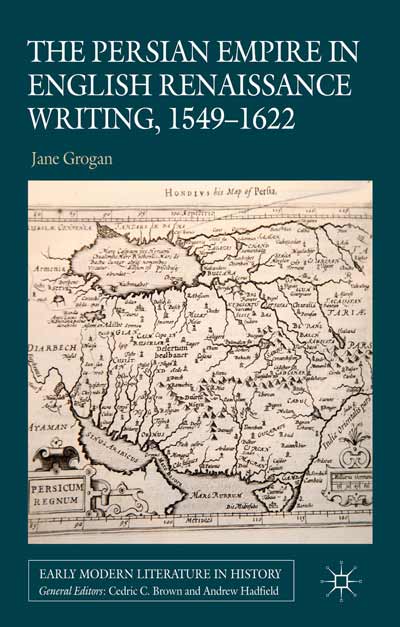
    Grogan, Jane. 2014. The Persian empire in English Renaissance writing, 1549 – 1622. (Early Modern Literature in History). Basingstoke: Palgrave Macmillan.
    The Persian Empire in English Renaissance Writing, 1549-1622 studies the conception of Persia in the literary, political and pedagogic writings of Renaissance England and Britain. It argues that writers of all kinds debated the means and merits of English empire through their intellectual engagement with the ancient Persian empire. It studies the reception of Xenophon’s Cyropaedia and the Histories of Herodotus, the bedrock of English conceptions of Persia and the Persian empire, in plays, poetry and political thought. Covering the period from the beginnings of Anglo-Persian relations under the auspices of the Muscovy Company in the 1560s and 1570s to the first Anglo-Persian military alliance in 1622, it traces the changing conception and uses of Persia – both Islamic and ancient – in the English literary and political imaginary, and demonstrates the contemporary uses of an idealized image of Persia rooted in the classical legacy.
    Table of Contents:
    • Introduction: Reading Persia in Renaissance England
    • Classical Persia: Making Kings and Empires
    • Romance Persia: ‘Nourse of Pompous Pride’
    • Staging Persia: ‘To ride in triumph through Persepolis’
    • Sherley Persia: ‘Agible things’
    • Epilogue: Ormuz

    About the Author:

    Jane Grogan is a Lecturer in Renaissance Literature at the School of English, Drama and Film at University College Dublin, Ireland.

  • The deconstruction of the Silk Road

    de la Vaissière, Etienne. 2014. Trans-asian trade or the Silk Road deconstructed. In Neal, Larry & Jeffrey Williamson (eds.), The Cambridge history of capitalism. Volume 1. The rise of capitalism: From ancient origins to 1848, 101–124. Cambridge University Press.

    The first volume of The Cambridge History of Capitalism provides a comprehensive account of the evolution of capitalism from its earliest beginnings. Starting with its distant origins in ancient Babylon, successive chapters trace progression up to the ‘Promised Land’ of capitalism in America. Adopting a wide geographical coverage and comparative perspective, the international team of authors discuss the contributions of Greek, Roman, and Asian civilizations to the development of capitalism, as well as the Chinese, Indian and Arab empires. They determine what features of modern capitalism were present at each time and place, and why the various precursors of capitalism did not survive. Looking at the eventual success of medieval Europe and the examples of city-states in northern Italy and the Low Countries, the authors address how British mercantilism led to European imitations and American successes, and ultimately, how capitalism became global.

  • Indo-Persian State Secretary

    Kinra, Rajeev. 2015. Writing self, writing empire: Chandar Bhan Brahman and the cultural world of the Indo-Persian state secretary. (South Asia across the Disciplines). Oakland, California: University of California Press.


    Writing Self, Writing Empire examines the life, career, and writings of the Mughal state secretary, or munshi, Chandar Bhan Brahman (d. ca. 1670), one of the great Indo-Persian poets and prose stylists of early modern South Asia. Chandar Bhan’s life spanned the reigns of four emperors: Akbar (1556–1605), Jahangir (1605–1627), Shah Jahan (1628–1658), and Aurangzeb ‘Alamgir (1658–1707), the last of the “Great Mughals” whose courts dominated the culture and politics of the subcontinent at the height of the empire’s power, territorial reach, and global influence.

    Chandar Bhan was a high-caste Hindu who worked for a series of Muslim monarchs and other officials, forming powerful friendships along the way; his experience bears vivid testimony to the pluralistic atmosphere of the Mughal court, particularly during the reign of Shah Jahan, the celebrated builder of the Taj Mahal. But his widely circulated and emulated works also touch on a range of topics central to our understanding of the court’s literary, mystical, administrative, and ethical cultures, while his letters and autobiographical writings provide tantalizing examples of early modern Indo-Persian modes of self-fashioning. Chandar Bhan’s oeuvre is a valuable window onto a crucial, though surprisingly neglected, period of Mughal cultural and political history.

    You can download* and read the book here.

    (more…)

  • Religious Appropriation of National Symbols in Iran: Searching for Cyrus the Great

    Merhavy, Menahem. 2015. Religious Appropriation of National Symbols in Iran: Searching for Cyrus the GreatIranian Studies. 48(6), 933-948.

    In this article I examine the debate over the character of Cyrus the Great in Iran during the last four decades, using it as a prism to view the struggle over the desired balance between religious and ethnic components of Iranian identity. Heated polemics over the historical figure of Cyrus and his legacy reveal undercurrents of Iranian identity dilemmas as well as different and conflicting views of Iranian identity. Beyond a mere historical or religious controversy, the debate over the “right” memory of Cyrus presents an interesting case of shifting emphasis on identity and sources of political inspiration in Iranian society from the late 1960s to the present. Moreover, putting the debate over the ancient king in perspective, there emerges a wider picture of religious adaptation and embrace of what once seemed pagan or secular.

  • Ethics of War and Peace in the Shahnameh of Ferdowsi

    Mahalati, Mohammad Jafar Amir. 2015. Ethics of War and Peace in the Shahnameh of FerdowsiIranian Studies. 48(6), 905-931.


    This article provides an overview of the ethics of war and peace in the most important and normatively influential work of epic literature known in the eastern lands of Islam, namely the shahnameh of Ferdowsi (d. 1020 CE). As one of the greatest sources of the Iranian cultural identity for over a millennium, Shahnameh (lit. The book of kings) defines normative ideals in the ethics of war and peace within narratives that connect the ancient history of Iran to its mythical eras and in effect to both the medieval time of the epic’s authorship and modern Iranian identity. By identifying limits, standards and legitimacy for war and peace in Shahnameh, this article aims to facilitate an Iranian contribution to the global literature and practice on peacemaking that has deep roots in the Islamo-Persian tradition.