• Representation of Aphrodite and Eros

    Representation of Aphrodite and Eros

    Moradi, Yousef & Almut Hintze. 2025. Representation of Aphrodite and Eros on Sasanian clay bullae: Evidence from the fire temple of Ādur Gušnasp at Takht-e Solaymān. Iranian Studies 1–31.

    This article examines five Sasanian bullae from the fire temple of Ādur Gušnasp with seal impressions depicting Aphrodite and Eros, and Aphrodite Anadyomene. It is argued that the original seal with Aphrodite and Eros likely dates from the late 1st century BCE to the early 1st century CE, reused between the 5th–7th centuries CE, while the Aphrodite Anadyomene seal is from the 2nd or 3rd century CE. Contextualizing these findings within Graeco-Roman and Iranian cultures, this article explores reinterpretations of Graeco-Roman iconography for both Zoroastrian and non-Zoroastrian audiences, as well as highlights that bullae with concave impressions of cylindrically curved objects on the reverse had once been attached to vessels, not just documents. Additionally, this article also discusses other sealings on the new bullae, some with Middle Persian inscriptions, identifying a mgw (priest) and an astrologer, providing the first attestation of the word axtar (constellation) on a Sasanian seal.

    Abstract
  • The Frontier Pushes Back

    The Frontier Pushes Back

    Garosi, Eugenio. 2025. The frontier pushes back: From local languages to imperial substrate(s) in scribal practices in 8th-century Central Asia. Iranian Studies FirstView. 1–15.

    This article draws on documentary texts from multilingual archives of early Islamic Central Asia to illustrate connections between the Arabic and Middle Iranian scribal world. Here, I contend that some lesser-known evidence from Sogdia contributes new elements to current debates on the contact between Arabic and Middle Iranian scribal traditions and provides a measure of “intensity” of Arab rule in the region more generally. In particular, ostraca from various Transoxanian administrative centers provide documentary confirmation that a class of biliterate Arabic-Sogdian scribes was active in the local bureaucracy as early as the mid-8th century. When viewed in dialogue with archives from coeval Iran and Iraq, the Transoxanian evidence helps lead to a more nuanced understanding of the so-called “Pahlavi diplomatic substrate” model.

    Abstract
  • Studia Iranica (52/1)

    Studia Iranica (52/1)

    The new issue of Studia Iranica is out (volume 52, issue 1). Here is the table of contents:

    • Maryam NOURZAEI, Thomas JÜGEL: On the Function of -ag in Middle Persian. Evaluative Marker or Derivational Suffix?
    • Parviz MOHEBBI: Sweet Orange and Mandarin in Iran and India (14th-19th Centuries) with a Glimpse at Europe
    • Piero DONNINI: Khayyām Literacy among Turkman Copyists
    • Willem FLOOR: Trois Rapports inédits de fonctionnaires belges concernant l’occupation ottomane (1907) et russe (1911) du territoire iranien
    • Comptes rendus

  • An Early Judeo-Persian Rabbanite Text

    An Early Judeo-Persian Rabbanite Text

    Bernard, Chams Benoît. 2025. An Early Judeo-Persian Rabbanite Text: Vat. Pers. 61, Its Linguistic Variety, Its Arabic Vocabulary, and the Targum Onqelos. Journal of Jewish Languages 1–55.

    Vat. Pers. 61, found in the Vatican library, is a Judeo-Persian translation of the Torah. It has been variously described as a 13th, 14th, or 15th century text. This study aims to more accurately pinpoint its age and establish whether it is a direct translation of the Masoretic Text or whether it is based on Targum Onqelos. Based on a limited corpus of this manuscript (the Decalogue and a few other verses), this study also provides a more detailed description of the language variety of the manuscript and discusses the Aramaic and Arabic loanwords found in it. The study concludes that Vat. Pers. 61 is largely based on Targum Onqelos, and the language of the text is found to be generally pre-Mongolian Early Judeo-Persian, which is rare for a religious Rabbanite text.

  • Authority, Assimilation and Afterlife of the Epilogue of Bīsotūn (DB 4:36–92)

    Authority, Assimilation and Afterlife of the Epilogue of Bīsotūn (DB 4:36–92)

    Barnea, Gad. 2025. Imitatio Dei, Imitatio Darii: Authority, Assimilation and Afterlife of the Epilogue of Bīsotūn (DB 4:36–92). Religions 16(5), 597.

    The Bīsotūn inscription of Darius I (DB) is a masterpiece of ancient literature containing descriptions of historical events, imperial propaganda, cultic statements, ethical instructions, wisdom insights, blessings and curses, and engagements with posterity. It was disseminated far and wide within the empire and left a lasting impression on the cultures with which it came into contact. However, a specific section of this royal inscription (DB 4:36–92), carefully crafted to address future audiences in the second person, stands out sharply from the rest of the text. This passage has made a striking, profound, and durable impression on future generations—which extended over the longue durée in both time and space. This article focuses on the decisive cultic theme undergirding DB in general and its fourth column in particular namely, the king’s profound sense of imitatio dei in the cosmic battle against “the Lie,” complemented by his appeal to an imitatio Darii by all future audiences of his words. The impact of this call can be traced in later literature: in a DB variant found at Elephantine and, most notably, a hitherto unknown exegetical legend found in Qumran, which seeks to explain this portion of DB through an Achaemenid court tale.

  • New Readings in Seven Middle Persian Documents

    New Readings in Seven Middle Persian Documents

    Asefi, Nima. 2025. New readings in seven Middle Persian documents from the archive of Hastijan with an edition of Berk. 19. Berkeley Working Papers in Middle Iranian Philology 3(5). 1-19.

    This article proposes new readings and interpretations for parts of seven Middle Persian documents first published by Dieter Weber, namely: Berk. 80, Berk. 95, Berk. 43B, Tehran B, LA1, Berk. 149, and Berlin 28. It also provides the editio princeps of Berk. 19.

    Abstract
  • Zoroastrian Conversations S02 E01

    Zoroastrian Conversations S02 E01

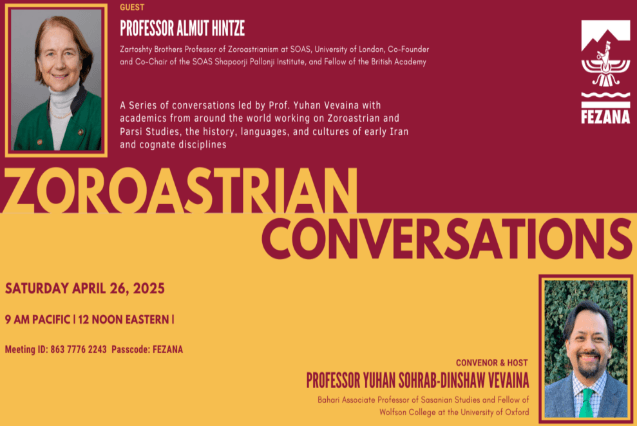
    Prof. Yuhan S.–D. Vevaina will open the first episode of the second season of ‘Zoroastrian Conversations’ with Prof. Almut Hintze, Zartoshty Brothers Professor of Zoroastrianism at SOAS, University of London, Co-Chair of the SOAS Shapoorji Pallonji Institute, and Fellow of the British Academy.

    Date:
    Saturday, 26 April 2025
    Time:
    9 AM Pacific | 12 Noon Eastern | 5 PM London | 9:30 PM Mumbai

    Zoom meeting ID: 863 7776 2243 Passcode: FEZANA.

    Zoom and other information: https://fezana.org/conversations/

  • The Achaemenid Persian Empire and its Non-Western Borderlands: A Change of Paradigm

    The Achaemenid Persian Empire and its Non-Western Borderlands: A Change of Paradigm

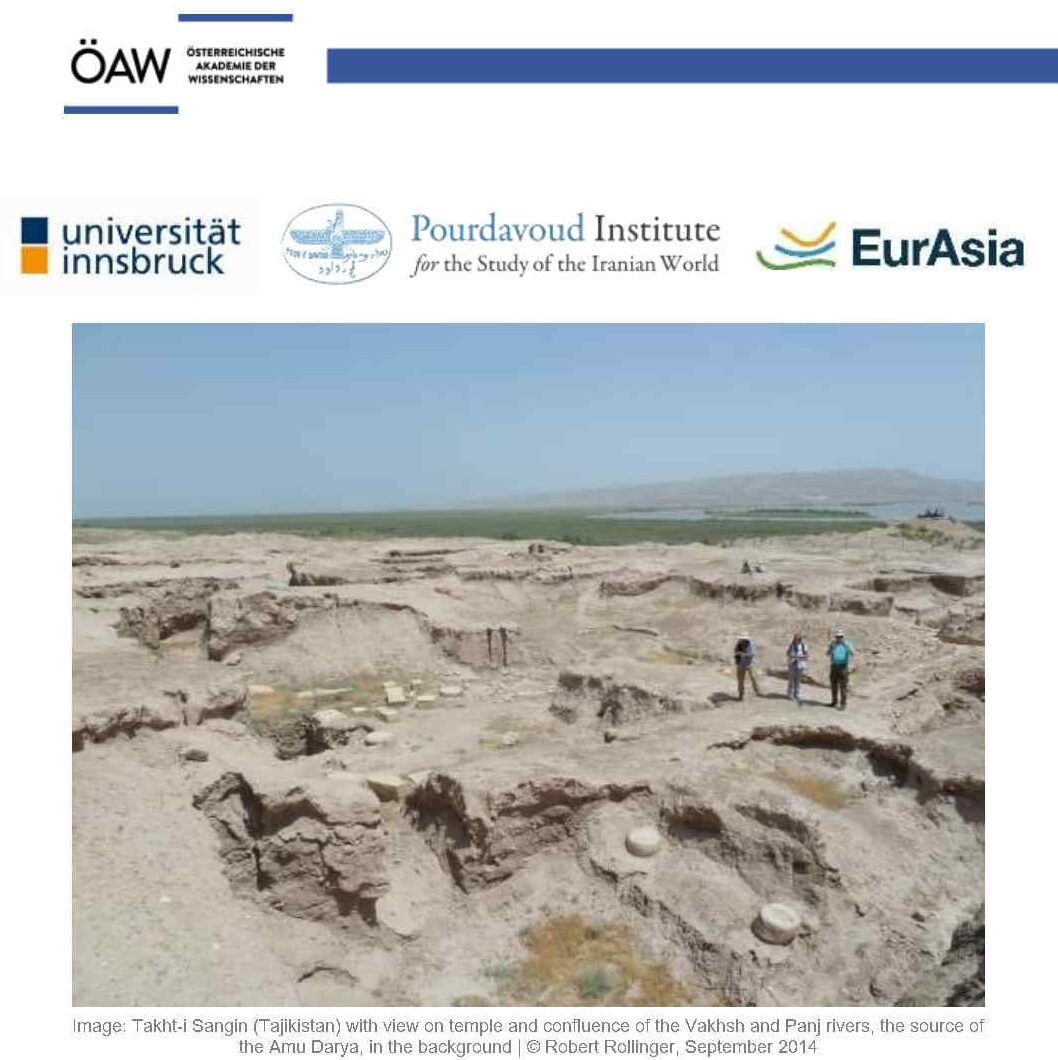
    The conference will once again centre on the Achaemenid Empire and those borderlands that research has only sporadically looked at so far: the Central Asian east, India and the Indian Ocean in the south-east, as well as the steppe regions in the north and north-east. The focus here is on interactions not only in spatial but also in temporal dimensions and thus on the systematic recording of innovations, breaks and continuities.

    Organized by Robert Rollinger

    Fri 21 November – Sat 22 November, 2025

    Innsbruck, Austria

    Ágnes-Heller-Haus (Innrain 52a)

    Program:

    Opening
    10:00-10:30 Welcome Address
    Brigitte Truschnegg (Innsbruck) | Dean of Studies, Faculty of Philosophy
    and History
    Robert Rollinger (Innsbruck) | Organizer

    Section 1
    Chair: Melanie Malzahn (Vienna)
    10:30-11:15 Formation of Frontier: New archaeological perspectives on nomadic-sedentary interaction between Lake Aral and Sogdiana (800-500 BCE)
    Sören Stark (New York)

    11:15-12:00 The Imperial State/Political Formation of the Achaemenids. Nomads, Frontiers and Empires, between Central Asia and the Steppes
    Bruno Genito (Naples)

    12:00-13:00 Lunch Break

    Section 2
    Chair: M. Rahim Shayegan (Los Angeles)
    13:00-13:45 Local Evolutions of Central Asian Polities during the Achaemenid Period
    Johanna Lhuillier (Lyon)

    13:45-14:30 The Northern Frontiers in History and Myth
    Anca Dan (Paris)

    14:30-15:00 Coffee Break

    Section 3
    Chair: Bernhard Palme (Vienna) & Suchandra Ghosh (Hyderabad)
    15:45-16:30 Persians in Northern Gandhara: An Achaemenid Mirage?
    Elisa Iori (Venice), co-authors Omar Coloru (Bari) & Luca Maria Olivieri (Venice)


    15:00-15:45 The Vine of the King: Monarchic Ideology between the Iranian and Indian Worlds
    Claudia Antonetti (Venice)


    16:30-17:00 Coffee Break

    Section 4
    Chair: Florian Schwarz (Vienna) & Josef Wiesehöfer (Kiel)
    17:00-17:45 Cultural Heritage as Political Negotiation on the Boundaries of the Achaemenid Empire
    Jenn Finn (Chicago)


    17:45-18:30 Alexander, India and Western Asia Minor: Imperial Borderlands in Comparison
    Julian Degen (Innsbruck)

    18:30 Buffet

    Saturday, Nov 22
    Section 5
    Chair: Nina Mirnig (Vienna) & Robin Coningham (Durham)
    09:30-10:15 The Mauryas and Achaemenids: Looking afresh at old Theories
    Upinder Singh (Sonipat)

    10:15-11:00 The Impact of Achaemenid Writing in India and the Linguistic Background to the Aramaic Ashoka Inscriptions
    Holger Gzella (Munich)


    11:00-11:30 Coffee Break

    Section 6
    Chair: Wu Xin (Bryn Mawr)
    11:30-12:15 A Kingdom of Clay (and Parchment): Tracing the Indus Province through Parsa Administration
    Gian Pietro Basello (Naples)


    12:15-13:00 How Persian was Chorasmia? Reassessing the Achaemenid Imprint in Northeastern Central Asia through Fieldwork
    Michele Minardi (Naples)


    13:00-14:00 Lunch Break


    Section 7
    Chair: Touraj Daryaee (Irvine)
    14:00-14:45 Connecting Centres and Borderlands: The Upper Satrapies as Hubs of Routes
    Hilmar Klinkott (Kiel)

    14:45-15:30 Revolt and Sedition in the Eastern Satrapies of the Achaemenid Empire: An Unsolvable Mystery?
    Orestis Belogiannis (Strasbourg)

    15:30-16:00 Coffee Break

    Section 8
    Chair: Kai Ruffing (Kassel)
    16:00-16:45 Persian Elites and the Achaemenid Northeast: Negotiating Power in the Borderlands
    Yazdan Safaee (Innsbruck)

    16:45-17:30 Interaction between Central Asia and the Achaemenid Empire
    Jan Tavernier (Louvain)

    17:30-18:00 Concluding Remarks | Robert Rollinger (Innsbruck)

    19:00 Conference Dinner

  • Between the Tigris and Zagros

    Between the Tigris and Zagros

    Peyronel, Luca. 2025. Entre le Tigre et le Zagros. Les recherches archéologiques de la mission italienne de l’Université de Milan dans la plaine d’Erbil (Kurdistan irakien). ArchéOrient – Le Blog.

    About ArchéOrient – Le Blog

    ArchéOrient-Le Blog is run by members of the « Archéorient » research centre of the University of Lyon 2 (CNRS/University Lyon 2), based at the Maison de l’Orient et de la Méditerranée (Lyon, France). The blog aims to promote exchanges and to give greater visibility to new scientific information in the field of archaeology and history of societies and environments during the Holocene in the Mediterranean, the Near and Middle East, the Caucasus and Central Asia, and more recently, the Horn of Africa and West Africa. This Blog is open to all representatives of the international scientific community and welcomes contributions in French and English.

  • Summer School of Oriental Languages

    Summer School of Oriental Languages

    The Summer School in Oriental Languages is a unique opportunity to study languages and scripts that are often described as rare, even though they are spoken or have been spoken by millions of speakers, in the form of major and minor courses. This summer school offers top-level teaching and the most recent research findings in Oriental languages and literature, with ECTS credits awarded upon validation.

    From the website

    The Summer School of Oriental Languages is organised by the University of Lausanne and will be held at the Venice International University (Italy), from 10–19 July 2025.

    For more information about the programme, registration, and ECTS requirements visit the website. The deadline for registration is 30 May 2025.