• The Bible as a Judeo-Persian Epic

    Moreen 2016Moreen, Vera Basch. 2016. The Bible as a Judeo-Persian epic: An illustrated manuscript of ʿImrānī’s Fatḥ-Nāma. Jerusalem: Ben Zvi Institute for the Study of Jewish Communities in the East.
    Shervin Farridnejad writes:
    ʿImrānī, one of the great Judeo-Persian poets, was probably born in Isfahan in 1454 and died in Kashan after 1536. Inspired by Shāhīn, the other great JP poet, ʿImrānī’s works concentrate on the post-Mosaic era from Joshua to the period of David and Solomon. Among his 12 poetic works, Fatḥ-Nāma “The Book of the Conquest” is his first and remains one of his important works.  He began the composition that comprises approximately ten thousand couplets in 1474. The content of this masnavī (narrative poem in rhyming couplets) deals with the legend of the conquest of the Holy Land by Joshua as well as events from  Joshua to the reign of Solomon.
  • The Archaeology of Kurdistan

    Kopanias, Konstantinos & John MacGinnis (eds.). 2016. The Archaeology of the Kurdistan Region of Iraq and Adjacent Regions.  Archaeopress Publishing Ltd.

    Kurdistan is home to some of the most important archaeological sites in the world, ranging from the Stone Age to the most recent past. While in earlier decades this exceptional potential did not receive the degree of attention which it merited, the past ten years has seen a burgeoning of cutting edge archaeological field projects across the region. This volume, the outcome of a conference held at the University of Athens in November 2013, presents the results of this research. For the first time the archaeological inventory of the region is being systematically documented, laying the foundations for intensive study of the region’s settlement history. At the same time the area has seen a flourishing of excavations investigating every phase of human occupation. Together these endeavours are generating basic new data which is leading to a new understanding of the arrival of mankind, the development of agriculture, the emergence of cities, the evolution of complex societies and the forging of the great empires in this crucible of mankind.

    See here the ToC of this book.

    About the Editors:
    Dr. Konstantinos Kopanias studied at the National and Kapodistrian University of Athens, Paris- Lodron University of Salzburg and the Eberhard Karls University of Tübingen. He worked as a postdoctoral researcher at the University of Athens, as adjunct faculty at the University of Crete and as an Allgemeiner Referent at the German Archaeological Institute in Athens.

    Dr. John MacGinnis did both his degree and his PhD at Cambridge University and is a specialist in the archaeology and inscriptions of ancient Babylonia and Assyria, on which he has published extensively. He has worked on sites across the middle east, including Cyprus, Egypt, Iraq, Syria, Sudan and Turkey.

  • Cultural Transfer along the Silk Road

    Espagne, Michel, Svetlana Gorshenina, Frantz Grenet, Sahin Mustafayev & Claude Rapin (eds.). 2016. Asie centrale: transferts culturels le long de la route de la soie. Paris: Vendémiaire.
    This collection of essays is the result of the International Symposium “Cultural Transfers in Central Asia: before, during and after the Silk Road” (Conference Program), held in Samarkand on 12–14 September 2013. Expanding the original Eurocentric orientation in a broad chronological and interdisciplinary perspective and involving new materials, the participants have attempted to test the methodological approach of the “cultural transfers” and the effectiveness of their basic concepts (ways of travel, guides, translators, innovation, assimilation of “new” assignments, semantic shifts, etc.) in the Central Asian context. In these studies Central Asia includes mainly the post-Soviet space and its Central Asian neighbors like Siberia, Xinjiang, Afghanistan, Iran and Azerbaijan. The purpose of the collection is to determine the significance of the theory of the “cultural transfers” and, if possible, the range of its applications.
  • Sexual Desire in Jewish, Christian and Zoroastrian Ethics

    Reżā ʿAbbāsī (1570-1635). Deatil of Two Lovers (A.H. 1039 A.H./1630 A.D.)
    Reżā ʿAbbāsī (1570-1635). Deatil of Two Lovers (A.H. 1039 A.H./1630 A.D.)

    Kiel, Yishai. 2016. Dynamics of Sexual Desire: Babylonian Rabbinic Culture at the Crossroads of Christian and Zoroastrian Ethics. Journal for the Study of Judaism 47. 1–47.

    The article examines the inherently dialectical view of sexuality reflected in Babylonian rabbinic culture, which differentiates the sexual act, consisting of the indivisible elements of procreation and sexual gratification, from notions of sexual desire. On the one hand, the Babylonian Talmud accentuates the relative role of both male and female sexual gratification in the sexual act, but, on the other hand, it expresses a pessimistic view of the sexual urge, which is reified as part and parcel of the demonic realm. This dialectical perception is resolved in Babylonian rabbinic culture through a paradoxical mechanism that seeks to extinguish sexual desire via marital sex. The article situates different aspects of this distinctive construction of sexual desire in the context of contemporaneous Christian and Zoroastrian views. First, the Babylonian rabbinic mechanism is contextualized with the Pauline view of marital sex as a therapy for those “aflame with passion” (1 Cor 7:9) and its reception in patristic literature. Second, the Babylonian rabbinic dialectic of sex and desire is viewed in the light of a similar bifurcated perception evident in the Pahlavi tradition: while Zoroastrianism advocated full-fledged marital relationships from its very inception, an important strand in the Pahlavi tradition expresses an ambiguous view of sexual desire, which is linked in various ways to the demonic sphere.
    The article is here online available .
  • Defining All-Israel in Chronicles : Multi-Levelled Identity Negotiation in Late Persian-Period Yehud

    Jonker, Louis. C. 2016. Defining All-Israel in Chronicles : Multi-Levelled Identity Negotiation in Late Persian-Period Yehud. Forschungen zum Alten Testament 106. Tübingen. Mohr Siebeck.


    In this book, Louis C. Jonker considers more sophisticated and nuanced models for applying the heuristic lens of “identity” in the interpretation of the Hebrew Bible book of Chronicles. Not only does he investigate the potential and limitations of different sociological models for this purpose, but the author also provides a more nuanced analysis of the socio-historical context of origin of late Persian-period biblical literature by distinguishing between four levels of socio-historic existence in this period. It is shown that varying power relations were in operation on these different levels which contributed to a multi-levelled process of identity negotiation. Louis C. Jonker shows the value of the chosen methodological approach in his analysis of Chronicles, but also suggests that it holds potential for the investigation of other Hebrew Bible corpora.

    Louis C. Jonker Born 1962; BA, HonsBA, MA, BTh, LicTheol and DTh from University of Stellenbosch; since 2010 Professor in Old Testament at the University of Stellenbosch; Congress Secretary of the 2016 meeting of the International Organization for the Study of the Old Testament (IOSOT).


    Table of Contents.


  • Jerusalem in the Achaemenid Period

    Kim, Jieun. 2016. Jerusalem in the Achaemenid period. Peter Lang AG, Internationaler Verlag der Wissenschaften.

    This is the first book to explore the importance of agriculture in relation to the restoration of the Jerusalem temple in the Book of Haggai during the Achaemenid period. Scholars discussing the rebuilding of the temple have mainly focused on the political and social context. Additionally,the missions of Ezra and Nehemiah have been used as a basis for analysing the economy of postexilic Judah. This has, however, understated the wider socio-economic significance of the temple by disregarding the agricultural capacity of Judah.
    The Book of Haggai is primarily concerned with agriculture and the temple. This analysis of Haggai includes an examination of the temple’s reconstruction from a historical and economic point of view, with agriculture playing a central role. Archaeological records are examined and show that prized commodities such as olives and grapes were produced in and around Jerusalem in large quantities and exported all over theancient Near East.
    This book is intended to shed new light on the value of agriculture for the people of Judah and the whole imperial economy. It also presents a new interpretation of the Book of Haggai and a new perspective on the temple economy in Jerusalem.
    Jieun Kim finished her second PhD at the School of Divinity,  University of Edinburgh in November 2013. After receiving her first  PhD from Yonsei University, she taught for several years in Seoul as a lecturer and an assistant professor. She is currently an independent scholar and her next research project will focus on land ownership in the Books of Ezra and Nehemiah.
  • Central Asia and Iran: Greeks, Parthians, Kushans and Sasanians

    Dabrowa, Edward (ed.). 2016. Central Asia and Iran: Greeks, Parthians, Kushans and Sasanians (Electrum 22). Krakow: Jagiellonian University Press.

    This volume contains 12 studies on political, social, economic, and religious aspects of the history of Central Asia and Iran in the period from the fourth century B.C.E. to the fifth century C.E. by leading specialists in the field. They interpret and reconstructing the region’s past based on various kinds of evidence, including literary, archaeological, linguistic, and numismatic. Some papers present the findings of recent archaeological excavations in Old Nisa and Uzbekistan for the first time.

    Table of Contents

  • On the Explanation of Chess and Backgammon

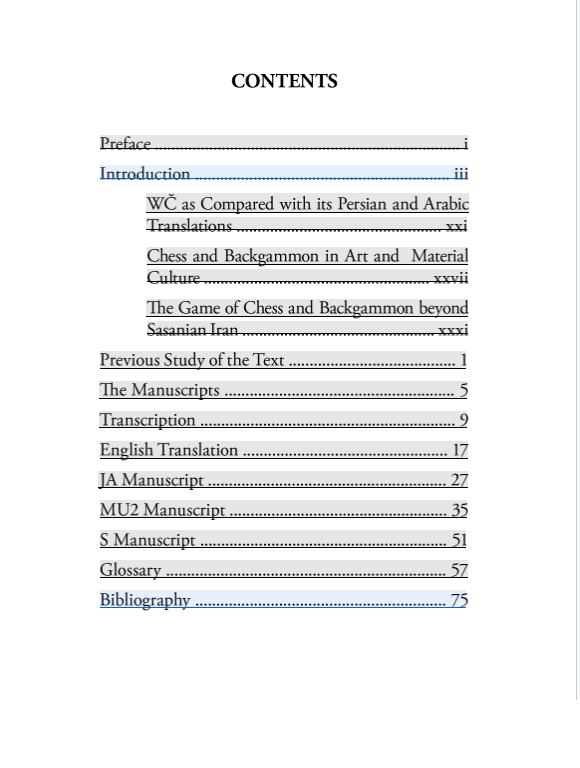
    Touraj, Daryaee. 2016. On the explanation of chess and backgammon: A Middle Persian text (Ancient Iran Series 2).  UCI Jordan Center for Persian Studies. H&S Media.

    The book is an edition of the earliest text in Middle Persian on the rules and views of the games of chess and backgammon, reported to be from the time of Khusro Anushirvan in the 6th CE.

    Table of Contents

  • The New Chronology of the Bronze Age Settlement of Tepe Hissar, Iran

    Gursan-Salzmann, Ayş. 2016.  The New Chronology of the Bronze Age Settlement of Tepe Hissar, Iran. Philadelphia. University of Pennsylvania Museum of Archaeology and Anthropology .

    Tepe Hissar is a large Bronze Age site in northeastern Iran notable for its uninterrupted occupational history from the fifth to the second millennium B.C.E. The quantity and elaborateness of its excavated artifacts and funerary customs position the site prominently as a cultural bridge between Mesopotamia and Central Asia. To address questions of synchronic and diachronic nature relating to the changing levels of socioeconomic complexity in the region and across the greater Near East, chronological clarity is required. While Erich Schmidt’s 1931-32 excavations for the Penn Museum established the historical framework at Tepe Hissar, it was Robert H. Dyson, Jr., and his team’s follow-up work in 1976 that presented a stratigraphically clearer sequence for the site with associated radiocarbon dates. Until now, however, a full study of the site’s ceramic assemblages has not been published.

    This monograph brings to final publication a stratigraphically based chronology for the Early Bronze Age settlement at Tepe Hissar. Based on a full study of the ceramic assemblages excavated from radiocarbon-dated occupational phases in 1976 by Dyson and his team, and linked to Schmidt’s earlier ceramic sequence that was derived from a large corpus of grave contents, a new chronological framework for Tepe Hissar and its region is established. This clarified sequence provides ample evidence for the nature of the evolution and the abandonment of the site, and its chronological correlations on the northern Iranian plateau, situating it in time and space between Turkmenistan and Bactria on the one hand and Mesopotamia on the other.

    Ayşe Gürsan-Salzmann, a graduate of Robert College (Istanbul) and Ball State University, earned her M.A. and Ph.D. degrees in anthropology from the University of Pennsylvania. She is Senior Consulting Scholar in the Mediterranean Section of the Penn Museum and the Deputy Director of the Gordion Archaeological Project.

    Table of Contents

  • Irano-Talmudica

    persian-talmud-1423640093In the recently published issue of the Jewish Quarterly Review, four contributions explore different aspects of Talmudic scholarship in its late antique Iranian context (Irano-Talmudica) . The study of the Babylonian Talmud, or Bavli, a crucial part of the Jewish canon since the Middle Ages, has gained fresh and advanced perspectives over the last two decades. In part, this new approach is the result of the scholars’ insights into the Talmud’s Iranian background as a text reflecting the inter-cultural dynamics between the Jews and their Zoroastrian neighbours under the Sasanian Empire.


    Brody, Robert. 2016. Irano-Talmudica: The New Parallelomania? Jewish Quarterly Review 106(2). 209–232.

    Among Talmudists, there has been an explosion of interest over the last fifteen or twenty years in exploring the significance of the Talmud’s Iranian background for the interpretation (on several levels) of the Bavli. This work, spearheaded by Yaakov Elman, represents an attempt to redress the imbalance between the contextual study of the Babylonian Talmud and of Palestinian rabbinic literature. Students of Palestinian rabbinic works have made extensive use for well over a century of literary and other sources of knowledge concerning the late ancient Greek-speaking world in order to illuminate numerous facets of the literature produced by Palestinian rabbis in this period; by comparison, little has been done on the Babylonian/Iranian front. There are of course objective reasons for this disparity—including the much more limited source material available for the study of Sasanian Iraq—but Elman and those he has inspired have been doing their best to overcome these obstacles.

    Secunda, Shai. 2016. “This, but Also That”: Historical, Methodological, and Theoretical Reflections on Irano-Talmudica. Jewish Quarterly Review 106(2). 233–241.

    Some fifteen years ago, Yaakov Elman and a handful of young talmudists embarked on a major effort to correct a scholarly lacuna, namely, the dearth of talmudic studies that take the Bavli’s Sasanian context seriously into account. The history of scholarship has been recounted time and again, but the primary point bears repeating. Unlike researchers of Palestinian rabbinic literature who have consistently aspired to read rabbinic texts alongside classical literature and the archaeological record of Roman Palestine, for decades most scholars of the Babylonian Talmud did not so much as glance at Sasanian literary or material remains. Working against the clock, as it were, scholars of Irano-Talmudica have already made important advances by laying the groundwork for a contextualized study of talmudic law in its Sasanian milieu, offering new readings of talmudic narrative and myth in light of Iranian parallels, and suggesting novel understandings of Babylonian rabbinic ritual against neighboring non-Jewish ritual systems.

    Kalmin, Richard. 2016. The Bavli, the Roman East, and Mesopotamian Christianity. Jewish Quarterly Review 106(2). 242–247.

    Scholarly study of the Persian nexus of the Bavli began approximately a century and a half ago, but this study has entered a new stage of methodological rigor and sophistication during the past two decades. In the tremendous enthusiasm for the study of Bavli in its Persian context, however, some scholars have forgotten the obvious point that it is essential to use all of the cultural contexts at our disposal. The ensuing discussion suggests a few areas where that study is already ongoing and has yielded important results and would greatly benefit from additional research. One very promising area of comparative study of the Bavli is the literature of the Mesopotamian neighbors of the Babylonian rabbis, the Syriac-speaking Christians.

    Gross, Simcha M. 2016. Irano-Talmudica and Beyond: Next Steps in the Contextualization of the Babylonian Talmud. Jewish Quarterly Review 106(2). 248–252.

    Traditional scholarly study of the Babylonian Talmud has largely ignored the work’s historical context. The underlying presumption of most scholarship was that the Bavli was the product of a reified rabbinic culture, with Palestinian rabbinic literature as its antecedent and geonic literature as its successor, and that the Babylonian rabbis were themselves an ideologically and culturally insular elite. In recent years, however, a school of scholarship, sometimes called “Irano-Talmudica,” sought to give historical context to the Bavli and its rabbis, challenging the presumed insularity of the Babylonian rabbis. This has proved to be a critical turn in the field. This drive to contextualize the Babylonian Talmud has begun to emerge from its infancy, raising a number of new questions: What are the most apt and fruitful sources and materials? Which methodology is most promising? What is the potential payoff for scholars investigating these sources? The answer to any one of these questions has an impact on the others.