• Le Yasna Haptaŋhāiti

    Le Yasna Haptaŋhāiti

    Kellens, Jean. 2025. Le Yasna Haptaŋhāiti (Publications d’Etudes Indo-Iraniennes 2). Strasbourg: Université de Strasbourg.

    Inséré entre la première la deuxième Gâthâ, le Yasna Haptaŋhāiti, rédigé en vieil-avestique, occupe les chapitres 35 à 41 du Yasna. Ce texte fait lobjet dune traduction commentée dans le présent ouvrage.

    Résumé
  • The realm of the Kuru

    The realm of the Kuru

    Witzel, Michael. 2025. The realm of the Kuru: Origins and development of the first state in India. Electronic Journal of Vedic Studies 30(2). 1–165.

    Major old-new article by Michael Witzel with references and discussions of the relevant Iranian traditions. Open access.

    This issue of EJVS contains the long version of my article “Early Sanskritization. Origins and development of the Kuru state” of 1997, published in a volume edited by B. Kölver. At that time, I had merely presented the outline and results of the longer paper published here. After 1997, I have added some data, over the next few years,to the unpublished long version. I have mow [sic] minimally updated it, for example by important genetic aDNA data about the first immigration of steppe people to India (Swat) around 1250 BCE. However, I could not find the time to thoroughly update the paper and therefore present it here as is, in the hope that it will be useful to colleagues.

    As the current version includes many sections of the 1997 paper, some repetitions and overlaps will occur in the bulk of the text, for which I beg the reader’s indulgence.

    Preface
  • WZO’s Annual Seminar 2025

    Three lectures as part of the World Zoroastrian Organisation’s annual seminar.

    • Alexandra Buhler: Relations between Zoroastrians in India & Iran during the late Qajar period
    • Khodadad Rezakhani: The Heart of the Empire: Ctesiphon & DilĒrānšahr in the Sasanian World
    • Vesta Sarkhosh Curtis: Royal Splendour: the art of the Sasanian kings
  • Iranica Antiqua

    Iranica Antiqua

    Volume 59 of Iranica Antiqua has been published:

    • 1 – 24 – Against Cuneiform: The Dawn of Writing in Iran
      DANESHMAND, Parsa
      abstract details
    • 25 – 33 – Cylinder Seals in the National Museum of Iran
      BAGHBIDI, Bahar Rezai, MIRGHADERI, Mohammad Amin, D’ORAZIO, Claudia
      abstract details
    • 35 – 62 – Petrographic and XRF Analysis of the Ceramics of the Achaemenid Period in the Ramhormoz Plain, Southwestern Iran
      AFSHARI, Leila, AKARSU, Rabia
      abstract details
    • 63 – 82 – In Search of the Plains of Gaugamela
      SZYPUŁA, Bartłomiej, GŁOGOWSKI, Piotr, MARCIAK, Michał
      abstract details
    • 83 – 108 – The Statue of the ‘Prince’ of Shami: Parthian Nobleman, Local Ruler or Arsacid King of Kings?
      SINISI, Fabrizio
      abstract details
    • 109 – 128 – Why the Title rāmšahr for Yazdgerd I?
      JALILIAN, Shahram
      abstract details
    • 129 – 151 – Between Dome and Eyvān: Building Techniques, Function, and Symbolism of the Kushk-e Ardashir in Bozpar (Bushehr, Iran)
      LABISI, Guiseppe
      abstract details
    • 153 – 193 – The Dynamics of Anthropogenic Landscape Evolution in the Bozpar Valley (South Iran). A Case Study for Small-Scale Hydraulic Engineering in Antiquity
      RASHIDIAN, Elnaz
      abstract details
    • 195 – 218 – Passing through the Northwestern Heights of the Alvand Mountains: Restoring the Caravan Routes between Asadabad and Hamadan in Different Historical Periods
      REZAEI, Iraj
      abstract details
  • Iran and the Caucasus 29 (2)

    Iran and the Caucasus 29 (2)

    Volume 29, issue 2, of Iran and the Caucasus has now been published. While all articles relate to the focus of BiblioIranica, two stand particularly out:

    This article is open access.

    Ever since its preliminary publication, Xerxes’ “Daiva” inscription (XPh) has been seen as an important and unique witness to early Achaemenid Mazdean orthopraxy and cultic propaganda. It is an essential document that captures a major reform in Achaemenid-Zoroastrian cult patterns and its relationship to cognate cults. This royal inscription describes a liturgical reform or, at least, the enforcement of such a reform, targeting and condemning the cult of the daivā—a designation describing competing deities. The key to decoding this reform hinges upon an obscure expression that appears thrice in the document—normalized as a-r-t-a-c-a : b-r-z-m-n-i-y—the meaning of which is yet to be fully understood. In this article, I revisit and analyze the various approaches previously taken to interpreting this remarkable syntagm and provide a methodological approach and a broader and more comprehensive translation which is presented in a more holistic comparative context—including onomastic, epigraphic and archeological data.

    Abstract

    There is no unified Yezidi source that would give a complete understanding of sins and retribution in this tradition. The article is an attempt to identify a number of sins and the expected retributions for them, based on the analysis of the text A’lī Šērē Xwadē Āxiratēdā—“ ‘Ali, the Lion of God in the Hereafter”. The text, which can be attributed to the apologetic genre, tells about ‘Ali’s journey to the afterlife and the opportunity he was given to see the punishments of sinners, in order to pass on this information to people in the “world of light”, i.e. the material world.

    Abstract
  • Across the deserts of Iran

    Across the deserts of Iran

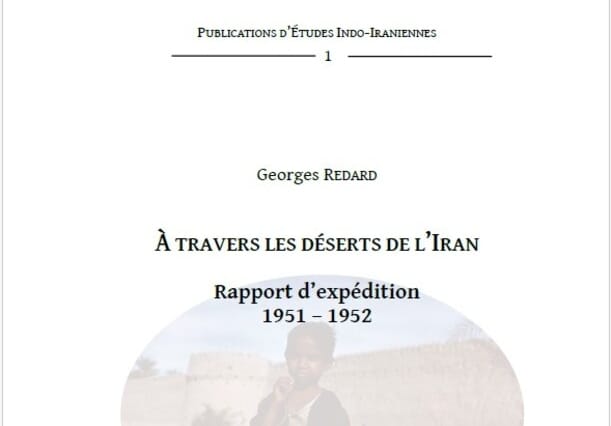
    Céline Redard, Université de Strasbourg, has established a new series entitled Publications d’Etudes indo-iraniennes. The first book in the series has already been published and two more volumes are announced. This promises to be an exciting series. The books of the series will be open access.

    Redard, Georges. 2025. A travers les déserts de l’Iran. Rapport d’expédition 1951 – 1952 (Publications d’Etudes Indo-Iraniennes 1). Edidetd by Céline Redard. Strasbourg: Université de Strasbourg.

    Le présent ouvrage contient le récit de voyage rédigé par Georges Redard (1922-2005) lors de sa première mission en Iran, de fin 1951 à début 1952, en compagnie de Murray Barr et Richard Nelson Frye. Le lecteur les suivra ainsi à travers les déserts de l’Iran pendant 49 jours, et prendra connaissance de leurs rencontres et de leurs découvertes, mais aussi de leurs ennuis mécaniques ou techniques. Autant d’anecdotes qui lui permettront de s’immerger dans une autre époque, une autre culture et d’entreprendre un voyage scientifique à leurs côtés.

    Résumé

    Georges Redard (1922-2005) était un linguiste suisse, qui s’est notamment intéressé aux langues iraniennes anciennes ainsi que modernes. Il fut professeur à l’Université de Neuchâtel sur la chaire de Grammaire comparée, puis à l’Université de Berne sur la chaire de linguistique indo-européenne.

  • The Zoroastrian Manuscripts of the Matenadaran

    The Zoroastrian Manuscripts of the Matenadaran

    Andrés-Toledo, Miguel Ángel (ed.). 2025. The Zoroastrian manuscripts of the Matenadaran. Facsimile edition (Corpus Avesticum / Handbuch der Orientalistik 32/6). Leiden: Brill.

    Armenia was a stronghold of the Zoroastrian religion in antiquity and late antiquity. Of the rich Zoroastrian literature that was composed and transmitted in the region, no single text was extant there after long periods of cultural, political and religious changes.
    The three Zoroastrian manuscripts of this facsimile edition, containing precious copies of texts in the Avestan, Pahlavi and Zoroastrian New Persian languages, are the only exception. Stemming from Iran and now preserved at the Mesrop Mashtots Institute of Ancient Manuscripts (Matenadaran), they are heirs of an ancient Iranian faith that once flourished also in Armenia.

  • Journal of Iran National Museum

    Journal of Iran National Museum

    The new issue (vol. 3, issues 1/2) of Journal of Iran National Museum is out. It is open access.

    Table of contents:

    • Sepehr Zarei: Giant Cores and Large Flake Production at Dehtal: An Acheulean Site in the Northern Hinterland of Persian Gulf, Iran
    • Hossein Davoudi; Marjan Mashkour; Fereidoun Biglari: Animal Biodiversity during the Late Pleistocene and Early Holocene in the Zagros Mountains: Evidence from the Wezmeh Cave
    • Arkadiusz Sołtysiak: Human remains from Zard-e Sahel, Kashan, Iran
    • Ali Khayani; Sahar Abdolahi: A Door Sealing from Tape Jameh Shuran Sofla, the Mahidasht Plain, Western Central Zagros
    • Saman Hamzavi Zarghani; Cyrus Barfi; Samira Jafari; Mohsen Zeidi: Tol-e Khaki: Tracing the Footsteps of a Chalcolithic Community in the highlands of Fars Province, Southern Zagros Mountains, Iran
    • Rouhollah Yousefi Zoshk; Hassan Afshari Salaki; Donya Etemadifar: Agricultural Practices in Proto-Elamite Susa: An Analysis of Proto-Elamite Tablets at Iran National Museum (MDP 26)
    • Parsa Daneshmand: An Inscription of Hammurapi in the National Museum of Iran
    • Kiumars Alizadeh: From Hanni to Kidin-Hutran the son of Kurluš: a new look into the Arjān bowl
    • Wouter Henkelman: Tacara- and *tacarana-: Palatial terminology in a new exemplar of A2Sde and in the Persepolis Fortification archive
    • Fahimeh Homayoun; Siroos Zare; Younes Zare; Hamid Fadaei: The Newfound Footprints of a Discrete Decoration Type on the Column Capitals at Persepolis: An Outline
    • Zahra Alinezhad: A Review of Coin Finds From Ernst Herzfeld’s Excavations at Persepolis in the National Museum of Iran
    • Sepideh Qaheri: Aegyptiaca of Achaemenid Persia: re-examination of the documentation from Iran
    • Lena Ohrstrom; Natascha Bagherpour Kashani; Roger Seilera; Beata Bode; Abolfazl Aali; Sara Khalifeh Soltani; Shapour Shirani; Gabriela Ruß-Popa; Thomas Stöllner; Frank Rühli: Paleopathological assessment of the ancient Iranian salt mummies #1, #7 and #X, Chehrābād salt mine of Douzlākh, Iran
    • Ali Aarab; Leila Khamooshi; Bahareh Salimian Rizi; Ali Shojaee Esfahani; Yimin Yang: The Origin of Cobalt: A Review of Blue Glazed Ceramics in Iran and China from the 12th to the 17th Centuries CE
    • Manouchehr Moshtagh Khorasani; Andrej Vladimirovich Gromov: An Analysis of the Arms and Armor of the Battle Scene titled “the battle of Yerevan” (National Museum of Iran)
    • Ali Tarmigh: Seismic Risk Mitigation of Art Objects in Museums
    • Naghmeh Hosein Qazvini: Museum and the sublime (Based on Kantian sublime)

  • Recent publications by Maria Carmela Benvenuto

    Recent publications by Maria Carmela Benvenuto

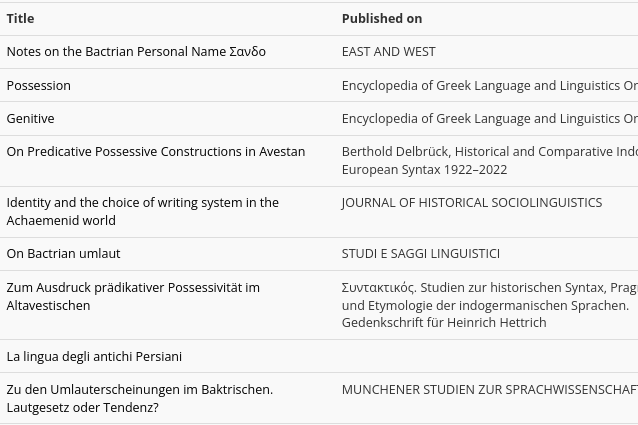
    We would like to bring a number of recent publications by Maria Carmela Benvenuto and her collaborators to the attention of our readers. Her publications are listed on her departmental page, but also on her academia account.

  • What is Zoroastrianism?

    What is Zoroastrianism?

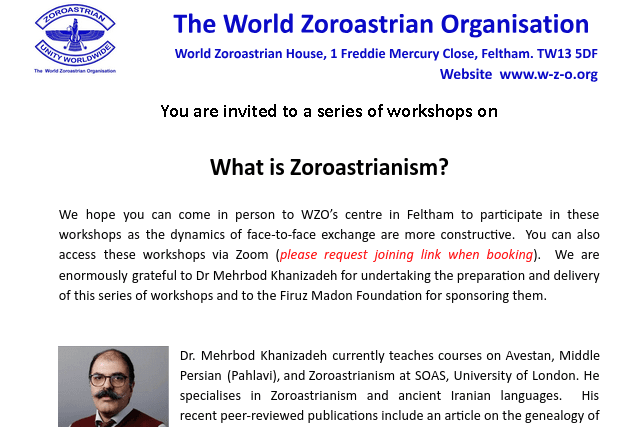
    In a series of workshops, Dr Mehrbod Khanizadeh (SOAS, University of London) will explore the history of Zoroastrianism from its roots in the second millennium BCE through to the present day. He will discuss religious, historical as well as social aspects of the religion’s development.

    Dr. Mehrbod Khanizadeh currently teaches courses on Avestan, Middle Persian (Pahlavi), and Zoroastrianism at SOAS, University of London. He specialises in Zoroastrianism and ancient Iranian languages.  His recent peer-reviewed publications include an article on the genealogy of the Iranian bilingual Avestan Pahlavi Yasna manuscripts, published in the Bulletin of SOAS in 2021, and a study of the etymology of the Avestan personal name pourušaspa- published in the journal of Iran and the Caucasus in 2024. His edition of the Avestan text of chapters 9-11 of the Yasna will be published as a monograph in 2025.

    Six sessions from 25 May to 30 November 2025.

    For more information and to register, see the document below: