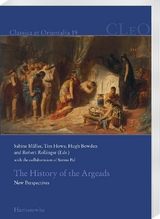
• The History of the Argeads

    Müllerm Sabine, Timothy Howe, Hugh Bowden & Robert Rollinger (eds.). 2017. The History of the Argeads. New Perspectives. (classica et orientalia 19), Wiesbaden: Harrassowitz.

    The Macedonian Argead Empire had an interesting and fascinating history already before its rise under its most famous rulers Philip II and his son Alexander III. Furthermore, the history of their predecessors provides a context for understanding their activities.
    This volume, based on a conference on Argead Macedonia in 2015, offers an account of the place of Argead Macedonia in the wider ancient world from the sixth century BC to the second century AD and beyond. Argead Macedonia is explored in the context of its regal, structural, historical, courtly and military traditions. Its alliances and enmities, its political networks and environment are scrutinized – particularly in regard to Persia, but also to Greece. In order to look at Argead Macedonia from a wider angle, going beyond ancient literary topoi and views on Macedonia in isolation, the authors analyze in which ways the Argead monarchy was integrated into the wider Eastern Mediterranean and Near Eastern world, influenced by it and having an impact upon it. The volume is divided into four sections. Different aspects such as Macedonia’s relationship with Achaemenid Persia, political and military matters, Argead coinage, dynastic profile and reception of the Argeads are examined.

    The introduction and the table of contents are available here.

  • Trilingual Greek-Aramaic-Middle Persian Pharmaceutical Lexical List

    Image from an 18th c. Syriac manuscript from Alqosh. Thomas touching the wounds of Jesus, with Simon Peter looking on. DFM 13, f. 60r. © hmmlorientalia

    Müller-Kessler, Christa. 2017. A Trilingual Pharmaceutical Lexical List: Greek – Aramaic – Middle Persian. Le Muséon 130(1–2). 31–69.

    This trilingual plant list in Greek, Aramaic, and Middle Persian (Pahlavi) is a late copy in the Aramaic square script from the Cairo Genizah of the ninth or tenth centuries with randomly applied Palestinian vocalisation (T-S K14.22). It is the second example of a trilingual lexical list, containing plant names after Barhebraeus’ plant list in the Menārath Kudhshē. The origin of the Vorlage speaks for Jundishapur as its place of completion, and Syriac used for the Aramaic glosses, since this fragment shows a number of Syriac calques, especially particles, which came in through the translation from one Aramaic dialect into another. This unique text source demonstrates again how closely interlinked Greek, Aramaic, and Middle Iranian were in Late Antiquity, despite the loss of most of the text material from this famous academy of medical studies. What this list makes also so valuable is the application of the grades of the plants’ effect that go back to Galen, as can be found in the remnant Syriac manuscript Mingana Syr. 661.
    Christa Müller-Kessler is an scholar of Syriac and Aramaic Studies at the Friedrich-Schiller-Universität Jena.
  • The Dynasty of Šahrwarāz in Egypt and Syria in the early 7th century

    Sárközy, Miklós. 2017. “Šahrwarāz dinasztiája Szíriában és Egyiptomban a 7. század elején“, Világtörténet, 7. (39.) évfolyam, 2017. 2. 235-248.

    The present paper discusses the foundation of the Syrian–Egyptian kingdom of Šahrwarāz. A well-known military leader of the Sasanian Empire who played a key-role in the Sasanian–Eastern Roman wars in the early decades of the 7th century AD, Šahrwarāz successfully conquered Syria and Egypt by 619 and became the military governor of these provinces. Being of obscure origin of the Northern Caucasus, Šahrwarāz started as a staunch supporter of Khusraw II but gradually distanced from his patron after some military failures and due to his own policy which soon resulted in a semi-independent Syrian-Egyptian kingdom ruled by Šahrwarāz by 626. His secret dealings with Eastern Roman forces in Syria soon led to his rising popularity in the eyes of emperor Heraclius who promised him the throne of Sasanian Iran. Eventually Šahrwarāz succeeded in usurping the Sasanian realm for a short period, therefore the vast resources at his disposal might have contributed to the spectacular downfall of the Sasanians.

  • Persian Interventions

    Hyland, John. 2017. Persian interventions: The Achaemenid Empire, Athens, and Sparta, 450−386 BCE. Johns Hopkins University Press.

    In Persian Interventions, John O. Hyland challenges earlier studies that assume Persia played Athens against Sparta in a defensive balancing act. He argues instead for a new interpretation of Persian imperialism, one involving long-term efforts to extend diplomatic and economic patronage over Greek clients beyond the northwestern frontier. Achaemenid kings, he asserts, were less interested in Ionia for its own sake than in the accumulation of influence over Athens, Sparta, or both, which allowed them to advertise Persia’s claim to universal power while limiting the necessity of direct military commitment. The slow pace of intervention resulted from logistical constraints and occasional diplomatic blunders, rather than long-term plans to balance and undermine dangerous allies.

    John O. Hyland is an associate professor of history at Christopher Newport University.

    The book is scheduled to be published in December 2017.
  • Sasanian Elements in Byzantine, Caucasian and Islamic Art and Culture

    Sasanian Elements in Byzantine, Caucasian and Islamic Art and Culture

    International Conference of the Leibniz-WissenschaftsCampus Mainz: Byzantium between Orient and Occident.

    October 18–20, 2017, Mainz/Germany

    Organized by Prof. Dr. Falko Daim (General Director, RGZM) and Prof. Dr. Neslihan Asutay-Effenberger (Johannes Gutenberg- Universität, Mainz)

    Cultural exchanges between Christianity and Islam, especially between Byzantium and its Islamic Neighbours, but also in the Caucasian region, have been an attractive topic for historians, art historians and archaeologists in recent years. Scholarly interest focuses on diplomatic gift exchange, trade, the mobility of artists and the common motifs in both Christian and Islamic objects. The stage extends from Spain to Afghanistan and justifies the necessity of this debate. Yet, unfortunately, the role of one of the important protagonists of this exchange, namely the Persian Sasanians, is less well researched, although many important artistic and cultural phenomena in Byzantium, Armenia, and Georgia as well as in the Islamic countries can only be understood when this culture is included.

    The Sasanian Empire (224-651 A.D.) extended over a large territory. In Late Antiquity and the early Medieval Era, it ruled the whole area of modern Iran, Iraq, Azerbaijan, Pakistan and Afghanistan. The Caucasian region was exposed to its political influence. Until the middle of the 7th century, Sasanians were the major rival of the Late Roman and Eastern Roman (Byzantine) Empire and exported art and culture into these civilizations through various means and on different levels. The cultural connections ended after the fall of the Sasanian Empire, which was replaced mainly by Arab Muslims, and a new era began: the new owners of the territory then adapted Sasanian elements into their own culture.

    From the10th century onwards, the Turkish dynasties such as the Ghaznawids (963-1186) or the Great Seljuks (1019-1157 / de facto until the 13th century) settled in Persia and styled themselves as the successors of the Sasanians as well as as Turks; hence, they were called “Persians” in Byzantine sources. The Sasanian artistic and architectural tradition continued to exist in these cultures. The same phenomenon also applies to the Turkish Rum-Seljuks, who founded their empire in Anatolia: Persian was the court language, the sultans were named after Sassanian heroes from the Shahname (Keykubad, Keyhusrev, Keykavus), and despite the religious prohibition, drinking scenes were depicted in the artworks and wine played an important role at the ceremonies and celebrations according to the Sasanian model.

    As can be clearly seen, the Sasanian Empire had not only ‘transfused’ its art and culture to its neighbourhood during its prime time, but also influenced the successor states after its decline. Just as Ancient Greek and Roman culture played an important role in the formation of Western Europe, the Sasanian Empire bequeathed, a remarkably rich cultural heritage to the Christian and Islamic East.

    The conference “Sasanian Elements in Byzantine, Caucasian and Islamic Art and Culture” succeeds “Der Doppeladler. Byzanz und die Seldschuken in Anatolien vom späten 11. bis zum 13. Jahrhundert”, which was held at the Römisch-Germanisches Zentralmuseum, Mainz in October 2010. The first event dealt with the cultural relations between Islam, particularly Turkish Islam, Byzantium and the Caucasus. At the forthcoming conference, we aim to discuss the role of the Sasanian Empire in the process of cultural exchange before and after its decline.

    See here the Conference Programme

    • Khodadad Rezakhani: “The Roman Caesar and the Phrom Kesar: Hrōm, Eranshahr and Kushanshar in Interaction and Competition”
    • Johannes Preiser-Kapeller: “From one edge of the (post)Sasanian world to the other. Mobility and migration between the Caucasus, Central Asia and the Indian Ocean in the 4th to 9th centuries CE”
    • Rustam Shukurov: “The Image of Byzantium in Persian Epics: from Firdawsi to Nizami”
    • Matteo Compareti: “The Representation of Composite Creatures in Sasanian Art. From Early Coinage to Late Rock Reliefs”
    • Neslihan Asutay-Effenberger: “Senmurv – Beschützer von Konstantinopel?”
    • Thomas Dittelbach: “Kalīla wa-Dimna – Der Löwe als symbolische Form”
    • Rainer Warland: “Das Eigene und das Fremde. Hellenistische Selbstvergewisserung, sassanidische Konfrontation und apokalyptische Endzeit als Lesarten der frühbyzantinischen Kunst (500–630 n. Chr.)”
    • Arne Effenberger: “Sassanidischer Baudekor in Byzanz: der Fall der Polyeuktoskirche in Konstantinopel”
    • Nikolaus Schindel: “Sassanidische Münzprägung im Kaukasus”
    • Nina Iamanidze: “Georgian Reception of Sasanian Art”
    • Armen Azaryan: “Architectural Decorations of the Armenian Churches of the 7th and the 10th–11th Centuries, and their Presumably Sasanian Sources”
    • Shervin Farridnejad: “Continued Existence of the Imagery Repertoire of Sasanian Court Ceremonies and Rituals in the Islamic Art”
    • Markus Ritter: “Umayyadische Rezeption sasanidischer Architektur”
    • Osman Eravşar: “Sasanid Influence on Seljuk Art and Architecture”

    Sponsorship

    Research Unit Historical Cultural Sciences

    Organization

    Prof. Dr. Falko Daim (Mainz)
    Prof. Dr. Neslihan Asutay-Effenberger (Mainz)

  • A manual for Iranian Studies (Handbuch der Iranistik, Vol. 2)

    Paul, Ludwig (ed.). 2017. Handbuch der Iranistik. Vol. 2. Wiesbaden: Reichert Verlag.
    The second volume of the Handbook of Iranian Studies  follows the concept of the first volume and develops it further. It follows the division of the first volume (for the first Volume see here) into eight discipline-defined sections and completes the research overview of the first volume in a comprehensive way with about 50 articles. Thus, in the second part, the few gaps of the first volume are closed in eight sections, and the “Iranian Philosophy and Sciences” are added in a ninth section. The view is also directed increasingly at the geographical periphery of the Iranian world. Several articles deal with the history, culture and present of Afghanistan, Tajikistan, Kurdistan and other regions. The second volume of the handbook of Iranian Studies, in addition to the first volume, also provides research reports. In the second volume, specialized research reports on certain areas are added in the second volume, such as “Persian Literature”: Contributions to Iranian exile and travel literature, current innovative topics such as gender, bio-ethics, the Internet and new media.
    You can see the table of the contents of this volume here.
    About the Editor:
    Ludwig Paul is professor of Iranian Studies at the Asien-Afrika-Institut, Universität Hamburg. He is a scholar of Iranian Linguistic, dialektology as well as Iranian modern history.
  • Arabs and Iranians in the Islamic Conquest Narrative

    Savran, Scott. 2018. Arabs and Iranians in the Islamic conquest narrative: memory and identity construction in Islamic historiography, 750-1050. (Culture and Civilization in the Middle East 57). London; New York: Routledge.

    Arabs and Iranians in the Islamic Conquest Narrative analyzes how early Muslim historians merged the pre-Islamic histories of the Arab and Iranian peoples into a didactic narrative culminating with the Arab conquest of Iran.

    This book provides an in-depth examination of Islamic historical accounts of the encounters between representatives of these two peoples that took place in the centuries prior to the coming of Islam. By doing this, it uncovers anachronistic projections of dynamic identity and political discourses within the contemporaneous Islamic world.  It shows how the formulaic placement of such embellishment within the context of the narrative served to justify the Arabs’ rise to power, whilst also explaining the fall of the Iranian Sasanian empire. The objective of this book is not simply to mine Islamic historical chronicles for the factual data they contain about the pre-Islamic period, but rather to understand how the authors of these works thought about this era.

    By investigating the intersection between early Islamic memory, identity construction, and power discourses, this book will benefit researchers and students of Islamic history and literature and Middle Eastern Studies.

    Table of Contents

    • 1. Introduction
    • 2. Shifting Patterns of Identity and Early Islamic Historiography in Context
    • 3. The Opening of the Drama: Shāpūr and the Sheikh
    • 4. Bahrām V Gūr, the Lakhmids, and the Hephthalite Disaster
    • 5. The Twilight of Sasanian Power: Khusraw I Anūshirvān and the Saga of Ḥimyar
    • 6. The Buildup to the Confrontation: Khusraw II Parvīz and the Rise of the Arabs
    • 7. The Climax: The Islamic Victory over the Sasanians
    • 8. Conclusion

    Scott Savran obtained his PhD from the University of Wisconsin in 2011. His research focuses on identity-based discourses in early Islamic historiography.

  • Herodotus and the Persian Empire

    The latest issue of Phoenix, the journal of the society Ex Oriente Lux, has been just published. Here is R.J. (Bert) van der Spek‘s summary of this special issue, ‘Herodotus en het Perzische Rijk’, Phoenix 63.2 (2017):

    Focus is on Near Eastern information that puts Herodotus in a more balanced perspective. Wouter Henkelman presents Egyptological (and other) information on the famous story of Cambyses and the Apis (III 27-9; 33; 64). He shows how early researchers of the Apis burials were deceived by taking Herodotus’ story at face value. It is better not to, rather to consider Herodotus’ agenda of defamation of Cambyses, which Henkelman defines as ‘character assassination’. He places the story in an Egyptian tradition of defamation of foreigners, of ‘Chaosbeschreibung’. Olaf Kaper discusses the excavations in the Dakhlah oasis, which was once a settlement of revolting king Petubastis IV. The mysterious story of an army sent by Cambyses to the Ammonians, that disappeared in the desert (III 25), might well simply reflect an annihilation by that army by Petubastis, followed by a damnatio memoriae by the Persians. CAROLINE WAERZEGGERS discusses the modern prejudices on Xerxes, exemplified by the film ‘300’. Western knowledge and interpretation of Xerxes is based on Herodotus, who has a very biased picture of Xerxes. Herodotus suggests to have visited Babylon, but who is not very reliable. He does not know anything about an important revolt in the second year of Xerxes’ reign, i.e. about the year of birth of Herodotus. Karel van der Toorn discusses ‘the long arm of Artaxerxes II’ by recognizing the Jewish community in Elephantine in Egypt, which caused tensions. In the fifth century, the time of Herodotus, this setting apart of the Jewish community was not yet so much clear, so that for Herodotus the Jews (in Elephantine and in Palestine” simply counted as “Syrians” (all spoke Aramaic).


  • A gold four-horse model chariot from the Oxus Treasure in the British Museum

    Mongiatti, Anudu, Neegel Meeks & John Simpson. 2017. A gold four-horse model chariot from the Oxus Treasure in the British Museum, Bulletin of the National Museum of Tajikistan 2, 105-123.

    The Oxus Treasure is one of the greatest collections of Achaemenid-period precious metal to survive. It was bequeathed to the British Museum by A. W. Franks in 1897 and been on almost continuous display at the Briti sh Museum since 1900/1901. It was catalogued by Dalton and the first edition published in 1905, and the collection contjnues to attract scholarly attention as well as public interest. In recent years a number of scientific analyses have been carried out on areas of this collection in order to better understand the composition and details of working on particular classes or individual objects. This paper outlines the results of the first scientific study of the outstanding gold model of a four-horse chariot, complete with its driver and passenger. Microscopic examination, X-radiography and scanning electron microscopy combined with energy dispersive X-ray analysis have revealed undocumented evidence for the skill of the Persian goldsmith in creating an intricate artefact produced using a variety of techniques, such as repoussé and chasing on gold sheets, granulation, wire twisting and hammering.