Category: Events

  • The Hidden Face of Surat

    the-hidden-suratThe Hidden Face of Surat: Exploring the History of a Cosmopolitan Centre, 1540-1750

    Sanjay Subrahmanyam, Distinguished Professor and Irving & Jean Stone Chair in Social Sciences, UCLA

    The Second JESHO Lecture on Asian History, organised by Brill Academic Publishers and Institute of Iranian Studies (Austrian Academy of Sciences)

    03.11.2016, 18:00
    Aula at the Campus (court 1.11), University of Vienna
    Spitalgasse 2, 1090 Wien

    The great port of Surat in western India dominated accounts of Indian Ocean trade between the late sixteenth and mid eighteenth century. Consolidated first by an Ottoman notable, it became the Mughal Empire’s western window into the worlds of the Red Sea and the Persian Gulf. In this lecture, I explore Surat’s other, less visible, aspect: namely as an intellectual centre, that brought together diverse and sometimes competing traditions. In turn, we shall see how this vibrant intellectual life was tied up both to certain structures of politics, and to commercial exchange at various scales.

    Programm (PDF)

    Sanjay Subrahmanyam is Professor and Irving and Jean Stone Endowed Chair in Social Sciences at UCLA. He taught at Paris from 1995 to 2002 as Directeur d’études in the Ecole des Hautes Etudes en Sciences Sociales, holding a position on the economic and social history of early modern India and the Indian Ocean world. In 2002, Subrahmanyam was appointed as the first holder of the newly created Chair in Indian History and Culture at the University of Oxford, a position he held for two years before moving to a chair in UCLA. From July 2005 to June 2011, he served as founding Director of UCLA’s Center for India and South Asia. In 2013, Sanjay Subrahmanyam was elected to a Chair in Early Modern Global History at the Collège de France in Paris. He is the author of The Career and Legend of Vasco de Gama (Cambridge: Cambridge University Press, 1997); Three Ways to be Alien: Travails and Encounters in Modern Eurasia (Waltham, Mass.: Brandeis University Press, 2011; Courtly Encounters: Translating Courtliness and Violence in Early Modern Eurasia (Cambridge, Mass.: Harvard University Press, 2012).

    Convenor
    Paolo Sartori, Institute of Iranian Studies, Editor–in-Chief of JESHO
    Hollandstrasse 11−13, 1020 Vienna
    T: +43 1 51581-6516
    paolo.sartori@oeaw.ac.at

  • The Legacy of the Ancient Kings

    The Legacy of the Ancient Kings. Ctesiphon and the Persian Sources of Islamic Art
    15.11.2016 to 02.04.2017
    Pergamonmuseum

    How did Islamic cultures and Islamic art arise? Where do their roots lie? Like the Islamic religion itself, Islamic art also built on its predecessors in the Middle East. Focussing on Ctesiphon, a vast landscape of ruins south of Baghdad, this exhibition is devoted to the Persian legacy inherited by Islam.

    Dominated by the monumental vaulted hall of the royal palace, the Taq-e Kesra, the city today is an emblem of the grandeur and downfall of the mighty Sassanid empire, a great power in ancient Persia about which little is known today. For centuries it competed with Rome and Byzantium. In the 7th century CE, however, the conquests by the Arab armies fundamentally changed the political balance of power. Culturally, too, a transformation took place – “Islamic art” was born. But had everything really changed?

    (more…)

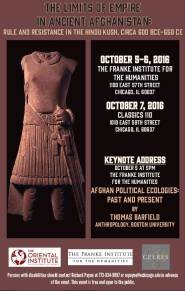
  • Symposium: The Limits of Empire in Afghanistan

    The Oriental Institute and the Franke Institute for the Humanities, University of Chicago, announce a conference to be held October 5-7, 2016.

    The Limits of Empire in Afghanistan: Rule and Resistance in the Hindu Kush, circa 600 BCE-650 CE

    In the first millennia BCE and CE, successive empires sought to incorporate the archipelago of territories in and around the Hindu Kush and to install their structures of rule. The Achaemenians, Seleucids, and Sasanians endeavored — and sometimes pretended — to rule regions of Afghanistan from their courts located in the Near Eastern core, upward of 2500 km distant. The Kushans, for their part, made Bactra and Begram the bases of an empire that extended far beyond into India and Central Asia. Apart from distance, these empires confronted a political geography in the Hindu Kush that was — like the Caucasus — uniquely unfavorable to imperial governance, as well as populations with disparate cultures, social structures, and political traditions. Afghanistan thus provides a test of the capacities of ancient imperial regimes to overcome distance, verticality, and difference to integrate territories into their trans-regional and trans-cultural orders. As even a passing familiarity with the history of the region suggests, efforts at empire failed at least as often as they succeeded in a geographical and cultural landscape highly conducive what James Scott calls the “art[s] of not being governed.” The conference aims to focus on the limits of empire in Afghanistan, as a means of better comprehending the workings of the regimes that laid claim to its territories and the responses of its populations.

    The conference convenes archaeologists, art historians, historians, philologists, and numismatists to debate current research in the context of ongoing theoretical debates concerning the formation, endurance, and limits of imperial systems within a highland political ecology.

    For a detailed programme and abstracts, see Symposium: The Limits of Empire in Afghanistan | The Oriental Institute of the University of Chicago.

  • The Christian Sogdian Gospel Lectionary E5 in Context

    bildschirmfoto-2016-09-27-um-12-08-04
    The monastery at Bulayïq, Dafusan’gaicum, Tulufan/Turpan, Xinjiang © Chiara Barbati 2015

    Lecture and Book Presentation at Tehran University

    The Christian Sogdian Gospel Lectionary E5 in Context

    Department for Iranian Studies at the University of Tehran in cooperation with The Austrian Academy of Science (ÖAW) present:

    Lecture : “The Christian Sogdian Gospel Lectionary E5 in Context
    By: Dr. Chiara Barbati (Institute of Iranistik, Austrian Academy of Sciences)
    Date: Wednesday, 5th October, 2016
    Place: University of Tehran, Faculty of Literature, Kamal Hall (4th floor)

    On the basis of a thorough philological-linguistic study, the book aims primarily at reintegrating the complex whole of the various phenomena that have contributed to creating what in modern scholarship runs under the name of Christian Sogdian Gospel Lectionary E5, a set of manuscript fragments preserved in the Turfan Collection in Berlin. The study applies a precise methodology that puts various disciplinary approaches on the same level in order to relate and interconnect textual, material and historical-cultural aspects. Specific codicological characteristics are considered in correlation with the broader manuscript tradition to which the fragments belong. The discussion of the Gospel lectionary leads to reflections on the transmission, reception and development of a specific body of religious knowledge, namely that of the Church of the East. The exploration of linguistic phenomena takes also into consideration the processes at work in the missionary history of the Church of the East in Central Asia between Late Antiquity and the early Middle Ages in the Oasis of Turfan in present-day Xinjiang, China. The book therefore addresses Iranologists as well as students of Eastern Christianity and of manuscript cultures.

    Chiara Barbati (PhD 2009) is a senior research fellow at the Institute of Iranian studies of the Austrian Academy of Sciences (ÖAW).  She specializes in Ancient and Middle Iranian languages. Her main fields of research are Sogdian language and literature with particular regard to the Christian Sogdian texts in relation to its Syriac sources, history of eastern Christianity through primary sources (Syriac) as well as secondary sources (Sogdian, Middle Persian, New Persian), paleography and codicology of pre-Islamic Iranian manuscripts and Iranian dialectology from an historical point of view.


  • Minorities in Iran and Beyond in Memory of Rudolf Macúch

    Rudolf Macúch (1919-1993)
    Rudolf Macúch (1919-1993)

    Minorities and Majorities in the Middle East and Asia

    In Memory of Rudolf Macúch (1919-1993)

    The Department of Comparative Religion is honoured to invites to the conference titled “Minorities and Majorities in the Middle East and Asia” which will take place at the Faculty of Arts of Comenius University in Bratislava on the days of 14th and 15th of September. The conference is dedicated to the memory of the world-renowned scholar Professor Rudolf Macúch. The talks cover different aspects of the religions and cultures of minorities, especially in today Iran and Iraq, from Mandaeans, Christians, Yezidis, Yārsān (Ahl-e Haq) and Sufīs to Buddhists, ect.

    Organizers: Department of Comparative Religion, Comenius University in Bratislava
    Slovak Association for the Study of Religions
    Venue: Comenius University in Bratislava, Faculty of Arts, 2 Gondova St.

    Conference programme (PDF):

    Wednesday, 14th September 2016

    • Maria Macuch: “Rudolf Macuch – A Life Dedicated to the Study of Minorities”
    • Eden Naby: “Modern Assyrian Culture and Prof Rudolf Macuch”
      Mahmoud Jaafari-Dehaghi: “Professor Rudolf Macúch at the University of Tehran”
    • Jiří Gebelt: “Rudolf Macúch’s Contributions to the Mandaean Studies in the Light of Current Research”

    PANEL 1: The Mandaeans of Iran

    • Muhammad Allahdadi: “Are Mandaeans Men of the Book? A Study of the Evolution of Shi’a Jurists’ Ideas about Mandaeans As Men of the Book”
    • Mohsen Jafari: “The Mandaeans: The Lost Tribe of the Iranian Constitution”
    • Reza Yarinia: “The Mandaean Cosmological Structure and Its Manifestation in the Purity of Creatures”
    • Behnam Eskandari: “The Mandaeans’ Mythical and Religious Communications with Other Religions”

    Thursday, 15th September 2016

    PANEL 2: Diasporas

    • Martin Klapetek: “The Near Orient? The Transfer of “Otherness” to European Contexts”
    • Torsten Tschacher: “On Being a Multiple Minority: ‘Indian Muslims’ in Singapore between ‘Race’ and ‘Religion”
    • Katarína Šomodiová: “The Iraqi Christian Community in Slovakia”

    PANEL 3: Multiplied and fragmented minorities

    • Alam Saleh: “The Fragmented Middle East: Ethnicity, Nationalism, and Religion”
    • Attila Kovács: “Minority-Majority Dynamics and the Public Space in the Old City of Jerusalem: A Visual Approach”
    • Dušan Deák: “Emplacing the Saintliness: Rural Muslim Religiosity between Vaishnavas Sufis and Demons”

    PANEL 4: Minority policies

    • Luboš Bělka: “Minority Religion: The History of Russia´s Policy towards Tibetan Buddhism in Buryatia (1717-2016)”
    • Marko Jovanović: “Uyghur Separatism: A Fight for Cultural or Religious Identity?”
    • Eszter Spät: “Religion and Nation-Building among the Yezidis of Iraq”

    PANEL 5:  Minorities and Religious Dogmatics

    • Alireza Bahrami: “Exploring Islam’s View about the Men of the Book”
    • Lukáš Větrovec: “Present-Day Reflections of the Viewpoints of Ibn Taymiyya on Non-Muslim Communities”
    • Qasem Muhammadi: “Religious Minorities ‘the Self’ or ‘the Other’ in the Islamic Government as Presented in the Shi‘a School of Thought”

    PANEL 7: Religious fractions and groups

    • Seyedeh Behnaz Hosseini: “Yārsān-a religious minority in Iran”
    • Mahmoud Jafari-Dehaghi: “Buddhism in the East of Iran”
    • Abdolmajid Etesami: “Zayd Ibn Ali Ibn Husayn (a.s.) and the Imamate”
    • Matej Karásek: “Christian sannyasis and Christian ashram movement in India: minors amongst Hindus or Christians?”

    PANEL 8: Minorities and majorities in literature & writing

    • Łukasz Byrski: “Writing Systems and the Minorities”
    • Deepra Dandekar: “Popular Islamic Literature and Muslim Minoritization in India”
    • Miklós Sárközy: “Wladimir Ivanow and his memoirs about Iranian Ismailis and Gypsies”
    • Estiphan Panoussi: “Hungarian Calvinist Church in Budapest Hungary Classifications of Difficulties of Some Verbal Roots and Homonyms the the Senaya Dialect of Neo-Aramaic”
  • Conference Program | societyforiranianstudies.org

    The eleventh biennal conference of the International Society for Iranian Studies will take place in Vienna from 2 to 5 August 2016.

    For more information on the conference, see this link. And here is the conference programme.

  • Iberia between Rome and Iran

    Iberia between Rome and Iran from Pompey to Heraclius

    Georgian Bolnisi inscriptions, 494 AD.
    Georgian Bolnisi inscriptions, 494 AD.

    07.- 09. July 2016, University of Jena

    An international colloquium on the history of Georgia in Late Antiquity (from the 1st century BC to the 7th century AD) organized by the Chair of Ancient History at the University of Jena.

    Central to the research are the close contacts of the Iberians to the Roman Empire on one side, and to the realms of the Parthians and Sasanians on the other side. Iberia formed an interface between the great powers and was strongly influenced by both sides. Some of these influences, such as the establishment of Christianity, territorial ambitions of the great neighbors or linguistic developments,  will be discussed at the conference, attended by German and internatioal scholars of the Ancient Studies and the history of Caucasian Iberia.

    Programm

    • Tassilo Schmitt: “Argo und Argumente. Historische Perspektiven auf den und aus dem Kaukasus”

    Sektion I – Iberien im Spannungsfeld der Großmächte

    • Frank Schleicher: “Die Chronologie der kartvelischen Könige und das Ende des iberischen Königtums”
    • Balbina Bäbler: “Pompeius im Kaukasus. Geographie und Topographie eines Feldzugs”
    • Henning Börm: “Die Grenzen des Großkönigs? Grundzüge der arsakidisch-sasanidischen Politik gegenüber Rom”
    • Giusto Traina: “Dynastic connections in Armenia and Iberia (I-III CE)”

    Sektion II – Zur Christianisierung Iberiens

    • Konstantin Klein: “Ein Königssohn, zwei Rabbinen und (fast) vierzig Nonnen – die Konversion Iberiens in der lateinischen, griechischen und armenischen Überlieferung”
    • Josef Rist: “Nino versus Gregor. Die Christianisierung Iberiens und seine Stellung zur Reichskirche im Vergleich mit Armenien”
    • Stephen H. Rapp Jr.: “The Conversion of Eastern Georgia: Cross-Cultural and Pan-Regional Perspectives”

    Sektion III – Zur Religiosität der Iberer (Moderator: Udo Hartmann, Jena)

    • Eka Tchkoidze: “Iberia between Christianity and Zoroastrianism (evidence from Georgian literary tradition)”
    • Cornelia B. Horn: “Die Georgier und das Heilige Land: Hagiographische, apokryphe und historische Elemente einer Beziehung”
    • Jan-Markus Kötter: “Bekenntnis als Mittel der Diplomatie – Die Stellung der iberischen Kirche zum Reich”

    Sektion IV – Zu den Quellen

    • Alexander Schilling: “Die ‚Diegesis ophelimos‘ (BHG 1060) in georgischer Überlieferung: historische und historiographische Kontexte”
    • Bernadette Martin-Hisard: “L’Ibérie des VIe-VIIe siècles d’après des traditions religieuses géorgiennes des IXe-XIIe siècles”
    • Armenuhi Drost-Abgarjan: “Das Bild der Iberer in der armenischen Literatur (5.-7. Jh.)”
    • Johannes Niehoff-Panagiotidis: “Griechisch, Aramäisch oder was? Die historischen Voraussetzungen für die Genese der georgischen Literatursprache”

    Sektion V – Archäologisches

    • Nodar Bakhtadze: “The Oldest Basilicas Revealed in Nekresi Former City and Assumptions on Architectural Design of the First Georgian Christian Churches”
    • Annegret Plontke-Lüning: “Von Dmanisi nach Bolnisi. Ein alter Pilgerweg in Niederkartli”
  • Friedrich Carl Andreas: A Man for All Seasons

    1886. Lou Salomé und Friedrich Carl Andreas (© Gottinger Tageblatt Verlag)
    1886. Lou Salomé und Friedrich Carl Andreas (© Gottinger Tageblatt Verlag)

    Friedrich Carl Andreas:
    ein Sohn der vier Himmelsrichtungen

    A talk by Martin Tamcke

    Thursday, July 7, 2016 at 19.00
    Lepsiushaus Potsdam

    A joint event organized by the Lepsiushauses Potsdam and the Theodor-Fontane-Archivs of the University Potsdam.

    The Orientalist Friedrich Carl Andreas (1846-1930) is mostly known as husband of Lou Andreas-Salomé, a well-known German writer and psychoanalyst. He was born as a descendant of Armenian, Malay and German ancestors in Indonesia and grew up in Hamburg and Geneva.  He studied Iranian and Oriental Studies (PhD, 1868 Erlangen) and participated as a volunteer in the Franco-German War. Between 1875 and 1881, he conducted field work in India with the Parsees and with a Prussian Research Expedition in southern Iran, where he remained for several years. His research in Europe focused on the languages and music of Ossetia and the Indo-Afghan borderlands. From 1903 to his death he was professor of western Asiatic and Iranian philology at the University of Göttingen. As a master of many living languages, Andreas specialized in the history of languages and civilizations, but his interests extended to philosophy and natural history. He excelled in reading difficult Oriental scripts, ancient or modern, and in perceiving the finest nuances of spoken languages, especially their accents. Together with his wife, a friend of Nietzsche and Freud, and Rilke, he travelled to Russia and visited Tolstoy. He was very active by the practical training of missionaries for Kurdistan and Central Asia and to the scientific analysis of texts and the religious movement of the Persian Bābīs. Working with the Manichean fragments from Turfan, he quickly isolated those texts written in Parthian (which he called the “northern dialect”) and identified another “Pahlavi dialect” as the Sogdian language. 

    Read more about him and his works here.

  • Between Zoroastrianism and Islam

    Photo © Gianroberto Scarcia
    Marijan Molé (1924-1963). Photo © Gianroberto Scarcia

    Between Zoroastrianism and Islam
    International conference on the work of Marijan Molé

    Friday, June 24, 2016, École française d’Extrême-Orient – 22, avenue du Président Wilson, 75116 Paris.

    Organized by Samra Azarnouche (EPHE).

    The works of Marijan Molé (1924-1963) has left a distinctive and lasting imprint on the field of Iranian Studies. His careful and insightful studies on the Avestan and Middle Persian literature, the Islamic mystical treatises as well as the Persian epics play an important role in our understanding of Iranian history, culture and religions. This conference focuses on one of the peculiarities of Molé’s research, namely the scholarly attempt at bridging the gap between pre-Islamic and Islamic Iranian Studies, between the different strata of religious and literary traditions, and between the great mythical and prophetic figures. The (recent) discovery of his Nachlass (IRHT and BULAC) gives us the opportunity to make an inventory of his legacy, which highlights the originality of his approach in the study of religions.

    Program (PDF):

    MOLÉ ET L’AVESTA: ENTRE TRADITION ET COMPARATISME

    • Jean Kellens: “le printemps des études gâtiques”
    • Philippe Swennen: “Marijan Molé à l’aube du nouveau comparatisme indo-iranien”

    PROPHÈTES ET HÉROS

    • Anna Krasnowolska: “Molé’s Early Works and his Study of Persian Epics”
    • Michel Tardieu: “Vies de Zoroastre, Vies de Mani, Vies de Muhammad :un apport de M. Molé à l’histoire des religions”

    COSMOLOGIE ET ESCHATOLOGIE : D’UNE TRADITION À L’AUTRE

    • Antonio Panaino: “Le gētīg dans le mēnōg et le système chiliadique mazdéen” selon la réflexion de Marijan Molé
    • Shaul Shaked: “Immortality and Eschatology”
    • Pierre Lory: “Marijan Molé, ‘Aziz Nasafî et l’Homme Parfait”

    RAYONNEMENT ET POSTÉRITÉ DE L’OEUVRE

    • Jaleh Amouzegar: “Marijan Molé en Iran”
    • Alexey Khismatulin: “He was years ahead of his time: Destiny of the Unpublished Works by Molé on the Naqshbandiya”
    • Conclusions: Frantz Grenet